5 Ways to Build a Cheap Emergency Shelter

When your roof is leaking and your feet go through the floor boards, it may seem clear enough that your home won’t stand up to a hurricane or some other large scale disaster. On the other side of the equation, even if your home is newer, or you rent an apartment, that doesn’t mean you should rely exclusively on your current home during a major crisis.(Here are 23 survival uses for honey that you didn’t know about.)

Regardless of your current living situation, there are many times and places where an external shelter located on your property or near your home will be of more use than expected. Here are some ways you can build an emergency shelter on a limited budget.

Preparedness Hacks: Once a nuke is heading your way, you might think that there isn’t much left to do, but you would be wrong!

Because we will show you America’s natural nuclear bunkers that are also EMP proof. When the sirens start wailing, all you need to do is pick the closest one to your home, where you can take cover before it hits.

Understand the Building Needs for Different Crisis Scenarios

Before you decide to try and build the cheapest emergency shelter possible, it is important to know which kind of emergencies you expect to get through while residing in the shelter. Have a look at some of the most common scenarios and how they may or may not change your building plans:

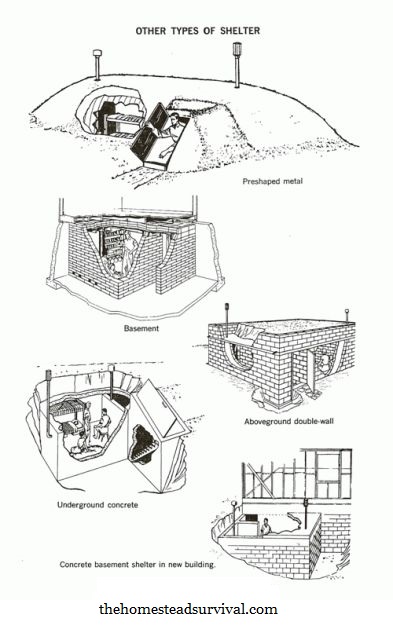
  • The best shelter for surviving a nuclear crisis will be one located underground. Just make sure that earth covers the top of the shelter as well as all around it. Underground shelters will also be the best for tornadoes.
  • Since water from hurricanes can sink deep into the ground, you may be in more danger underground than above. A shelter that will survive a hurricane must be able to withstand heavy winds and rain. Look into shelters that have rounded or dome like shapes as they will offer less resistance to the wind. This, in turn, means that it will be harder for the wind to pick up the shelter and destroy it.
  • Gas, disease, and similar attacks require a shelter that is as waterproof and air proof as possible. While it does not matter if the shelter is above ground or below, you will need to be able to filter the air and enrich it with oxygen. Ideally, shelters for these kinds of emergencies plus nuclear crisis should also include a decontamination area. If you go outside, it will be very important to have a place where you can remove your clothes and remove debris and other possible pollutants from your skin before entering the shelter.

Cheap Materials For Building Shelters Near Your Home

Chances are, you will be surprised how natural materials or ones you consider to be “junk” can be repurposed into making a durable emergency shelter. Here are some materials that you more than likely have on hand right now, can find abandoned with little effort, or can build up in a fairly short amount of time.

As you consider these items, remember that building a viable shelter isn’t just about the materials, it is about how you assemble and support them.

  • Old tires – old tires can be cut into any number of shapes that can be used to cover holes or build a waterproof layer. They can also provide flexibility to the shelter that may be of use during earthquakes, or when building an unusual design.
  • Plastic water bottles – of all the possible materials for building an emergency shelter, this one is the most overlooked, yet the most valuable. In fact, today, people are building full scale homes using plastic water bottles filled with dirt, sand, or water. They have excellent insulative properties and lend just enough support to other materials that would be difficult, if not impossible to turn into a permanent shelter.
  • Metal food cans – as with tires, you can use tin cans for covering different areas, as well as for strength. Do not forget that you can always cut these cans open, lay the flat, and then fold them into strips. This can make them useful for supporting different parts of the shelter as well as holding parts together. Metal food cans are also very useful for making solar heaters that can provide warmth for your shelter and hot water.
  • Canvas bags – when filled with sand or soil, the canvas bags are some of the most useful things you can use for building an emergency shelter. They are easy to stack up, and can provide a good bit of protection from the elements. They are also the best building material to shield from bullets.

Cost Cutting Without Losing Quality

When you are on a very tight budget, even a few extra dollars can be hard to eke out of your budget. For example, even though smaller sized water bottles may work well for an emergency shelter, there is no getting around the fact that buying water by the gallon is cheaper.

It does not pay to buy larger bottles in order to try and save money because your emergency shelter will not be as sturdy or reliable. This is just one area where cost cutting would create more problems than it solves.

On the other hand, there are some other places where you can safely cut costs without losing the benefits you want most from the shelter:

  • Try to build a smaller shelter or break it up into smaller modules. If you build the shelter in add-on modules, you may also improve the overall strength of the shelter, plus extend the cost of building the shelter over a longer period of time.
  • Canvass the local area to see if others have useful trash that they are willing to give you. You can also check out sites where high volumes of tires and other waste tend to collect with little or no attention from others. Abandoned lots, and other areas may be a good place to find items that can be repurposed for your shelter at no cost.
  • Look in second hand and thrift stores for canvas items that you can sew into bags for making sand bags.
  • Take a careful survey of natural materials. Even if you can’t find a beach or plenty of sand, do not overlook the soil in your back yard for filling plastic bottles or canvas bags.
  • Keep an eye on local public auctions. You never know when useful building materials may become available from one or more locations.

Where to Hide the Shelter

Hiding your shelter can be difficult for any number of reasons. To begin, people are bound to notice that you are doing something unusual. While keeping your building tasks out of plain sight will help with this problem, there are some others to consider.

Never overlook the possibility of electronic surveillance means during the building process and after the shelter is built and stocked with supplies. In fact, before you even buy or begin saving materials to make the shelter, you should make sure you know what kind of methods may be used to locate the shelter.

From there you can amend the design and then figure out the best location for hiding it. Here are some basic rules for making your shelter easier to hide:

  • Keep the shelter small or have a series of small shelters spread out so that no single site gains attention.
  • Make sure the shelter is properly disguised based on the surrounding terrain
  • Study how time of day, lighting effects, and weather patterns may reveal the existence of the shelter
  • Have multiple access points so that you can get from any area on the property to the shelter without being seen or observed
  • Use “hiding in plain view” with caution. You can use different shapes or several other methods to ensure people see the structure, but either don’t recognize what it is, or place no importance on it. As with any other kind of disguise, the shelter should blend in and look so normal it is forgotten. If you decide to go in the opposite direction, the shelter should look so strange it will be ignored as a point of blocking out irrelevant information.

During a SHTF situation, pain could become an annoyance for some, but unbearable for others.

If doctors are scarce and medicine becomes even scarcer, this one little weed, found all over North America and similar to morphine, could be a saving grace.

Best Ways to Get to the Shelter in an Emergency

When disaster strikes, there is nothing worse than knowing safety is just a few feet away, yet you have no way to get there. In this case, if your house is no longer safe, you must still have a way to get to your emergency shelter and the supplies that will get you through the disaster. Here are some possible ways you can use to get to the shelter:

  • Make use of underground tunnels. Even if you have only a crawlway under your house, it will be worth your while to dig an underground tunnel that comes up in your emergency bunker. It does not matter if the shelter is above ground or below. If possible, you should make it your business to have access to the crawlway in each room on the downstairs level of your home. You should tunnel access points throughout the yard. At the very least, if you find a way to get outside, you can still use these entry and exit points to get to your shelter.
  • If your shelter is above ground, you may want to try accessing it directly instead of using an underground tunnel. This must be done so with caution so that no one sees where you are going or notices any kind of foot traffic leading to the shelter. When using above ground travel methods, do not forget to take advantage of trees or other objects that create blind spots. There are many ways to get from Point A to Point B without being seen if you know how to place objects around your yard, and then use them for cover in a time of need.
  • Tall trees in your yard and rope can also be used to move from limb to limb until you reach an appropriate access point.

Dugout Shelters

When it comes to saving money on an emergency effort, dugout shelters offer some of your best options. That being said, underground bunkers or shelters can be extremely dangerous if they aren’t built correctly or something else causes you to become trapped below ground.

You should have at least one underground shelter on your property so that you can use it if the situation calls for it.

Today, there are many different designs of dugout shelters to choose from. You can build something simple as a one room underground cavity braced with wooden beams. Alternatively, you can tunnel and go to different depths to create multiple rooms and structures.

As long as the soil in this area perks well and is solid, you should be able to build a fairly good shelter.

During the process of planning to build a dugout shelter, do not overlook digging deeper into bedrock. This is very important if the soil is very shallow and there is no other way to dig down deep enough. While it may cost a bit more to dig through the bedrock, reaching this level can open up opportunities to increase the stability of the shelter.

Dugout shelters can also be useful when it comes to saving on other parts of stocking and maintaining the shelter. For example, while you are choosing a location for the shelter, you should make sure you know about how underground water moves around and through your property.

Depending on the area, you may be fortunate enough to find an underground stream with clean water nearby, or some point where you can easily access the water table. Since clean water is necessary for both short and long term survival, being able to harness an underground source in your emergency shelter will be a huge advantage.

Experts predict that an EMP strike that wipes out electricity across the nation would ultimately lead to the demise of up to 90% of the population. However, this figure begs an important question: if we were able to live thousands of years without even the concept of electricity, why would we suddenly all die without it?

Fortified Living Brush Shelter

When combined with a secondary underground shelter, you will find that most of your emergency needs will be met more easily than if you built just one emergency shelter from some other material.

Typically, you will find that making shelters covered with still living trees, or bushes will also cost less than using other kinds of materials. These shelters have a number of other advantages that you might want to consider:

  • As you may be aware, homeless people are often drawn to derelict buildings or ones that seem to be abandoned. These very same people, however, aren’t likely to dig into a bunch of bushes covered in poison ivy or something else that looks equally unpleasant. By the time you factor in people that fear contact with insects in shrubs, you can have some peace of mind knowing that a living brush shelter will be overlooked.
  • Today, some preppers believe our society is likely to collapse at any moment. Others may think we have some time yet. Regardless of where you are on this continuum, there is a good chance that, as a homeowner, you are also paying property tax. Unlike recognizable shelter, you are likely to find that the tax assessor isn’t going to recognize a bunch of shrubs as living space let alone a building. Therefore, you won’t have to worry about a tax hike, securing permits, or other problems that can come up when building a more conventional bunker.
  • Living brush shelters can also hide plants that can be consumed for food and medicinal needs.

Sandbag and Concrete Shelters

As noted earlier, sandbag shelters are remarkably durable and can withstand many different kinds of attacks. No matter whether you are concerned about bullets or keeping out rioters, the walls of a sandbag shelter can keep just about anything out. In fact, even if you decide to build some other kind of shelter, fortifying it with sandbags will be to your advantage.

Insofar as cost, if you live near beach or have some other access point to free sand, it will cost you almost nothing to build this shelter type.

Using Plastic Bottles and Other Recyclable Materials

There is no question that a growing number of people believe some kind of major disaster is looming. At the same time, actively engaging in prepper activities and taking concrete steps can be both expensive and time consuming.

From this perspective, it is more than likely many people know they need to put building an emergency shelter as a top priority. However, like being trapped in a nightmare, it may be impossible to start working towards this goal.

Once you find yourself in a catastrophic situation, it is a good idea to make sure you know how to build a shelter from what others see as junk. While others are busy fighting and killing over more obviously useful resources, you can obtain things like used plastic bottles and turn them into a viable shelter.

In their simplest form, all you need to do is fill the bottles with dirt or water, and then use mud to seal the bottles together to form walls and ceilings.

At the very least, if you don’t feel drawn to building some other kind of shelter you can try this one as the basis for a greenhouse or part of a gazebo. The important thing is to know how to build walls using this construction material so that you can make use of it in a time of need when you have no choice but to make building an emergency shelter your top priority.

Sustainable Mobile or Knock Down Shelters

Aside from buying a tent that you can put in your yard for emergency shelter, it is also possible to build wall units that are collapsible and can be moved around with relative ease. For these shelters, look at different kinds of polymers or other lightweight materials.

If you need a larger shelter with a bit more substance than a tent, designing a knock down shelter may be a good option for you. When combined with brush piles or other natural disguises, the mobile nature of this shelter can provide some unexpected advantages.

That being said, do not forget that your supplies and stockpile will most likely need to be housed somewhere else. No matter how fast you can disassemble, pack, and move the main shelter, it is never a good idea to have to waste time on items inside can cannot simply be folded up and put away.

If you own a car, this is one of the easiest and cheapest things to turn into a place that you can turn to for emergency shelter. Just make sure that you give some thought to maintaining your privacy and preventing people from realizing that you are living in the vehicle.

Emergency shelters that will last form months to years can be built at a low cost if you focus on some creative or unusual options. You can also go with more conventional underground bunker designs and add fortifications as your budget allows.

Regardless of the first shelter type that you choose, it is also important to be ready to build a second one so that you can address as many emergency needs as possible without spending a fortune on just one design.

How To Turn Your Q-Hut Into An EMP-shielded Home (For most people, it would be a considerable waste of resources to erect a building that did not serve its intended purpose.”)

Can a Quonset Hut be turned into an EMP-shielded home? With this reader question, the devil is in the details. If you are ready to face them, grab a napkin, sharpen a pencil and then go rent a crane: you have work to do!

First let’s see what it takes to shield something from EMP and how a Quonset Hut is constructed to determine if this building could provide a cost effective solution to EMP under the right circumstances.

I imagine that the reason that leads to this question is something along the lines of: “Quonset Huts have a steel skin, and steel is a conductor, so they must provide some shielding against EMP. Almost 200,000 of the buildings were manufactured for WWII, some are still in use by the military to this day and many others are still knocking around as surplus, so maybe this could be an inexpensive way to build a shielded home or retreat or some sort.

But the subject of EMP is complex, and a building is a major investment. For most people, it would be a considerable waste of resources to erect a building that did not serve its intended purpose.”

The (Very) Basics of How to Shield Against EMP

As you may recall from an elementary physics class (or a diligent 2-seconds of research on your “Inter-web Thingy,”) Faraday cages can be used to shield vulnerable microelectronics from EMP.

For some, but certainly not all, of our readers, that fact and perhaps how to improvise a Faraday cage from a metal trash can (or similar conductive vessel with a tight fitting lid) is about the deep end of the pool when it comes to the depth of their knowledge this particular subject.

Now, that is not a bad thing. Where that not the case, us folks toward the nerdier end of the scale might be doing something other than writing about EMP survival, so I’m good with that.

But society’s ever-decreasing attention span being what it is, that is to whom I orient this type of article, so those of you who are “Walter White-level intelligence”, and beyond, you will have to bear that in mind (or break down and buy the book.)

A Faraday cage provides EMP shielding by creating a conductive skin around what you are trying to protect. Imagine that this conductive skin helps conduct some of the flow of energy around a protected envelope, like a river flowing around a sand bar. This is a bit of an oversimplification, but I think it is an effective analogy for most people.

The idea is that most of river goes around the sand bar. You end up with a lot less intensity of water flow inside the sand bar than outside because the amount of flow that penetrates the sand bar is reduced by the (shielding effect of the) sand bar. The bulk of the flow of water is “conducted” around the sand bar like the conductive skin of a Faraday cage conducts electricity around the occupant of the cage.

Another way to say this is that the Faraday cage attenuates (or reduces) the intensity of the field strength of the EMP that is able to penetrate the shielding provided by the cage.

Back to the sand bar analogy, the shielding provided by the conductive skin of the Faraday cage is the difference in EM flow outside and inside the cage. So the cage does not completely stop or shut out the EMP, it just “turns down the volume” to point that it doesn’t “blow the speakers” (so to speak) of electronics protected by the cage. The volume of sound, EMP wave flow or sound wave flow is lower or quieter inside the cage than outside it.

This protective skin needs to have the following properties:

1. It must completely encapsulate whatever you are trying to protect. Depending of the frequency range of energy you are protecting against, the skin can be a cage or a mesh. But for our application, openings as small as a quarter inch could allow EMP inside, compromising the protected space. So mesh would have to be roughly 20 openings per inch or finer. If you are trying to shield a multisided space such as a cube, all six side would have to be shielded. I often see people forget about the floor! EMP is not like rain, you cannot just drape a space blanket over the object and call it good.

2. The flow of electrons through the skin must be unimpeded. If you join two or more sheets of conductive material to form the conductive skin, the seams where they mate must be free of non-conductive paint or any other insulation. I see people make this mistake a lot with metal ammo cans. They fail to remove the paint where the lid fits onto the box and remove the rubber gasket. Gaskets are still helpful, but they need to be conductive gaskets as opposed to the non-conductive rubber gaskets that come in the cans.

3. Any insufficiently shielded wires or other conductors penetrating the skin compromise its integrity.

4. The conductive skin must have a non-conductive layer gap of air between the skin and whatever you are protecting. If the object touches the skin or is too close to it, the electromagnetic energy can be conducted from the skin into what you are trying to protect.

5. The conductive material must provide sufficient electromagnetic shielding (measured in decibels) to protect against EMP. The thicker the conductive material, the more shielding it will provide. To shield against the field strength of an EMP generated by a nuclear weapon detonated high in the earth’s atmosphere, directly above your location, would require approximately 73dB of shielding. If the weapon was detonated hundreds of miles away, this number will be lower.

Just keep in mind that the relationship of shielding thickness to the number of dB of shielding it provides is logarithmic, so doubling the shielding layer thickness does not double the dB of shielding.This means that if you buy a Faraday bag that provides 40dB of shielding, and you put your bag inside another 40dB you don’t end up with 80dB of shielding. You would end up with less than 50dB of shielding at that level.

And to protect against a super-EMP weapon (a nuclear weapon optimized to yield the maximum amount of energy released in the form of EMP as opposed to light or heat) this number would have to be much higher. You would not be talking Mylar bags, aluminized bags or tinfoil anymore, you would need a shielding material more along the lines of an aluminum pressure cooker for that.

quonset

How Does the Quonset Hut Stack Up As a Faraday Cage?

Once assembled, a Quonset Hut is essentially a semicircular cross-section of corrugated, of galvanized steel that can be moved by crane and set on a concrete slab or wooden floor. Steel is a conductor, so won’t that offer some electromagnetic protection?

If you have been paying attention, you may already know the answer. IF the steel sections have been properly joined THEN you have a start.

Notice that the answer is conditional and that even then, a Quonset Hut can only be viewed as possible place to start or source of raw material in the form of steel. Even if the integrity of the building’s steel skin is maintained, you would still have some major issues to deal with in order to turn it into an EMP-shielded structure.

Here is what it would take to turn a “Q-Hut” into an EMP-shielded stronghold:

  • Any sealant, lacquer, paint or other non-conductive material between the seams of steel sections, any holes or gaps a quarter of an inch or larger will compromise the free flow of electrons through the shielded “skin” of the structure so they would have to be stripped and replaced with conductive product.
  • Any holes or gaps a quarter of an inch or larger will compromise the shielded envelope, including any windows, doors and the entire floor would not be shielded by “upside down steel half pipe” formed by the steel portion of the Quonset Hut. All these areas would need to be covered with material that meets our shielding requirement of greater than 73dB (for a normal nuclear weapon used to initiate Compton Scattering, generating a nuclear high-altitude EMP, not a super-EMP weapon.) As mentioned, 20OPI or smaller mesh could be used for the windows and to encapsulate any solar panels you add. To add solar panels to the project, please refer to my past articles on the subject starting here: How to Protect Your Solar Gear from EMP (Part 1)
  • No unshielded long conductors such as electrical wiring should be attached to the building without first being shielded, shunted through EM-shielded gaskets, fitted with fast switching (less than a millisecond) surge protection with power handling in the same range as lighting protection circuits. They should also be properly grounded.
  • The conductive skin should be separated from the building interior by a gap or suitable non-conductor. A non-conductive spray-on bed lining material or any other non-conductive material could be used for this purpose, just do not forget the floor!

There you go! If this does sound like a fun project, let me know, I just might squeeze you into my consulting schedule so I can see how it turns out, so shoot me an email.

Better yet, leave your comments below. Either way, I enjoy reading them, and have even been known to respond to reader questions and comments from time to time.

Introduce Yourself (Example Post)

This is an example post, originally published as part of Blogging University. Enroll in one of our ten programs, and start your blog right.

You’re going to publish a post today. Don’t worry about how your blog looks. Don’t worry if you haven’t given it a name yet, or you’re feeling overwhelmed. Just click the “New Post” button, and tell us why you’re here.

Why do this?

  • Because it gives new readers context. What are you about? Why should they read your blog?
  • Because it will help you focus you own ideas about your blog and what you’d like to do with it.

The post can be short or long, a personal intro to your life or a bloggy mission statement, a manifesto for the future or a simple outline of your the types of things you hope to publish.

To help you get started, here are a few questions:

  • Why are you blogging publicly, rather than keeping a personal journal?
  • What topics do you think you’ll write about?
  • Who would you love to connect with via your blog?
  • If you blog successfully throughout the next year, what would you hope to have accomplished?

You’re not locked into any of this; one of the wonderful things about blogs is how they constantly evolve as we learn, grow, and interact with one another — but it’s good to know where and why you started, and articulating your goals may just give you a few other post ideas.

Can’t think how to get started? Just write the first thing that pops into your head. Anne Lamott, author of a book on writing we love, says that you need to give yourself permission to write a “crappy first draft”. Anne makes a great point — just start writing, and worry about editing it later.

When you’re ready to publish, give your post three to five tags that describe your blog’s focus — writing, photography, fiction, parenting, food, cars, movies, sports, whatever. These tags will help others who care about your topics find you in the Reader. Make sure one of the tags is “zerotohero,” so other new bloggers can find you, too.