5 Best Guns to Have Against Looting Rioters- One Of The Scariest Things That We Can Have Happen to Us, As A Society, Is A Breakdown In Social Order

One of the scariest things that we can have happen to us, as a society, is a breakdown in social order. More than anything, that means a breakdown in law and order; essentially a time of anarchy, even if there is still a government in place.

The rioting following George Floyd’s death has put a number of municipalities, or parts of municipalities, in just this place. Police departments are being held back from doing their jobs to avoid confrontation, leaving the streets to those who are inciting the riots and destroying their cities.

Before I go any further, let me say that it has become increasingly clear that those who are initiating those riots are not the peaceful demonstrators, who are exercising their First Amendment rights. Rather, a number of mayors, governors and police chiefs have come forth, stating that they have clear evidence that the riots have been started by imported muscle, not by local demonstrators.

Nevertheless, these cities are in danger from the riots. There are those who are calling to move those riots out into the suburbs, because “that’s where the problem lives.” Whether they are calling for a racial civil war or not, it seems clear that those voices are pushing to further the violence, expanding it out into areas where their perceived “enemies” live and work.

At the same time, there have been a number of calls to “defund the police;” to the point where protesters in Washington, DC painted that on the street in front of the White House. It would be interesting to follow the money trail on that and see who is behind that movement, but that’s not my purpose here. My purpose is that you and I are ready to defend ourselves, our homes and our families, if those riots move into our neighborhoods.

Let’s Think it Through

Before discussing specific firearms that you might want to have on hand to deal with rioters, let’s talk a minute about the defensive strategy that we need to have in place, even if that is just in our own minds.

We must remember that people in that mob are essentially invisible to the law, in that it is hard to identify them and get a conviction; but you are someone they can identify, putting you at risk. On top of that, your actions will be held under public scrutiny, which is a much harsher judge than the law.

For our purposes, the best defense is one in which you never have to fire a shot. We must remember that the law only allows us to use deadly force in self-defense. That means that the courts have to agree, after the fact, that what we did was reasonable and necessary. If you shoot in today’s political and social atmosphere, you have to realize that you might be convicted, just to appease the mob, even if it was in self-defense.

With that in mind, one thing you want to do is to intimidate the mob, if you can, rather than shooting them. We’ve seen that happen recently, as store owners have stood guard at their places of business, well armed and ready to defend their livelihood. In most cases, the riots have passed those places by, and gone on to ravage other places of business.

If you are forced to fire a shot in order to defend home and family, you’re better off if you are able to merely wound the attackers, rather than killing them. This is a risky strategy, as a wounded assailant could still cause you great harm. But on the hand, it lessens the chances of ending up in jail.

You also want to consider ballistic body armor and even a helmet, to go with whatever gun you use. The mob can kill and often does. Even if they are unarmed, there is always the possibility of them beating someone to death. That ballistic armor can even be a help against that, spreading the force of blows and lessening the chance of them causing harm.

OK, Let’s Look at Some Specific Guns

Whenever it comes to “best” guns, everyone has their own opinion. That’s a given. What I’m after here is more to get you thinking about particular types of guns, rather than specific models. While all of the guns I’m going to mention are excellent firearms, I’m presenting them more as categories, rather than specific makes and models, even though I’m listing the makes and models too. I’m also going to talk a little about specific ammo loads, in cases where I feel it is applicable.

Kel-Tek KSG
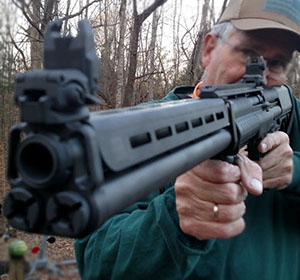
5 Best Guns to Have Against Looting Rioters

If there was ever a gun that was designed for close-range firepower, I’d have to say it is the Kel-Tek KSG.

While there are other excellent shotguns on the market, which follow the design of the KSG, this is the original. It is a bullpup shotgun, with dual switchable magazines, giving it a total capacity of 14 + 1 rounds. Seven round of each of two types of rounds, plus whatever is carried in the chamber.

A typical load for the KSG would be 00 buckshot in one magazine and slugs in the other.  That’s great for CQB, especially where breaching is necessary. But breaching is unlikely to be necessary in this case. Rather, you need the ability to defend yourself, perhaps without even killing anyone.

I would load that second barrel with a less-lethal round, like beanbags, rather than slugs. I’d also put something a bit smaller to replace 00 buckshot, such as #4 buckshot. That provides the option of starting out with something that can drive the crowd off, and then escalate firepower if needed. Even escalated, #4 buckshot is less deadly than 00 buckshot.

Mossberg 590M Shockwave
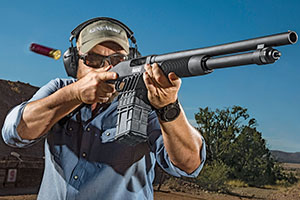
5 Best Guns to Have Against Looting Rioters

While the KSG is a great shotgun, it is a bit pricey. For those that can’t afford that, some other sort of a tactical shotgun would be great to have; something like the Mossberg 590M.

Mossberg has long been recognized as the standard for tactical shotguns. The 590M is a removable magazine-fed version of the very popular shockwave shotgun.

This removable magazine overcomes one of the biggest limitations for most shotguns, reload time. Rather than being forced to take the time to hand feed rounds into the loading chute to fill the internal magazine, you can slap a new magazine and keep going, just as you can with an AR-15 or semi-automatic pistol.

One modification I would make, to either this or the KSG, is to add a red dot sight. Most people consider shotguns to be a “point and shoot” weapon; but at the range you’ll probably be shooting, it would be good to have the ability to aim, allowing you to pick your target. You’re not going to have much shot spread and you want to make sure you can hit the right trouble maker.

Glock 21

5 Best Guns to Have Against Looting Rioters

After considerably ballistic testing, I’ve come to some definite conclusions about what pistol calibers are the best for certain circumstances. For most people, this argument comes down to 9mm vs. .45 ACP. Personally, I’m a fan of both, even though I see them as being useful for different things.

The .45 ACP round was originally developed for the US Army, who was having trouble with Moro tribesmen attacking them high on drugs. They needed a round that would have high energy transfer, increasing the chances of knocking down these tribesmen, even if they didn’t feel the hit. The .45 ACP gave them that and there really hasn’t been another round developed which matches this ability.

If we assume that any rioters will be high on at least adrenaline, if not more serious drugs, then we need this knockdown ability. The Glock 21 holds 10 rounds, three more than the 1911, which is why I’ve selected it. Glocks are also highly customizable, with lots of after-market parts available.

Springfield XDS

5 Best Guns to Have Against Looting Rioters

Such a time, when there is a chance of riots, coupled with reduced police protection, gives justification for concealed carry, if any were needed. There is always the possibility of being caught by that mob, away from home.

While I personally wouldn’t want to take on a mob with nothing more than a pistol, I’d much rather take them on with a pistol than with my bare hands.

My favorite concealed carry gun is the Springfield XDS, chambered in .45 caliber. I’ve carried other guns in the past and then settled on the XDS. Not only does it give me the knockdown power of the .45, but it does so in an easy to shoot, very reliable handgun, that’s fairly small for a .45. Mine is modified to have both tritium night sights and a laser sight, allowing me to use it any time anywhere.

The problem with this gun, as with any concealed carry gun, is magazine capacity. That’s especially true for a .45 caliber. Those fat bullets take up a lot of room, which translates to a small magazine capacity. I compensate for this by carrying two 7-round magazines, in addition to the 5 round magazine that’s in the pistol. Twenty rounds still isn’t enough to take on a mob, but hopefully it’s enough to scare them away, if nothing else.

AR-15
5 Best Guns to Have Against Looting Rioters

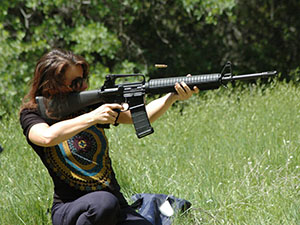
No matter what else you have, you should have an AR-15 as your backup gun. While I would not want to start shooting with that, due to the lethality of a rifle slug, I would want to have it leaning against the wall, loaded and ready, in case I needed a lot of firepower quickly. There are few civilian guns on the market, which can match the firepower that an AR-15 can offer us.

As for what particular AR-15 you should buy, I won’t even attempt to pick one. There are so many on the market, that it’s hard to pick out just one. Besides, my personal AR-15 is one that I’ve built myself, picking out the parts that I wanted. So I can’t tell you a brand.

More than anything, I’d say your optics are important. I’d be sure to have a red dot sight, as well as a powerful tactical light mounted on the rifle. That should take care of most circumstances. While infrared or night vision devices might be nice, you’ll lose important details in the image, so I’d probably avoid them.

Food Confiscation: How to protect your food stores and production from government confiscation

Did you know that if you have even a small subsistence farm to grow and or raise food for your family it all could be confiscated. Did you know the government is currently trying to identify and register all food producers to support this goal? Whether you are aware or not, at any time the president deems necessary, the US can now confiscate key resources in the name of national security. In particular, the food you worked hard to grow or raise could be seized. Naturally, it makes no sense to spend your time and money developing a farming capability to insulate your family from hard times only to have it seized. By following a few basic rules, you can help to protect your food supply and ensure those that helped cause the collapse and refused to prepare aren’t fed on your watch.

President Obama also nationalized our nation’s food supply through executive order. This executive order effectively orders the heads of various agencies to include the US Department of Agriculture (USDA) to identify critical resources under their purview and develop policies on how to ensure their production and procurement during national emergencies. As with most government regulation, this order on the surface doesn’t sound too draconian. However, the devil is in the details regarding its implementation. In order for the USDA to “secure” the US food supply, it becomes necessary to identify everyone involved in food production. Once identified, then upon order, the USDA can send nationalized goon squads to confiscate any and all “critical resources” deemed necessary for national security. National security may very soon include declaring “preppers” “extremists and depriving them of their stores of food. In this particular case, it could involve your entire crop.

In this video, i will unearth a long-forgotten secret that helped our ancestors survive famines, wars, economic crisis, diseases, droughts and anything else life trew at them.
So pay chose attention because this video will change your life forever for the good!

Doubt this affects you? Consider this, if you live in North Carolina, you must register with the state if you have even one chicken. This is ostensibly being done to rapidly inform, monitor, and protect the state’s poultry farmers from avian flu strains. However, as soon as anyone in government starts talking about “protecting” anything, one should suspect subterfuge. In this case, the government suddenly feels that you must be forced to “register” even if you have one chicken. By the government’s own admission, small isolated flocks have almost no risk to catching or passing the current avian flu strains due to their lack of ability to intermingle with wild waterfowl and then spread the virus to other birds. As such, one must consider alternative reasons the government feels that it is necessary to pry so deeply into private citizens’ lives. I would entertain the government’s arguments if they were focused solely on large commercial poultry farms, but they are not. This North Carolina regulation targets even an owner of a single bird as a pet and as such, is far too broad to be considered justifiable. However, when considering the quiet push behind the scenes by the USDA to identify all food producers, it makes much more sense.

You may be thinking that North Carolina is an isolated incident or that this is only applicable to poultry, but it is not. Let’s look at Wisconsin, which now “mandates” livestock premises registration. Again, as in North Carolina, if the regulation was solely focused on large scale livestock operations, it could be justifiable for the monitoring and tracking of disease. However, just like in North Carolina, this applies to even the smallest of hobby farms and in fact applies to anyone that has even one animal. It is also completely unnecessary. Just like the family that has a few chickens as pets in North Carolina, the family in Wisconsin with a pot belly big or rabbits do not pose any demonstrated increased risk to the livestock of the state. As such, once again, the trend supports a motive more indicative of complete registration and tracking of “all” food resources vice monitoring and mitigation of livestock diseases. Wisconsin isn’t alone. Both Michigan and Indiana also mandate registration of “any” livestock of any number being kept anywhere. Digging a bit deeper, the state link to the USDA policy of registration, monitoring, and tracking of all livestock (under the guise of tracking infectious disease) becomes very clear. In fact, the Council of State Governments blatantly tells us the states are in fact tracking all farms and livestock at the behest of the USDA.

Again, I recognize that skeptics will assert these are nothing more than well intentioned regulations being taken out of context and that they would need to see more specific evidence. To rebut their arguments, I could write volumes about the numerous new government regulations relating to heirloom seeds, animal and plant propagation, food storage, small gardens, raw foods, off-grid living, and water rights. When these regulations are considered in their entirety they form a powerful body of evidence that supports my assertion the government is building a broad database to use in the event it decides to confiscate food. However, the willfully ignorant and blind supporters of government tyranny are not of my concern. No amount of “evidence” will overcome their cognitive dissonance. My concern is to warn and inform those of you amongst us that have proven immune to brain washing and still have free thinking independent minds. Therefore, the fact remains that there is a growing trend at both the federal and state level of forcing everyone with live stock, orchards, gardens, etc. to register with the government. Once this database is complete, the government will no doubt use it to extract taxes and fees, conduct inspections and raids, and ultimately, should the need arise, confiscate your food. To prevent mitigate possible confiscation attempts from both government agents and looters; one should consider employing my four rules of food security.
Living without power, cars, electronics or running water may seem like a nightmare scenario but to pioneers it was just the way life was. Having the skills to survive without modern conveniences is not only smart in case SHTF, it’s also great for the environment. Keep in mind that the key to a successful homestead does not only lie on being able to grow your own food but on other skills as well. Learning these skills will take time, patience and perseverance, and not all of these skills are applicable to certain situations. Hopefully, though, you managed to pick up some great ideas that will inspire you and get you started! Just like our forefathers used to do,  The Lost Ways Book teaches you how you can survive in the worst-case scenario with the minimum resources available.It comes as a step-by-step guide accompanied by pictures and teaches you how to use basic ingredients to make super-food for your loved ones.

Experts predict that an EMP strike that wipes out electricity across the nation would ultimately lead to the demise of up to 90% of the population. However, this figure begs an important question: if we were able to live thousands of years without even the concept of electricity, why would we suddenly all die without it?

My first rule comes from the movie “Fight Club.” Don’t talk about your food production and storage. Although it may be obvious to neighbors you garden or raise a small amount of livestock such as hogs and poultry for personal consumption, the broader public doesn’t need to know. Continuing with that point, how much food you put up for long term storage and where it is stored should never be an open topic of discussion. Let them think you have nothing in food stores even if that means using disinformation.

My second rule is to disperse your food stockpiles using food caches. If you have stored adequate amounts of food for your family properly, even a complete confiscation of your current harvest shouldn’t push you to food lines and soup kitchens. Just like with firearms, don’t store your food all in one place. Food preserved properly can be cached in the ground just like most anything else and store literally for years. In fact, well camouflaged in-ground storage areas similar to mini-root cellars are excellent places to store food. Just make sure you don’t mix foods like apples and potatoes, which will cause the other to go bad quickly in your food cache. The simplest of these food caches can be constructed by digging a hole below the frost line big enough to store what you want. Then load your cache, cover it with a board, add a layer of insulation, and cover it with a layer of dirt (dirt alone can be used to cover and insulate). To finish it, camouflage the cache site any remove traces of a trail to it. I favor using a technique where you cache a mixed bundle of food stuffs capable of supporting the basic nutritional needs of your family for a month. This method allows a cache to remain undisturbed until you actually are going to use it and includes all of your food staples. It also justifies the investment of energy making the site.

My third rule requires developing the skills to identify and use wild and edible plants. As I have written many times about any government bureaucrat with an accompanying goon squad or looter can identify a cellar of potatoes and a field of corn. However, very few will ever be able to recognize wild spinach, pokeweed, dandelions, chicory, huckleberries, and common milk weed as “food.” In fact, most will walk right past these tasty, super-nutritious wild plants assuming them to be weeds in a fallow field you didn’t plant this year. Further, even if they recognize them as potentially being cultivated, they wouldn’t have enough sense or knowledge to know when to pick them, what parts to pick, and how to prepare them without potentially poisoning themselves. Like the bureaucrats and looters though, if you don’t study this knowledge on your own, you will not be capable of employing this critical food security technique. I find that the best way to employ this technique is in a deliberate fashion. Leave small plots of your garden or fields to appear “fallow,” but in reality, plant these plots with a natural mix of wild edibles. This requires you to collect the seeds from various edible plants the season before and store them in a cool, dark, dry location. In the spring, till up the soil in that plot, mix the wild seeds, and broadcast them throughout the fresh soil. Then lightly cover the seeds and allow nature to do its work. The plot will grow up appearing as if it is a natural mix of weeds typical of any fallow field or recently disturbed ground, but in reality will be a dense mix of mutually supporting edible plants that require little to no further gardening. In fact, the yield may far exceed the yields of your cultivated plant species, will naturally choke out undesirable weeds, and require no additional work aside from harvesting. I apply the same basic concept to my fruit and nut trees. Naturally, having an orchard setting is smart, but also intentionally plant Black Walnut, Butternut, various hickory, apple, pear, plum, and pawpaw trees throughout your property and forest. These trees will also blend in to the natural flora and an untrained eye will never be able to pick them out as fruit and nut bearing trees outside of an orchard setting. Respective of livestock, one faces more difficult challenges keeping their existence hidden. One technique to leverage is to raise free range animals, which are difficult to completely account for and round up. In the event of an inspection, theft, or confiscation, it is unlikely that without the owners help, the offender will be able to locate and completely coral and capture all of the free range livestock. For animals such as ducks and chickens, this can be accomplished pretty easily; especially, if non-traditional coups are used and they are dispersed throughout the property. However, with grazing livestock and hogs, a fence must be used to limit their range. Still though, with enough property, one can let their animals roam as they graze and forage like the old cattle ranchers of the West. Ultimately, if confiscations were to begin, one could simply release their livestock to become feral and be hunted rather than allowing their livestock to be stolen or seized.

My fourth rule is to register absolutely nothing unless you absolutely have to. Whether or not you choose to comply with government regulations is a matter you must individually assess and decide upon. If registering your farm, livestock, or garden isn’t mandatory, this is a no brainer…don’t. However, when it becomes “mandatory,” one must consider the pros and cons. For example, maybe it is best if you just register “some” of your livestock to give legitimacy to your farming operation, but not draw unnecessary attention from authorities. Maybe you simply want no trouble and are willing to risk confiscation so you comply 100%. Maybe the risks are not the issue and you decide that your moral and ethical code to resist encroaching tyranny at all opportunities is more important so you register nothing. I cannot make this decision for you, but you must make it. Either way, my first three rules are designed to work equally well whether or not you decide to comply when the time comes.

In summary, the USDA working in conjunction with the military and the Department of Homeland Security have set in motion plans to identify and track all critical resources in this country to include food. The impact of this could mean that in a time of crisis, if the government deems it necessary, it will confiscate your food. To ensure your food security, I have provided you four basic rules to follow that will help you cache your food, diversify your crops, and provide for better overall food security in the face of looting or confiscation.

Have you ever thought about living without electricity, internet or mobiles? We can guarantee that the majority of our readers can never imagine this kind of scenarios.

However, there are chances that this type of conditions arises in your life due to flooding, tornadoes, draught or even war.

How could you survive in this type of dangerous condition? We believe you should stay prepared by learning the essential skills needed to deal with these disasters, watching this video

Untitled-2.png

NewsBlog The Police and Military when SHTF – Friend or Armed Foe?

Preparing to survive in a post-SHTF world is challenging. More than anything, we have to realize that we’re preparing blind. We don’t know what sort of disaster we’re facing or what the post-disaster world is going to look like. With those two pieces of information missing, it’s hard to know exactly how people will react and what they will do. Therefore, we must prepare for the worst.

There is a wide-ranging assumption that public servants will abandon their posts. I would have to say that this assumption is totally unfair. We live in a hurricane zone and my wife is a city employee. She and her co-workers are required to agree that they will stay on the job, protecting the citizens of the city and keeping city services running, both during and after a hurricane. While a few might abandon their posts if things get bad enough, most seem to be people who will follow through on that requirement.

But what about a worst-case scenario? What about in the wake of an EMP or other grid-destroying event, which would result in a true breakdown of society and the banking system; a situation where they would no longer be paid to do their jobs?

That’s a difficult question. For some, like my wife, their positions probably wouldn’t exist anymore. But the real issue here is emergency workers and law enforcement officers. We would greatly need their services in the wake of such a serious disaster. Would they stay on the job or would they feel they had to abandon their posts to care for their families?

There’s really no way of knowing the answer to that question until the time comes. It is a very individual question, so I imagine that some will stay, while others leave. Whether they stay or leave will largely determine whether they are friend or foe.

In this video, i will unearth a long-forgotten secret that helped our ancestors survive famines, wars, economic crisis, diseases, droughts and anything else life trew at them.
So pay chose attention because this video will change your life forever for the good!

The Cops Who Stay on the Job

Police officers tend to be highly disciplined individuals, much like soldiers. In fact, many start out as soldiers, then move to law enforcement when they get out of the military. As such, they are largely people with a high regard for the law. Oh, there are the few bad apples; but despite stories saying otherwise, there aren’t many of them.

Those who stay on the job will be concerned with maintaining law and order in the worst of circumstances. They will also be subject to the politicians who are still in place over them. This means that if those politicians declare martial law, they will most likely enforce martial law, unless they believe that to be an unlawful order.

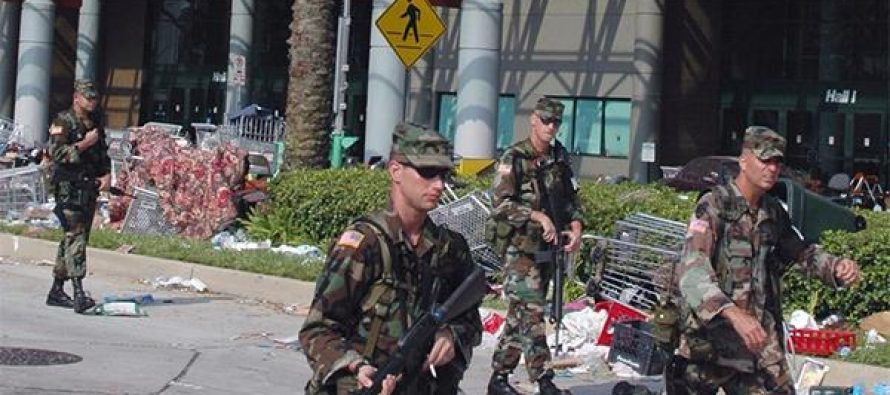
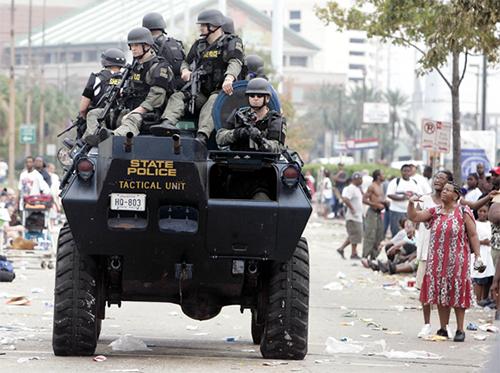
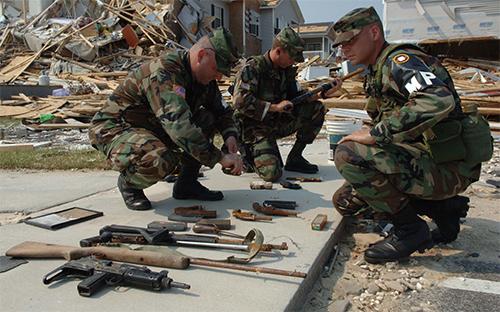
This could get sticky. As we saw during Hurricane Katrina, declaring martial law would probably mean they would be confiscating guns as well. That would put the police in the position of appearing to be the enemy in the eyes of any Second Amendment supporter. Whether or not they actually became an enemy would depend on how you, I and other gun owners would react to them. If we use force to reject their orders to turn over our guns, they will use force in response. That makes them our de-facto enemies.

The Cops Who Abandon their Posts

Some police officers may choose to abandon their posts, especially if they feel that their families are in danger. In that case, the question is what they will do to protect and care for their families. While there are very few bad cops out there, there is always the possibility that a cop will turn bad in such circumstances, out of desperation to take care of their families.

These people will be dangerous, because they will be able to present themselves to the public as law-enforcement officers, when in fact they are acting like criminals. There could even be some cases in smaller communities, where the police take over, much as warlords take over in times of anarchy. Should that happen, the police in question would be extremely dangerous.

It would be our duty, in such a case, to stand up against the police. But here’s the problem. How do you tell if what they are doing is in the public interest, or just in self-interest? If they are acting in the public interest, our duty is to support them, so we need to be sure they are the enemy, before treating them as such.

The National Guard

If military forces are called out to help gain control, it will be the National Guard, not the active military. US law prohibits the use of US military forces within the borders of the United States. Even if politicians in high places wanted to use the regular Army, it is doubtful that Army officers, all of whom know that prohibition in the law, would allow it.

But state Governors can call out the National Guard to help law enforcement in maintaining law and order. It’s not unusual for this to happen in the case of natural disasters. I would say that we should expect it to happen in a true SHTF scenario.

National Guard forces are US Army reserve soldiers and formations, which are “owned” by the governors of the several states. They serve a dual role, both as state owned military forces and reserves for the federal forces. If called out in a disaster situation, they could serve either to support law-enforcement or to provide disaster relief. In either case, they would be armed.

The Police and Military when SHTF – Friend or Armed Foe 2

Should martial law be declared, it is highly likely that the National Guard would be called out. If guns are confiscated, they are the ones who would most likely do the confiscation. They would probably be as polite as possible about it; but if they decided to obey that order, they would do their best to fulfill it.

However, the National Guard, like other military forces, is made up of predominantly conservatives. There’s a very good chance that they would refuse an order to disarm the population. Military officers swear an oath to uphold the Constitution and they would likely see the disarm order as a clear violation of the Second Amendment. As such, it would be their duty to refuse that order.

UN Troops

Of all these options, UN troops is the most dangerous. Any decision to use UN troops would have to be made at the federal government level. Were such a decision to be made, the troops which would be brought in to help maintain civil order would not be American troops. They would be unfamiliar with our culture (other than what they had seen in movies) and unfamiliar with our laws.

To these troops, a firearm confiscation order would seem perfectly reasonable, especially when you consider that they would probably come from a country where they don’t enjoy our Second Amendment protections. There would be no appeal to them on the grounds of our Constitution.

Should this happen, refusing an order to turn over your guns would be dangerous. The only thing that would protect any of us is the fact that there is no federal gun registration. Even so, there are states which require a permit to own guns, as well as concealed carry licenses which many of us have. That would give them a starting point for where to look.

Getting into a battle with armed troops is foolish. In such a situation, the only practical recourse is to hide all your guns where they won’t be able to find them, with the exception of a few, which you could then allow them to confiscate, making them think you’ve obeyed the order.

Regardless of the specific situation we would end up encountering, chances are that any police or military forces which were still in operation, would be there as part of whatever government managed to survive. Unless such forces decide to go rogue, we can count on them being there to help.

That doesn’t mean they’ll be our friends though. Unless you know them personally, they will look on you with suspicion, just like they will everyone else. Anyone carrying a weapon openly will be suspect. That doesn’t mean that they’ll hassle you, take away your weapons, fire upon you or arrest you; it just means that they will be watching to make sure that you aren’t a problem that they need to deal with.

The best thing you and I will be able to do in such a situation is to keep ourselves below the radar, so that we aren’t noticed. If we are not noticed, hopefully we will be left alone.

Should orders go out to confiscate any supplies that are stockpiled, it would probably be a good time to put our bug out plans into effect. Hopefully, we’ll all have a cache of supplies elsewhere, so that when we lose the supplies that we have stockpiled at home, we’ll still be okay.

Have you ever thought about living without electricity, internet or mobiles? We can guarantee that the majority of our readers can never imagine this kind of scenarios.

However, there are chances that this type of conditions arises in your life due to flooding, tornadoes, draught or even war.

How could you survive in this type of dangerous condition? We believe you should stay prepared by learning the essential skills needed to deal with these disasters, watching this video

Untitled-2.png

Blending In: The Secret to Keeping The Target Off Your Back- As the sun sets on America’s affluent lifestyle, it will become more likely that you’ll find yourself in the company of desperate and dangerous people, no matter where you live

It’s no secret that there are predatory people in our society. Whether they are driven by poverty, or are sociopathic in nature, it’s a simple mathematical probability that you will eventually run into these people in your life. They choose their victims in a way that is not unlike predators in the animal kingdom. They are often ruthlessly efficient at sniffing out weaknesses, and sensing when you’re off your guard.

While many of the strategies below were originally tailored for urban areas, rural scenes have their fair share of sketchy trailer parks, rest stops, and dive bars. As the sun sets on America’s affluent lifestyle, it will become more likely that you’ll find yourself in the company of desperate and dangerous people, no matter where you live. Learning to spot predatory individuals and make yourself an undesirable target, is easily transferred from one scenario to another with the proper adjustments. There’s only one rule that is universal in avoiding any violent situation. Check your pride at the door.

Anyone in the Prepper community who has gone through the forums and comments of any survival website, knows what I’m talking about. Some people are eager to fight and prove themselves for all the wrong reasons (many of them will become a problem for you if the system breaks down). They often lose sight of the term “survival” and focus on “glory”. It doesn’t matter how skilled you are, it rarely takes one punch to win, and it seldom takes one shot to put someone down. Most fights turn into a kind of, blow by blow attrition until one person submits. No one, no matter how good of a fighter they are, gets out of a confrontation without getting hurt. It’s up to you to chose your battles carefully, and the best strategy is to not get into a fight in the first place. If of course, it can be avoided.

Now that that’s out of the way, lets discuss some strategies you can easily recognize. Body language in particular. It’s often said, that when you’re in a bad neighborhood you need to act confident. You need to walk straight and keep your eyes on your surroundings. Don’t ever stop to twiddle with your cell phone. Nobody gets mugged more often these days, then someone who has all of their awareness siphoned into a portable, expensive gadget. Another red flag for criminals, is if you appear to be lost (especially if you’re a tourist). To a predator, being lost means you’re awareness is no longer in your immediate vicinity, but inside your mind as you struggle to recall the directions. They may also wait for you to pull out your cell phone and lose even more awareness.

Another aspect of body language is eye contact. It’s the surest way to prove to people in your vicinity, that you are in fact aware. The eye contact shouldn’t be too strained though. Depending on cultural context, extended eye contact is often a sign of aggression (if you’re traveling to another country, always research the body language of the locals). The best thing to do is to make brief eye contact and continue to scan your surroundings, and occasionally look over your shoulder as well to show you have awareness in all directions.

One of the more underrated aspects of body language, is in your walking gait. In a study conducted back in 1981, researchers with a hidden camera filmed pedestrians walking through a bad neighborhood over the course of several days. They then visited a prison and showed the footage to various inmates who had been convicted of assault or murder (wouldn’t you just be thrilled to find out you were filmed and shown to convicts?). They were asked to rate on a scale of 1-10, how easy they felt it would be to attack each person they saw in the film. While the elderly were chosen more often than not, certain body language markers stood out across gender and age boundaries. They found that:

“The typical victim as perceived by the criminal respondents in this study would have either a long or a short stride, but not a medium stride…This typical victim would probably move his or her body so that body weight would shift laterally, diagonally, or with an up/down movement… In terms of whole body movement, the typical victim would move unilaterally, one side at a time, rather than contralaterally, moving left arm and right leg and then right arm and left leg. (Even those victims who did move contralaterally combined this movement with upper and lower body parts moving against each other rather than moving together.) Finally, the victim would tend to lift his or her feet while walking rather than using a more fluid swing movement.”

If you have a hard time imagining yourself walking in the way that’s described above, you probably walk like a normal person, and that’s exactly what you want to go for. A level, medium stride with symmetrical movements of the arms and legs, swinging your feet rather than plodding them up and down. Again, it’s very similar to how a predator chooses a victim in the wild. They scan for any signs of weakness, illness, or injury amongst the herd. The easiest way to spot that from a safe distance, is to observe how their victims move.

Outside of how aware you are and how you carry yourself, there is the matter of how you dress. You want to look similar to the local color, but you must take care with your choices. Choose drab colors, nothing flashy. This will help you avoid the mistake of choosing gang colors, which by their nature, tend to be flashy and noticeable. It goes without saying you shouldn’t wear anything that indicates wealth or status, but you wouldn’t want to go in the other direction either. Wearing something incredibly shabby and worn out, might give you the appearance of being homeless, who are often targeted for reasons other than wealth.

All in all, when you find yourself in unfamiliar surroundings, don’t stand out. Dress down, walk normally (if you don’t know how to do that, then I don’t know what to tell you), be aware, let the people around you know you’re aware, and of course, check your pride at home. If there is a way out of a fight, like fleeing or given out a decoy wallet, do it. I said it once and I’ll say it again. Nobody wins a fight without getting hurt. If you plan to defend your belongings, it’d better be worth the possibility of serious injury or the unfortunate legal ramifications of defending yourself.

“Light ‘Em Up”: Warrior-Cops Are the Law — and Above the Law — as Violence Grips America

From their front porches, regular citizens watched a cordon of cops sweep down their peaceful street in Minneapolis, Minnesota. Rankled at being filmed, the cops exceeded their authority and demanded that people go inside their houses. When some of them didn’t obey quickly enough, the order — one heard so many times in the streets of Iraqi cities and in the villages of Afghanistan — was issued: “Light ’em up.” And so “disobedient” Americans found themselves on the receiving end of non-lethal rounds for the “crime” of watching the police from those porches.

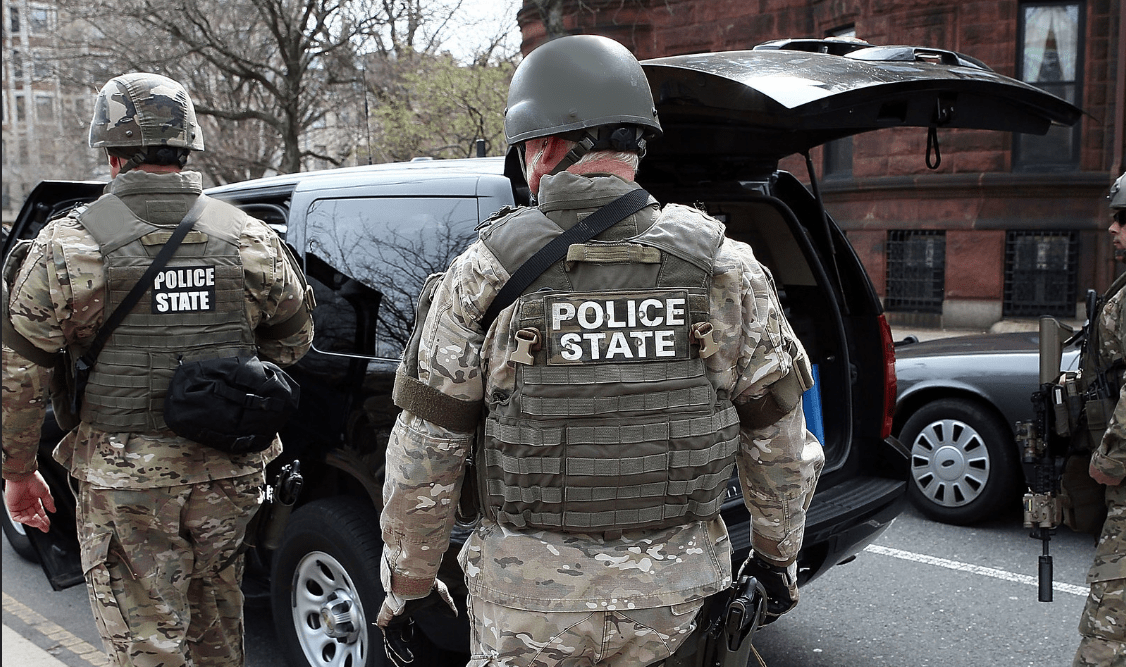
It’s taken years from Ferguson to this moment, but America’s cops have now officially joined the military as “professional” warriors. In the wake of George Floyd’s murder on May 25th, those warrior-cops have taken to the streets across the country wearing combat gear and with attitudes to match. They see protesters, as well as the reporters covering them, as the enemy and themselves as the “thin blue line” of law and order.

The police take to bashing heads and thrashing bodies, using weaponry so generously funded by the American taxpayer: rubber bullets, pepper spray (as Congresswoman Joyce Beatty of Ohio experienced at a protest), tear gas (as Episcopal clergy experienced at a demonstration in Washington, D.C.), paint canisters, and similar “non-lethal” munitions, together with flash-bang grenades, standard-issue batons, and Tasers, even as they drive military-surplus equipment like Humvees and MRAPs. (Note that such munitions blinded an eye of one photo-journalist.) A Predator drone even hovered over at least one protest.

Who needs a military parade, President Trump? Americans are witnessing militarized “parades” across the U.S.A. Their theme: violent force. The result: plenty of wounded and otherwise damaged Americans left in their wake. The detritus of America’s foreign wars has finally well and truly found its place on Main Street, U.S.A.

Cops are to blame for much of this mayhem. Video clips show them wildly out of control, inciting violence and inflicting it, instead of defusing and preventing it. Far too often, “to serve and protect” has become “to shoot and smack down.” It suggests the character of Eric Cartman from the cartoon South Park, a boy inflamed by a badge and a chance to inflict physical violence without accountability. “Respect my authoritah!” cries Cartman as he beats an innocent man for no reason.

So, let’s point cameras — and fingers — at these bully-boy cops, let’s document their crimes, but let’s also state a fact with courage: it’s not just their fault.

Who else is to blame? Well, so many of us. How stupid have we been to celebrate cops as heroes, just as we’ve been foolishly doing for so long with the U.S. military? Few people are heroes and fewer still deserve “hero” status while wearing uniforms and shooting bullets, rubber or otherwise, at citizens.

Answer me this: Who granted cops a specially-modified U.S. flag to celebrate “blue lives matter,” and when exactly did that happen, and why the hell do so many people fly these as substitute U.S. flags? Has everyone forgotten American history and the use of police (as well as National Guard units) to suppress organized labor, keep blacks and other minorities in their place, intimidate ordinary citizens protesting for a cleaner environment, or whack hippies and anti-war liberals during the Vietnam War protests?

Or think of what’s happening this way: America’s violent overseas wars, thriving for almost two decades despite their emptiness, their lack of meaning, have finally and truly come home. An impoverished empire, in which violence and disease are endemic, is collapsing before our eyes. “When the looting starts, the shooting starts,” America’s self-styled wartime president promised, channeling a racist Miami police chief from 1967. It was a declaration meant to turn any American who happened to be near a protest into a potential victim.

As such demonstrations proliferate, Americans now face a grim prospect: the chance to be wounded or killed, then dismissed as “collateral damage.” In these years, that tried-and-false military euphemism has been applied so thoughtlessly to innumerable innocents who have suffered grievously from our unending foreign wars and now it’s coming home.

How does it feel, America?

The End of Citizen-Soldiers, the End of Citizen-Cops

I joined the military in 1981, signing up in college for the Reserve Officer Training Corps, or ROTC. I went on active duty in 1985 and served for 20 years, retiring as a lieutenant colonel. I come from a family of firefighters and cops. My dad and older brother were firefighters, together with my brother-in-law and nephew. My niece and her husband are cops and my sister worked for her local police department for years. My oldest friend, a great guy I’ve known for half a century, recently retired as a deputy sheriff. I know these people because they’re my people.

Many cops — I’d say most — are decent people. But dress almost any cop in combat gear, cover him or her in armor like a stormtrooper out of Star Wars, then set all of them loose on the streets with a mandate to restore “LAW & ORDER,” as our president tweeted, and you’re going to get stormtrooper-like behavior.

Sure, I’d wager that more than a few cops enjoy it, or at least it seems that way in the videos captured by so many. But let’s remind ourselves that the cops, like the rest of America’s systems of authority, are a product of a sociopolitical structure that’s inherently violent, openly racist, deeply flawed, and thoroughly corrupted by money, power, greed, and privilege. In such a system, why should we expect them to be paragons of virtue and restraint? We don’t recruit them that way. We don’t train them that way. Indeed, we salute them as “warriors” when they respond to risky situations in aggressive ways.

Here’s my point: When I put on a military uniform in 1985, I underwent a subtle but meaningful change from a citizen to a citizen-airman. (Note how “citizen” still came first then.) Soon after, however, the U.S. military began telling me I was something more than that: I was a warrior. And that was a distinct and new identity for me, evidently a tougher, more worthy one than simply being a citizen-airman. That new “warrior” image and the mystique that grew up around it was integral to, and illustrative of, the beginning of a wider militarization of American culture and society, which exploded after the 9/11 attacks amid the “big-boy pants” braggadocio of the administration of President George W. Bush and Vice President Dick Cheney as they set out to remake the world as an American possession.

Why all the “warrior” BS? Why “Generation Kill” (one of those memorable phrases of the post-9/11 era)? Was it to give us a bit more spine or something to rally around after the calamity of those attacks on iconic American targets, or perhaps something to take pride in after so many disastrous wars over the last 75 years? It took me a while to answer such questions. Indeed, it took me a while to grasp that such questions were almost beside the point. Because all this warrior talk, whether applied to the military or the cops, is truly meant to separate us from the American people, to link us instead to wider systems of impersonal authority, such as the military-industrial-congressional complex.

By “elevating” us as warriors, the elites conspired to reduce us as citizens, detaching us from a citizen’s code of civics and moral behavior. By accepting the conceit of such an identity, we warriors and former warriors became, in a sense, foreign to democracy and ever more divorced from the citizenry. We came to form foreign legions, readily exploitable in America’s endless imperial-corporate wars, whether overseas or now here.

(Notice, by the way, how, in the preceding paragraphs, I use “we” and “us,” continuing to identify with the military, though I’ve been retired for 15 years. On rereading it, I thought about revising that passage, until I realized that was precisely the point: a career military officer is, in some way, always in the military. The ethos is that strong. The same is true of cops.)

In 2009, I first asked if the U.S. military had become an imperial police force. In 2020, we need to ask if our police are now just another branch of that military, with our “homeland” serving as the empire to be conquered and exploited. That said, let’s turn to America’s cops. They’re now likely to identify as warriors, too, and indeed many of them have served in America’s violent and endless wars in Afghanistan, Iraq, and elsewhere. These days, they’re ever more likely to identify as well with authority, as defined and exercised by the elites for whom they serve as hired guns.

In the aftermath of George Floyd’s murder, the warrior-mercenary mindset of the police has been fully exposed. For what was Floyd’s great “crime”? At worst, if true, an attempt at petty theft through forgery. He’d lost his job due to the Covid-19 crisis and, like most of us, was lucky if he saw a one-time check for $1,200, even as the rich and powerful enjoyed trillions of dollars in relief.

Rarely are the police sent to prosecute scofflaws in high places. I haven’t seen any bankers being choked to death on the street under an officer’s knee.  Nor have I seen any corporate “citizens” being choked to death by cops. It’s so much easier to hassle and arrest the little people for whom, if they’re black or otherwise vulnerable, arrest may even end in death.

By standing apart from us, militarized, a thin blue line, the police no longer stand with us.

A friend of mine, an Air Force retired colonel, nailed it in a recent email to me: “I used to — maybe not enjoy but — not mind talking to the police. It was the whole ‘community partners’ thing. Growing up and through college, you just waved at cops on patrol (they’d wave back!). Over the last five years, all I get is cops staring back in what I imagine they think is an intimidating grimace. They say nothing when you say hello. They are all in full ‘battle rattle’ even when directing traffic.”

When military “battle rattle” becomes the standard gear for street cops, should we be that surprised to hear the death rattle of black men like George Floyd?

Speaking Truth to Power Isn’t Nearly Enough

Perhaps you’ve heard the saying “speaking truth to power.” It’s meant as a form of praise. But a rejoinder I once read captures its inherent limitations: power already knows the truth — and I’d add that the powerful are all too happy with their monopoly on their version of the truth, thank you very much.

It’s not enough to say that the police are too violent, or racist, or detached from society. Powerful people already know this perfectly well. Indeed, they’re counting on it. They’re counting on cops being violent to protect elite interests; nor is racism the worst thing in the world, they believe, as long as it’s not hurting their financial bottom lines. If it divides people, making them all the more exploitable, so much the better. And who cares if cops are detached from the interests of the working and lower middle classes from which they’ve come? Again, all the better, since that means they can be sicked on protesters and, if things get out of hand, those very protesters can then be blamed. If push comes to shove, a few cops might have to be fired, or prosecuted, or otherwise sacrificed, but that hardly matters as long as the powerful get off scot-free.

President Trump knows this. He talks about “dominating” the protesters. He insists that they must be arrested and jailed for long periods of time. After all, they are the “other,” the enemy. He’s willing to have them tear gassed and shot with rubber bullets just so he can pose in front of a church holding a Bible. Amazingly, the one amendment he mentioned defending in his “law and order” speech just before he walked to that church was the Second Amendment.

And this highlights Trump’s skill as a wall-builder. No, I don’t mean that “big, fat, beautiful wall” along the U.S. border with Mexico. He’s proven himself a master at building walls to divide people within America — to separate Republicans from Democrats, blacks and other peoples of color from whites, Christians from non-Christians, fervid gun owners from gun-control advocates, and cops from the little people. Divide and conquer, the oldest trick in the authoritarian handbook, and Donald Trump is good at it.

But he’s also a dangerous fool in a moment when we need bridges, not walls to unite these divided states of ours. And that starts with the cops. We need to change the way many of them think. No more “thin blue line” BS. No more cops as warriors. No more special flags for how much their lives matter. We need but a single flag for how much all our lives matter, black or white, rich or poor, the powerless as well as the powerful.

How about that old-fashioned American flag I served under as a military officer for 20 years? How about the stars and stripes that draped my father’s casket after his more than 30 years of fighting fires, whether in the forests of Oregon or the urban tenements of Massachusetts? It was good enough for him and me (and untold millions of others). It should still be good enough for everyone.

But let me be clear: my dad knew how to put out fires, but once a house was “fully involved,” he used to tell me, there’s little you can do but stand back and watch it burn while keeping the fire from spreading.

America’s forever wars in distant lands have now come home big time. Our house is lit up and on fire. Alarms are being sounded over and over again. If we fail to come together to fight the fire until our house is fully involved, we will find ourselves — and what’s left of our democracy — burning with it.

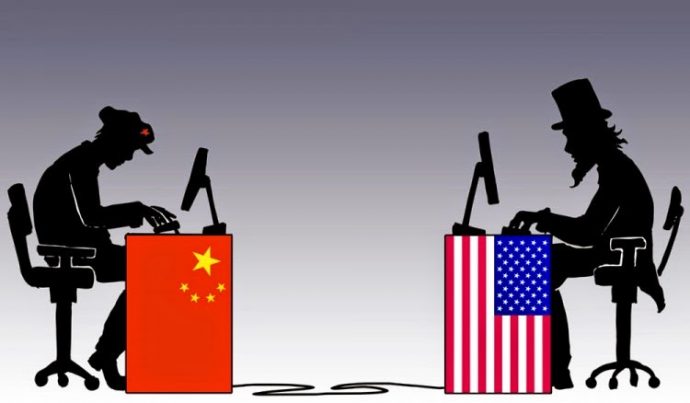
Cyberwar between the United States and China (This will be the new “Cold War 2.0”, i.e. a series of IT, economic and industrial guerrilla warfare actions, and of actions of defamation)

How is the new “Cold War 2.0”,which currently characterizes the ever less collaborative relations between the United States and China, developing?

Some data may be interesting in this regard. On March 3, 2020 the Chinese cybersecurity company Qihoo 360 accused CIA of having hacked many Chinese companies for over 11 years.

 They are – almost obviously – aviation companies, large global commercial Internet networks, research institutions and certainly also Chinese government agencies.

Not to mention the cryptocurrency operations often organized by people and entities traceable to the North Korean government.

Both the Chinese and the US governments, in fact, use various and complex entities and mechanisms to operate in cyberwar. Firstly, the “front companies”. Just think of the Chinese group APT40, which even hires hackers – as everybody does, after all. Secondly, the intrusions to collect cyberdata in the large multinational companies, or even in State agencies, which often remain blocked for a few days and, in that phase, transfer vast masses of data to the “enemy”.

 Thirdly, the theft of IP and trade secrets- another mechanism that everybody uses.

Obviously this is not the case of Italian Agencies, which, at most, can entrust a small, but good Milanese company to do some hacking, possibly in accordance with the law.

 It now seems that the Italian ruling classes are composed above all of what in the 1920s Gaetano Salvemini called “the Paglietta of the Naples Court”.

On the military level, the United States believes that today the Chinese Joint Chiefs of Staff can hit well and quickly any opposing C3 system (Combat, Control, Communication) and that it can also carry out automated, but smart warfare operations, from the very first moments in which a significant regional military clash occurs.

Although many US experts in the sector also maintain that, still today, the United States hasa better base of action and, probably some advanced technologies that could enable the United States to have a better and wider cyber action. Nevertheless, this is not necessarily the case.

Certainly China is well aware that the Western and especially North American response to a harsh cyberattack would entail an even harsher, immediate and ruinous reaction against Chinese targets in the homeland and in the other regions.

Hence cyberwar’s parallel IT operations are mainly carried out by Russia: just think of the attack on French TV5Monde in 2015 or on Ukrainian energy companies in late December 2015, as well as on Sony in 2014. We can also mention the 2017 attack – through the use of a computer virus, WannaCry – which, however, was a cyberattack attributed by the United States to North Korea.

 On the technical-legal level, the Chinese legislation that governs the Chinese cyberwar is mainly contained in the National Security Law of 2015 and finally in the Intelligence Law of 2017, in which it is laid down that cyber operations can be conducted both by the Ministry of National Security, the old guoan, and by the Office for Internal Security of the Public Security Ministry.

 The operations abroad normally concern the Centre for the Evaluation of Intelligence and Technology (CINTSEC), which is an integral part of the Ministry for State Security.

 The other autonomous cyber networks operating within the People’s Liberation Army(PLA) add to this official network.

At geopolitical level, China does not want to trigger any conflict with the United States. Neither a traditional conflict nor a cyber one. Quite the reverse.

China’s current real goal is to bridge the technological and operational gap between the two cyberwars, both on a strictly military level and, above all, on the economic and technological one.

 China knows that – as Napoleon said – “wars cost money” and it is good not to make them if they can be avoided.

 For the United States, China needs cyberwar to win “particularly informationalised local wars”.

Conversely, for Chinese theorists, cyberwar is the only real strategic war of the 21st century, as it was the case for nuclear war in the 20th century.

 In other words, the technological and doctrinal area that allows to win a medium and large conflict and then sit at the peace negotiating table with of Phaedrus’s motto Quia sum Leo.

 Also on a global and commercial level, China even plans to build a large private company that can compete on an equal footing with what in China is called “the eight Kongs”, namely Apple, Cisco, Google, IBM, Intel, Microsoft, Oracle and Qualcomm.

 Therefore, at military level, China wants first of all its full cyberspace security so as to ensure the security of critical intelligence, both of regions and economic activities.

Also on the American side, however, there is currently a tendency to reduce the Chinese cyber penetration power, both at military and commercial levels. Some analysts maintain that,in recent years, the Chinese cyber presence has been very exaggerated.

There is a psywar operation – this time, certainly, of North American origin, but recently present on the Web – which currently makes us add a further analytical factor on the intelligence cyberwar and, above all, on the implementation of cyber criteria in psywar.

Nowadays there is a sort of “Report of a Military Contractor” available on the Web- as it is officially entitled – which is supposed to reveal just what the United States would like to hear still today, i.e. that Covid-19 is just a “Chinese virus” that was designed and made in the now very famous Wuhan laboratory.

 This report was drafted by a previously unknown Multi-Agency Collaboration Environment (MACE), a group of cyber and non-cyber experts, whose site is only part of the Sierra Nevada Corporation.

However, it is still a current relevant contractor of the US Department of Defence.

Hence the usual “external centre” that is used to say things that it would be unreasonable to say directly.

 The report states it is based on evidence related to the posts of the intra-and extra social networks, both of the laboratory and its employees, as well as on the data provided by non-military satellites and finally on the positioning data of mobile phones.

 All this in view of even saying that “something” happened – probably by chance and accidentally, but in any case extremely severe and uncontrolled – in the Wuhan laboratory, only with regard to the Covid-19 virus.

 This is a further phase of the modern misinformation technique: at first, it was said that the virus deliberately came out of the Hebei laboratory, while now it is underlined that it probably “escaped” unintentionally from its microscopic cage.

It is easy to understand what they really want to communicate: even if the Chinese government were not responsible, international lawsuits for claiming damages would still be possible.

 Nowadays, at least in the West, misinformation is carried out at first by hardly hitting the opponent and later possibly apologizing for saying something inaccurate or wrong. A psychological warfare technique that creates the “aura” of the case without later supporting and corroborating it. It is very dangerous.

 A really dangerous tactic, especially in the presence of an increasingly evolved and advanced Network.

The document, however, does not report as many as seven locations of mobile and institutional phones within the Wuhan laboratory – too great a flaw to be accidental.

 MACE also states that, allegedly, a whole conference inside the Hebei laboratory was “cancelled”, due to an unspecified disaster, while, again in the documents of the laboratory, there are pictures with a clear internal date concerning precisely that event, the conference of November 2019.

 One of these pictures was also found in the social media of a Pakistani scientist who had participated.

 Even the aerial photographs provided by the company Maxar Technologies are a sign of obvious and normal repairing of roads, certainly not specific roadblocks placed due to an unforeseen and very severe event.

A few days ago President Trump stated that the “virus came out of the lab because someone was stupid”. Too easy and, I believe, useless even for a legal and insurance case against the Chinese government itself.

 Moreover, these is the more or less manipulated data which, however, has certainly been useful to develop and spread the theory of “Chinese fault” for the outbreak of the epidemic and then pandemic, just in the midst of the great “acquisition of intelligence data” to which Trump and Pompeo referred.

 All this just to reaffirm, without any reasonable doubt, the wilful or culpable guilt of the Chinese government in the outbreak of the coronavirus pandemic, and hence to stop the development of China and make it retreat, – with huge legal costs – from a development rate that was already within reach.

 Moreover, the aforementioned MACE report lacks some data that we would simply call cultural intelligence, i.e. not knowing that the first week of October is a “golden” week for China, e.g. the National Day which commemorates the foundation of the People’s Republic of China, announced by Mao Zedong in a very famous speech at the Square of Heavenly Peace Square, with an even more famous phrase: “the Chinese people have stood up!”

 How can they not know this, even believing they are intelligence people?

 The same happened with a US report on the coronavirus issue transmitted from US to Australian intelligence agencies and later immediately published in a Sydney newspaper. Obviously everyone also “manipulate” documents to defame the opponent, but there are many ways and means of doing so.

On a more strictly doctrinal level, however, the issue brings us back to the analysis developed in 1999 by the two famous PLA Colonels, Quiao Lang and Wang Xiangsui, entitled Unrestricted Warfare.

 It was a manual on what we would today call asymmetrical warfare.

Today, however, Quiao Liang thinks that – even at this stage of the conflict -war is still linked to the manufacturing industry. This means you can have excellent scientific research and a good network of research centres, but if you do not turn all this into mass and important industrial products, as Quiao Liang says, “you have just won a medal, but nothing more”.

 Liang also maintains that the United States is therefore using up its weapons and industrial equipment stocks.

Furthermore, the more the coronavirus crisis worsens -considering the scarcely effective reaction of the US economic and health system – the more the consumption of North American military and civilian stocks increases, although the ability to produce them decreases more than proportionally.

Hence has the United States still have a manufacturing and mass industry, as well as the ability to turn technological evolution into mass products, to wage an asymmetrical or conventional war but, above all, to continue it until the final victory?

  The Chinese Air Force General seems to imply that this is not the case.

Hence, in his mind, currently the only reasonable solution for China is to expand its production system, but never underestimate the “traditional” medium-low technology manufacturing industry, which is the one that reproduces and expands production forces and enables it to last over time, which is the only real guarantee of victory.

 You do not eat fintech products, but rather Californian tomatoes and Midwest meat.

 Those who want to collect technological jewels can certainly do so and – as the General maintains – obviously also China must do so, but what is still and always needed is the great mass production and items that, coincidentally, have become scarce all over the world: masks, respirators, food, traditional infrastructure, as well as means of transport.

It is fine if you believe that war and the economy are a superhero scenario, but you have to win, i.e. “to last one minute more than your opponent” – hence you need to go back to a mass, industrial, stable and growing civilization for the “real” economy.

 The myth of high technology as the key to everything, induced by the development of the current United States, has made everyone else in the world lose the true sense of modernization, the key concept of the Chinese political narrative, from Deng Xiaoping to present days and in the future.

You cannot think of a future civilization in which social verticalisation is such that a share of over-rich countries slightly higher than 1% follows the vertical impoverishment of all the others.

 A mass impoverishment which also leads to a reduction of manufacturing production. The products are later sent to “Third World” countries to trigger a process of social pyramidalization that is almost unprecedented in human history. And what is it for? For uselessly spending the mad money produced by fintech?

 Therefore, the Chinese General believes that a US decoupling from China – as all the economists close to the White House preach-is needed to prevent China from taking all the most important technological and defence patents. In his opinion, however, also China must not decouple from the USA at all. This is not useful for high technology, but if anything, to avoid doing the same as the United States on a mass level.

 If there is decoupling – as the current US economists preach – the Chinese products will become more competitive compared to the US and US-related products. Hence the US monetary hegemony would soon disappear and the same would be true for the its double use of the dollar that made an old FED Governor say to his European colleagues: “the dollar is our currency,but it is your problem”.

Therefore, in the long run, it will also be impossible to let China – with its low-cost productions – be replaced by Vietnam, Myanmar and the other countries in the so-called “pearl necklace” of Southeast Asia.

Moreover, if after the coronavirus crisis, there will be further robotization of the workforce, how will it be possible to maintain many and sufficiently high wages which, after the pandemic, will obviously be distributed to a smaller number of available workers?

 Low wages – and hence also scarce tax revenues – as well as crisis of State spending and decrease in social and military spending, especially in the high tech sector, which always has a very high unit cost.

 Therefore, just to recap, the Empire is facing severe danger.

 As the Chinese General maintains, “we must not dance with wolves”, i.e. we must not follow the pace of US dance to reap only the technological fruits, but rather maintain and expand the great manufacturing production and, above all, even avoid taking up the cultural, industrial and scientific traits of the United States, which the Chinese General deems to be at the end of its civilization cycle.

According to Chinese analysts, the United States is a “country that has gone directly from dawn to decadence”, just to put it in the words of a French ambassador.

Hence China needs to solve the Taiwan issue autonomously, as well as also harshly oppose the actions against Huawei, by reacting blow-for-blow with the U.S. companies in China, such as IBM, Cisco, etc., and stopping their activities in China, where necessary. Anything but hybrid warfare.

 Here we are at a commercial and quasi-conventional war between two powers, i.e. an old Western power,on the one side, and an Asian power on the other which, however, does not want at all to be relegated and closed in the Pacific, as implied and assumed by the new US military projects for closing the Ocean, from California to Japan, or for trying to block the expansion of the Silk Road or still trying to block the expansion line to the South and East of China, as President Xi Jinping has recently advocated.

Certainly China is currently not lagging behind on the cyberwar issue. Nevertheless it does not want to use it as a substitute for conventional war or psywar for dual-use technologies, nor to play the game of the total defeat of a hypothetical “enemy”.

China can now avail itself of the Third Department of the People’s Army, the network dedicated to cyberwar within the PLA, but also of the Strategic Support Force.

 This will be the new “Cold War 2.0”, i.e. a series of IT, economic and industrial guerrilla warfare actions, and of actions of defamation – specifically at military level – of confidential information to be stolen from the enemy in a tenth of a second, as well as of cultural manipulation and-eventually, but only in the end-of fake news.

5 Essential Tips to Living Frugally and Preparing for What’s to Come

Prepper or not, learning about frugality is crucial. Preppers are mainly gearing up for the apocalypse, and the current COVID-19 pandemic a vindication of their years of preparation. Stockpiling weeks or months’ worth of supplies, investing in survivalist skills or bunkers, packing a get-home bag, and prepping to survive doomsday involve money one way or another.

How do you prudently and economically spend your money and be on top of your finances? Accordingly, this article tries to awaken the frugal in you through tips that are practical and pretty useful for day-to-day life and eventualities.

Frugal Tip No. 1: Amass Real-Life Skills

The do-it-yourself movement teaches you to be more hands-on in everyday matters. It also helps you to be careful about your funds; instead of buying a replacement or hiring services outright, examine if you can do the task yourself first.

Great Skills To Make Money

Here are some practical skills to help you save your dollars and your life if it comes to that:

  • Home cooking: you can save on delivery fees and choose the ingredients and quantity for allergy-free and healthy meals. During crucial times, being able to make something out of scraps and leftovers in the fridge is quintessential.
  • Planting or growing food: harvest vegetables and herbs fresh from your backyard to your table and spend less on groceries.
  • Sewing: buy fewer clothes, and make repairs or alterations to old ones.
  • Grooming: learning to cut your hair or that of your children and partner saves money and waiting times at the salon.
  • Doing household repairs: the basics of plumbing, carpentry, and home maintenance can go a long way to keep your house safe and in good shape. You’ll need these skills, even more, when you live off the grid and have only yourself to rely on.
  • Hunting and foraging/gathering: if you are out in the wild or when the food situation goes awry, you can turn to these skills to survive, just like the old times.

Frugal Tip No. 2: Track Your Expenses

Budgeting, saving, and spending are all connected. If you keep wondering where your wages ago, it’s time to keep track of them:

  • Pen and paper: with your planner, journal, or dedicated notebook, itemize every single thing you spent on for the day, and tally them at the end of the month. The challenge is to keep going at it and not miss a single day.
  • Spreadsheets: for on-the-go editing and access online, keep tabs of your daily expenses through Google Sheets and Office 365 Excel.
  • Apps: they are convenient and free (there may be in-app purchases). You can categorize expenses that make it easier to spot trends and purchases you can minimize or drop.

Frugal Tip No. 3: Get Out of Debt

It’s hard to set an emergency fund or double the money in your bank when you have debts to pay. One tip is to focus on the loan balance and pay it off as fast as what this couple did. If you can choose which to pay off first, prioritize the ones that have higher interest rates. Also, reach out to your banks/lenders for a realistic debt repayment plan.

Getting out of debts and staying free of them involve mindful decisions about purchases, the classic needs versus wants, and living within one’s means.

Frugal Tip No. 4: Start with Value

Dictionary definition aside, frugality has taken on different meanings to different people. One thing’s for sure, you can be frugal and pay more to get better value. Instead of going for the lowest-priced product, consider the quality and other attributes that make it a worthwhile purchase for you in the long run.

Going for value is somehow related to Robert Burton’s famous proverb, “penny wise, pound foolish.” Per the idiom, one is bent on making the most out of their pennies but is wasteful with large sums of money that whatever savings are offset.

Learn To Save Money

Frugal Tip No. 5: Raise Money for “Fun”

Being frugal doesn’t necessarily mean depriving yourself of nice things, especially if they are the buy-them-for-life kind. It’s also important to treat yourself every once in a while to avoid frugality fatigue, which happens when you are too caught up saving and feeling miserable about it.

Why not create a fund exclusively for those impulse or emotion-driven purchases? This “fun money” can come from your side gigs. One lucrative source of extra income is selling things online, from handcrafted items, old clothes, thrift finds, to travel photos.

Selling items you no longer need declutter your house and leads them to frugal customers who, like you, want bang for their buck. Even with little to no capital for inventory, you can start a business using a trusted platform.

Save and Prepare

It’s true: you can only do so much to prepare for what’s to come. But you have an advantage if you have resources at your disposal and know how to manage them wisely.

What’s your go-to frugal tip?

What the Government Can or Can’t Do Under Martial Law

The big M word in the survivalist and prepper world, Martial Law, is a very disturbing concept and one we have seen in small bouts here in America. In our lifetime we have never been closer to seeing true Martial Law crop up in cities across the nation.

We have hundreds of thousands of National Guard members in cities all over the country. Make no mistake about it, the National Guard is here to help. They have been helping with everything, from getting food and resources to people and setting up testing locations.

The question becomes: why and how would Martial Law hit big cities in the nation?

The Simple Martial Law Scenario

All over the country governors are relaxing restrictions. You may be in favor of that or you may not. Regardless, we are going to see an increase in cases of COVID-19 as people come together again. We cannot be sure the effect this will have.

What happens if the cases skyrocket and we see the government panic and pull the emergency break? What if we tumble into lockdown #2? We are already seeing people protesting to get things back to normal.

If we lockdown again and the average American cannot get back to work, there will be civil unrest like nothing we have seen in this nation. At this point violence will have to be suppressed. Welcome in Martial Law!

So, let’s look at what the government can or cannot do under martial law.

Firearms Confiscation

Firearms have been confiscated in this nation before. While it might seem improbable, if we are dealing with threats from civil unrest, you will see isolated incidences of gun confiscation.

It only takes a little thinking to understand what a brittle bridge this is to cross, however, when you bring overwhelming force to a community most will surrender their weapons. We watched this happen following the devastation of Hurricane Katrina.

In fact, we have watched Mayors all over the nation lean on “emergency” legislation that limits the 2nd Amendment. Just take this “law” from New Orleans:

“Subject to the provisions of Act 275 of 2006 (Regular Session), the Emergency Authority is hereby empowered, if necessary, to suspend or limit the sale, dispensing, or transporting of alcoholic beverages, firearms, explosives, and combustibles.”

Curfew

This is one of those situations where many places, under emergency authority, have already created rules with curfew. From places like New Jersey, where you might expect it, to as far south as South Carolina, we have already seen curfews put in place.

It would make a stricter Martial Law style curfew easier to establish.

Restrictions on Free Speech

Unfortunately, thanks to our buddies at Google, we already have our speech restricted on almost every major level. Sure, you can go out to a bar and say most of what you want to say. However, the largest vehicles of mass communications are so regulated it’s embarrassing.

This is yet another example of how we have been primed for Martial Law. When you look at it from that angle, how hard would it be to level your ability to communicate and voice your opinions? If the internet goes dark, your cell signal shuts off and you cannot assemble, what do you have?

Removal of Personal Property

There is no doubt that the removal of personal property and even the removal of people from their own property is possible with Martial Law. In fact, executive orders to take PPE and other items from citizens have already been enacted.

Months ago, we had people from the administration threaten to take people’s goods if they were stockpiling hand sanitizer, toilet paper, masks, and other PPE. This had many preppers on alert.

Eliminate Your Right to a Speedy Trial

Even in Martial Law, you will be tried for crimes. Now, what you consider to be a CRIME might change drastically, however you will be tried. You will not be tried by a jury of your peers. Instead, the military will become judge, jury, and jailor.

As scary as that sounds you will still have a trial to decide your fate. This is not a guarantee but there is legal precedent that your 6th Amendment will be upheld. While President Lincoln suspended Habeas Corpus during the Civil war, Lambdon P. Milligan fought his military tribunal sentencing and the Supreme court ruled in his favor.

In 1866 the Supreme court ruled there could be no military trials for US citizens.

 Nationwide Martial Law

Despite the fantasy of a nationwide Martial Law, the resources do not exist to lockdown every American city. In fact, we couldn’t lockdown the major cities all at the same time. We are talking about tens of millions of people.

However, we could very well see sections of Boston, NYC, and Detroit, among others, face a Martial Law type presence.

I hope you have connected the dots while reading this article. Many of these “Emergency Acts” that have been enacted at the state and federal level have already stolen your liberty in writing. The government has built a framework for Martial Law and in some cities the violence has already started. Not to mention we have willingly walked into a world of censorship.

Pay close attention to positioning. The American military is great at positioning and I have to believe that much of what is happening in our nation is about positioning resource to cut down civil unrest due to this lockdown and, God forbid, successional lockdowns to come.

The fact is, we have given up tremendous amounts of power. Those who rule over us are fully prepared to send in the shock troops, if need be. It is time for America to be smart and get people back to work, safely. It’s time to isolate at risk populations.

Otherwise we will see Martial Law in cities across this nation and now you know what we stand to lose.

Trump Against the Government: Officials Conflicted Over Lying for the President

Once upon a time in the United States there was a consensus among national politicians that there were two areas where there should be a unified approach to policy. They were national security and foreign policy, both of which involved other nations, which made desirable a perception of unity on the part of the president and his cabinet, no matter who was in power. That meant that dissent from individual politicians should never rise to the level of pitting one party against another on the basic Establishment view of what was desirable in terms of U.S. national interests.

That viewpoint has survived at least somewhat intact to this day, even weathering the turmoil of Vietnam, but the apple cart has been somewhat upset by new players in the game, namely the various federal bureaucracies, to include law enforcement, intelligence and the Pentagon. The 2016 election demonstrated that the FBI and CIA in particular were willing to get involved in the game of who should be president, and in so doing they compromised major foreign policy and national security norms, which produced Russiagate as well as the wildly inflated current claims being leveled against China and Russia and even Iran looking ahead to elections in November.

As noted above, the Establishment view on foreign and national security policy was based on the principle that there must always be a united front when dealing with situations that are being closely watched by foreigners. If a cabinet secretary or the president says something relating to foreign or military affairs it should be the unified view of both the administration and the loyal opposition. Unfortunately, with President Donald Trump that unanimity has broken down, largely because the chief executive either refuses to or is incapable of staying on script. The most recent false step involved the origin of the corona virus, with the intelligence community stating that there was no evidence that the virus was “man made or genetically modified” in a lab followed by the president several hours later contradicting that view asserting that he had a “high degree of confidence” that the coronavirus originated in a laboratory in Wuhan, China based on secret information that he could not reveal.

There has also been reports that the Trump White House has in fact been pushing the intelligence community (IC) to “hunt for evidence” linking the virus to the Wuhan laboratory, suggesting that the entire China gambit is mostly political, to have a scapegoat available in case the troubled handling of the virus in the United States becomes a fiasco and therefore a political liability. This pressure apparently prompted an additional statement from the Office of the Director of National Intelligence saying: “The IC will continue to rigorously examine emerging information and intelligence to determine whether the outbreak began through contact with infected animals or if it was the result of an accident at a laboratory in Wuhan.”

Secretary of State Mike Pompeo, who has claimed without providing any details that there is “overwhelming evidence” that coronavirus came out of the Wuhan laboratory, is reportedly leading the push to demonize China. He and other administration officials have expressed their frustration over the C.I.A.’s apparent inability to come up with a definitive explanation for the outbreak’s origin. C.I.A. analysts have reportedly responded that there is no evidence to support any one theory with “high confidence” and they are afraid that any equivocating response will immediately be politicized. Some analysts noted that their close monitoring of communications regarding the Wuhan lab suggest that the Chinese government itself does not regard the lab as a source of the contagion.

To be sure, any intelligence community document directly blaming the Chinese government for the outbreak would have a devastating impact on bilateral relations for years to come, a consequence that Donald Trump apparently does not appreciate. And previous interactions initiated by Trump administration officials suggest that Washington might use its preferred weapon sanctions in an attempt to pressure other nations to also hold China accountable, which would multiply the damage.

Given what is at stake in light of the White House pressure to prove what might very well be unprovable, many in the intelligence community who actually value what they do and how they do it are noticeably annoyed and some have even looked for allies in Congress, where they have found support from the Pentagon over Administration decision making that is both Quixotic and heavily politicized.

House Armed Services Committee Chairman Adam Smith of Washington has responded to the concerns expressed to him by both the military and intelligence communities, admitting that he is “…worried about a culture developing” where many senior officials are now making decision not on the merits of the case but rather out of fear that they will upset the president if they do not choose correctly.

While the intelligence agencies are concerned over the fabrication of a false consensus over the coronavirus, similar to what occurred regarding Iraq’s alleged possession of weapons of mass destruction in 2002-3, the Defense Department is more concerned that fundamental mechanisms that have been in place since the Second World War are now under attack, including how the military maintains discipline and punishes officers and enlisted men who have deviated from established policies.

Appealing to his base of support, Trump has notoriously pardoned Chief Petty Officer Edward Gallagher, a Navy seal who was clearly guilty of murder in Afghanistan, and even met with him afterwards in the White House. Regarding Gallagher, Senate Armed Services Committee Democrat Jack Reed of Rhode Island said in a November that “The White House’s handling of this matter erodes the basic command structure of the military and the basic function of the Uniform Code of Military Justice.”

Trump is now meddling in the treatment of Navy Captain Brett Crozier, who was relieved of his command after he went public with complains about the spread of coronavirus on his ship. In early April the president said “I may just get involved.” In the military services such interference even has a name, “undue command influence.” Clearly, the White House is seeking to squeeze every bit of political advantage it can from the Crozier story.

Congressman Smith has also described the situation in a colorful fashion as “The president has made it clear as far as he is concerned the single most important attribute that anybody in the federal government can have is a willingness to kiss the president’s ass as often as possible” which “undermines your ability to be competent, to make decisions based on what is the right thing to do as opposed to what is going to feed the president’s limitless ego.”

To be sure, Donald Trump is not about to change and if he is re-elected one can only expect four more years of the same, but public confidence in government can only be maintained if there is at least some belief that decision making is a rational process. Trump has clearly turned that axiom on its head in his tendency to blame other parts of the government for what are manifestly his own failings. His characterization of senior officials, many of whom he himself appointed, as “losers” casts the entire government in a bad light. Whether the strategy of divide and conquer within one’s own administration will work out for Trump will certainly be decided in November.

Death Toll of Western Aggressive Wars in the Middle East to Coronavirus Worldwide: 5,000,000 to 220,000

Nobody knows how many people died as a result of the UK/US Coalition of Death led destruction of Iraq, Afghanistan, Libya and, by proxy, Syria and Yemen. Nobody even knows how many people western forces themselves killed directly. That is a huge number, but still under 10% of the total. To add to that you have to add those who died in subsequent conflict engendered by the forced dismantling of the state the West disapproved of. Some were killed by western proxies, some by anti-western forces, and some just by those reverting to ancient tribal hostility and battle for resources into which the country had been regressed by bombing.

You then have to add all those who died directly as a result of the destruction of national infrastructure. Iraq lost in the destruction 60% of its potable drinking water, 75% of its medical facilities and 80% of its electricity. This caused millions of deaths, as did displacement. We are only of course talking about deaths, not maiming. This very sober analysis from Salon makes a stab at 2.4 million for Iraqi deaths caused by the war.

The number of Iraqi casualties is not just a historical dispute, because the killing is still going on today. Since several major cities in Iraq and Syria fell to Islamic State in 2014, the U.S. has led the heaviest bombing campaign since the American War in Vietnam, dropping 105,000 bombs and missiles and reducing most of Mosul and other contested Iraqi and Syrian cities to rubble.

An Iraqi Kurdish intelligence report estimated that at least 40,000 civilians were killed in the bombardment of Mosul alone, with many more bodies still buried in the rubble. A recent project to remove rubble and recover bodies in just one neighborhood found 3,353 more bodies, of whom only 20% were identified as ISIS fighters and 80% as civilians. Another 11,000 people in Mosul are still reported missing by their families.

For a vivid illustration, here is a photo of Sirte, Libya, after it was kindly “liberated” by NATO aerial bombardment. NATO carried out 14,000 bombing sorties on Libya.

The neo-con drive to dominate the Middle East, in alliance with Saudi Arabia and Israel, has caused an apocalyptic level of death and destruction. It really is very difficult indeed to quantify the number of people killed as a direct result of the policy of “liberal intervention” in these countries. Bombing people into freedom has collateral damage. There are also the vast unintended consequences. The destruction of Afghanistan, Iraq, Libya and Syria launched a wave of refugee migration which led to politicial instability throughout Europe and contributed to, among many other consequences, Brexit.

For the purposes of argument, I am going to put an extremely conservative figure of 5 million on the number of people who died as a result of Western military intervention, direct or proxy, in the Middle East.

Now compare that to the worldwide death toll from coronavirus: 220,000. Let me say that again.
Western aggressive wars to coronavirus: 5,000,000 : 220,000.

Or put it another way. The total number of deaths from coronavirus in the UK so far is about half the number of civilians killed directly by the US military in the single city of Mosul.

Makes you think, doesn’t it? There are four horsemen of the apocalypse, and while of course I do not blame people for focusing on the one which is riding at them personally, do not forget the others. Coronavirus has not finished killing. But then nor have western wars.

The sight which I cannot stand is the mainstream media which cheered on the horseman of war as they argued for the invasion Iraq on the basis of lies – and still defend it as a “liberation” – who now pretend massive concern for human life. The hypocrites are disgusting.

I was wrong when I initially wrote about the coronavirus.

Before I detail where I was wrong, let me say where I believe I was right. Large general population sampling antibody studies are now just beginning to emerge, and I feel reasonably confident that I was in fact correct that the mortality rate of coronavirus is under 1%, and probably not too different from the 0.5% generally quoted for Hong Kong flu. The term “infection fatality rate” is now being used to describe this true mortality rate. The “infection fatality rate” is the percentage of those who get the disease who die.

These are very early days for whole population sampling antibody studies, and the true picture should become more plain over the next month or two. I must say I have found it alarmingly difficult to explain to people the rather simple concept that you cannot infer a mortality rate among everybody who catches the disease, from the results you get when by definition you have only been offering tests to the most acute cases presenting as needing serious treatment. Of course a fair proportion of the worst cases don’t make it through the disease. But there is a population of millions in the UK (and nobody has a serious idea how many) who have had the disease with no or mild symptoms, and who do not figure in the statistics.

The very large majority of people in the UK who have had coronavirus have never been tested. That is simply true. How many, nobody knows. That is also true.

I do not endorse the extrapolation from New York to the UK, in this Daily Mail piece, to try to calculate how many people may have had coronavirus in the UK. But buried in there is the best collection I can find anywhere of what sampling antibody studies are indicating for the “infection fatality rate” across various US and European locations, and there is a strong clustering under 1%. Now these are preliminary studies, though almost all from reputable institutions. Proper, large scale, antibody testing programmes to produce peer reviewed and authoritatively published studies are on the way, but not here yet. I repeat, though, that I think the infection mortality rate is somewhere below 1%.

Where I was wrong, was in not realising that what is different about this disease from a flu is that it is really very, very contagious. So a far higher percentage of the population get it, all at once. Over two seasons, only about 30% of the UK population got the Hong Kong flu. Unchecked, it seems this coronavirus can spread very much quicker than that. I do not know why, but it appears that it can. So the lockdown policies to prevent health services being overwhelmed are needed and do have my support.

I do not however support the level of alarmism and panic. Of course the disease is really appalling for those who get it badly. It is a painful, protracted and terrifying experience. But a similar level of scrutiny of extreme illnesses of other kinds would bring similar stories. I have had three brushes with death in my own life.

In 2003 I had multiple pulmonary emboli (bloodclots in both lungs), which left me in a coma for days, was incredibly painful and I understand very similar in terms of experience to the end phase of this coronavirus. In 1986 I was actually declared dead in a hospital in Kaduna, Northern Nigeria (salmonella paratyphoid B), and was woken up on a morgue trolley by a cockroach eating my nostril. In 1974 I had emergency surgery for peritonitis, and was in hospital for 5 weeks and then a convalescent home. Retailing the experience or images of any of these illnesses would be as capable or more of generating the terror being created by the detailed coverage of extreme cases of coronavirus.

Yes the coronavirus is horrible if you get it badly. Almost all severe disease is horrible and death very seldom consists of peacefully stopping breathing, despite Hollywood. I wonder if having lived so much in Africa has changed my attitude to death. We do not see death much in the UK. Did you know the British have a 350% higher propensity than the Italians to put their elderly into care homes? That is why the deaths in Italy were so much more visible, even though the truth is that the UK government is doing not significantly better, and quite probably worse, than the Italian government, at containing the virus. It is only now making a start at adding English care home deaths to the official statistics (Scotland has for weeks).

I do support lockdown, I do support every sensible precaution being taken because the virus is so contagious. I utterly deplore the vast quantities being spent on war, the $220 billion being squandered on Trident missiles while the most basic precautions stockpiling against the much more real threat of a pandemic were not undertaken, because Tories begrudged spending a few millions on the NHS. I get all of that and I repeat it. But we must not be panicked into believing that the threat is greater than it is. You have approximately a 99% chance, (still nobody knows for certain) of surviving this disease if you catch it. If you are under 60, your chance of death is almost certainly at worst 1 in 500 if you catch it. If you are older or like me have heart and lung issues, it looks a bit bleak. But we are not immortal, nor would I wish to be.

But remember this. Your odds of survival are massively better than were those of a civilian in a country that your country chose to invade in recent years. Did you, personally, do enough to try to stop that?

Remember, there are other horsemen.