Preparing to survive in a post-SHTF world is challenging. More than anything, we have to realize that we’re preparing blind. We don’t know what sort of disaster we’re facing or what the post-disaster world is going to look like. With those two pieces of information missing, it’s hard to know exactly how people will react and what they will do. Therefore, we must prepare for the worst.
There is a wide-ranging assumption that public servants will abandon their posts. I would have to say that this assumption is totally unfair. We live in a hurricane zone and my wife is a city employee. She and her co-workers are required to agree that they will stay on the job, protecting the citizens of the city and keeping city services running, both during and after a hurricane. While a few might abandon their posts if things get bad enough, most seem to be people who will follow through on that requirement.
But what about a worst-case scenario? What about in the wake of an EMP or other grid-destroying event, which would result in a true breakdown of society and the banking system; a situation where they would no longer be paid to do their jobs?
That’s a difficult question. For some, like my wife, their positions probably wouldn’t exist anymore. But the real issue here is emergency workers and law enforcement officers. We would greatly need their services in the wake of such a serious disaster. Would they stay on the job or would they feel they had to abandon their posts to care for their families?
There’s really no way of knowing the answer to that question until the time comes. It is a very individual question, so I imagine that some will stay, while others leave. Whether they stay or leave will largely determine whether they are friend or foe.
Police officers tend to be highly disciplined individuals, much like soldiers. In fact, many start out as soldiers, then move to law enforcement when they get out of the military. As such, they are largely people with a high regard for the law. Oh, there are the few bad apples; but despite stories saying otherwise, there aren’t many of them.
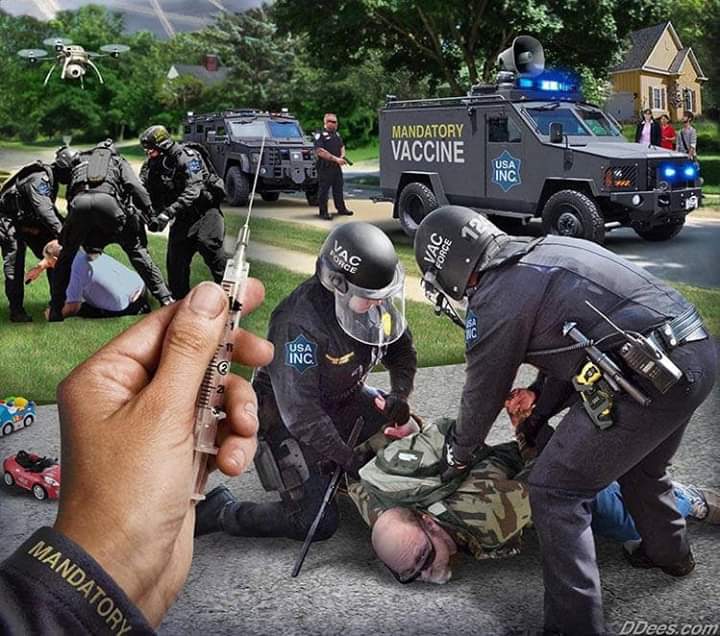
Those who stay on the job will be concerned with maintaining law and order in the worst of circumstances. They will also be subject to the politicians who are still in place over them. This means that if those politicians declare martial law, they will most likely enforce martial law, unless they believe that to be an unlawful order.
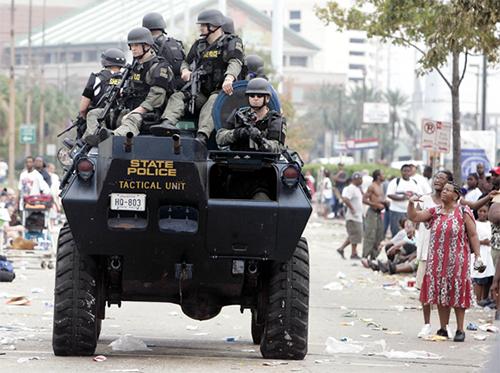
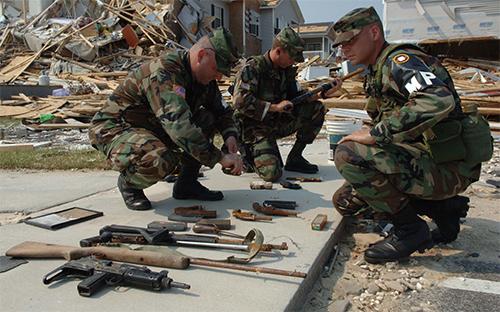
This could get sticky. As we saw during Hurricane Katrina, declaring martial law would probably mean they would be confiscating guns as well. That would put the police in the position of appearing to be the enemy in the eyes of any Second Amendment supporter. Whether or not they actually became an enemy would depend on how you, I and other gun owners would react to them. If we use force to reject their orders to turn over our guns, they will use force in response. That makes them our de-facto enemies.
The Cops Who Abandon their Posts
Some police officers may choose to abandon their posts, especially if they feel that their families are in danger. In that case, the question is what they will do to protect and care for their families. While there are very few bad cops out there, there is always the possibility that a cop will turn bad in such circumstances, out of desperation to take care of their families.
These people will be dangerous, because they will be able to present themselves to the public as law-enforcement officers, when in fact they are acting like criminals. There could even be some cases in smaller communities, where the police take over, much as warlords take over in times of anarchy. Should that happen, the police in question would be extremely dangerous.
It would be our duty, in such a case, to stand up against the police. But here’s the problem. How do you tell if what they are doing is in the public interest, or just in self-interest? If they are acting in the public interest, our duty is to support them, so we need to be sure they are the enemy, before treating them as such.
The National Guard
If military forces are called out to help gain control, it will be the National Guard, not the active military. US law prohibits the use of US military forces within the borders of the United States. Even if politicians in high places wanted to use the regular Army, it is doubtful that Army officers, all of whom know that prohibition in the law, would allow it.
But state Governors can call out the National Guard to help law enforcement in maintaining law and order. It’s not unusual for this to happen in the case of natural disasters. I would say that we should expect it to happen in a true SHTF scenario.
National Guard forces are US Army reserve soldiers and formations, which are “owned” by the governors of the several states. They serve a dual role, both as state owned military forces and reserves for the federal forces. If called out in a disaster situation, they could serve either to support law-enforcement or to provide disaster relief. In either case, they would be armed.
Should martial law be declared, it is highly likely that the National Guard would be called out. If guns are confiscated, they are the ones who would most likely do the confiscation. They would probably be as polite as possible about it; but if they decided to obey that order, they would do their best to fulfill it.
However, the National Guard, like other military forces, is made up of predominantly conservatives. There’s a very good chance that they would refuse an order to disarm the population. Military officers swear an oath to uphold the Constitution and they would likely see the disarm order as a clear violation of the Second Amendment. As such, it would be their duty to refuse that order.
UN Troops
Of all these options, UN troops is the most dangerous. Any decision to use UN troops would have to be made at the federal government level. Were such a decision to be made, the troops which would be brought in to help maintain civil order would not be American troops. They would be unfamiliar with our culture (other than what they had seen in movies) and unfamiliar with our laws.
To these troops, a firearm confiscation order would seem perfectly reasonable, especially when you consider that they would probably come from a country where they don’t enjoy our Second Amendment protections. There would be no appeal to them on the grounds of our Constitution.
Should this happen, refusing an order to turn over your guns would be dangerous. The only thing that would protect any of us is the fact that there is no federal gun registration. Even so, there are states which require a permit to own guns, as well as concealed carry licenses which many of us have. That would give them a starting point for where to look.
Getting into a battle with armed troops is foolish. In such a situation, the only practical recourse is to hide all your guns where they won’t be able to find them, with the exception of a few, which you could then allow them to confiscate, making them think you’ve obeyed the order.
Regardless of the specific situation we would end up encountering, chances are that any police or military forces which were still in operation, would be there as part of whatever government managed to survive. Unless such forces decide to go rogue, we can count on them being there to help.
That doesn’t mean they’ll be our friends though. Unless you know them personally, they will look on you with suspicion, just like they will everyone else. Anyone carrying a weapon openly will be suspect. That doesn’t mean that they’ll hassle you, take away your weapons, fire upon you or arrest you; it just means that they will be watching to make sure that you aren’t a problem that they need to deal with.
The best thing you and I will be able to do in such a situation is to keep ourselves below the radar, so that we aren’t noticed. If we are not noticed, hopefully we will be left alone.
Should orders go out to confiscate any supplies that are stockpiled, it would probably be a good time to put our bug out plans into effect. Hopefully, we’ll all have a cache of supplies elsewhere, so that when we lose the supplies that we have stockpiled at home, we’ll still be okay.
Today I’d like to share with you a “3-second survival hack” you can use to skyrocket your chances of protecting your loved ones during ANY crisis.
Did you know that if you have even a small subsistence farm to grow and or raise food for your family it all could be confiscated. Did you know the government is currently trying to identify and register all food producers to support this goal? Whether you are aware or not, at any time the president deems necessary, the US can now confiscate key resources in the name of national security. In particular, the food you worked hard to grow or raise could be seized. Naturally, it makes no sense to spend your time and money developing a farming capability to insulate your family from hard times only to have it seized. By following a few basic rules, you can help to protect your food supply and ensure those that helped cause the collapse and refused to prepare aren’t fed on your watch.
President Obama also nationalized our nation’s food supply through executive order. This executive order effectively orders the heads of various agencies to include the US Department of Agriculture (USDA) to identify critical resources under their purview and develop policies on how to ensure their production and procurement during national emergencies. As with most government regulation, this order on the surface doesn’t sound too draconian. However, the devil is in the details regarding its implementation. In order for the USDA to “secure” the US food supply, it becomes necessary to identify everyone involved in food production. Once identified, then upon order, the USDA can send nationalized goon squads to confiscate any and all “critical resources” deemed necessary for national security. National security may very soon include declaring “preppers” “extremists and depriving them of their stores of food. In this particular case, it could involve your entire crop.
Doubt this affects you? Consider this, if you live in North Carolina, you must register with the state if you have even one chicken. This is ostensibly being done to rapidly inform, monitor, and protect the state’s poultry farmers from avian flu strains. However, as soon as anyone in government starts talking about “protecting” anything, one should suspect subterfuge. In this case, the government suddenly feels that you must be forced to “register” even if you have one chicken. By the government’s own admission, small isolated flocks have almost no risk to catching or passing the current avian flu strains due to their lack of ability to intermingle with wild waterfowl and then spread the virus to other birds. As such, one must consider alternative reasons the government feels that it is necessary to pry so deeply into private citizens’ lives. I would entertain the government’s arguments if they were focused solely on large commercial poultry farms, but they are not. This North Carolina regulation targets even an owner of a single bird as a pet and as such, is far too broad to be considered justifiable. However, when considering the quiet push behind the scenes by the USDA to identify all food producers, it makes much more sense.
You may be thinking that North Carolina is an isolated incident or that this is only applicable to poultry, but it is not. Let’s look at Wisconsin, which now “mandates” livestock premises registration. Again, as in North Carolina, if the regulation was solely focused on large scale livestock operations, it could be justifiable for the monitoring and tracking of disease. However, just like in North Carolina, this applies to even the smallest of hobby farms and in fact applies to anyone that has even one animal. It is also completely unnecessary. Just like the family that has a few chickens as pets in North Carolina, the family in Wisconsin with a pot belly big or rabbits do not pose any demonstrated increased risk to the livestock of the state. As such, once again, the trend supports a motive more indicative of complete registration and tracking of “all” food resources vice monitoring and mitigation of livestock diseases. Wisconsin isn’t alone. Both Michigan and Indiana also mandate registration of “any” livestock of any number being kept anywhere. Digging a bit deeper, the state link to the USDA policy of registration, monitoring, and tracking of all livestock (under the guise of tracking infectious disease) becomes very clear. In fact, the Council of State Governments blatantly tells us the states are in fact tracking all farms and livestock at the behest of the USDA.
Again, I recognize that skeptics will assert these are nothing more than well intentioned regulations being taken out of context and that they would need to see more specific evidence. To rebut their arguments, I could write volumes about the numerous new government regulations relating to heirloom seeds, animal and plant propagation, food storage, small gardens, raw foods, off-grid living, and water rights. When these regulations are considered in their entirety they form a powerful body of evidence that supports my assertion the government is building a broad database to use in the event it decides to confiscate food. However, the willfully ignorant and blind supporters of government tyranny are not of my concern. No amount of “evidence” will overcome their cognitive dissonance. My concern is to warn and inform those of you amongst us that have proven immune to brain washing and still have free thinking independent minds. Therefore, the fact remains that there is a growing trend at both the federal and state level of forcing everyone with live stock, orchards, gardens, etc. to register with the government. Once this database is complete, the government will no doubt use it to extract taxes and fees, conduct inspections and raids, and ultimately, should the need arise, confiscate your food. To prevent mitigate possible confiscation attempts from both government agents and looters; one should consider employing my four rules of food security. Living without power, cars, electronics or running water may seem like a nightmare scenario but to pioneers it was just the way life was. Having the skills to survive without modern conveniences is not only smart in case SHTF, it’s also great for the environment. Keep in mind that the key to a successful homestead does not only lie on being able to grow your own food but on other skills as well. Learning these skills will take time, patience and perseverance, and not all of these skills are applicable to certain situations. Hopefully, though, you managed to pick up some great ideas that will inspire you and get you started! Just like our forefathers used to do, The Lost Ways Book teaches you how you can survive in the worst-case scenario with the minimum resources available.It comes as a step-by-step guide accompanied by pictures and teaches you how to use basic ingredients to make super-food for your loved ones.
My first rule comes from the movie “Fight Club.” Don’t talk about your food production and storage. Although it may be obvious to neighbors you garden or raise a small amount of livestock such as hogs and poultry for personal consumption, the broader public doesn’t need to know. Continuing with that point, how much food you put up for long term storage and where it is stored should never be an open topic of discussion. Let them think you have nothing in food stores even if that means using disinformation.
My second rule is to disperse your food stockpiles using food caches. If you have stored adequate amounts of food for your family properly, even a complete confiscation of your current harvest shouldn’t push you to food lines and soup kitchens. Just like with firearms, don’t store your food all in one place. Food preserved properly can be cached in the ground just like most anything else and store literally for years. In fact, well camouflaged in-ground storage areas similar to mini-root cellars are excellent places to store food. Just make sure you don’t mix foods like apples and potatoes, which will cause the other to go bad quickly in your food cache. The simplest of these food caches can be constructed by digging a hole below the frost line big enough to store what you want. Then load your cache, cover it with a board, add a layer of insulation, and cover it with a layer of dirt (dirt alone can be used to cover and insulate). To finish it, camouflage the cache site any remove traces of a trail to it. I favor using a technique where you cache a mixed bundle of food stuffs capable of supporting the basic nutritional needs of your family for a month. This method allows a cache to remain undisturbed until you actually are going to use it and includes all of your food staples. It also justifies the investment of energy making the site.
My third rule requires developing the skills to identify and use wild and edible plants. As I have written many times about any government bureaucrat with an accompanying goon squad or looter can identify a cellar of potatoes and a field of corn. However, very few will ever be able to recognize wild spinach, pokeweed, dandelions, chicory, huckleberries, and common milk weed as “food.” In fact, most will walk right past these tasty, super-nutritious wild plants assuming them to be weeds in a fallow field you didn’t plant this year. Further, even if they recognize them as potentially being cultivated, they wouldn’t have enough sense or knowledge to know when to pick them, what parts to pick, and how to prepare them without potentially poisoning themselves. Like the bureaucrats and looters though, if you don’t study this knowledge on your own, you will not be capable of employing this critical food security technique. I find that the best way to employ this technique is in a deliberate fashion. Leave small plots of your garden or fields to appear “fallow,” but in reality, plant these plots with a natural mix of wild edibles. This requires you to collect the seeds from various edible plants the season before and store them in a cool, dark, dry location. In the spring, till up the soil in that plot, mix the wild seeds, and broadcast them throughout the fresh soil. Then lightly cover the seeds and allow nature to do its work. The plot will grow up appearing as if it is a natural mix of weeds typical of any fallow field or recently disturbed ground, but in reality will be a dense mix of mutually supporting edible plants that require little to no further gardening. In fact, the yield may far exceed the yields of your cultivated plant species, will naturally choke out undesirable weeds, and require no additional work aside from harvesting. I apply the same basic concept to my fruit and nut trees. Naturally, having an orchard setting is smart, but also intentionally plant Black Walnut, Butternut, various hickory, apple, pear, plum, and pawpaw trees throughout your property and forest. These trees will also blend in to the natural flora and an untrained eye will never be able to pick them out as fruit and nut bearing trees outside of an orchard setting. Respective of livestock, one faces more difficult challenges keeping their existence hidden. One technique to leverage is to raise free range animals, which are difficult to completely account for and round up. In the event of an inspection, theft, or confiscation, it is unlikely that without the owners help, the offender will be able to locate and completely coral and capture all of the free range livestock. For animals such as ducks and chickens, this can be accomplished pretty easily; especially, if non-traditional coups are used and they are dispersed throughout the property. However, with grazing livestock and hogs, a fence must be used to limit their range. Still though, with enough property, one can let their animals roam as they graze and forage like the old cattle ranchers of the West. Ultimately, if confiscations were to begin, one could simply release their livestock to become feral and be hunted rather than allowing their livestock to be stolen or seized.
My fourth rule is to register absolutely nothing unless you absolutely have to. Whether or not you choose to comply with government regulations is a matter you must individually assess and decide upon. If registering your farm, livestock, or garden isn’t mandatory, this is a no brainer…don’t. However, when it becomes “mandatory,” one must consider the pros and cons. For example, maybe it is best if you just register “some” of your livestock to give legitimacy to your farming operation, but not draw unnecessary attention from authorities. Maybe you simply want no trouble and are willing to risk confiscation so you comply 100%. Maybe the risks are not the issue and you decide that your moral and ethical code to resist encroaching tyranny at all opportunities is more important so you register nothing. I cannot make this decision for you, but you must make it. Either way, my first three rules are designed to work equally well whether or not you decide to comply when the time comes.
In summary, the USDA working in conjunction with the military and the Department of Homeland Security have set in motion plans to identify and track all critical resources in this country to include food. The impact of this could mean that in a time of crisis, if the government deems it necessary, it will confiscate your food. To ensure your food security, I have provided you four basic rules to follow that will help you cache your food, diversify your crops, and provide for better overall food security in the face of looting or confiscation.
“Freedom faces a new enemy. The tyranny comes under the disguise of expert rule and benevolent dictatorship. The new rulers do not justify their right to dominance because of divine providence but now claim the right to rule the people in the name of universal health and safety based on presumed scientific evidence.”
…Under the leadership of Stalin, Churchill, and Roosevelt, twenty-six nations agreed in January 1942 to the initiative of establishing a United Nations Organization (UNO), which came into existence on October 24, 1945.
Since its inception, the United Nations and its branches, such as the World Bank Group and the World Health Organization (WHO), have prepared the countries of the world…[for] a world government…
The next decisive step toward the global economic transformation was taken with the first report of the Club of Rome. In 1968, the Club of Rome was initiated at the Rockefeller estate Bellagio in Italy. Its first report was published in 1972 under the title “The Limits to Growth.” The president emeritus of the Club of Rome, Alexander King, and the secretary of the club, General Bertrand Schneider, inform in their Report of the Council of the Club of Rome that when the members of the club were in search of identifying a new enemy, they listed pollution, global warming, water shortages, and famines as the most opportune items to be blamed on humanity with the implication that humanity itself must be reduced to keep these threats in check.
Today I’d like to share with you a “3-second survival hack” you can use to skyrocket your chances of protecting your loved ones during ANY crisis.
Since the 1990s, several comprehensive initiatives toward a global system of control have been undertaken by the United Nations with Agenda 2021 and Agenda 2030.
The 2030 Agenda was adopted by all United Nations member states in 2015. It launched its blueprint for global change with the call to achieve seventeen sustainable development goals (SDGs). The key concept is “sustainable development” that includes population control as a crucial instrument. Saving the earth has become the slogan of green policy warriors. Since the 1970s, the horror scenario of global warming has been a useful tool in their hands to gain political influence and finally rule over public discourse.
In the meanwhile, these anti-capitalist groups have obtained a dominant influence in the media, the educational and judicial systems, and have become major players in the political arena. In many countries, particularly in Europe, the so-called green parties have become a pivotal factor in the political system. Many of the representatives are quite open in their demands to make society and the economy compatible with high ecological standards that require a profound reset of the present system.
In 1945, [Julian] Huxley noted that it is too early to propose outright a eugenic depopulation program but advised that it will be important for the organization “to see that the eugenic problem is examined with the greatest care, and that the public mind is informed of the issues at stake so that much that now is unthinkable may at least become thinkable.”
Huxley’s caution is no longer necessary. In the meantime, the branches of the United Nations have gained such a level of power that even originally minor UN sub-organizations such as the World Health Organization (WHO) have been enabled to command individual governments around the world to obey their orders. The WHO and the International Monetary Fund (IMF)–whose conditionality for loans has changed from fiscal restraint to the degree to which a country follows the rules set by the WHO–have become the supreme tandem to work toward establishing the new world order.
As Julian Huxley pointed out in his discourse in 1945, it is the task of the United Nations to do away with economic freedom, because “laisser-faire and capitalist economic systems” have “created a great deal of ugliness” (p. 38). The time has come to work toward the emergence “of a single world culture” (p. 61). This must be done with the explicit help of the mass media and the educational systems.
CONCLUSION With the foundation of the United Nations and its sub-organizations, the drive to advance the programs of eugenics and transhumanism took a big step forward. Together with the activities of the Club of Rome, they have stage to initiate the great reset that is going on currently.
With the pronouncement of a pandemic, the goal of comprehensive government control of the economy and society has taken another leap toward transforming the economy and society.
Are you a conservative, a libertarian, a Christian or a gun owner? Are you opposed to abortion, globalism, Communism, illegal immigration, the United Nations or the New World Order? Do you believe in conspiracy theories, do you believe that we are living in the “end times”?
If you answered yes to any of those questions, you are a “potential terrorist” according to official U.S. government documents.
At one time, the term “terrorist” was used very narrowly. The official definition of terrorism is “The use, or threat, of force with the intention of achieving a political goal.” That makes it pretty clear what sort of people are covered, and for decades it worked well. The government applied the label “terrorist” to people like Osama bin Laden and other Islamic jihadists. But the Obama administration removed all references to Islam from terror training materials, and instead the term “terrorist” was applied to large groups of American citizens.
And if you are a “terrorist”, that means that you have no rights and the government can treat you just like it treats the terrorists that were being held at Guantanamo Bay. So if you belong to a group of people that is now being referred to as “potential terrorists”, please don’t take it as a joke. The first step to persecuting any group of people is to demonize them. And right now large groups of peaceful, law-abiding citizens are being ruthlessly demonized.
Below is a list of 72 types of Americans that are considered to be “extremists” and “potential terrorists” in official U.S. government documents. To see the original source document for each point, just click on the link. As you can see, this list covers most of the country…
The groups of people in the list above are considered “problems” that need to be dealt with. In some of the documents referenced above, members of the military are specifically warned not to have anything to do with such groups.
We are moving into a very dangerous time in American history. You can now be considered a “potential terrorist” just because of your religious or political beliefs. Free speech is becoming a thing of the past, and we are rapidly becoming an Orwellian society that is the exact opposite of what our founding fathers intended.
Today, a new coordinated psychological operation has been sprung to convince every living patriot across the Five Eyes sphere of influence that the enemy of the free world who lurks behind every conspiracy to overthrow governments, and western values is…China.
Over the past weeks, a surge in slanderous, and often conjectural stories of Chinese subversion has repeatedly been fed to a gullible western audience desperate for an enemy image to attach to their realization that an obvious long-term conspiracy has been unleashed to destroy their lives. While the left has been fed with propaganda designed to convince them that this enemy has taken the form of the Kremlin, the conservative consumers of media have been fed with the narrative that the enemy is China.
The reality is that both Russia and China together have a bond of principled survival upon which the entire multipolar order is based. It is this alliance which the actual controllers of today’s empire wish to both destroy and ensure no western nation joins… especially not the USA.
Every day we read that secret lists of millions of Chinese communist party members have infiltrated western national governments or that espionage honey pots have targeted anti-Trump politicans in California, or that Chinese military are conducting operations in Canada, or that China intentionally created COVID-19 and deployed it around the world to subvert the western liberal order.
In all cases, the stories pumped out by mainstream media rags reek of 1) Five Eyes propaganda psy-op techniques, and often unverified accusations, while 2) deflecting from the actually verifiable British Intelligence tentacles caught repeatedly shaping world events, regime change, infiltration, assassination and conspiracies for over a century including the push to overthrow Trump under a color revolution.
Among the most destructive of these conspiracies orchestrated by British Intelligence during the past century was the artificial creation of the Cold War which destroyed the hopes for a multipolar world of win-win collaboration guided by a U.S.-China-Russia alliance as envisioned by FDR and Henry Wallace.
When reviewing how this perversion of history was manufactured, it is important to hold firmly in mind the parallels to the current anti-China/anti-Russian operations now underway.
Cold War Battle Lines are Drawn
Historians widely acknowledge that the actual catalyst for the Cold War occurred not on March 5, 1946, but rather on September 5, 1945. It was at this moment that a 26-year-old cipher clerk left the Soviet Embassy in Ottawa with a list of code names for supposed spies planted within the British, Canadian and American governments controlled by the Kremlin. In total this young defector took telegram notes attributed to his boss Colonel Zabotin and 108 other strategic documents that supposedly proved the existence of this Soviet conspiracy to the world for the first time.
The young clerk’s name was Igor Gouzenko, and the scandal that emerged from his defection not only created one of the greatest abuses of civil liberties in Canadian history, but a sham trial based on little more than hearsay and conjecture. In fact, when the six microfilms of evidence were finally declassified in 1985, not a single document turned out be worthy of the name (more to be said on that below).
The outcome of the Gouzenko Affair resulted in the collapse of all U.S.-Canada-Russia alliances that had been fostered during fires of anti-fascist combat of WWII.
Voices like Henry Wallace (former Vice-President under FDR) watched the collapse of potential amidst the anti-Communist hysteria and sounded the alarm loudly saying: “Fascism in the postwar inevitably will push steadily for Anglo-Saxon imperialism and eventually for war with Russia. Already American fascists are talking and writing about this conflict and using it as an excuse for their internal hatreds and intolerances toward certain races, creeds and classes.”
In “Soviet Mission Asia,” Wallace revealed the true agenda for the conspiracy that would infiltrate nation states of the west and orchestrate the next 75 years of history saying: “Before the blood of our boys is scarcely dry on the field of battle, these enemies of peace try to lay the foundation for World War III. These people must not succeed in their foul enterprise. We must offset their poison by following the policies of Roosevelt in cultivating the friendship of Russia in peace as well as in war.”
This fight against those actual top-down controllers of fascism whom Wallace had bravely put into the spotlight would sadly not prove successful. Between 1945 and the collapse of Wallace’s Progressive Party USA presidential bid in 1948, those strongest anti-Cold War voices both in the USA and in Canada were promptly labelled “Russian agents” and saw their reputations, careers and freedoms destroyed under the CIA-FBI managed spectre of the Red Scare and later McCarthyism. In Canada, Wallace’s Progressive Party co-thinkers took the form of the Labor Progressive Party (LPP) then led by Member of Parliament Fred Rose, LPP leader Tim Buck and LPP National Organizer Sam Carr- all three would represent the anti-Cold War fight to save FDR’s vision in Canada and all of whom would figure prominently in the story of Igor Gouzenko.
The Gouzenko Hoax Kicks Off
When Prime Minister King heard those claims made by Gouzenko, he knew that it threatened the post war hopes for global reconstruction and for this reason was very hesitant to make the unverifiable claims public for many months or even offer the defector sanctuary for that matter.
After the story was eventually strategically leaked to American media, anti-communist hysteria skyrocketed forcing King to establish the Gouzenko Espionage Royal Commission on February 5, 1946 under Privy Council Order 411. Earlier Privy Council Order 6444 had already been passed extending the War Measures Act beyond the end of the war and permitting for detention incommunicado, psychological torture and removing Habeus Corpus of all those who would be accused of espionage.
By February 15, 1946 the first 15 targets were arrested and held for weeks in isolation in Ottawa’s Rockliffe Military Barracks without access to family or legal counsel. All those arrested without charge suffered weeks of psychological torture, sleep deprivation and were put on suicide watch with no communication with anyone but inquisitors from the Royal Commission. Both Judges who presided over the show trial were rewarded with Orders of Canada and were made Supreme Court Justices in the wake of the affair.
With a complete disregard for any notion of civil liberties (Canada still had no Bill of Rights), lead counsel E.K. Williams blatantly argued for the creation of the Royal Commission “because it need not be bound by the ordinary rules of evidence if it considers it desirable to disregard them. It need not permit counsel to appear for those to be interrogated by or before it”.
During the show trial, none of the defendants were allowed to see any evidence being used against them and everyone involved including RCMP officers were threatened with 5 years imprisonment for speaking about the trial publicly. The only person who could speak and write boundlessly to the media was the figure of Igor Gouzenko himself. Whenever appearing on TV or in court, Gouzenko who was to charge over $1000 for some interviews and received generous book deals, and government pensions for life, always appeared masked in a paper bag on his head. Even though this cipher clerk never actually met any of the figures standing trial, his testimony against them was treated like gold.
By June 27, 1946 the Royal Commission released its final 733 page report which, along with Gouzenko’s own books, became the sole unquestionable gospel used and re-used by journalists, politicians and historians for the next decades as proof of the vast Russian plot to undermine western values and steal atomic secrets. There was in fact nowhere else to go for a very long time if a researcher wished to figure out what actually occurred.
As it so happened, all trial records were either destroyed or “lost” in the days after the commission disbanded, and if people wanted to look at the actual evidence they would have to wait 40 years when it was finally declassified.
The result of the trials?
By the end of the whole sordid affair, 10 of the 26 arrested were convicted and imprisoned for anywhere from 3-7 years. While these convictions are themselves often cited as “proof” that the Gouzenko evidence must have been valid, on closer inspection we find that this is merely the effect of a game of smoke and mirrors.
It must first be noted that of the 10 found guilty, not one indictment or conviction of espionage was found. Instead, five defendants were found guilty of assisting in the acquisition of fake passports during the 1930s which were used by Canadian volunteers to fight with the MacKenzie-Papineau Battalions in the Spanish Civil War against Franco’s fascist coup while the other five were convicted of violating Canada’s Official Secrets Act during WWII entirely on Gouzenko’s testimony. The other 16 targets were released without ever having been charged of a crime. The two leaders of the supposed spy ring that received the longest sentences were Labor Progressive Party leaders Fred Rose and Sam Carr who had been the loudest advocates of FDR’s international New Deal and the exposure of the financial sponsors of fascism that aimed at world empire (more to be said on this in an upcoming report).
When the Gouzenko evidence was finally declassified in 1985, Canadian journalist William Reuben wrote a fascinating analysis called “The Documents that Weren’t There” where he noted the absence of anything one could reasonably call “evidence” among the thousands of items.
After spending weeks investigating the six reels of declassified microfilm, Reuben found only what could be described as “a hodgepodge, reminiscent of one of Professor Irwin Corey’s double talk monologues”.
Listing the vast array of telephone directories from 1943, RCMP profiles, lists of travel expense vouchers and passport applications, Reuben asked:
“What is one to make of this jumble? With no indication as to when any of the exhibits were obtained by the RCMP, how they related to espionage or any wrongdoing and for the most part, no indication of when they were placed in evidence at the hearings it is impossible to determine their significance, authenticity or relationship to other evidence.”
In short, not a single piece of actual evidence could be found.
Additionally when reviewing the 8 handwritten telegrams of Russian notes outlining the spy code names and instructions from the Kremlin which Gouzenko originally took from his embassy in 1945, no forensic evidence was ever attempted to match the handwriting with Colonel Zubatov to whom it was attributed and who always denied the accusation.
Reuben goes further to ask where are the 108 secret documents that Gouzenko famously stole and upon which the entire case against the accused spies was based? These documents were not part of the declassified microfilms, and so he noted: “as with the eight telegrams, there is no physical evidence to prove that the originals existed or came from the Soviet Embassy”.
He also asked the valid question why it was only on March 2, 1946 (six months after Gouzenko’s defection) that any mention was made of the 108 documents?
Could the lack of evidence and the long gap in time be related to Gouzenko’s five and a half month stay at Ottawa’s Camp X spy compound under the control of Sir William Stephenson before his defection was made public? Could those apparent 108 documents used by Gouzenko’s dodgy dossier have anything to do with the Camp X Laboratory which specialized in forging letters and other official documents?
If you find yourself thinking about the parallels of this story to the more recent case of the Brookings Institute’s Igor Danchenko who was found to be the “source” of the dodgy dossiers used to create RussiaGate by MI6’s Christopher Steele, Richard Dearlove and Rhodes Scholar Strobe Talbott, then don’t be shocked. It means you are using your brain.
What was Camp X?
Camp X was the name given to the clandestine operations training center in the outskirts of Ottawa Canada on December 6, 1941.
It was created by the British Security Cooperation (BSC) headed by Sir William Stephenson- a spymaster who worked closely with Winston Churchill. BSC was created in New York in 1940 as a covert operation set up by the British Secret Service and MI6 to interface with American intelligence. Since the USA was still neutral in the war, Camp X was used to train the Special Operations Executive, as well as agents from FBI’s Division 5 and OSS in the arts of psychological warfare, assassination, espionage, counter-intelligence, forgeries and other forms of covert action.
The leadership cadre that was to survive the purge of OSS in October 1945 and go on to lead the new CIA when it was formed in 1947 were all trained in Camp X.
In his book Camp X: OSS, Intrepid and the Allies’ North American Training Camp for Secret Agents, historian David Stafford notes that Gouzenko’s attempts to contact media and government offices on the night of September 5, 1945 were met with cold shoulders and even Prime Minister William Lyon MacKenzie King himself wanted nothing to do with the man, writing in his diary: “if suicide took place let the city police take charge and secure whatever there was in the way of documents, but on no account for us to take the initiative.”
It was only due to the combined direct intervention of Stephenson and Norman Robertson (head of External Affairs and leading Rhodes Scholar) after an emergency meeting, that King was persuaded to give Gouzenko sanctuary. King had not even known about Camp X’s purpose at the time.
While King wished to defend FDR’s vision for a post-war world of cooperation with Russia, Stafford notes: “Stephenson vigorously opposed King’s view. Like SIS headquarters in London, BSC (British Security Cooperation) for most of the war had operated a counter espionage section to keep an eye on Communist subversion… he was convinced, even before the Gouzenko affair, that BSC could provide the nucleus of a post-war intelligence organization in the Western Hemisphere. The cipher clerk’s defection provided him a golden opportunity”. (1)
Canadian Journalist Ian Adams had reported that Gouzenko’s “defection came at a wonderful time when there was tremendous resistance from the scientists involved in developing the atomic bomb. They wanted to see an open book on the development of nuclear power with everybody collaborating so that it wouldn’t become the ungodly arms race that it did become and is today. So if Gouzenko hadn’t fallen into the western intelligence services’ lap, they would have had to invent somebody like him.”
A Final Word on the Real Infiltration of Western Governments
As Henry Wallace and FDR understood all too well, the real subversive threat to world peace was not the Soviet Union, or China… but rather the supranational financial-intelligence-military architecture that represented the globally extended British Empire that had orchestrated the dismemberment of Russia during the Crimean War, the USA during the Civil War and China during two Opium Wars. This was and is the enemy of the Labour Progressive Party of Canada that took the form of the Fabian Society CCF run by 6 Rhodes Scholars and it was this Rhodes Scholar/Round Table agency that was resisted by Canadian nationalists O.D. Skelton and Ernest Lapointe, and which fully took over Canada’s foreign ministry with their deaths in 1941.
This story was told in my Origins of the Deep State in North America.
This same hive of Rhodes Scholars and Fabians increasingly took control of American foreign policy with the death of Franklin Roosevelt, the ouster of Wallace and the rise of the new Anglo-American Special Relationship manufactured by Churchill, Stephenson and their lackies in the USA. This is the beast that infiltrated and undermined labor unions across the Five Eyes during the Cold War and ensured that pesky patriots like Paul Robeson, John Kennedy, Malcolm X, Martin Luther King, and many others who resisted, would not be long for this world.
This is the structure whose hands have shown themselves time and again behind the dodgy dossiers that started the Iraq War, to the false intelligence used to justify wars in Libya, and Syria. It is the same structure which has been caught managing the regime change in the USA since 2016 with its assets cooking up dodgy dossiers accusing Russia of putting their puppet into the White House, to orchestrating mass vote fraud in the elections of 2020.
This is the same operation which has always aimed at dismembering the USA, Russia, China and every other nation state who may at any time utilize the power of their sovereignty to declare political and economic independence from this supranational parasite and choose to work together to establish a world of win-win cooperation rather than tolerate a new technocratic feudal dark age.
Our panel of experts answers the age-old question ‘If you could only grab one gun when SHTF, what would it be?’
The question is pretty commonly heard at gun shops, barbecues and shooting ranges. Every shooter knows it, and every shooter thinks about it. What gun would you choose if you could only have one gun? It seems simple, but experts and enthusiasts alike know how difficult it can be.
The question gets a little trickier when we add a caveat: What if it’s during the apocalypse? Now you have to consider ammunition; if you run out of ammo, will you be able to scrounge some up? What about hunting and self-defense?
Answering this question can be difficult, but that’s why we’ve assembled an assortment of industry experts to offer their opinions. On top of learning more about each of these gurus, these answers can also help you formulate your own.
Nick Collier
Affiliation: DoubleStar Corp.
Position: Senior Executive, DoubleStar, Training Academy Instructor
SHTF Gun: AR-15
I’d choose an AR-15 for a SHTF situation. That’s an easy choice. I have had this conversation many times with industry associates as well as family members and friends. With the thousands of variations available, the AR-15 is the best choice. My decision is based on the following: training, reliability, ease of use, size and ammunition.
I have spent ample time training on this firearm. I feel like I would be able to handle the weapon in a variety of situations. Whether I am in a rural setting taking distant shots or a densely populated area, the AR-15 is capable of kill shots in excess of 300 yards, and it’s short enough to maneuver in urban terrain.
The reliability of the AR-15 is only as good as the sum of its parts. When built with quality components, the AR-15 will perform in most any condition, as proven by our military and law enforcement over the years. I adhere to the “buy once, cry once” principal when buying gear. Go ahead and pay for the good stuff and you won’t have to buy it again.
Ease of use is another big factor. Not everyone is a trained firearms enthusiast, so you may encounter situations where you are unable to fire and need to teach someone in your group to return fire or hunt for food. The AR is very basic and easy to use. My 9-year-old son has been shooting one since he was big enough to hold it up, and in my training experience, it doesn’t take much to get the average person up to speed safely.
The size of the AR-15 makes it easy to carry. If you have ever covered a long distance on foot, you know every ounce you are carrying counts. Moving through obstacles also requires a small, compact firearm. Any hunter can tell you that climbing over fallen trees and rough terrain is easier with a smaller, shorter rifle, and the AR-15 can be made short to carry and adjusted for the correct length of pull with collapsible stocks.
The last and maybe biggest factor is ammunition. The AR-15’s standard 5.56mm cartridge is big enough to put down small- to medium-sized targets with well-placed shots. Whether it’s a zombie horde or a whitetail dinner that comes into the scope, the 5.56mm cartridge can handle it. Carrying six to ten 30-round magazines on your plate carrier or in your backpack still leaves room for things like water, food and medical supplies on your trek without adding too much bulk or weight. Other factors include caliber conversions for larger ammunition and parts availability. The AR-15 is the most popular rifle in America, and it should be easy to find ammunition and parts while scavenging. For these reasons, the AR-15 is the ideal SHTF firearm.
Mike Detty
Affiliation: Mad Dawg Global Marketing, Inc.
Position:President
SHTF Gun: AR-15 carbine
Guns are tools, and each of them has been designed to perform a certain job. Unfortunately, an event of apocalyptic proportions can limit our choices, so the selection of just one gun is extremely critical. To me, this means choosing a gun that has a great degree of versatility. My pick would be an AR-15 carbine.
For many years I competed in USPSA competition and considered myself an above- average shooter, and I own many nice, custom 1911 pistols. But I have enough experience behind a carbine to know that no matter how much I practice with my pistol, I will never be able to shoot one as accurately as one of my AR-15 carbines. AR-15s are accurate while the 5.56mm cartridge is light on recoil, making this combination especially effective and easy to shoot for all family members.
Besides the precision of a carbine, there is also the capacity factor. Thirty-round AR magazines are abundantly available at bargain prices. My own home-defense guns all use 40-round Magpul 5.56mm magazines.
Flattop carbines are especially versatile and offer the shooter the ability to use folding backup sights, reflex sights or a scope depending on the task at hand. Free-floating handguards make it easy to attach lights, lasers and other accessories to aid the shooter.
The AR’s modular design also makes it easy to switch uppers—i.e., convert the gun from a short M4-style carbine to a long-range precision rifle with ease. Guns can even be converted to hard-hitting calibers like the .458 SOCOM or inexpensive .22 LR.
The ubiquitous of the AR-15 makes its choice a logical one in a doomsday scenario. Parts, magazines and ammunition should be easier to find with such a popular gun. Unwanted parts or accessories should also make for good trading fodder.
My own choice for home defense is an AR-15 SBR with a 7-inch barrel, a flash suppressor and a red dot reflex sight. In the event of an unimaginable catastrophe where I can only grab one gun before I leave my home, I would feel very well protected with my AR-15!
Mykel Hawke
Affiliation: U.S. Army Special Forces veteran, survival instructor, author, star of the Travel Channel’s “Lost Survivors”
Position: Founder and Director of SpecOps Adventures and Training
SHTF Gun: Scavenger 6 by Ralston Arms
Like any skilled person, I prefer to use the right tool for the task. However, sometimes you have to make do and improvise. As a survival guy, I live with a long machete, large, medium and small knives and a backup. The same principles apply for my weapons; I have sniper rifles, shotguns, AR-15s, pistols. But if I must choose just one weapon, I want the one that will give me the biggest bang for the buck, which means it has the most utility and versatility.
So, for me, the best all-around weapon to carry in a bug-out situation would be the Scavenger 6 by Ralston Arms. Designed by one of the most creative survival inventor/designer guys I’ve ever met, Tim Ralston, it’s a weapon that can shoot 21 different calibers. In a survival situation, you never know what kind of ammo will be available. It’s very likely you’ll sooner or later expend whatever ammo you have stored and you can’t always carry all the ammo with you, but if your weapon will shoot whatever is around, you’re well ahead of the power curve, and in a crisis, that could be the difference between surviving and pushing up daisies.
Jared Hinton
Affiliation: Vista Outdoor
Position: Communications Coordinator for Firearms & Ammunition
SHTF Gun: Savage 11 Hog Hunter
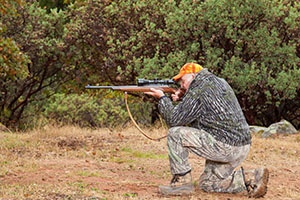
I’m a bolt-action fanatic, and a gunsmith first. Somewhere deep down inside me, I still believe that the autoloading firearm is a passing fad; lever actions, bolts and revolvers are simple mechanical mechanisms that still rise to the top of my list if SHTF. Don’t get me wrong—I play with the AR platform, and I’ve assembled more ARs than I can count. The AR-15 is a great option if you expect a firefight. My primary concern is a simple rifle that anyone can operate and maintain should I become immobilized. Backup iron sights are mandatory. If anything happens to the optic, I can’t be stuck guessing where I am shooting. I need to be able to harvest game while having the ability to stop two-legged varmints. No excess hanging off the gun, waiting to get caught on brush while moving. Simplicity.
I value the ability to make one shot matter, and believe the Savage 11 Hog Hunter rifle in .223 Remington would be tough to beat if things got bad in a hurry. The Model 11 Hog Hunter comes in at 7.25 pounds, so it’s no flyweight, but I’ll take the extra weight of the medium-contour barrel for better off-hand control on target. Pre-threaded for a suppressor, the medium-contour barrel won’t submit to point-of-impact shifts that a sporter-weight barrel will with a suppressor out front. I’d top the rifle with a Weaver Classic 1-3x24mm optic in Weaver rings. Light, simple, reliable and the adjustable LPA sights ensure I can hit what I’m aiming at no matter the situation. With an optic, I can keep the entire package under 10 pounds, which is a reasonable threshold for days on the move.
Moving parts and reciprocating mass are more likely to wear, raising concerns over long-term maintenance. Autoloaders have a tendency to make a person waste ammo with extra trigger pulls. The Hog Hunter is compact, made to be hauled through the stuff no one wants to move through, precisely where I’ll be lurking. The Savage action is extremely strong, and should I come across ammo that is questionable, I know that the chances of the action failing are all but nonexistent. The zero-headspace system of the Savage barrel nut and floating bolt head give me a 100-percent reliable lockup that guarantees maximum accuracy and safety.
By choosing the .223 Remington as my caliber, I can carry a high volume of ammo. I need to pack as much ammo on my person as possible. While we’re at it, make it 69-grain Federal Gold Medal rounds; I need to know I’m hitting exactly where I’m aiming. Federal’s Gold Medal Match ammunition is sufficient to engage targets out to 600 yards while I make evasive maneuvers. It also doesn’t hurt that I have a large stockpile of it cached at the farm. It’s not designed for expansion, so it doesn’t excessively damage rabbits, pheasants and vermin that I may need to eat. I also have a decent supply of Fusion ammo stashed around; the 62-grain bonded bullet is more than sufficient for the biggest Minnesota deer I’ll encounter.
If SHTF, my goal is to avoid a close-range confrontation. I don’t need to eliminate most threats—I just need to slow them down long enough for me to get out of the area. Being discreet is my go-to plan, and getting to and holding our farm ground would be my top priority. The Model 11 Hog Hunter is versatile enough that I could trust my life with it when the going gets tough.
Jason Morton
Affiliation: CZ-USA
Position: Vice President of Marketing
SHTF Gun: CZ Scorpion EVO
If SHTF, I can assume that I’m not expecting a typical self-defense scenario, which our daily-carry pocket dump anticipates in these pre-apocalypse times. Instead I have to assume that we can expect multiple encounters with multiple targets. Since my first choice, air support, isn’t an option, I’m reduced to choosing only one gun.
Whatever I choose has to accomplish three goals: have adequate stopping power against multiple targets, be easy to carry with lots of ammo and, given the likelihood of a target rich environment, be common enough in caliber to have a reasonable expectation of finding more ammo when necessary. The multiple-target expectation means that for me, I need semi-auto capability. It also needs to be maneuverable both indoors and out. I think an SBR is just the ticket here. Assuming there is no government at this point, an SBR won’t require a tax stamp—just a hacksaw.
Caliber-wise, I like the .22 LR because I can carry lots of ammunition with me. Unfortunately, I have to find that ammo first and haven’t had very good luck doing that for several years. I know bunches of people are hoarding it in their basements, but if I try to scavenge it from there, I’m very likely to become one of their targets. Let’s say that the .22 LR won’t work due to ammo availability, and we don’t even need to consider stopping power for this one. The 5.56mm and 9mm calibers are going to be the most commonly encountered rounds. They are close enough to the same overall bullet weight that we can call choosing one over the other a draw. For stopping power though, the 5.56mm NATO has to get the nod, assuming I can come up with something other than FMJs, but that’s not a guarantee.
The 5.56mm gives me more range over the 9mm, but I’m more concerned with multiple close targets, so a 9mm carbine or submachine gun is probably going to be my go-to gun in this scenario. It’s got plenty of magazine capacity, good stopping power with the defensive loads most commonly found in the caliber, and it generates low recoil. The 9mm is lighter in weight than a 5.56mm carbine and with a folding stock, and it’s easily concealed. Some might accuse me of being a little biased here, but my top pick has to be the CZ Scorpion EVO for my SHTF gear bag. The Scorpion is fast and reliable. Add a red dot and a suppressor and it’s even better.
Sean Murphy
Affiliation: Nightforce Optics
Position: Marketing Communications Manager
SHTF Gun: DEVGRU “RECCE” carbine
In the event of a true SHTF situation, we must accept that our “normal” day isn’t so normal. If I am limited to taking just one firearm to help me solve problems in a SHTF environment, it’s going to be a rifle.
In my eyes, it is hard to beat the all-around qualities of a good AR-15 carbine. My personal favorite for “the one” is a modern interpretation of the DEVGRU “RECCE” carbine. This upgraded AR-15 has a medium-contour, 16-inch, stainless steel, match barrel; a slim, 15-inch handguard; a muzzle device to accept a suppressor; a collapsible buttstock; and a match trigger. When paired with a good optic/ammo combination, you now have a very effective platform to deliver rounds accurately on target at any practical distance.
Topping off the carbine would be a Nightforce 2.5-10X riflescope, attached in a Nightforce Ultralite Unimount. This piece of glass is a perfect all-around optic that enables close/fast firing at low power, and up to 10X power for target indentification and shooting at longer-range targets. Quality ammo with heavy 69- to 77-grain projectiles or a premium- bonded bullet would be fed through the rifle for the best balance of accuracy and maximum terminal effect downrange.
The moderate weight and overall handiness of this package makes it easy for such a combination to accompany me on many trips hunting for deer, ridding fields of prairie dogs, competing in field/action rifle matches and countless trips to the range. The carbine is not too heavy to carry in hand or on a sling and is a good size to stash in a vehicle. I can deliver precision fire out to 600 yards with reliability (and a little farther on good days), but also engage targets at CQB ranges with ease. Other qualities to like about this setup are the plethora of magazines available, light recoil, ease of operation and perhaps most importantly, reliable operation. As higher-level maintenance or repairs became necessary; the parts availability and limited tools required make it an easy task for a competent person to handle.
Additionally, lights, lasers, bipods, night-vision devices and a whole range of other accessories can be added or removed to suit a particular use or environment. Chambered in 5.56mm NATO, this setup can also accommodate nearly any .223/5.56mm ammo one had stashed or had to scrounge.
If things go seriously wrong in my part of the world, my anticipated threat levels are going to go up, and my armament levels will go up to match. While a handgun provides an easy solution to carry all day, the energy on target, effective range, ammunition capacity and modularity of an AR-15 rifle cannot be ignored. My preference for an “accurized” carbine provides a balanced set of features for nearly any use, from hunting to defense or even limited offense if needed. I like having options to deal with problems, and my “RECCE” gun would be the one to grab.
Robin Sharpless
Affiliation: Redding Reloading
Position: Executive Vice President
SHTF Gun: Marlin 1894C
This is a very fun question to answer. It gives insight into both professional and personal preferences. Many will look at personal interest and or a favorite cartridge. Others will think about the sexiest gun to have during this time. For me, I’ll be driven by practicality.
As an avid handloader, my decision will be driven by something that is effective on wild game for food and predators, be they two- or four-legged. But it also must conducive to being handloaded and offer real versatility. Therefore, my choice is a .357 Magnum lever-action rifle, the Marlin 1894C. With its 18-inch barrel, it can generate enough energy to kill a deer, disable an attacker and handle coyotes but is also compact and convenient enough for easy carrying. Mine would sport a peep sight that works very well for my eyes, and the rifle’s overall handling characteristics make it a good choice for instinctive or point shooting when necessary.
From the reloading front, the choice of the .357 Magnum allows for the use of a variety of powders and, most importantly, the ability to simply and easily cast bullets for future use. Hopefully I’ll have a large stock of good projectiles on hand, but if that’s not the case, this caliber is a simple one to cast bullets for, regardless of what that dark future may hold.
Since the .357 Magnum has a straight-walled case, I won’t need to have lube for sizing. It is extremely easy to load for, and long case life is a positive. Additionally, in a future where we may have to scrounge for components. With that in mind, .357 Magnum and .38 Special brass is going to be relatively easy to find. Through creative loading we can create a range of offerings from quiet, low-velocity, low-flash defense loads to heavy-bullet loads capable of taking deer-sized North American game for food. While I would not tackle a grizzly bear, I would have confidence with this rifle on a black bear, which, by the way, could produce lube for my cast bullets if needed, with a heavy bullet and slower powder.
Bill Wilson
Affiliation: Wilson Combat
Position: President and Founder
SHTF Gun: Wilson Combat Tactical Lightweight .308 (rural), Wilson Combat AR9B(urban)
I think there are two different answers to this question based on where I am geographically. If I’m living on my ranch in rural Texas when SHTF and I can only have one firearm for the foreseeable future, my pick would be a lightweight .308 Winchester AR with a 14.7-inch barrel. I’d hopefully also have two additional upper receivers—in 6.5 Creedmoor and .338 Federal—with 18-inch, crowned-muzzle barrels for longer-range defense and more killing power for hunting. I’d really feel pretty naked without a handgun on my side since I carry one 24/7, but the question was one gun, and a .308 Winchester AR would handle most any defensive situation I would likely encounter in rural Texas and still put meat on the table as needed. Also .308 ammunition is pretty common in this neck of the woods—not that I don’t always have plenty on hand!
My setup would be as follows: I’d choose a Wilson Combat Tactical Lightweight .308 with a 14.7-inch barrel and a permanently attached Q-Comp flash suppressor. I’d add a top-quality optic like a Leupold 2-12x42mm VX-6 riflescope as well as a Streamlight TLR-1 HL weapon light and a sturdy Blue Force Gear Vickers two-point sling.
If allowed, my extra 6.5 Creedmoor upper would have a mid-weight, 18-inch, crowned-muzzle barrel and a Leupold 2-12x42mm VX-6 scope. The .338 Federal upper would have a light “Hunter” 18-inch, crowned-muzzle barrel and the same scope.
If I am in a large city on business (I would never live in a city!) when SHTF and I can only have one firearm for the foreseeable future, my answer changes. For this one I’m assuming total society breakdown and chaos in the city. For that, the need for concealed carry is a thing of the past. That being said, I’d go with one of our new AR9B 9mm carbines that uses Beretta 92/M9 magazines, which I normally take with me when I travel. In a true SHTF situation in an urban area, I want to be prepared for multiple assailants at relatively short ranges.
A light and short carbine that is easy to carry and deploy in tight places would be very handy. A 9mm carbine would also allow me to carry a lot of ammunition, and using subsonic loads, it would be almost as quiet as a suppressed 5.56mm. An additional plus would be the very likely chance that eventually I would be able to acquire a 9mm pistol, and ammunition compatibility would be a good thing.
For this setup I’d choose a Wilson Combat AR9B with a fluted, 14.7-inch barrel and a permanently attached Q-Comp flash suppressor. I’d use a Leupold 1-6x24mm VX-6 scope and an Aimpoint CompM4s, both in QD mounts, as well as a Streamlight TLR-1 HL weapon light and a Blue Force Gear Vickers two-point sling.
With a possible end to the COVID-19 pandemic in sight, one question that remains unanswered is whether or not the sizable number of people who moved from urban centers to suburban and exurban areas will return to the cities. While some cities will undoubtedly rebound, survey evidence reveals that an overwhelming number of Americans not only would like to live outside city centers, but also that they find that their social lives are anything but stale outside cities. Such appreciation for suburbia stands in stark contrast to countless narratives from urbanists who sing the praises of the city, often highlighting their financial, political, and cultural prowess and decrying the suburbs as monotonous and soulless. As such, planners and politicos alike should be cautious when thinking about planning after the COVID-19 vaccine has been administered. It may be foolish to assume that Americans who moved from urban cores dislike their new environs and will want to return.
Thanks to newly released data on civic life collected by the Survey Center on American Life, it is now known that even before COVID-19, Americans did not perceive that suburbs were economic or social dead zones. Fielded at the end of 2019 to over 3,600 Americans, the data makes it abundantly clear that suburban areas were the most desirable urban form while cities were actually the least preferred. Only 16 percent of Americans would opt to live in a city if they could live anywhere in the United States. In contrast, 36 percent—the plurality—preferred a suburban area, with another 28 percent stating a small town and 20 percent a rural area.
When age is considered, suburbs are still the area most in demand. This fact is worth noting, for it is widely thought that young people eschew the bland suburbs for cities. However, just 20 percent of 18-29 year olds would ideally live in cities, while 39 percent would prefer suburban areas and another 23 percent would like small towns. City life was even less popular among older Americans—just 12 percent of those 55 and older wanted to live in a city—and the data reveals that Americans across the board believed that cities were the least desirable conurbation.
Relatedly, narratives readily hold that suburban areas are both bland and spatially isolated, leading to a sense of spatial dislocation and loneliness when compared to cities, but the data does not suggest that there is truth to these ideas either. When Americans were asked how closely connected they felt to the area in which they lived, 62 percent of urbanites say very or somewhat close, but that figure barely moves to 61 percent for suburban areas. Moreover, 19 percent of urbanites compared to 16 percent of suburbanites claim to be lonely either nearly all the time or most of the time. These numbers are sadly too high, but not appreciably different.
When formal groups that are not religious such as sports teams, book clubs, PTAs, neighborhood associations, or political organizations are considered—and these are considered the glue of communal life by many social theorists—there are no real urban/suburban differences there either. Twenty-one percent of those in cities participate in such groups monthly, identical to those in suburbs. And, as for confidence in one’s local government acting in the best interests of the people, the differences are minor, with suburbs being a bit better: 57 percent to 53 percent. Neither cities nor their suburbs are particularly good models for overwhelmingly high levels of civic engagement, but it is not the case that city dwellers are participating in leagues and groups in any greater numbers compared to their suburban counterparts.
Going further, while attitudes about a place may not entirely square with empirical reality, how Americans think about place remains hugely important in their decision-making about living arrangements. And Americans were far more optimistic about their family’s future in suburbia compared to cities. Suburban Americans are more likely than city dwellers to think that they live in a place where people look out for each other (76 percent to 65 percent) and that suburbs are a good place to raise a family (90 percent to 77 percent).
Finally, one of the most salient measures of a social community is the existence of “third places”: places where people can go that are outside of their homes and places of work and mix and feel connected, from gyms to bars to bowling alleys. Once again, suburbs are not all that different from cities. In fact, when asked if you have a third place—a coffee shop, bar, restaurant, park, or other public place that one visits regularly—it turns out that two-thirds of Americans have such a place. While it is easy to think that the suburbs are empty and devoid of such critical places to meet up and socialize given that many think of houses and yards with people driving everywhere, suburbanites do have these places to socialize. In cities, 73 percent of Americans have such places, but so do 68 percent of those in suburban areas and small towns. Only 52 percent of rural-area residents have third places, so those areas are missing these amenities. But it is a myth that suburbs are devoid of social spaces or that they are social deserts.
This all being said, it worth noting the cities are often a bit more demographically diverse than their suburbs, and that is reflected in the sample here. In this data, 18 percent of those in cities, compared to 11 percent in suburbs, are Black. Whites make up 66 percent of suburbanites, compared to 45 percent of urban dwellers. Furthermore, larger numbers of suburbanites are generally more affluent in the sample.
However, relatively equal numbers of people live in cities and the suburbs by age. Thirty-seven percent of the 18-29 year olds and 40 percent of the 50-64 year olds, for instance, live in the suburbs, and fairly close numbers of married (41 percent) and unmarried (36 percent) people live in the suburbs as well. There are differences, but they are not huge, and more importantly, they reveal that those who live the suburban life are anything but monolithic.
Cities are wonderful places, but these new data powerfully show that it is imprudent to assume that socio-economic life outside urban centers is devoid of human connection. The problem with so much anti-suburban rhetoric is that many Americans are extremely happy with their lives in suburbia, and social life in America’s suburban areas is thriving; it is anything but empty, economically dead, or soul crushing. Even before the COVID-19 pandemic, many cities were already losing their allure and Americans rejected cities for numerous reasons including space, cost, and general difficulty in raising families. Cities may bounce back over time, but it would be presumptuous to think that those who left urban areas will be miserable and run back as soon as possible. For them, at least, the suburbs provide a richness regularly overlooked by many who write about the city and its virtues.
Just because your home is already built does not preclude you from upgrading your residential security to include an impenetrable safe or panic room. Our team can guide you in how to build a safe room in your existing home using our wide range of reinforcement materials and expertise.
How to Build A Panic Room:
Choose a room that is quickly accessed and easily secured
Determine threats you may face
Select secure walls and windows
Select secure entry door
Install components
Create and practice an emergency action plan
Planning Your Home’s Safe Room
Follow our guide to get started in planning a panic room for your home.
Step 1: Choose Safe Room Location
Try and pick a room that has no existing windows. This will help conceal the presence of your new safe room, as well as minimize the potential entry points. If the only suitable room has windows, this still can be solved. Our team will guide you to upgrading towards forced entry resistant or bullet resistant windows for the location.
Safe rooms and panic rooms should be placed as close to the frequented living spaces as possible. The room should be accessible in the case of an emergency. Seconds can be of the essence. It is best that the safe room be located on the same floor as the bedrooms of your homes.
Attempt to camouflage your safe room as much as possible. More so than the amount of steel protecting you, this will eliminate potential threats. Some factors to consider are the location of the room – where would a criminal not expect to find a room or closet? Others are how to disguise the entry door.
Step 2: Determine Possible Threats
All subsequent decisions about how to build and protect your safe room will depend on what threats you wish the room to be protected from. Are you primarily looking to protect valuables, people or both? Do you expect to just resisting hammers, or might you be under attack from handguns or even assault rifles?
One of the most commonly used measures of protection for a safe room is protection to the various UL 752 ballistic levels.
Step 3: Select Panic Room Windows and Walls
The room’s walls should be constructed out of materials that can withstand force entry and firearms. If you are retrofitting an existing home it may be hard to construct concrete walls. Luckily there are great retrofit options. Look to use ballistic panels made out of fiber glass panels or Kevlar wall panels instead.
These panels are relatively easy to install and cost effective. Unlike steel they can be cut to fit on site and also don’t interfere with Wifi and cellular signals. They also come in a variety of bullet resistant or forced entry resistant protection levels.
Often a room will be selected that does not have windows – such as a closet or basement area – but many of our clients do have windows in their safe room. This is particularly the case when a safe room will be built into a bedroom.
Ballistic and blast windows can simply replace existing annealed windows to provide the desired level of protection. Generally windows of these type are fixed and inoperable. However, we do offer some of the only operable ballistic windows, which may be preferred as a means of escape.
Step 4: Select Secure Entry Door
The door to your panic room is the most important security feature of your room. It is the first place that criminals will attempt entry through for it is the only security component of the room that is literally designed to allow people to pass through.
Custom safe room entranceThe door locking capabilities will depend on your planned use of the room. If planning to secure valuables, the door must be lockable from the outside. The unlocking method can be sophisticated though a convenient one makes use of the room for a greater amount of one’s valuables more likely.
If planning to only secure people during an emergency the door need only be lockable from the inside. This allows the door to be unlocked during normal use for fastest possible entry.
Of course, many safe rooms are used for both purposes. In these cases look to have an easy to access lock for day to day use while engaging a more robust locking system when away for an extended period or during an emergency.
The door must be properly secured to the surrounding wall, ensuring the wood or metal door jamb is of sufficient thickness. The door should use a high security lock which has multiple locking points. This will minimize ability for the pins to be disengaged.
The door leaf itself must also be able to withstand abuse without allow entry. Proper thick gauge steel should be used to prevent pass through.
Step 5: Install Safe Room Components
All of our materials we provide for safe rooms are designed to be conveniently installed by a local contractor or sometimes even a DIY homeowner. They are factory assembled as much as practically possible. Someone with experience installing standard doors, windows and walls will be able to use the same skills for high security versions. However, it is highly recommended to work with a licensed and bonded contractor.
Note also that most security components are much heavier than standard features, which makes handling them more cumbersome.
Additionally for certain components – like doors with multi-point locks – it is important to work with various precise measurements. The most important measurement to determine when manufacturing doors and windows is the rough opening of the room.
Our team can help you plan all of this and be in direct contact with your contractor to advise on design and installation.
Step 6: Create (and Practice) an Emergency Plan
A safe room must be used to be effective. We recommend creating a basic plan to maximize the value of your safe room. With regards to storing valuables, determine some rules of thumb about when the door will be locked and what you’ll keep inside.
With regards to protecting your family, make a few rules of thumb on which type of possible threats you will use the room for. If you hear a strange noise in the night should your family head there immediately? Might you want someone in the family in charge of bringing small children to the room?
What method will you use to alert authorities? What method will you use for an “all-clear”.
Don’t forget to have a line of communication to the outside world. An extra cell phone, radio or dedicated phone line will all allow you to call 911 once you are securely in your safe room.
Additional Ideas for Stocking Your Safe Room
As you may be in the room for a long time be sure to have food and water. A minimum of three gallons of water per person will allow for a lengthy stay.
Store nonperishable food items in the safe room.
A small medical kit would also be useful.
Periodically rotate your supplies so that nothing expires
Also consider having a flashlight and other emergency items.
How Much Does A Panic Room Cost?
A panic room’s cost depends on the size and how secure its components are. An 8′ x 10′ panic room may cost between $9,000 – $40,000 for high security walls and door, plus an additional $3,000 – $20,000 for expert installation. Ballistic windows add additional cost. Additional, more exotic features such as over pressure filtration systems, automation and luxury interiors can greatly increase the overall price.
Nobody has said it yet, but the Coronavirus has turned into a TEOTWAWKI event. Not the kind of “end of the world we knew” event that we all expected, but still one nevertheless. No matter how many people end up getting sick and how many die, the current changes in the ways we do things are so severe, that many of these are likely to end up becoming a permanent part of our society.
Some of them will not necessarily be for the best. Our government, at all levels, has taken a huge amount of authority upon itself, much of which is of questionable legality. While I don’t think that there are many people who would argue the government’s right to quarantine, shutting down churches and other places of worship as “non-essential” comes directly against our First Amendment rights.
But the real question is whether or not the government is going to be willing to give up all that control that they’ve taken. Historically, governments which gain control over something are not quick to give that control up. What’s to make any of us think that they will do so in this case?
Nevertheless, for the moment, many of us are obeying various government mandates to stay home, with companies telling as many of their employees that can, to do so as well. So, as we all sit in our homes, trying to telecommute with noisy kids in the background and our spouses on the other side of the table, working on their computer, we need to start thinking ahead. There will be an end to all this and we will have to emerge from our caves to see the light of the sun once again.
But what sort of world will we emerge into? Experts are forecasting that anywhere from 20 to 34 percent of our workforce will be laid off during the course of this pandemic. If we come anywhere near the top end of those predictions, it will be huge; much worse than the Great Depression. Unfortunately, from the viewpoint of where we are today, a worldwide economic depression seems to be in all of our futures, starting even before the pandemic burns out.
So how can you and I prepare ourselves for that coming depression? There are actually many things that we can do, but the first of them is to restructure our finances. Specifically, get rid of, or at least cut down on unnecessary expenses, so that we are ready when the depression hits.
Car Payments
Many families are paying more for their two car payments, than they are for their mortgage payment. If you think about that for a minute, it really doesn’t make much sense.
But cars and light trucks have gone up incredibly in price, at least partially due to all the bells and whistles they put on a car these days.
In a financial collapse, the people who are hit the hardest are those which are in debt. Those car payments are some of the biggest debt you have. So, it only makes sense to attack it first.
Trading your cars in for something used, but still in good condition, can save you a lot of money from your monthly payments. If you’re fortunate to find a good deal, you might even be able to get rid of one of those payments, really saving yourself some money.
Entertainment Expenses
The home computer has evolved into an entertainment center, or maybe the home entertainment center has evolved into a computer. Either way, many of us are spending a fair amount on cable service, plus an assortment of different movie websites. Netflix is no longer enough, producers have decided to divide and conquer, requiring us all to have multiple subscriptions in order to see all the movies we want to.
The obvious problem with this is that it can get rather expensive. Not only that, but it’s obviously an unnecessary expense. Now, I realize you might not agree with that, especially with your kids home from school. But at least find out how to cancel your subscriptions and have the information handy, so that if you have to, you can pull the plug on them.
Service Expenses
From mowing our lawns, through curbside pickup of our groceries, to having a mechanic repair our cars, we all pay others to do things for us. That’s fine, when you can afford it, helping others to have jobs.
But when the economy goes belly up, you’re going to need to save that money.
One of my favorite money saving techniques is that I’m a consummate do-it-yourselfer. I do everything from making gifts for my wife to making my own furniture, with car repairs somewhere in-between. The more you can do for yourself, the less you have to pay others to do. And in the midst of the next depression, you probably won’t be able to afford paying someone else to do it.
Coffee Habits
How much do you spend on coffee every month? Do you even know? How about every day? You should be able to figure that out.
That can add up to quite a bit over a month, especially if you’re buying the high-dollar made to order lattes and cappuccinos.
You can get just as good a cup of coffee, including all the assorted flavoring syrups, in your own kitchen. It might take a little experimentation to get it right, but you can probably even get a better cup of coffee than what you’re buying right now. And you can do it without paying seven bucks a cup.
Eating Out
Speaking of coffee, let’s expand on that idea. How much do you spend a month on eating out? If you happen to be the average American family, then that figure is somewhere between $250 and $300 per month. If you eat lunch out or from the cafeteria at work, that figure might be even higher.
There’s nothing wrong with eating out, just as long as it’s not in excess. How much is excess? That depends on how much you make. So for most of us, that figure is likely to be changing, sometime in the next few months. With that being the case, wouldn’t it be a good idea to start working on it now?
Don’t go overboard on take-out, just because you’re part of the lockdown going on. Take this time to experiment with some new recipes, so that you can keep your family happy, without having to eat out all the time.
Vices
Speaking of coffee again, there are those people who would call coffee an addiction.
This includes people who are at least emotionally addicted to having their two cups in the morning, before they are human enough to talk to anyone without biting their hand off.
Another word we can use for that is “vice”, a word normally associated with smoking, drinking, gambling, prostitution and drugs.
I’m not trying to accuse you of anything, but if you smoke or drink, this might be a good time to think of quitting. The cost of a few beers a day or a couple of packs of smokes may not seem like much, but it does add up. I’m sure you could find something better to do with the extra $150 to $350 a month than a two-pack-a-day habit can cost.
Unnecessary Monthly Payments
Creditors, especially the big credit card companies, have worked overtime to convince us all that the way to buy anything is on credit. That’s led us to having an average credit card debt of $6,028. While some of those purchases may have been necessities, I’d venture to guess that many are things we could have waited to buy, if we had a little more patience.
Either way, they are a problem or, more likely, they will be a problem when the economy collapses and we’re stuck holding that debt. As with any other debt, it will be one more (or several more) creditors calling and asking us when we’re going to pay our bills. If you’ve secured that debt with some sort of collateral, you might end up losing whatever you’ve put up to cover the debt.
Excessive Shopping
This one might cause some battles in your home, but how about cutting out unnecessary shopping? The trick here is to determine what really qualifies as unnecessary.
Women will say that all the “toys” that men buy are unnecessary and men will say that all the clothes their wives buy are. Either way, between the toys and the clothes, it can get really expensive.
Here’s something you can try, if you want to get a real handle on your shopping expenses. Make a deal with each other, that before you can buy something, you have to get the other to agree that it is necessary. If she wants a new pair of shoes, she’s got to convince her husband that she actually needs them. Likewise, if he wants to buy a tool, he’s got to convince her that he can’t do the pending repair or other project without it.
Quit Replacing Things
Long ago our society transitioned to being a disposable society. Other than some pretty major things, like cars and houses, we no longer repair anything.
We throw it away and replace it. In many cases, there’s no other option.
But we’ve gone far beyond that now, in that we don’t just replace things that are broken, we replace things that are just fine, for no other reason than because they are “old”.
Of course, our definition of old in many cases is highly subject to questioning, as last year’s cell phone model really isn’t old, just because the company has come out with a new one. Yet many of us will replace that phone, just to have the new one, “complaining” that our old one “Just doesn’t work right anymore”.
Smartphones aren’t the only thing we do this with. We also do it with eyeglasses, frying pans and even dishes. Once people had a mixed batch of dishes, because they kept using the remainder of a set, when some of them got broken. Today, we’ll throw away the rest of the set or donate it to charity, just so we can buy a new one.
There’s nothing wrong with using something that’s “old”, as long as it works. Why not try to see how long you can keep that cell phone or those glasses, rather than seeing how quickly you can replace them?
Avoid Gimmick Products
Our homes are filled with gimmicks and gadgets. Some are obvious, while others manage to slip under the radar. One of those is cleaning supplies. There’s really not much you can’t clean with Clorox in a spray bottle, but many of us have special cleaners for the bathtub, the kitchen, our appliances and even the toilet. Not so surprisingly, most of those “special” products are basically the same thing, in different packaging.
Figure out what you really need and stick with it. Don’t let Madison Avenue convince you that you need their latest product, just because it’s “New” and “Different”. It’s probably neither. All that’s new is the packaging and the advertising campaign.
How many of you believe that this country is plunging head-first into a state of revolution? How many of you believe that a planned currency collapse coupled with the implementation of a brutal martial law and gun confiscation will be the trigger events which will incite the coming revolution? In addition, nonsense climate change policies designed to bring America and most Americans to their knees will occur under a Democratic Party leadership. The Democrats are aligned with the UN troops in our country under the Kigali Principles of UN Peacekeeper intervention (ie invasion of the United States). As I have demonstrated, Nancy Pelosi and Beto O’Rourke are aligned with former Mexican President Nieto who took $100 million to leave the Sinaloa cartel alone. In part, I blame the deaths of these 9 American citizens on Pelosi, Eric “Fast and Furious” Holder and Obama. It was their open border, let-the-drugs-flow policies that led to these deaths. These horrific murders are just the beginning of what is coming to both sides of the border. What else can we expect than when we witness Pelosi and O’Rourke hanging out with Nieto?
The exit of California from the Union would devastate our economy and agricultural production. Key Democrats are aligned with this movement. Senators Kamala Harris and Feinstein and Governor, Gavin Newsome, are aligned with the Communist Chinese on a number of fronts. Many Democrats and even some Republicans are being blackmailed by the Epstein operation. I could go on, but the readers know where this is leading. We are a nation that has forsaken its rule of law just like Nazi Germany did in 1932. Adam Schiff is holding Soviet-style hearings with secret witnesses, hearsay evidence and outright liars. This is your judicial future America should the Democrats takeover. We would be witnessing the Obama administration on steroids.
Being a coach and former athlete, I know the feeling of a once-inferior opponent rising up to defeat my team. I know the feeling of underestimating an opponent. I have done that with the Democrats. The Kentucky Governor’s race is proof of what I am saying along with the fact that Texas is turning “blue”. We are all faced with the possibility that the Democrats could be running the country in the next several months. These are Democrats in name only. These individuals are Communists and I am not exaggerating when I say that many are demonically possessed and serve Satan. Then there are radicalized Democrats like AOC and Omar. They run their Congressional offices like a makeshift terrorist organization. They crawled out from underneath the rock we call the “Justice Democrats”. There is nothing that these people will not do to solidify their power. And I have just had the “aha moment” of my life when I have come to the final realization that they and their fellow servants of Satan could be running this country in a few months.
Many of us in the alternative media believe that this is the likely scenario that will very soon turn this country into the most dangerous country on the face of the earth. It might behoove us to look a little closer at the nature of revolution in order to predict where all of this is likely headed. In the present political climate, I see no way to stem the tide of unthinkable brutality and violence which seems imminent. It is in this mindset that I set about to research the topic of revolution and this series of articles reflects the results of the research. And as a result of past and common patterns of revolution, it appears as if a clear picture is beginning to emerge.
We already are in a civil war. The last thing to happen in a civil war is the piling up of bodies. And America, make no mistake about it, the enemy controls the media, the military industrial complex, the stock market and the banks. Guerrilla war will be the only viable form of resistance.
Four Levels of Warfare
Most military strategists identify four levels of conflict; (1) nuclear war is the trump card of all conflict; (2) conventional warfare; (3) guerrilla warfare; and, (4) terrorism.
It is safe to say that if our country does indeed descend into revolution, nuclear war will not come into play, for if it did, there would be nothing to rule over in the aftermath.
The United States has witnessed civil war of a conventional nature In the 1860’s as two mighty armies of that era locked horns in what proved to be the conflict in which America suffered her greatest loss of life. In the Civil War, both sides had equivalent weaponry and as a result employed conventional tactics. However, given the disparity of technology and resources between the people the globalist controlled forces of the new Democratically controlled government, a conventional war would prove to be a disaster for the rebel forces. If key elements of the military were to break away and support the people, perhaps a conventional war would unfold. However, it is not likely that the upcoming civil war will be conventional as it is not probable that the military will bifurcate and turn in on itself. The likely mode of the revolutionary war conflict facing the people of the United States is that it will consist of either guerrilla warfare or terrorism.
Guerrilla Warfare Or Terrorism?
Terrorism is the least preferred option by any insurgent group. With terrorism, there is absolutely no hope of final victory because territory is never occupied. For that reason, nobody aspires to engage in terrorism if they have a viable alternative and the American people do have a choice given how well armed we are. However, terrorism arising out a defeated guerrilla force is a distinct possibility as it would represent American guerrilla’s fallback position should they be defeated. Subsequently, does the MIAC Report which labeled Libertarians, Constitutionalists, Second Amendment Supporters, Ron Paul Supporters, Veterans and now Christians as domestic terrorists, make a little more sense as to why DHS made these bold proclamations? The DHS of the Obama years understood and demonstrated their understanding of these facts and has also prepared for what I just wrote about in the previous paragraph. Hillary was to be 2016 recipient of Obama’s work, but Donald Trump happened.
The Veterans Administration estimates that there are approximately 21.5 million veterans living in the United States. We also live in a country with over 300 million privately owned guns. These combined factors point clearly to a guerrilla war being the preferred and necessary mode of combat which will likely be visited upon this country.
What Is Guerrilla Warfare?
Guerrilla warfare, for most of human history, is not new. Tribal war, which traditionally pits one guerrilla force against another, is the oldest form of warfare. The new “conventional” form of warfare, which pits guerrillas against “conventional” forces, is more recent as it first arose in Mesopotamia 5,000 years ago.
The good news for future American freedom fighters is that guerrilla war has been getting more successful since 1945, but unfortunately guerrilla fighters still lose most of the time. An analysis of past conflicts featuring guerrilla war, reveals that only 25% of guerrilla forces, out of 443 such conflicts since 1775, were successful. The government prevailed almost 64% of the time with the remainder of the conflicts ended in a stalemate. Conversely, since the end of WWII, the percentage of success for guerrilla forces has indeed gone up to 39.6%. Yet that still means that government forces have continued to prevail 51% of the time. When the American people engage in a guerrilla war in the upcoming years, the people have less than a 40% chance of success.
Length of Guerrilla Wars
Guerrilla wars are rarely short and as a result do not favor the American culture and our collective psyche of instant gratification. When Americans flip the switch on the wall, we expect the light to come on. Will Americans set aside their entitlements as well as their entrenched soft lifestyle and rise to the occasion? Only time will tell.
The Vietnamese culture with an external locus of control predominating the people where the group is more important than the individual is the perfect mindset for guerrilla fighters. This could prove to be the American rebels biggest challenge because guerrilla warfare is not something that one does like driving over a speed bump. It is a way of life, a very hard way of life filled with misery, extreme sacrifice and unspeakable losses.
For my money, the best guerrilla fighters in the modern era were the Viet Cong in which Vietnamese people were involved in some form of guerrilla war from 1942-1975. After the Americans invaded Vietnam, the forces in the north had a saying, “born in the north, to die in the south.” There were nearly two generations of Vietnamese people in which war was an unavoidable part of life. What General Westmoreland and LBJ failed to recognize was that in order to defeat and totally subdue the Vietnamese people, the Americans would have had to have engaged in unspeakable genocide because despite the fact that the US won every single battle of the war, the Vietnamese rebels were never going to give up. Do we Americans have that same tenacity to persevere like the Vietnamese?
Prior to WWII, guerrilla wars lasted an average of seven years. Following WWII, guerrilla conflicts lasted an average of 10 years. Will Americans embrace the tenets and sacrifices of guerrilla war and can it ever become a way of life? I believe that conditions would have to be unspeakably horrendous for America to embrace a conflict under these conditions. I think that things would have to be so bad, so completely genocidal, that fighting and dying would be the only viable alternative for America in order to embrace guerrilla warfare as a way of life. What I am saying here is that we are a very soft people.
How Close Are We to the Inevitable Conflict?
Successful guerrilla leaders such as Lawrence of Arabia, Mao, Castro and Giap all concur that there are three phases of any guerrilla war. However, before the phases can unfold there are two preconditions which must be met.
The first condition which is a prerequisite for guerrilla war, is based upon the fact that there has to be a decisive battle for the belief systems of the people as a whole. The globalists have invested billions of dollars in order to dominate the mainstream media. On the other side is the alternative media. Both sides are vying for control of the belief systems of the country.
There are two very distinct ideologies playing out today in the court of public opinion. On one hand, the future rebels are adept at exposing the loss of national sovereignty and civil liberties every chance they get. Conversely, the globalist dominated media is spending billions of dollars to convince the masses that there is no such thing as a conspiracy theory and despite some governmental incompetence, the government loves and protects its people. And the globalists are being somewhat effective. Have you ever noticed that when you are describing a globalist inspired conspiracy such as what happened at Benghazi, and no matter how well documented your position is, that your audience frequently responds with “you must be one of these conspiracy theorists.” Our facts are rarely attacked because they are accurate, but the idea of the existence of any kind of conspiracy is what is challenged. This kind of programming coming from the media is brilliant and effective. Who is winning this war of words? The jury is still out, but the unmistakable conclusion is that the ideological battle lines for the upcoming conflict have clearly been drawn. One might argue that social media censorship will eventually beat down the alt media.
The globalists sell the sheep on the notion that we have to control you to protect you (from a threat of our creation), and the other side is saying “we will take our chances, give us freedom.”
The second precondition which must be met prior to descending into guerrilla war consists of both sides engaging in an arms race. In response to the Obama administration’s threat of seizing our guns for the false flag events of the Aurora Batman massacre and Sandy Hook, Americans went on a gun-buying frenzy which continues to this day. DHS has engaged in their own arms buildup as they have purchased 2.2 billion rounds of ammunition to go with 2700 new armored personnel carriers and that is not all. The federal government has invested in 730,000 drones, super soldier robots and intelligence gathering techniques which are mind-blowing. As an aside, Snowden’s public revelations related to the extent of the NSA’s illegal surveillance activities contained nothing that most of us in the alternative media did not already know. It is my belief that Ed Snowden knows a lot more than has been reported related to the reasons underlying the NSA spying and the media is refusing to report on it.
In summary, the American people and their government have engaged in an arms race very similar in nature to two rival countries preparing to go to war.
Conclusion
The preconditions for armed conflict and the likelihood that the conflict will be guerrilla is very likely. In Part Two of this series, an analysis of the commonalities between past guerrilla conflicts (e.g. Giap, Mao, Castro, etc.) will be offered. Emerging from the discussion in the next part in this series is the discovery of the fact that there three overlapping phases to guerrilla war and it will be a shocking surprise to all of us as to how far along this country is in relation to these three phases. All that is needed is the right trigger event and that will be discussed in the next part as well.
Today I’d like to share with you a “3-second survival hack” you can use to skyrocket your chances of protecting your loved ones during ANY crisis.