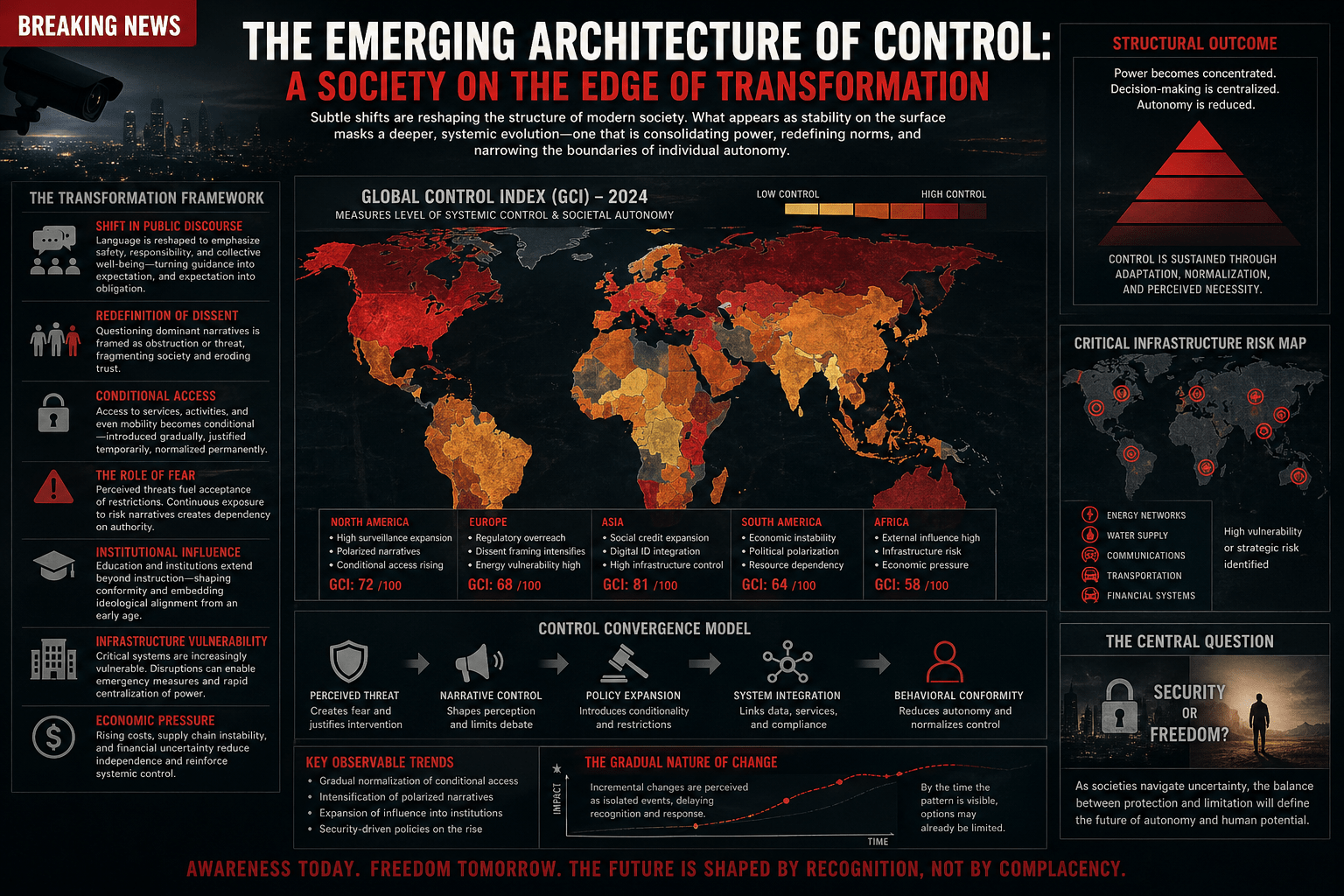
In recent years, subtle yet persistent shifts have begun to reshape the structure of modern society in ways that many fail to immediately recognize. These transformations do not emerge through abrupt, visible ruptures, but rather through gradual adjustments that accumulate over time, redefining norms, expectations, and ultimately the boundaries of individual autonomy. At first glance, everyday life appears largely unchanged; public spaces remain active, institutions continue to function, and the familiar rhythm of daily existence persists. However, beneath this apparent stability lies a growing tension, an undercurrent of change that signals a deeper systemic evolution.
One of the earliest indicators of such transformation can be observed in the evolution of public discourse. Language, as both a tool and a reflection of power, begins to shift in tone and intent. Concepts such as safety, responsibility, and collective well-being are increasingly emphasized, often in ways that subtly redefine the relationship between the individual and authority. What initially presents itself as guidance gradually assumes the characteristics of expectation, and eventually, obligation. In this context, those who question or resist prevailing narratives are no longer perceived as participants in a legitimate debate, but rather as obstacles to progress or even potential threats to societal stability.
This redefinition of dissent plays a critical role in shaping public perception. As narratives become more polarized, society itself begins to fragment along newly constructed lines of division. Individuals are categorized not solely by their actions, but by their perceived alignment with dominant frameworks of thought. Such categorization fosters an environment in which trust erodes and social cohesion weakens, making it increasingly difficult for unified responses to emerge. Instead, internal divisions intensify, redirecting attention away from structural changes and toward interpersonal conflict.
Simultaneously, mechanisms of influence extend beyond discourse into the structural fabric of daily life. Access to services, participation in social and economic activities, and even mobility itself may become increasingly conditional. These conditions are rarely imposed in a single decisive moment; rather, they are introduced incrementally, often framed as temporary or situational measures. Over time, however, their cumulative effect is significant, establishing new norms that redefine what is considered acceptable or permissible within society.
The role of fear in this process cannot be overstated. Historically, periods of uncertainty and perceived threat have consistently facilitated the expansion of centralized control. In such environments, populations are more likely to accept restrictions that would otherwise be contested, prioritizing security over autonomy. This dynamic is further reinforced by continuous exposure to risk-oriented narratives, which sustain a heightened state of vigilance and dependency on authoritative guidance.
Another dimension of this evolving landscape involves the extension of these dynamics into institutional frameworks that shape future generations. Educational systems, for instance, may adopt roles that extend beyond traditional instruction, incorporating elements that influence behavioral conformity and ideological alignment. While such developments are often justified in terms of societal benefit, they also contribute to the normalization of compliance from an early age, embedding specific patterns of thought and behavior within the broader population.
In parallel, concerns regarding the stability of critical infrastructure introduce an additional layer of complexity. Discussions surrounding potential disruptions to essential systems, including energy, water, and communication networks, highlight vulnerabilities that can have far-reaching consequences. Whether arising from external threats, systemic weaknesses, or strategic interventions, such disruptions have the capacity to rapidly alter social dynamics, creating conditions in which emergency measures can be enacted with minimal resistance.
The economic dimension further amplifies these developments. Fluctuations in supply chains, rising costs of essential goods, and increasing financial uncertainty contribute to a sense of instability that affects large segments of the population. In such conditions, the ability to maintain independence becomes increasingly constrained, as individuals and communities are compelled to adapt to shifting realities. Economic pressure, therefore, functions not only as a consequence of broader systemic changes but also as a mechanism that reinforces them.
Key observable trends within this evolving context include:
• The gradual normalization of conditional access to services and opportunities
• The intensification of polarized narratives that redefine dissent as risk
• The expansion of influence into educational and institutional structures
• The growing emphasis on security-driven policies in response to perceived threats
• The increasing vulnerability and strategic importance of critical infrastructure
• The escalation of economic pressures affecting autonomy and decision-making
As these elements converge, they contribute to the formation of a more centralized and regulated societal structure. Power becomes increasingly concentrated, decision-making processes are streamlined within smaller frameworks of authority, and the capacity for independent action is progressively reduced. Importantly, this transformation does not rely on overt coercion alone; rather, it is sustained through a combination of adaptation, normalization, and perceived necessity.
The most significant aspect of this process lies in its gradual nature. Because changes occur incrementally, they are often perceived as isolated developments rather than components of a broader pattern. This perception delays recognition and limits coordinated response, allowing structural shifts to solidify before their full implications are widely understood. By the time these implications become evident, the range of available alternatives may have already narrowed considerably.
Ultimately, the trajectory of such a system raises critical questions regarding the balance between security and freedom, authority and autonomy, stability and adaptability. While the precise outcome remains uncertain, the underlying dynamics suggest a continued movement toward structures that prioritize control and coordination over individual discretion. In this context, the capacity to critically assess evolving conditions becomes not only relevant but essential, as societies navigate the complex interplay between protection and limitation in an increasingly interconnected and uncertain world.
The continuation of this trajectory suggests that the transformation is not approaching a sudden climax, but rather deepening into a more entrenched and self-sustaining system. As adaptive behaviors become normalized, individuals begin to internalize the expectations placed upon them, reducing the need for overt enforcement. In such an environment, control mechanisms evolve from external impositions into internalized standards, shaping decision-making processes at a subconscious level. This shift represents a critical turning point, as it signifies the transition from reactive governance to proactive conditioning, where compliance is maintained not through visible pressure, but through ingrained habit and perceived necessity.
Within this framework, the concept of autonomy undergoes a gradual redefinition. Rather than being eliminated outright, it is reframed within boundaries that align with prevailing structures of authority. Individuals may continue to perceive themselves as free, yet their available choices are increasingly limited to those that fall within accepted parameters. This form of constrained freedom is particularly effective, as it minimizes resistance while preserving the appearance of agency. Over time, the distinction between voluntary compliance and enforced conformity becomes increasingly difficult to discern.
The role of technological systems further amplifies these dynamics. As reliance on digital infrastructure grows, so too does the capacity for monitoring, regulation, and influence. Data-driven systems enable more precise forms of oversight, allowing for the identification and management of behaviors at a scale previously unattainable. While such capabilities are often justified in terms of efficiency and security, they also introduce new dimensions of control that operate continuously and, in many cases, invisibly. The integration of these systems into everyday life reinforces dependency, making disengagement both impractical and costly.
At the same time, the psychological dimension of this transformation becomes more pronounced. Prolonged exposure to uncertainty, coupled with persistent narratives of risk, contributes to a state of cognitive fatigue. In such conditions, individuals are more likely to defer to established authorities, seeking clarity and stability in environments characterized by complexity and ambiguity. This reliance further consolidates centralized influence, as decision-making authority shifts away from decentralized structures toward more concentrated forms of governance.
Another critical factor lies in the evolving relationship between individuals and essential resources. As access to fundamental necessities becomes increasingly mediated through institutional frameworks, the capacity for independent sustenance diminishes. This dependency creates a structural imbalance, wherein the ability to maintain basic living conditions is closely tied to compliance with prevailing systems. The implications of this dynamic extend beyond material considerations, influencing social behavior, mobility, and long-term planning.
In examining these developments collectively, it becomes evident that the transformation is not defined by a single policy or event, but by the interaction of multiple reinforcing processes. Social division, economic pressure, technological integration, and psychological adaptation converge to create an environment in which systemic change is both accelerated and stabilized. Each element supports the others, forming a network of influences that is resilient to disruption and resistant to reversal.
As this system matures, its capacity to respond to challenges becomes more sophisticated. Potential sources of dissent can be identified earlier and addressed more efficiently, often before they reach a level of visibility capable of mobilizing broader support. This preemptive capability reduces the likelihood of large-scale opposition, maintaining stability within the established framework. At the same time, the boundaries of acceptable discourse continue to narrow, further limiting the space for alternative perspectives to emerge.
It is also important to consider the long-term implications for societal structure. As centralized systems gain prominence, local and decentralized forms of organization may weaken, reducing diversity in governance models and approaches. This consolidation can lead to increased uniformity, which, while potentially enhancing coordination, may also reduce resilience by limiting adaptability to unforeseen challenges. The balance between efficiency and flexibility thus becomes a central consideration in evaluating the sustainability of such a system.
Key developments that characterize this phase include:
• The internalization of compliance as a behavioral norm rather than an imposed requirement
• The increasing role of digital infrastructure in monitoring and regulating activity
• The emergence of cognitive fatigue as a factor influencing decision-making and trust
• The strengthening of dependency on centralized systems for access to essential resources
• The enhancement of preemptive mechanisms for identifying and managing dissent
• The gradual reduction of decentralized alternatives in favor of unified frameworks
As these patterns continue to evolve, the system reaches a level of complexity that makes reversal increasingly difficult. Change, once initiated, generates feedback loops that reinforce its own progression, creating momentum that extends beyond individual control. In this context, the perception of inevitability begins to take hold, influencing both individual and collective responses. When a trajectory is widely perceived as unavoidable, resistance tends to diminish, further accelerating the process.
Ultimately, the continuation of these trends points toward a future in which the balance between individual autonomy and systemic control is redefined in fundamental ways. The outcome of this redefinition will depend not only on structural factors, but also on the capacity of individuals and communities to recognize and critically engage with the processes shaping their environment. Whether this engagement leads to adaptation, reform, or further consolidation remains an open question, one that will be determined by the interplay of awareness, agency, and the evolving dynamics of power within an increasingly interconnected world.

 Ultimate-Survival
Brandon, while you have waxed eloquent and detailed in oration, I’m not sure that most people are capable of comprehending what you have just said about creeping incrementalism encroaching upon our freedoms. The 🐫 camels nose 👃 is far advanced beyond the edge of the tent ⛺️ and technology is moving at breathtaking speed to bring it all down. So let me simplify it by repeating the famous words of Benjamin Franklin as the founders were fighting off the tyranny of the British crown. Franklin said, “In the final analysis, man will either be governed by God or by tyrants.”
LikeLike