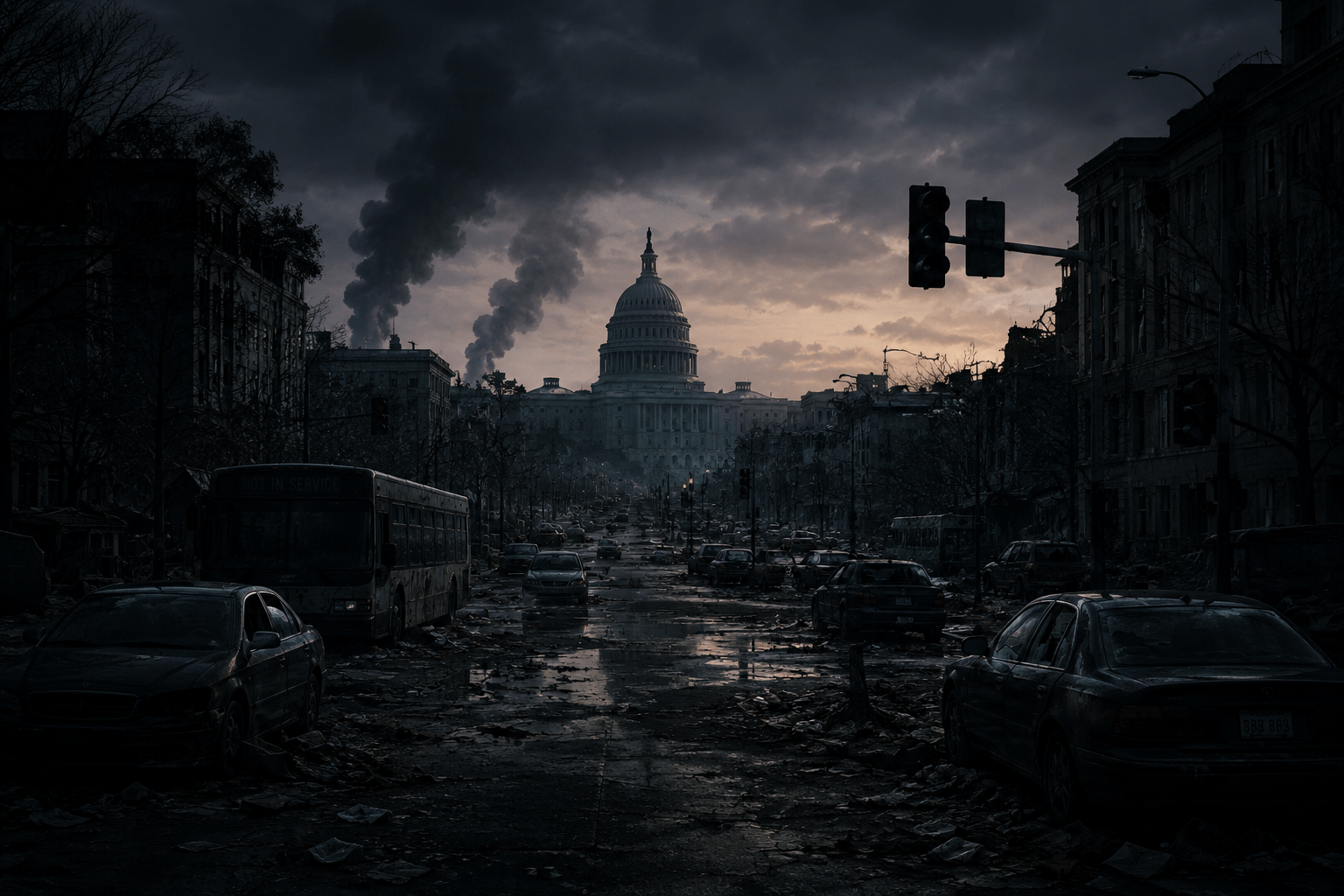
For generations, electricity became so deeply woven into everyday life that most people stopped noticing it altogether. It was no longer viewed as technology but as something permanent, almost as reliable as the sunrise itself. Every morning began with lights illuminating bedrooms before dawn, coffee makers humming in quiet kitchens, phones reconnecting to wireless networks, refrigerators preserving enough food to feed entire families, and millions of vehicles carrying workers across cities whose traffic systems depended entirely on invisible currents flowing beneath streets and highways. Modern civilization did not merely use electricity—it breathed through it. Hospitals, financial institutions, water treatment facilities, communication networks, transportation systems, food distribution centers, and national defense all relied on an uninterrupted flow of power. Few ever paused to consider what would happen if that current disappeared not for a few hours, nor even for several days, but indefinitely.
History has shown that societies rarely collapse because of a single dramatic event. More often, they unravel because countless systems fail simultaneously until the weight becomes impossible to bear. An extended nationwide blackout would not simply darken homes or interrupt television broadcasts; it would begin dismantling every structure that allows millions of strangers to coexist peacefully in a complex civilization. Every service people casually depend upon each day is connected to another system somewhere else. Remove one pillar, and the others begin to crack. Remove the foundation itself, and the entire structure begins to lean before anyone realizes it is already falling. By the time panic becomes visible, the collapse is no longer beginning—it is already well underway.
Those fortunate enough never to experience a prolonged blackout often imagine such an event as little more than an inconvenience. Candles replace lamps, batteries power flashlights, neighbors gather outdoors to wait for utility crews, and life eventually returns to normal. Reality would almost certainly unfold very differently once the hours stretched into days and the days into weeks. The greatest danger would not arrive with darkness itself but with the slow disappearance of certainty. Every passing hour without reliable information would deepen anxiety. Every unanswered question would generate ten more rumors. Fear spreads remarkably fast when communication disappears, and before long uncertainty becomes more destructive than the disaster that created it.
WARNING: This AI Documentary Was Meant To Stay Hidden… Don’t Watch If You’re Not Ready

Perhaps the most unsettling aspect of such a collapse would be how ordinary it appears during its earliest moments. There would be no apocalyptic soundtrack, no dramatic announcement echoing across the country, and no instant realization that history had just changed forever. Families would finish dinner by candlelight believing power crews were already working somewhere beyond the horizon. Parents would reassure frightened children that everything would be back to normal by morning. Friends would joke about finally taking a break from social media, while restaurants hurriedly served thawing food before it spoiled. The illusion of normality would survive far longer than the electrical grid itself, delaying the realization that this was no ordinary emergency but the beginning of something entirely unfamiliar.
I. The First Illusion to Die
The first twenty-four hours would probably be remembered not for chaos but for misplaced optimism. Most citizens would assume they were witnessing an unusually large power outage rather than the opening chapter of a national catastrophe. Utility companies had restored electricity after hurricanes, ice storms, floods, and wildfires countless times before, so there seemed little reason to believe this event would be different. Grocery stores would remain crowded yet orderly, gas stations would continue serving customers until backup generators exhausted their fuel, and local authorities would encourage patience while attempting to assess a situation they themselves barely understood. Even as communication networks became increasingly unstable, confidence in a rapid recovery would remain surprisingly strong because modern societies are conditioned to believe that every problem has technicians somewhere already working on the solution.
That confidence would begin fading the moment communication itself started disappearing. Mobile phones, once considered indispensable, would gradually become useless as backup batteries inside cellular towers reached the end of their operating lives. The internet would vanish almost silently, leaving millions staring at blank screens that offered no explanation. Television stations would disappear one after another, followed by radio broadcasts whose emergency generators eventually succumbed to the same unavoidable limitations. For the first time in generations, people would find themselves completely isolated from the constant stream of information that had shaped modern life. Entire communities would be forced to rely on neighbors, handwritten notes, and rumors carried from one street to another. In the absence of verified information, speculation would quickly become its own form of currency, and every conversation would produce a different explanation for what had happened.
Without reliable news, fear would evolve unpredictably. Some would believe the outage affected only their region and expect assistance from neighboring states. Others would become convinced that foreign militaries had launched an attack. Conspiracy theories would multiply overnight, each one spreading faster than the last because there would be no functioning platforms capable of correcting misinformation. Stories of secret government bunkers, hidden military facilities operating with unlimited electricity, mysterious aircraft crossing the night sky, and evacuation convoys traveling toward undisclosed locations would circulate endlessly from neighborhood to neighborhood. Whether true or entirely fabricated would become almost irrelevant. People desperate for answers rarely distinguish between evidence and hope, especially when both become equally difficult to obtain.
The psychological effects would be immediate and profound. Human beings possess a remarkable ability to endure hardship when they understand the circumstances surrounding it, but uncertainty attacks something much deeper than physical comfort. Every unanswered question leaves room for imagination, and imagination has always been capable of producing fears far greater than reality itself. Parents would struggle to reassure children despite feeling equally frightened. Business owners would sit outside their darkened stores wondering whether reopening would ever again be possible. Emergency workers, accustomed to receiving constant updates through sophisticated communication systems, would suddenly find themselves making life-and-death decisions based on fragmented information and educated guesses. The blackout would not merely extinguish lights; it would extinguish confidence, replacing it with a growing realization that nobody truly knew what tomorrow would bring.
II. When Water Becomes More Valuable Than Gold
Long before supermarket shelves stood empty, another crisis would quietly begin unfolding beneath streets, inside pumping stations, and throughout the vast infrastructure responsible for delivering clean water to millions of homes every single day. Modern cities rarely depend upon nearby rivers or natural springs alone. Water travels extraordinary distances through treatment facilities, storage reservoirs, underground pipelines, pressure systems, and electrically powered pumps working continuously around the clock. Most people never notice this intricate network because it performs its task so flawlessly that running water feels almost like a law of nature rather than one of humanity’s greatest engineering achievements. The moment electricity disappears, however, that illusion begins to collapse with astonishing speed.
Initially, very little would seem different. Water towers and elevated storage tanks would continue supplying homes through gravity, allowing faucets to function normally for a limited period. Families might interpret this as evidence that essential infrastructure remained intact, reinforcing the belief that recovery was only a matter of time. Yet beneath the surface, reservoirs would no longer refill, purification systems would cease operating, and pressure throughout the network would begin declining almost imperceptibly. Every glass poured from a kitchen sink would represent a resource that was steadily disappearing without replacement. By the time most households noticed weaker water pressure, the crisis would already be impossible to reverse through ordinary means.
As taps gradually fell silent across entire neighborhoods, priorities would change almost instantly. Food, entertainment, financial concerns, and even personal property would become secondary to one fundamental necessity: finding drinkable water before dehydration forced increasingly desperate decisions. Families would search parks for decorative ponds, collect rainwater from rooftops, and travel toward nearby lakes, rivers, or streams carrying whatever containers they could find. Those fortunate enough to own private wells might briefly enjoy an advantage, although many modern well systems also depend on electric pumps. Others would discover that water is not merely something to find but something that must also be purified, stored, rationed, and protected. In only a matter of days, an ordinary plastic bottle that once cost a few dollars could become one of the most valuable possessions a person owned.
The disappearance of clean water would create problems extending far beyond thirst itself. Hospitals would struggle to maintain sanitation, apartment buildings would become increasingly uninhabitable, and basic hygiene would rapidly deteriorate. Wastewater treatment facilities unable to function properly would introduce new public health risks just as access to medical care became increasingly limited. Illnesses once considered minor inconveniences could spread through exhausted communities already weakened by dehydration, poor nutrition, and overwhelming stress. Civilization depends upon countless invisible systems quietly performing their duties every hour of every day. Water may be the least appreciated among them—until the day it stops flowing.
III. The Empty Shelves and the End of Abundance
By the end of the first week, another illusion that had quietly shaped modern life for generations would disappear forever. Most people believed supermarkets stored enormous reserves of food somewhere behind their neatly organized aisles, but the reality had always been very different. Modern commerce relied on an intricate logistical machine that functioned with astonishing precision, delivering fresh products every single day from warehouses that themselves depended upon constant shipments arriving by truck, rail, cargo ship, and aircraft. Shelves appeared permanently full not because there was an endless supply waiting in reserve, but because millions of individual deliveries arrived exactly when they were scheduled. Once transportation stopped moving and distribution centers fell silent, the illusion of abundance collapsed almost immediately. Entire stores that had once seemed capable of feeding thousands of families became little more than empty buildings scattered with broken glass, overturned shopping carts, and abandoned cash registers that no longer served any purpose.
The transformation would happen far more quickly than most people imagined possible. Refrigerated products would spoil within days, forcing store owners to discard enormous quantities of food before eventually abandoning their businesses altogether. Canned goods, bottled water, dried rice, flour, cooking oil, and powdered milk would vanish first, followed closely by anything capable of lasting more than a few weeks without refrigeration. Those arriving early might leave with enough supplies to survive temporarily, but countless others would discover shelves stripped completely bare. Arguments over the final remaining provisions would become increasingly common, and in many places those arguments would inevitably turn violent. Security cameras would no longer function, alarm systems would remain silent, and police departments already overwhelmed by larger emergencies would simply lack the personnel necessary to protect every commercial district. The supermarket, once a symbol of comfort and routine, would become one of the first visible reminders that the country had entered an entirely different reality.
Outside the cities, farmers would face a crisis few urban residents had ever considered. Growing food had long ceased to depend solely on fertile soil and favorable weather. Modern agriculture relied on electrically powered irrigation systems, computerized equipment, refrigerated storage facilities, diesel-powered machinery, fertilizer production plants, veterinary medicine, and complex transportation networks capable of moving crops across thousands of miles before they spoiled. Even those fortunate enough to harvest successful crops would quickly discover they had no reliable way of transporting them to distant populations. Grain stored in silos would remain trapped without functioning distribution systems. Dairy farms unable to refrigerate milk would be forced to discard it. Livestock producers confronted impossible choices as feed supplies dwindled and veterinary support disappeared. The countryside might still produce food, but producing food and delivering it safely to millions of hungry people were two entirely different challenges.
As hunger spread, communities would begin changing in subtle yet unmistakable ways. Neighbors who had once exchanged friendly greetings over backyard fences would become increasingly cautious about revealing what little remained inside their homes. Curtains stayed closed throughout the day. Cooking fires were carefully concealed after sunset to avoid attracting unwanted attention. Conversations shifted away from ordinary concerns toward whispered discussions about hidden food caches, abandoned farms, rumors of government supply convoys, and isolated communities supposedly surviving somewhere beyond the collapsing cities. Whether those stories were true hardly mattered. Hope itself became a survival resource, and even the most unlikely rumor offered something precious to people struggling against despair.
The most shocking videos in the world! (Full video below)

The first organized scavenging groups would likely emerge before the end of the second week. Some would consist of ordinary families pooling resources and searching abandoned neighborhoods for overlooked supplies. Others would become something far more dangerous. Former criminal organizations, opportunistic gangs, and loosely connected groups of desperate survivors would recognize that warehouses, pharmacies, distribution centers, and isolated farms contained resources worth risking everything to obtain. Without reliable communications, functioning surveillance, or rapid emergency response, entire industrial districts could be stripped clean in a matter of hours. Those who had prepared carefully would soon learn another harsh lesson: possessing supplies and protecting them were two entirely different skills. Food no longer represented comfort or convenience. It had become power, and power has always attracted those willing to seize it by force.
IV. When Hospitals Became Places of Waiting Instead of Healing
Few institutions better represented the achievements of modern civilization than the hospital. Behind every operating room, intensive care unit, emergency department, laboratory, and pharmacy stood an invisible army of machines working continuously to preserve human life. Electricity powered ventilators, dialysis equipment, refrigeration units storing blood and medication, diagnostic imaging systems, sterilization equipment, electronic medical records, communication networks, elevators, lighting, climate control, and countless other systems so commonplace that patients rarely noticed them. Medicine had advanced remarkably over the past century, but much of that progress depended upon a technological foundation that was never designed to function without reliable electrical power. Once that foundation disappeared, even the world’s most advanced hospitals would begin fighting a battle they could not win indefinitely.
Emergency generators would initially provide a reassuring sense of continuity, allowing doctors and nurses to continue caring for patients while expecting outside assistance to arrive within hours. Yet generators consume fuel relentlessly, and fuel itself depends upon a functioning supply chain that no longer exists. Every passing day would force administrators into increasingly painful decisions regarding which departments could remain operational and which would have to close. Elective procedures would vanish immediately, followed by diagnostic services requiring specialized equipment. Intensive care beds would become scarce. Operating rooms would be reserved only for the most critical emergencies. Medical staff trained to save every possible life would suddenly confront situations in which resources simply could not meet demand. Those decisions would haunt survivors long after the crisis ended.
Pharmacies would soon face equally devastating shortages. Modern society depends upon an extraordinary range of medications that millions of people require not for occasional illnesses but every single day simply to remain alive. Individuals living with diabetes, heart disease, epilepsy, kidney disorders, severe asthma, autoimmune conditions, and countless other chronic illnesses would discover that prescriptions cannot be refilled when factories cease production and distribution warehouses stand abandoned. Refrigerated medicines would spoil as temperatures climbed. Antibiotics would become scarce. Pain medication, insulin, blood pressure treatments, and emergency drugs would gradually disappear from hospital shelves despite the desperate efforts of healthcare workers to conserve every remaining dose. Diseases that modern medicine had learned to manage successfully would begin reclaiming lives with frightening efficiency.
The collapse of sanitation would magnify every medical challenge. Without dependable supplies of clean water, infections would spread rapidly through overcrowded shelters and densely populated neighborhoods. Minor cuts that once required nothing more than antiseptic cream could become life-threatening. Foodborne illnesses would increase as refrigeration disappeared. Improvised waste disposal would contaminate water sources already under immense strain. Healthcare professionals accustomed to preventing outbreaks through vaccination programs, laboratory testing, sterilization procedures, and sophisticated infection control would suddenly find themselves relying upon methods that belonged to another century. Even the most experienced physicians would recognize a painful truth: knowledge alone cannot compensate forever for the complete absence of equipment, medication, electricity, and clean water.
Beyond the physical suffering, hospitals would become places where hope itself gradually faded. Families searching desperately for missing relatives would gather outside buildings no longer capable of accepting additional patients. Ambulances would remain parked for lack of fuel or functioning dispatch systems. Corridors once filled with purposeful urgency would become quieter as exhausted medical personnel struggled through impossible shifts without knowing whether relief would ever arrive. The emotional burden carried by doctors, nurses, paramedics, and support staff would be almost impossible to measure. They had devoted their lives to preserving others, yet now they would witness countless tragedies they possessed neither the tools nor the resources to prevent. In many ways, the collapse of modern medicine would represent something even more devastating than the failure of technology itself—it would symbolize the moment an entire civilization realized that its greatest achievements had depended upon a fragile current flowing silently through wires that most people never noticed until it was gone.
V. The Unraveling of Law and Order
Civilization is held together by far more than laws written on paper. Its true foundation lies in a quiet understanding shared by millions of strangers: that tomorrow will resemble today, that emergency services will answer when called, that courts will continue functioning, that food will reach the stores, and that violence remains the exception rather than the rule. Once those assumptions begin to disappear, the institutions built upon them weaken with surprising speed. Police officers, firefighters, emergency medical personnel, and local officials would undoubtedly continue performing their duties for as long as possible, but they would be confronting a crisis unlike anything for which modern emergency planning had ever prepared them. Every hour would bring more calls than could be answered, more neighborhoods requesting assistance than available personnel could possibly reach, and more difficult choices about where increasingly limited resources should be sent.
As communications deteriorated and fuel reserves dwindled, law enforcement agencies would gradually lose one of their greatest advantages: coordination. Patrol cars unable to refuel would remain parked. Dispatch centers struggling with intermittent power would receive only fragments of the information they once processed effortlessly. Officers responding to one emergency might have no reliable way of knowing that another crisis had erupted only a few streets away. Communities that had always depended upon professional protection would slowly realize they had become largely responsible for their own security. Some neighborhoods would organize watches, establish rotating patrols, and cooperate remarkably well under extraordinary circumstances. Others would fracture under pressure as fear, suspicion, and desperation eroded years of trust in only a matter of days.
The greatest threat would not necessarily come from organized criminal groups, although they would certainly exploit the vacuum wherever possible. History has repeatedly demonstrated that prolonged instability changes ordinary people in extraordinary ways. Individuals who had never imagined breaking the law might eventually conclude that feeding their families outweighed every other moral consideration. A father staring at hungry children does not think like the same man who once walked peacefully through a brightly lit supermarket. Desperation has always blurred the line between survival and crime, and in a society where food, water, medicine, and fuel had become scarce beyond imagination, that line would become increasingly difficult to recognize. Every empty home might be viewed as a potential source of supplies, every isolated farmhouse as an opportunity, every stranger as either a threat or a lifeline.
Night would become something fundamentally different from what modern society has known for generations. Entire metropolitan areas that once glowed brightly enough to be visible from space would disappear beneath a darkness broken only by scattered campfires, lanterns, and the occasional distant blaze consuming abandoned buildings. Streets once filled with traffic would fall eerily silent except for footsteps, whispered conversations, and sounds whose origins remained impossible to identify. The absence of electric light would reshape human behavior almost immediately. Travel after sunset would become increasingly rare, not because movement was impossible but because uncertainty itself had become dangerous. Every unfamiliar silhouette carried questions that daylight no longer answered, and every unexpected noise invited caution where confidence had once existed.
Yet even amid the uncertainty, remarkable examples of resilience would emerge. Churches, schools, volunteer organizations, and ordinary neighborhoods would become centers of cooperation, pooling remaining resources and caring for those least capable of caring for themselves. Retired nurses might reopen forgotten medical skills. Farmers could exchange food for labor rather than money. Mechanics would repair equipment once destined for scrap because replacement parts no longer existed. Elderly men and women whose childhoods had been shaped by simpler times would suddenly possess practical knowledge that younger generations had never needed to learn. The collapse of technology would not erase compassion, but it would reveal just how heavily modern civilization had depended upon systems that quietly allowed compassion to flourish.
VI. The First Winter
If the initial weeks belonged to confusion, the arrival of winter would belong to endurance. Seasonal changes have always tested civilizations, yet modern societies rarely experience them directly because electricity shields people from nature’s harshest extremes. Heated homes, insulated workplaces, reliable transportation, and uninterrupted fuel supplies transformed winter into little more than an inconvenience for most families. Remove those protections, however, and cold once again becomes what it was for countless generations before us: an adversary capable of claiming lives with relentless indifference. Regions that had comfortably supported millions of residents through advanced infrastructure would suddenly reveal how dependent they had become upon systems no longer functioning.
Homes designed around central heating would cool steadily as outdoor temperatures declined. Improvised fireplaces, wood stoves, and salvaged heating methods would appear wherever possible, but not every residence could be adapted safely. Forests surrounding towns might slowly disappear beneath the axes of desperate families searching for firewood. Furniture, fencing, abandoned structures, and eventually entire vacant houses could become sources of fuel as traditional supplies vanished. Smoke rising above neighborhoods would signal not comfort but necessity, while the smell of burning wood replaced the distant hum of electrical transformers that had once filled the background of everyday life without anyone noticing.
Food shortages would become even more severe as energy demands increased. A body exposed to prolonged cold requires more calories simply to maintain its temperature, yet available supplies would likely continue shrinking. Hunting pressure could rapidly reduce wildlife populations near populated areas, forcing people to travel greater distances in search of game. Fishing, trapping, and preserving food through smoking or drying would become essential skills rather than hobbies. Communities that had successfully stored grain, seeds, and preserved food before the disaster would stand a far better chance of surviving until spring than those relying solely upon what remained inside abandoned stores.
It would also be during the long winter that stories unlike any heard before would begin spreading between isolated settlements. Travelers arriving from distant regions might speak of entire cities left almost completely deserted, of highways lined with abandoned vehicles stretching beyond the horizon, and of military installations surrounded by mystery where lights supposedly continued shining through the darkness. Others would insist that hidden research facilities had never lost power at all, while some claimed to have intercepted faint radio transmissions hinting that fragments of organized government still existed somewhere beyond the silence. Whether those stories reflected reality, misunderstanding, or wishful thinking would remain impossible to determine. In an age without instant communication, myths would travel just as quickly as facts, becoming part of the psychological landscape of survival itself.
As months passed, survivors would begin recognizing a difficult truth. The greatest challenge had never been the moment the lights went out. It had been everything that followed. Hunger, isolation, exhaustion, disease, fear, bitter weather, and the slow erosion of certainty demanded far more than physical strength. They required patience, adaptability, cooperation, and the willingness to abandon assumptions that had defined modern life for generations. Every sunrise marked another small victory, not because conditions had improved, but because another day had been endured.
Conclusion: Beyond the Darkness
It is tempting to believe that modern civilization is too advanced, too interconnected, and too technologically sophisticated to face a prolonged collapse of this magnitude. After all, the systems surrounding us appear permanent. Water flows whenever a faucet is opened, supermarkets replenish their shelves overnight, hospitals perform procedures once considered miraculous, and communication circles the globe in fractions of a second. These conveniences have become so reliable that they feel less like remarkable achievements and more like permanent features of existence itself. Yet history repeatedly reminds us that every civilization, regardless of its accomplishments, ultimately depends upon foundations that are often invisible until they fail.
Perhaps the most unsettling lesson imagined by this scenario is not the disappearance of electricity itself but the realization that countless aspects of ordinary life rely upon an intricate web of systems working silently together every hour of every day. Remove enough of those connections at once, and familiar routines begin unraveling with astonishing speed. The comforts people often overlook—clean water, stocked pharmacies, refrigerated food, reliable transportation, functioning hospitals, and dependable communication—are not isolated conveniences but parts of a single living network that supports millions of lives simultaneously.
And perhaps that is the image that lingers longest after the story ends—not the darkness itself, nor the empty streets or silent cities, but a single unanswered question echoing through every abandoned neighborhood as another night falls without the distant glow of electric lights.
What becomes of a civilization when the one thing it assumed would always return… never does?
Caught on Camera: What the Government DOESN’T Want You to See Inside This Home!


 Ultimate-Survival
The guy in this YouTube has some ideas about the scenario you have pictured in your article.
LikeLike