
We tell ourselves a tidy story about human invention: incremental, cumulative, the product of labs, markets, and the stubborn curiosity of individuals. Stand back from that story for a moment, and a different pattern emerges. For most of our history, technological change was glacial. Then, within a few generations, the world was rewired: alternating current, radio, radar, lasers, semiconductors, fiber optics — an asymptotic leap that transformed how we move, communicate, and power our lives. The leap is not merely a matter of chronology; it is patterned. Certain breakthroughs arrive as clusters, often with baffling elegance and preternatural insight.
That dissonance is the point of departure for this brief. We frame a working hypothesis that has rhetorical power even if one treats it as speculative: if an external intelligence — call it the Curators, the Venusians, the Aldebaran-linked stewards — has habitually seeded select ideas into receptive human minds and discreetly inserted field technologies into our environment, then the artifacts and trajectories we see today are the wake of that influence. What follows is not an exercise in exotica for its own sake. It is a pragmatic, evidence-driven plan for how a society should behave if such a channel were real: how to verify it, how to steward it, and how to ensure its benefits do not become instruments of coercion.
Inspiration
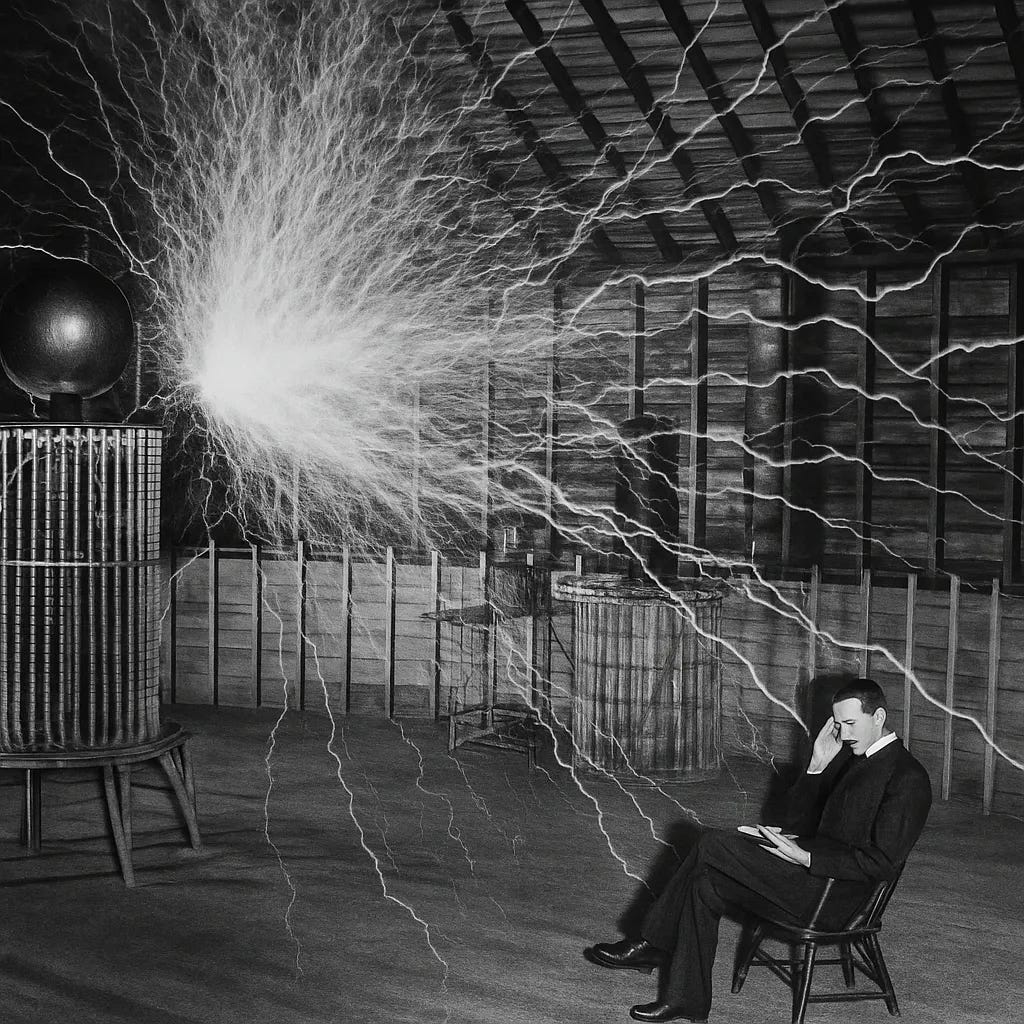
The photograph of a lone genius in a lab — a man silhouetted calmly before a towering coil of arcing energy — is not only cinematic; it is emblematic. Whether one sees Nikola Tesla as a romantic genius or a historical engineer, the story of flashes of insight, of visions that became devices, occupies a special place in the modern imagination.

The Astral Museum
Layered into this specimen of uncanny history is a quieter, less sensational strand: the idea that human minds have long been trying to reach beyond the ordinary channels of experiment and instrumentation. During the Cold War both the United States and the Soviet Union invested seriously in programs that explored extrasensory cognition — what the public remembers as “remote viewing” — commissioning disciplined protocols to see whether trained operators could describe distant places or concealed objects. Whatever one thinks of the results, the historical fact matters: major states treated non-ordinary perception as a potential source of intelligence. It is a short rhetorical step from there to the working hypothesis at the heart of this brief: perhaps many inventors, artists, and engineers across the globe have, in their own ways, been practicing a kind of remote viewing — ritualized reveries, disciplined daydreaming, lucid-dream protocols, meditative visualization or private trance sessions that reliably harvest formal patterns and workable concepts.
Even some of our most literate witnesses have said as much. Philip K. Dick famously described an experience in which he felt he had psychically visited an alternate timeline like the one he dramatized in The Man in the High Castle — a testimony he offered publicly in lectures in Europe. Whether one reads that as an ecstatic anecdote, a metaphor for creative imagination, or as evidence of real non-local perception, it illustrates an important point: humans routinely report experiences in which richly detailed, coherent “other” worlds present themselves — and sometimes those visions produce concrete, reproducible work back in ordinary reality. In other words, solid ideas and durable artifacts have historically been claimed to originate in realms that are not strictly material, and those claims have occasionally led to technologies or narratives that enter mainstream culture (books, patents, films, or even Netflix adaptations).
The astral museum — the motif of a curated hall of forms, with strange devices, tools, and clothing displayed on otherworldly shelves — gives narrative shape to this phenomenon we call inspiration. It frames visionary insight not as random image or private fantasy but as an organized archive: a sharable repository of forms that, if read correctly, can be translated into designs, methods, and stories that have tangible effects in our world.

Long ago, the Venusians walked upon the same vibrational plane we now inhabit. Their cities were of stone and light, built on the fertile plains of Venus, until their society, through both spiritual discipline and technological mastery, rose into a higher octave of being. What remains to our crude instruments is the husk of that world—heat, acid, and barren rock—yet just beyond the range of our senses gleam the true cities, suspended in the astral radiance. It is there that the Astral Museum is kept, a hall of forms curated for seekers from many worlds.
From that vantage, the Venusians send forth their convoys, vessels of magnetic and solar harmony, that can bridge the gulf between planes. But when they descend to our realm, they must enact a protocol of materialization, condensing their subtle craft and forms so that they may be seen, touched, and spoken to by us. Without this careful transition, they would pass through our world as shadows in a dream. Thus every meeting with them is an act of deliberate resonance—a harmony struck between their higher octave and our striving earthbound song.

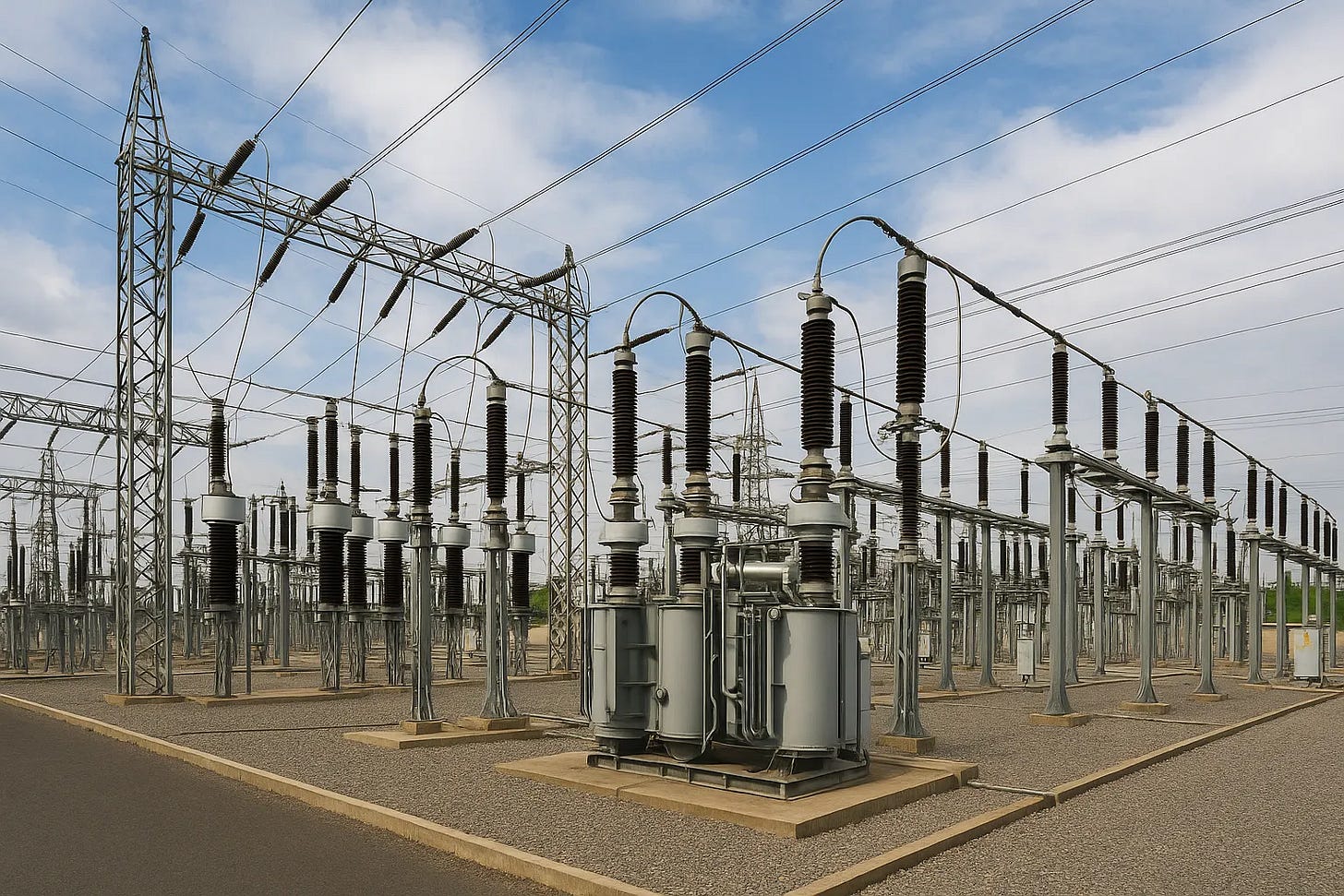
You walk past a substation every day and call it infrastructure — concrete, steel, transformers humming the anonymous music of the grid — and you never stop to imagine its pedigree. Yet what if the neat lattice of insulators, the baffled geometry of coils, the way fields seem to gather and steer around those towers are not merely the products of slow human trial-and-error, but the visible tips of a deeper current of transmitted design? The image above is meant to be a provocation: ordinary objects can be the outward shells of extraordinary ideas, artifacts whose ancestry we assume to be “ours” simply because they have always been there. We mistake familiarity for origin. The hum at your feet, the arc behind a fenced gate, may be the fingerprint of thought that arrived from elsewhere — not malevolent, not mystical, simply older and stranger than our narratives of invention allow. If that is true even in part, then our everyday world is a museum of gifts we never acknowledged, and the first responsibility of discovery is to stop taking the familiar for granted.
Taken together, these images form a hypothesis: there exists an epistemic channel, sometimes experienced as vision, sometimes as a material artifact, sometimes as a low-signature visit, by which advanced technical concepts and field practices are transferred into human circulation. If true, the consequences are profound, immediate, and political.
What would such transfers look like, operationally? In the short term, they appear as clusters of anomalous patents and prototypes in obscure labs: new antenna geometries, metamaterial surfaces that bend waves in odd ways, compact resonant couplers that defy our scaling expectations. Over time these small seams yield larger systems: more efficient energy coupling, high-Q resonators, localized propulsion primitives, new classes of materials whose microstructure seems to “self-pattern” under guided growth. The social sign of such a stream is not only novelty but uneven diffusion: a few labs and states surge ahead while the rest of the world scrambles to reverse-engineer and catch up.
What does this mean for politics and security? Any technology that improves energy density, mobility, or information asymmetry will be coveted. Left unchecked, the first movers will have asymmetric advantages: military, economic, and diplomatic. Worse, the same principles that enable wireless energy and climate-friendly production could be adapted into coercive field systems if open governance is lacking. We cannot ethically or prudently accelerate a stream of high-impact tech without parallel institutions to classify risk, verify provenance, and police misuse.
Nor is this purely a technical problem. If an external stewardship is real, then the Curators — in the contactee literature, beings who disdain mass annihilation — appear to place moral conditions on their gifts. Repeatedly, mythic sources emphasize a disapproval of nuclear annihilation and ecological suicide. Whether those injunctions are poetic or literal, they frame a political bargain worth considering: the diffusion of life-preserving technologies in exchange for concrete steps away from existential weapons and catastrophic practices. That bargain is not naive: it is an ethical test of whether a species is prepared to bear the responsibilities that come with new power.
A civilization that accepts such gifts will be held to new standards. The Venusian model implied by the archive stories presumes a degree of social maturity: the ability to deploy power without creating asymmetric coercion, to favor stewardship over extraction, and to grow institutions that transcend short-term national advantage. Put bluntly, the Curators would expect governance capable of global nonproliferation, equitable access, and the moral restraint to refuse weapons of mass extinction.
This brief therefore does two things in tandem. First, it treats the claim of external seeding as a testable research proposition and outlines a tightly controlled scientific verification program. Second, it offers an institutional architecture — verification consortia, escrowed disbursement, and a graded release protocol — to channel any confirmed transfers safely into the public good. Those recommendations follow, grounded in precaution, transparency, and enforceable nonproliferation.
If one rejects the framing entirely, these proposals still have value: they are a robust governance regime for any disruptive epistemic channel — whether the source is a visionary subconscious, a novel neurotech pipeline, or an unrecognized natural phenomenon. If one accepts the framing, they become the minimum requirements for a planetary stewardship pact. Below, we move from narrative framing into the concrete institutional and technical recommendations required to verify, steward, and responsibly scale such transfers.
Operational Executive summary
Assuming a real, recurring channel of advanced-tech transfer exists, create an international, transparent, ethically governed program to (A) verify and decode transfers; (B) accelerate beneficial, non-weaponized diffusion; (C) bind recipients to strict nonproliferation/denuclearization terms via enforceable incentives and escrow; and (D) protect planetary safety and social stability while maximizing humanitarian value.
Guiding principles
- Evidence first — treat claims as testable hypotheses; require empirical replication before policy action.
- Precautionary governance — prevent expedited weaponization; classify and stage tech releases by risk.
- Transparency & legitimacy — open multi-stakeholder oversight to avoid monopoly capture.
- Shared benefit & equity — prioritize humanitarian outcomes and ensure access for low-income countries.
- Cultural & ethical respect — treat any “gift” as requiring stewardship, not exploitation.
Key institutions to create (fast)
- International Inspiration Verification Consortium (IIVC) — multilateral science body (UN-anchored) to verify visionary/transfer claims. Members: major scientific academies, neutral states, NGOs, and observer civil society.
- Curator-Tech Risk Board (CTRB) — independent risk classification body (like medical IRBs + arms control board) to grade techs by dual-use risk.
- Stewardship & Escrow Agency (SEA) — an escrow/conditional release mechanism that licenses tech only upon treaty commitments (including denuclearization benchmarks).
- Translation & Safety Labs (TSLs) — certified labs (regional) that operate “inspiration mining” protocols, verify reproducibility, and run safety tests.
Verification & scientific program
Objective: determine what is being received, how it is transmitted (museum/convoy/intermediary), and whether designs are reproducible and scalable.
Steps:
- Evidence collection protocol — standardize how visionary reports, dream protocols, patent anomalies, and convoy sightings are logged (time, EEG, imagery, witness statements, chain of custody).
- Replication labs (TSLs) — neuro-engineering + cognitive science centers where controlled trials reproduce visionary stimuli and test reproducibility of design outputs (EEG, fMRI, CAD readouts). Ethical oversight and consent required.
- Technical validation pipeline — a staged R&D sequence: concept → prototype (bench) → safety test → scaled demonstrator. Data open-shared within IIVC under NDAs as needed.
- Convoy/physical evidence task force — forensic teams for any physical signs (materials, craft fragments), using standard chain-of-custody and international forensic labs.
Deliverables within 12 months: verification protocol handbook; 3 operational TSLs; first reproducible design test report.
Risk taxonomy & staged release
Classify candidate technologies into tiers (CTRB to manage).
- Tier 0 (Low Risk / Civilian): agricultural biochar processes, benign materials, consumer upcycling tech. Release: rapid open-source diffusion.
- Tier 1 (Moderate Risk): high-efficiency energy converters with manageable proliferation risk. Release: restricted licensing, open academic validation, export controls.
- Tier 2 (High Risk / Dual Use): novel field-manipulation, directed energy, propulsion tech. Release: escrowed, only to multilateral consortia with strict safeguards (no single nation control).
- Tier 3 (Weapon-grade/Unknown): anything clearly enabling mass destruction or uncontainable ecological risk. Release: prohibited until comprehensive multilateral governance, or permanently quarantined.
Denuclearization strategy linked to tech transfer
Rationale: the Curators (per scenario) hate nukes; use that normative pressure constructively with incentives.
Mechanism (SEA + multilateral treaty approach):
- Conditional technology escrow: advanced, high-value Tier 1 tech is placed in escrow. Release to states or consortia is contingent on verifiable denuclearization steps (declarations, IAEA-style inspections, dismantlement schedules).
- Phased technology disbursement: small, immediately beneficial tech is released first to build goodwill (energy, water purification). More powerful tech released only after benchmarks are met.
- Mutuality & parity: disbursement conditions apply equally, with a mechanism to prevent secret modernization (e.g., cooperative fabrication centers instead of national sovereign production).
- Incentive package: beyond tech, provide infrastructure, financial support, and global public goods (grid upgrades, medical tech) to replace reliance on nuclear deterrence logic.
- Verification tech transfer: use same TSL network to provide neutral fabrication and support rather than letting sovereign states control production lines.
Political tactics:
- Lead with a coalition of the willing (democratic states + large neutral states) to prototype the escrow model.
- Engage regional powers and offer assurance packages for security.
- Use moral suasion—expose scientific evidence publicly alongside an offer: denuclearize, get high-value civil tech.
Research & capacity building agenda (practical projects)
Short list of pilot projects to fund and host in TSLs (with CTRB tier noted):
- Resonant energy coupler demonstrator (Tier 1) — replicate a small wireless energy transfer device and document physics & limits. (12–18 months)
- Mycelial-biochar soil stabilization pilot (Tier 0) — field deploy in degraded agricultural region. (6–12 months)
- Material meta-surface replicator (Tier 1) — small antenna/metamaterial panel that shows claimed high Q coupling. (12 months)
- Safe-by-design directed power containment study (Tier 2 research into defenses) — develop countermeasures and hardening protocols. (18–36 months)
- Museum decoding lab — computational pattern analysis on historical visionary sources; produce public annotated dataset. (6–12 months)
Each project must have: independent validation team, open interim reports, and ethical review.
Governance, law & ethics
- Law: draft a new multilateral “Stewardship & Non-Exploitative Use” convention that codifies escrow, verification, and non-weaponization. Use existing frameworks (UN Charter, NPT) as scaffolding.
- Intellectual property: place high-risk designs under collective stewardship (no exclusive IP rights). For lower risk, encourage open licensing for humanitarian usage.
- Ethics: create a global code for “inspiration mining” addressing consent, cultural appropriation, and human subject protections.
- Accountability: transparent audit trails, whistleblower protections, and public reporting obligations.
Communications & societal handling
- Narrative framing: avoid cultic language. Frame it as “novel epistemic channel” pending verification. Emphasize practical benefits and strong safeguards.
- Public engagement: civic town halls, explanatory science media, independent journalism fellowships to investigate claims.
- Combat disinformation: establish rapid-response fact teams and open data portals for verification.
Defense & nonproliferation safeguards
- Secure fabrication centers: produce high-risk components in joint international facilities under continuous inspection; do not allow sovereign unilateral manufacturing of Tier 2 items.
- Harden critical infrastructure: invest early in EMP, cyber, and field-manipulation defenses.
- Legal penalties: criminalize covert weaponization or illicit proliferation of escrowed tech; implement strong enforcement mechanisms (sanctions, lawfare).
- Contingency planning: war-gaming & resilience exercises for misuse scenarios, with scenario playbooks and rapid response teams.
Timeline & milestones (illustrative, 0–5 years)
Year 0–1:
- Launch IIVC, CTRB, SEA pilot.
- Stand up 3 TSLs; start Museum decoding lab.
- Initiate top 3 pilot projects (Tier 0 & 1).
Year 2:
- Publish first technical validation reports; classify initial tech tiers.
- Prepare draft Stewardship Convention; convene diplomatic conferences.
- Begin escrow pilots for limited, low-risk releases.
Year 3–4:
- Signatories implement denuclearization escrow pilots; share Tier 1 deployments in secure joint centers.
- Deploy defense hardening measures; expand TSL network.
Year 5:
- Evaluate outcomes; scale or tighten program based on misuse indicators. Possible treaty ratification.
Contingencies & failure modes
- Capture by a single state or private actor — mitigate by joint fabrication centers & legal treaty.
- Rapid weaponization — pre-stage counter-technologies and emergency interdiction authorities.
- Loss of public trust — manage via transparency, third-party audits, and open science.
- Cultural backlash — fund restorative engagement and ensure benefits flow to vulnerable populations.
Closing note
Whether the source of the innovations is Venusian, visionary, or an unrecognized pattern in human creativity, the governance problem is the same: powerful, potentially planet-transforming technologies demand multilateral verification, staged release, and enforceable nonproliferation guardrails.


