The Total Tipping Point Also Involves A Cold War! (No One Wants to Think About A Nuclear Crisis – And Hopefully It Will Never Happen – But We All Must Accept The Fact Nuclear Tensions Are Rising Globally With Russia)

No one wants to think about a nuclear crisis – and hopefully it will never happen – but we all must accept the fact nuclear tensions are rising globally with Russia and China (and others are seeking nukes) so we should prepare ourselves and our loved ones in the event the unthinkable strikes our soil.

For decades, movies and some in the media have portrayed a nuclear attack as a “doomsday” event implying most people would be killed on impact … and survivors would want to die once they come out of their shelters.

In reality, unless you are actually at ground zero or within a several mile radius of the blast zone (depending on the size of the nuke, of course), there is a very high probability you’ll survive as long as you…

  • limit your exposure to radiation and fallout,
  • take shelter with proper shielding,
  • wait for the most dangerous radioactive materials to decay.

In other words, you CAN survive a nuke attack … but you MUST make an effort to learn what to do! By learning about potential threats, we are all better prepared to know how to react if something happens.

Please realize this is being written with small nuke devices in mind (like a 1-kiloton to 1-megaton device). A larger device, ICBM or a nuclear war would cause more wide-spread damage but some of this data could still be helpful. These are some very basic tips on sheltering for any type of nuclear (or radiological) incident.

What happens when a nuke explodes?

A nuclear blast produces a blinding light, intense heat (called thermal radiation), initial nuclear radiation, 2 explosive shock waves (blasts), mass fires, and radioactive fallout (residual nuclear radiation).

The below graphic shows the destruction of a test home by an atomic blast on March 17, 1953 at the Nevada Proving Ground. The structure was located 3,500 feet from ground zero, and the time from the first to last picture was 2.3 seconds.  It shows the force of the blast wave then the radiating energy set it on fire.

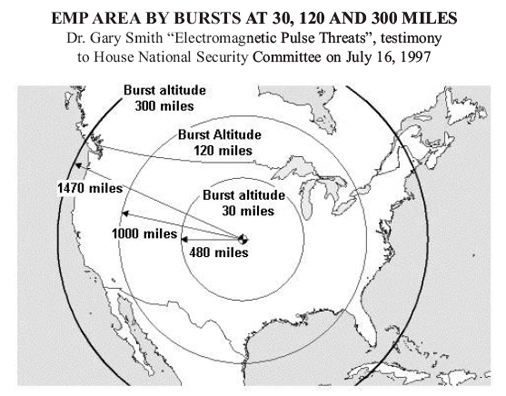
Also, if a nuke is launched over our continent and explodes miles above the earth, it could create an electromagnetic pulse (EMP). An EMP is a split-second silent energy burst (like a stroke of lightning) that can fry electronics connected to wires or antennas like cell phones, cars, computers, TVs, etc. Unless electronics are grounded or hardened, an area or nation could experience anything from minor interference to crippled power, transportation, banking and communications systems.

An EMP from a high-altitude nuke (where a nation or group succeeds in detonating a nuclear device carried miles into the atmosphere) could affect electronics within 1,000 miles or more as shown below. (Evidence suggests some countries and groups are working on enhanced and non-nuclear EMP weapons or e-bombs.)

high altitude emp or electromagnetic pulse threat

What is the most dangerous part of a nuclear attack?

Both the initial nuclear radiation and residual nuclear radiation (also called radioactive fallout) are extremely dangerous.

Initial nuclear radiation is penetrating invisible rays that can be lethal in high levels.

Radioactive fallout (residual nuclear radiation) is created when the fireball vaporizes everything inside it (including dirt and water). Vaporized materials mix with radioactive materials in the updraft of air forming a mushroom cloud.

Fallout can be carried by winds for hundreds of miles and begin falling to the ground within minutes of the blast or take hours, days, weeks or even months to fall. The heaviest fallout would hit ground zero and areas downwind of that, and 80% of fallout would occur within 24 hours. Most fallout looks like grey sand or gritty ash and the radiation given off cannotbe seen, smelled, tasted or felt which is why it is so dangerous. But as the materials decay or spread out radiation levels will drop.

More about radiation

Types of radiation – Nuclear radiation has 3 main types of radiation…

  • alpha – can be shielded by a sheet of paper or by human skin. If alpha particles are inhaled, ingested, or enter body through a cut, they can cause damage to tissues and cells.
  • beta – can be stopped by skin or a thicker shield (like wood). Beta particles can cause serious damage to internal organs if ingested or inhaled, and could cause eye damage or possible skin burns.
  • gamma – most dangerous since gamma rays can penetrate the entire body and cause cell damage throughout your organs, blood and bones. Since radiation does not stimulate nerve cells you may not feel anything while your body absorbs it. Exposure to high levels of gamma rays can lead to radiation sickness or death, which is why it is critical to seek shelter from fallout in a facility with thick shielding!

Radiation detection devices – You cannot see, smell, taste or feel radiation, but special instruments can detect even the smallest levels of radiation. Since it may take days or weeks before First Responders could get to you, consider having these devices handy during a crisis or attack since they could save your life.

Measuring radiation – Radiation was measured in units called roentgens (pronounced “rent-gens” and abbreviated as “R”) … or “rads” or “rem”. An EPA document called “Planning Guidance for Response to A Nuclear Detonation 2nd Edition June 2010” explains … 1 R (exposure in air) ≅ 1 rad (absorbed dose) ≅ 1 rem (whole-body dose). Although many measuring devices and older documentation use R and rem, officials and the media now use sievert (Sv) which is the System International or SI unit of measurement of radiation. The formula to convert sieverts to rems is quite simple … 1 Sv = 100 R (rem).

How many rads are bad? – High doses of radiation in a short span of time can cause radiation sickness or even death, but if that high dose is spread out over a long period of time, it’s not as bad.

According to FEMA, an adult could tolerate and recover from an exposure to 150R (1.5 Sv) over a week or 300R (3 Sv) over a 4-month period. But 300R (3 Sv) over a week could cause sickness or possibly death. Exposure to 30R (0.3 Sv) to 70R (0.7 Sv) over a week may cause minor sickness, but a full recovery would be expected. But radioactive fallout decays rapidly so staying in a shelter with proper shielding is critical!

The “seven-ten” rule – For every sevenfold increase in time after the initial blast, there is a tenfold decrease in the radiation rate. For example, a 500 rad level can drop to 50R in just 7 hours and down to 5R after 2 days (49 hours). In other words, if you have shelter with good shielding and stay put for even just 7 hours … you’ve really increased your chances of survival. Your detection devices, emergency radio or cell phone [if the last 2 are working, that is] can assist you in knowing when it’s safe to come out.

Coping with reality is the best way to beat it. Prepare. Most of us are. We are just waiting for the S to HTF, so to speak. Once it does, and it will again, we will be comfortable and unafraid while others won’t be able to function without submitting to their own enslavement in exchange for a can of corn.

So how do I protect myself and my family?

Basic shelter requirements – Whether you build a shelter in advance or throw together an expedient last-minute shelter during a crisis, the area should protect you from radiation and support you for at least 2 weeks. Some basic requirements for a fallout shelter include …

  • shielding
  • ventilation
  • water and food
  • sanitation and first aid products
  • radiation monitoring devices, KI (potassium iodide), radio, weapons, tools, etc

Reduce exposure – Protect yourself from radioactive fallout with …

  • distance – the more distance between you and fallout particles, the better
  • shielding – heavy, dense materials (like thick walls, earth, concrete, bricks, water and books) between you and fallout is best. Stay indoors or below ground. (Taking shelter in a basement or a facility below ground reduces exposure by 90%. Less than 4 inches of soil or earth can reduce the penetration of dangerous gamma rays by half.)
  • time – most fallout loses its strength quickly. The more time that passes after the attack, the lower the danger.

Indoor shelter locations – If you don’t have a fallout shelter, these options could provide protection from dangerous radiation by using proper shielding materials.

  • basement – find the corner that is most below ground level (the further underground the better)
  • 1-story home / condo / apartment – if no underground facility, find a spot in center of home away from windows
  • trailer home – find sturdier shelter if possible (like a basement or brick or concrete building)
  • multi-story building or high-rise – go to center of the middle section of building (above 9th floor if possible). Note: if rooftop of a building next to you is on that same floor, move one floor up or down since radioactive fallout would accumulate on rooftops. Avoid first floor (if possible) since fallout will pile up on ground outside.

Shielding materials – All fallout shelters must provide good protection from radioactive particles. FEMA suggests having a minimum of several inches of concrete or 1 to 2 feet of earth as shielding around your shelter, if possible, and the more the better. Per FEMA, the following shows examples of shielding materials that equal the protection of 4 inches (10 cm) of concrete …

  • 5 – 6 inches (12 – 15 cm) of bricks
  • 6 inches (15 cm) of sand or gravel
  • 7 inches (18 cm) of earth
  • 8 inches (20 cm) of hollow concrete block
  • 10 inches (25 cm) of water
  • 14 inches (35 cm) of books or magazines
  • 18 inches (46 cm) of wood

Make an expedient shelter – Some very basic ways to build an expedient last-minute shelter in your home, apartment or workplace to help protect you from dangerous radiation include…

  • Set up a large, sturdy workbench or table in location you’ve chosen. If no table, make one by putting doors on top of boxes, appliances or furniture.
  • Put as much shielding (e.g. furniture, file cabinets, appliances, boxes or pillowcases filled with dirt or sand, boxes of food, water or books, concrete blocks, bricks, etc.) all around sides and on top of table, but don’t put too much weight on tabletop or it could collapse. Add reinforcing supports, if needed.
  • Leave a crawl space so everyone can get inside and block opening with shielding materials.
  • Leave 2 small air spaces for ventilation (about 4-6″ each) – one low at one end and one high at other end. (This allows for better airflow since warm air rises.)
  • Have water, radiation detection devices, KI, battery operated radio, food and sanitation supplies in case you have to shelter in place for days or weeks.

In summary, those within the blast zone of Ground Zero (depending on the size of the nuke) won’t make it .. BUT .. if you are a few miles outside the zone your chances of surviving it are high but you MUST have detection devices to monitor levels of radiation and a plan to stay sheltered for at least 48 hours or up to a few weeks. First Responders will have to wait for the deadly fallout to decay before they enter a hot zone so the more you prepare, the better your odds of surviving a terrorist nuke.

The video below is simply shocking… Because not even Trump or Putin expect such a thing!!!

This Could Kick-Start World War 3 Fellow Patriot

Our country is headed to a Nuclear World War 3

And we are NOT prepared for it…

This coming war won’t be fought with tanks and infantry like the first two…

Where is the safest place to live on earth in the event of massive climate change?

What we think we know about natural consequences, within 30 years:

  • The seas will rise some
  • Weather will become more extreme, while staying the same in type
    • dry places will be dryer
    • wet places will be wetter
    • hot places will be hotter
  • Precipitation patterns may change regionally
  • Supply chains will falter, some will fail, regional food production will become more essential, especially hydroponics and indoor farming
  • Food supplies will change from global to more regional, agriculture will have to go fully organic, regenerative. Disowning industrial agriculture corporations, giving the land back to farmers, will be essential in the transition.
  • Forests in lower, hotter regions will burn off, or dry out and die off. Reforestation via rewilding animal populations, may be a solution
  • Some rivers will dry out, fish populations will go extinct regionally
  • Mountains will be free of snow for longer periods. The Alps will require an adjustable water management system, including new rainwater retaining systems where glaciers have vanished.
  • Floods in places where rivers were constrained by human intervention, and large spaces have been sealed with construction, will increase in severity and frequency.
  • Groundwater aquifers may dry up regionally, and/or become heavily contaminated (Colorado River, Nile)

In Europe

Central and Northern Europe, Northern Spain, North Western France, the entire Alps, except some Baltic coastal regions like Holland and Belgium, should be safe.

In General, being in hilly regions is preferable, make sure there’s plenty of precipitation, preferably spread out over the year. These patterns will change, keep informed.

I expect that, where I live, wooded mountains in the middle of Tirolia, Austrian Alps is a good place to make a stand as any. I live right by the river, and even in the flooding last year, I had a dry basement. I have to say though, another 10 cm and that would have changed. So, I am looking to move a bit higher up on the sunny hillside, just a couple hundred meters, since I grow my own food, I don’t want to be too high up. So far, in my region, not much has happened to the weather patterns beside the snow becoming less and less. I guess, finding enough snow for snowboarding will not be my biggest problem.


We will also have direct humane consequences. The rich of the world never cared for the poor, that will not change. Yes, there will be regional protests, but the rich, spoiled western consumers have proven that, beyond protesting, they do not want their consumerism and comfort to be infringed upon.

We know, the planet can not sustainably support the current human population, unless, we, the rich 10%, reduce our CO2 footprint and consumption of resources by a factor of 10. Let’s face it, that’s not happening, so what’s the alternative? For decades we have read the reports from Asia and Africa, about exploited peoples and exploited resources, nothing has changed. We are just fine with our transnational corporations exploiting these countries and their peoples, just don’t bring them here. If we wanted these things to change, we would change our consumer behaviour, our strongest, most powerful democratic voice.

From this, our behaviour, I conclude

  • Rich, well armed countries will keep immigrants out by force. Hundreds of Millions of migrants, climate refugees will move north through Africa, or Turkey and the Balkan, and starve or die of disease on the way.
  • Rich countries will let the populations in poor countries which are more affected by climate change, suffer the brunt. Poor countries will be naturally depopulated via starvation, squalor, gang violence and disease, the world population will be decimated. This is necessary, as these poor people of these regions have a CO2 footprint of 100 kilograms a year, which can not be allowed to increase. After all, we’ll keep ours at 11 tones a year, 16 tons in the US.
  • Rich, well armed countries will keep exploiting poorer countries, mostly the rich north keeps taking the candy from the poor south.
  • The rich in the north will finally understand that they are not ethical, or morally upstanding, and come to terms with it. They will let the poor perish in the hundreds of millions, (sorry, survival of the well armed, survival of those who lack empathy, or do not let their empathy stop them from subduing the poor and weak) to then have the planet in a condition that has a better chance of supporting a reduced human population sustainably. (Look around, this has begun years ago)

You think I exaggerate? Think again.

The broken $100-billion promise of climate finance — and how to fix it

At Glasgow’s COP26 summit, countries will argue for more money to mitigate and adapt to the effects of climate change.

Did you really think they would pay? If the rich would pay this bill, then the poor people would raise their CO2 footprint, that can’t be allowed to happen. If this bill is paid, the path is laid to make the rich countries pay for their historic CO2 consumption. Sorry, that’s not happening.

COP26: Rich countries ‘pushing back’ on paying for climate loss

Poorer countries say they are not able to get compensation for the damage caused by climate change.

Remember, who the UN have become:

Corporate Capture of Global Governance: WEF-UN Partnership Threatens UN System

Deeply concerned about corporate capture of the UN system, 289 organizations from all regions of the world, as well as 27 individuals, have endorsed a collective letter to the United Nations Secretary General, H.E. Mr. António Guterres, to terminate the strategic partnership agreement recently signed by the United Nations and the World Economic Forum.

The UN has partnered with the WEF, the World Economic Forum, which is funded and governed by corporate elites. ABB, Cisco, Chevron, Glencore, OPEC, Shell, BP, Amazon, Microsoft, The Bill and Melinda Gates Foundation, Virgin etc.

Hundreds of Civil Society Organizations Worldwide Denounce World Economic Forum´s Takeover of the UN | Transnational Institute

The call, made in an open letter, denounces attempts to ‘delegitimiz[ing] the United Nations and weaken(ing) the role of states in global decision-making.

Now, in the UN, and via the most powerful economic Lobby Group, the WEF, these unelected global leaders make legislation. They write the laws that should regulate their industries in the interest of humans and the environment. It’s absurd.

The privatisation of global governance: forget New York, keep Davos? ǀ View

Notwithstanding the differences, one would be excused to compare the WEF’s Annual Meeting in late January in Davos with the annual high-level meeting of the UN General Assembly in late September in New York. Both are preceded by overview reports presented by their respective CEOs.

These wealthier, more established nations to support the world’s most vulnerable countries moving forward, would be a nice thing to have, but you don’t really believe that will happen, do you?

UN under fire over choice of ‘corporate puppet’ as envoy at key food summit

Organisation accused of kowtowing to big business by appointing former Rwandan agriculture minister with links to agro-industry

I am only showing these, to make you understand what we are, we, the rich and powerful in the Western social democracies. We need to recognise why things are happening the way they are.

Europe will have her Navies prevent African Climate Refugees from leaving North Africa, just like we have made the refugees coming through Belarus, Turkey, Greece and Italy into political ping pong balls. In Greece and Turkey we have refugee camps where the conditions are inhumane, to put it mildly, who cares, Libya has become a Mecca for human trafficking, need I say more.

Protesting is not the same as actually caring. Asking to give a refugee family asylum in your home, that would be caring, but I have yet to hear of such cases happening.


As for the the US

In General, the US are a vast country, the hilly or mountainous regions in the West and in the East, where there is historically enough precipitations, should be good places to make a stand, ecologically speaking.

When it comes to humans, the US are a different place. Even right now, right and left are beyond speaking terms, the right have left our realm of reality altogether. If Trump wins in 2024, all I can say, emigrate, go to Mexico or Canada, unless you are really rich, then you can afford protection.

Due to virtually unrestricted gun ownership and literally pandemic psychosis and psychopathy, the amount of arms in the population will be society’s Achilles heel in the US.

  • Well armed groups of marauders will ravage the unarmed, the unprotected. Remember, there is not even enough solidarity in the US for a universal healthcare system.
  • Every living being that draws power or water from the colorado river, will have to move. That’s 40 Million Americans moving from California north east.

40 Million People Rely on the Colorado River. It’s Drying Up Fast.

One of the country’s most important sources of fresh water is in peril, the latest victim of the accelerating climate crisis.

  • What the US have done to other nations (North American Native Peoples, China, Philippines, Marshall Islands, East Timor, Iraq, Afghanistan, Central and south America) will give you an Idea of what will happen with the poor inside the US, what the rich 1% or 10% will do with the rest. Consider how the poor, vets included, the sick and the weak are treated in the US, historically, and currently.

Here, a little History, not for the faint hearted with empathy.


In summary.

  • Move north, away from flat coastlines, away from severe storm paths, away from big urban areas
  • Move to where the locals are friendly, in a tight, advanced solidary society, preferably non religious and well educated
  • Learn how to be of help inside the society you chose, making it better and safer by being part of it
  • Learn how to grow food, indoor and outdoor, sustainably, If you have surplus, help out those who have not enough, fortunes change
  • Learn how to build a sustainable home, live sustainably
  • Learn how to consume less, while living healthier and more honest with yourself

Live Long And Prosper.

How to Prepare for Financial Crisis- Security for the Next Economic Collapse (During the financial crisis of 2007 and 2008, the U.S. Congress held closed door sessions to discuss the economic crisis.)

The worst thing about a financial collapse is that you cannot predict when it is going to happen, how soon it will happen, or how long it will last for.

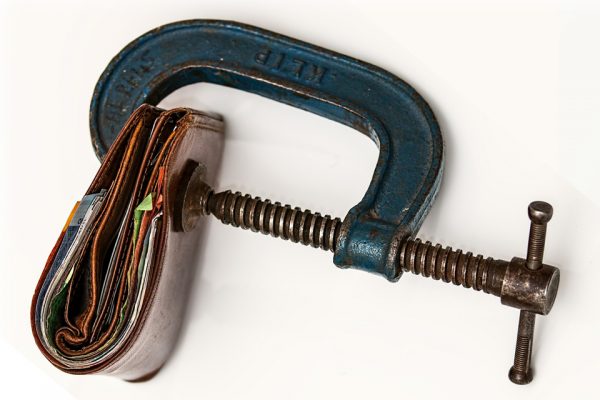
All you can do is take the steps needed to prepare for an economic collapse, embrace frugal methods, and start thinking about your bank and wallet as a survival tool, rather than a spending tool.

When the last economic crisis hit, the 2008 financial crisis, the world was shocked at the speed in which it set in. From what started as a meltdown in the US mortgage market, the rest of the world collapsed in a domino effect in rapid succession.

For most of us, that economic collapse was something we just weren’t prepared for, and for those that were not prepared, it was a very tough period.

The question everyone is asking now is ‘when is the next economic collapse?’. It could be this year, the next or in five years. But as many economists argue, we are due for one, and the next one could be much worse than the previous financial downturns.

Since the only thing we can do is ready ourselves for another economic downturn, we take a look at 8 steps you can start taking now to survive an economic collapse.

But first, let’s take a look at some of the basics, to understand why we need to prepare for an economic collapse.

What is an economic collapse?

Simply put, an economic collapse, interchangeably used with the term financial collapse, is a series of very severe economic conditions. Many survivalists and preppers say an economic collapse is the one thing that they are preparing for, as it includes several symptoms that place risk on our necessary needs, such as food, water, power, and safety.

One of the worst factors about a financial collapse is the fact that it doesn’t abide by a timeline. Natural disasters, for instance, while very destructive, are short, with their duration measuring only for days let alone weeks. This allows recovery efforts to commence almost immediately. Economic downturns, however, are unmeasurable in length and for most, will last a minimum of a year, with the aftereffects resonating for several years as a nation recovers.

During an economic collapse, some symptoms affect large companies and industries, with very visible signs, felt in the family home. For instance, common symptoms of collapse are high bankruptcy rates, widespread unemployment, hyperinflation, a spike in death rates (attributable to depression or other financial causes), social collapse, and a high increase in crime.

What is an Economic collapse?

What causes an economic collapse?

Financial systems can be affected by a large number of different scenarios, and for the most part, a country can bounce back quite quickly with severe financial fluctuations going undetected by the majority of the population. But for the causes, they seem to be factors that can create a ripple effect in a country’s financial industry, resulting in economic loss shockwaves.

If we look back at history, one financial collapse is not like the other. Yes, their symptoms are the same and in the home, loss, grief, and stress are all experienced, but their causes remain unique.

The 2008 Global Financial crisis was triggered by factors such as the burst of the US housing bubble, easy credit conditions, fraudulent lending services, overleveraging, and shadow banking practices. This is different from Venezuela’s economic collapse, which has only been felt in that country and not across the world. In Venezuela, the causes of its economic crisis were caused by presidential policies and a fall in oil prices as well as several other contributing factors. Since its beginning, Venezuela has experienced severe spikes in crime, corruption, poverty, and hunger issues.

There have been some other economic downturns that have completely different causes but have all displayed widespread unemployment, poverty, hunger, and social chaos. They include:

  • 1998 Argentine Great Depression
  • 2001 Turkish Economic Crisis
  • 2008 Icelandic Financial Crisis
  • European Debt Crisis
  • 2014 Russian Financial Crisis

The economic crisis is not just limited to societies, it can also be limited at an individual level. But, an individual can recover much quicker than a society, by making good choices for him or herself. Keep in mind, this his pernicious crisis can likely be prevented or minimizes with some planning. Avoiding certain situations and leaning towards safe investing strategies can make all the difference.

What causes an economic collapse?

What are the warning signs of an economic collapse? –SEE VIDEO

As we have seen above, a financial downturn can set in very rapidly, and before we know it we have lost our jobs, stores are shutting down, and we’re left high and dry. But there are some warning signs to watch out for. These are early indicators for a potential financial downturn and possible economic collapse.

Of course, your first source is to stay up to date with the news. All good survivalists are avid readers of politics, finance, and weather – the three things that can kick us out of our home or make us go hungry. So inevitably, they are the go-to sections for survivalists, and anyone else that cares about what happens in the world, and indirectly themselves.

Also watch: Just like the Gestapo, the FBI has vast resources, vast investigatory powers, and vast discretion to determine who is an enemy of the state.– SEE VIDEO

According to Lombardi Letter, there are five signs that an economic collapse is about to happen. They are:

  1. Growing government debt: when an economy slows, the government usually steps in to help stimulate spending again, but with high debt, the government might not be able to make that injection.
  2. Stock markets trading at all-time highs: investors are taking more risk on the market, markets continue to trade higher meaning investments are bull-market driven and not research-based which could lead to a stock market bubble.
  3. Unemployment rate: eligible worker, retirement, and student rates all identify trends in people not contributing to the economy and could slow down economic growth
  4. Unstable government: this boils down to the leader and government team in the decisions and actions that may affect the economy in various ways
  5. Rising national debt: this means less consumer spending in the economy and more money spent on paying a debt.

Although those five economic collapse red flags are present in any collapse, there are also other things we can do to be ahead of a financial collapse disaster. And that is to look at what the warning signs displayed by the people involved in it all, America’s elite Wall Street executives and Silicon Valley entrepreneurs.

What are the warning signs of an economic collapse?

What are the world’s richest preppers doing?

A good sign of an economic downturn is when you see some of the world’s richest executives preparing for an economic disaster. You know things are about to go wrong if they are taking considerable efforts to protect themselves and their families.

Silicon Valley millionaires and Wall Street investors are buying big houses overlooking lakes in New Zealand and other underpopulated places in the world should they need the security of a hideaway to bug out to, should a severe financial downturn happen.

One of the world’s wealthiest technology entrepreneurs, and Trump advisor, Peter Thiel (co-founder of PayPal),  became a New Zealand citizen in 2011 and has a large family mansion fitted with panic rooms on a homestead property. He plans to live out an economic collapse in that self-sufficient mansion in New Zealand, far away from Silicon Valley, when the early warning signs appear. Facebook Product Manager Antonio Martinez has five acres of isolated land in the Pacific Northwest where he has stockpiled food, water, generators, and solar panels with shelter as a bug out location.

On the Wall Street executive side, a member of an investment firm, quoted in the New Yorker, has a helicopter on standby at all times to take him to his underground bunker where he plans on living out an economic collapse with a self-sufficient garden, power source and food and water supply. Meanwhile, Mayfield Fund managing director Tim Chang has bug-out bags for him, his wife and four-year-old, and several established bug-out locations in regional areas.

Richest preppers
Peter Thiel (middle) with President Trump.

How can you prepare for an economic collapse?

Let’s face it, we can’t fight an economic collapse, we can’t run from it either. Even if it were to be isolated to one country, such as in Venezuela, our savings would be very little in any other country, effectively trapping us and turning us into financial crisis refugees. The only thing we can do is prepare for an economic collapse and be a little more frugal when the going gets tough.

So let’s take a look at the 8 steps you can take to prepare for an economic collapse.

1. Learn simple economics so you can identify early warning signs

The list I provided above on economic collapse red flags to look out for is not a complete list, there are an endless amount of warning signs that you will be able to see if you regularly view financial news on the stock market’s performance and the nation’s economy.

Basic understandings of economics will help you in not only noticing an early downturn but will help you identify possible safe havens for your money and economic minefields that you should avoid.

How can you prepare for an economic collapse?

2. Cash is king

When you have cash, it’s buying power that many might lose. When I mention cash, this also refers to money in the bank. Just make sure that whatever investments you have, you can quickly liquidate them should you need to and secure the cash. I would recommend not having investments in anything that takes longer than a week to withdraw. As you have seen in the past, an economic recession can set in in the blink of an eye and some resources may not be valid for liquidating due to early bankruptcy.

If I can give any advice to financial collapse preppers out there, it would be to get your savings in a safe place. Savings and checkings accounts should always carry a certain amount of emergency money as these can be withdrawn quickly. This is much better than having all of your money in a term deposit account that provides restrictions on when you can withdraw your money.

Also try to have a set amount of cash on hand, especially if you are picking up warning signs of a recession. This amount of money will be able to act as an emergency stash until you can withdraw the money in your account and have your assets liquidated.

cash is king in an economic collapse

3. Start building an emergency cash fund

An emergency fund should not be in credit, it should be from the cash you saved in a savings account from your monthly income. You can file this in any savings account with your bank (most allow for a free account to be opened). This fund is essentially a do not touch fund, or as some prefer to call it, a SHTF fund. Make sure you have enough money to at least allow you to buy tickets to another country and support yourself and your family for a month.

This type of fund allows you to leave a country before the US dollar becomes weak and should provide for enough time to get a job in that country until the collapse has resided.

Prepping basics: how to start prepping

4. Start being more frugal with your monthly bills

When you have no money coming in, the worst thing to have is money coming out on expenses that you don’t need. Start minimizing your bills by going through them each month with a highlighter and seeing where most of your money is going. Is there a way to limit that? Perhaps the power is a little higher than it should be and the air-conditioning or heater is being left on?

Practicing sustainable methods such as organic gardening, generating your power, and utilizing your own space is a great way to also lessen monthly expenses and become more self-reliant in case of an economic collapse where regular comforts might not be reachable in the same manner as we are used to. You can invest in solar panels or grow your produce to supplement your food expenditures. This is also a growing trend as a lot of people are pushing towards self-sufficiency and off-the-grid methods.

A few of the people that have already moved to unpopulated areas are running gardens on their properties that can completely sustain their whole family all-year-round. It doesn’t take long to learn urban gardening skills or country homesteading skills and they are both very fun and rewarding tasks.

urban garden

5. Generate an additional (collapse-proof) form of income

Our writer from Venezuela was an engineer but started making cheese, learned to use a CNC crafting and cutting kit, and became a freelance writer for various websites as a way to find alternative income when his country’s economy collapsed.

Diversifying the income, and distributing the money in the accounts you believe you may need, and even your means to receive money is crucial. In an economy like this, I believe that keeping the 20% of the monthly income in silver would have worked, but Venezuela is not a place where preppers and people concerned about taking the direction of their future are plentiful, so a trading network would have been pretty difficult to set up.

Many try starting an at-home business to ensure they have a bit of extra cash each month aside from their normal job, and as a fallback when times are tough and they have faced job loss. Of course, those skills would have to be essential skills required in a collapse, which could be things such as sewing, gardening, building, repairs, selling your foods, accounting, and other things that households would regularly require.

employment in an economic collapse

6. Get out of debt

If you have considerable debt, build a strategy to get out of it as quickly as possible. In the case of a financial collapse, there will be multiple job losses and widespread income loss. The sooner you remove debt the sooner you can remove the worry of having to pay debts when you have no source of income.

As a method to manage any debt you have owing, try the following:

  • Create a spreadsheet budget plan in excel or online using a free budget calculator
  • Use a column for incomings and another for outgoings.
  • Create another column for your debt repayments and list their interest rates as well
  • Identify and rank each debt by their interest rates from high to low
  • As you find you have savings in the bank, pay off the debt with the highest interest rate
  • When that debt is paid off completely,  move onto the next one.
get out of debt

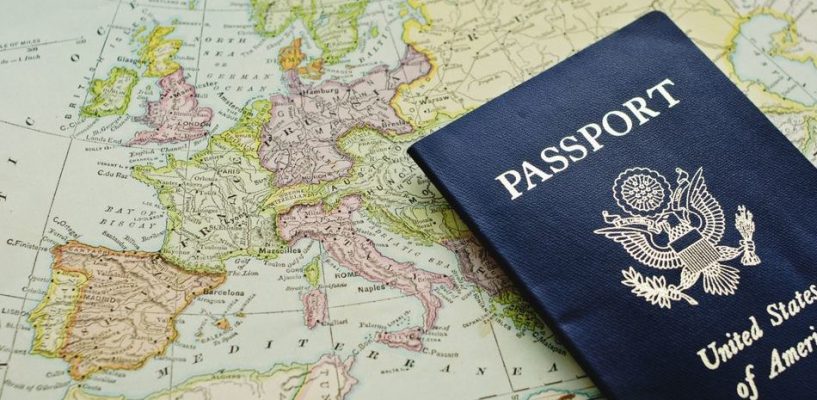
7. Make sure your passport is current

Should the country be at a point where it is about to take a steep dive downwards, it might be time to get out and spend some time abroad. This is a common move for many economic refugees as they wait for their country to regain financial security.

Your passport should have enough remaining time, with at least a few years on it so that you can avoid unnecessary complications with having to renew a passport overseas. Also, research countries that you might choose as a refuge destination and research their visa laws, as well as any possible employment there.

Make sure your passport is current

8. Start prepping

If a financial collapse does occur, you are going to want to start prepping so that, should an economic downturn occur, you have enough food saved up while you either grow your food in the garden to supplement it or find another source of free food. Chances are you will need food more than water as water will still run, but stores may close down and shelves may empty quite quickly.

Part of our guide to start prepping involves identifying a bug-out plan, location, a suitable bug out bag and bug out contents. If a true economic collapse was to occur, there will be a high increase in crime rates, social disorder, looting, and likely clashes with law enforcement and military. It is a safe option to consider leaving busy urban areas as these are most likely the areas that will be prone to violence.

how to be a prepper

9. Use Websites and Apps Now

In this age of technology, the best way to prepare is to make use of the applications and websites available to you. There are many investing applications to store money. Here is a list of best investing applications to consider.

Must watch this video- Experts predict that an EMP strike that wipes out electricity across the nation would ultimately lead to the demise of up to 90% of the population.

Fidelity Investments is a well-known investment brokerage. The firm charges a fee or commission for executing buy and sell orders submitted by an investor. These brokerage accounts are operated through licensed firms. Through this, the investors deposit funds and buy investments. Fidelity has almost 200 investor centers around the United States. They assist customers on iMessage, google assistant, and Facebook messenger. The fidelity mobile application is fresher and easier that bring excellent trade executions and exchange-traded fund (ETF) research on the mobile screen.

The Robin Hood application has been very significant in the online brokerage industry since it launched in 2014 as a mobile application. It allows customers to buy and sell stocks without paying any commission. It offers an abundance of research, news, charting, and educational resources. It is successful because it allows individuals to open accounts with very little funds and gives them access to their entire platform.

The Acorns application is a newer kind of investment. It automatically links debit and credit card purchases while investing from them. It has 650 thousand members most of which are millennials. People can easily invest spare change to the next dollar on all purchases. Acorns do not charge a commission but they can charge one dollar per month fee on some accounts.

The Nutmeg application, which was launched in 2011, is a cheaper investment platform. It focuses on ETFs and tracker funds to provide wealth management services. The portfolio invested, as well as the different countries and industry sectors invested in, are reviewed regularly by Nutmeg. Even if the markets fluctuate, the portfolios will have the same exposure to each asset.

The TD Ameritrade mobile application is one of the most powerful platforms on the market. It gives a succinct brief on the market, as well as stock and portfolios. It allows the person to trade in foreign currencies and many other complex options. Large investment selection makes it the number one application. You’ll have access to research and top-notch customer support.

10. Expand your Skills

It is important to learn skills that can serve as an alternative to the individual’s job, should you lose your job. And, in the current climate of job globalization and automation, almost every sort of job is at risk. During the financial crises, there is a huge rate of unemployment. A person should utilize his skills in another industry or field so they can stand out from all the other candidates who will also be searching for jobs.

Over to you…

Many of us have already been affected by past economic downturns. They are reoccurring beasts that can be escaped. The only thing we can do is to ensure we are prepared so that we can survive the many problems that come with an economic collapse.

In this post, we have identified what is an economic collapse, how to tell when a financial collapse is about to happen, and how to prepare for an economic collapse. I hope this information has helped you form a more clear picture of how to start your economic collapse preparations.

Attention: The US is Facing The BIGGEST Threat Of The Century

War Is Just Around The Corner

You’re about to lose everything you’ve worked so hard for your entire life and it’s even not going to be your fault! – your house, your car, your credit card will be worthless…

So pay chose attention because this video will change your life forever for the good!

Messing with your head: the government’s psychological war against the nation explained. (THE ANTIDOTE TO BRAINWASHING IS INCREASED UNDERSTANDING. ARM YOURSELF WITH KNOWLEDGE!)

This article was first posted in 2021 and recently updated.

This is a brilliant piece featuring two of my personal heroes: Brian Gerrish, co-founder of the superb UK Column and Reiner Füllmich, the top German lawyer and human rights warrior.

They make a very powerful alliance and we should encourage high calibre freedom fighters and trail blazers like this to unite against humanity’s common enemy.

This interview fully exposes the “pandemic” hoax for what it is and has been from the outset: a psych-engineered attack on human freedom complete with mind games designed to cow and introvert the populace.

This interview is quite an education.

Arm yourself with knowledge!

Brian Gerrish’s testimony to Reiner Füllmich:

Our oppressors are very frightened people

On 28 May 2021, I gave evidence to the 54th session of the Stiftung Corona Ausschuss, the German-based extraparliamentary inquiry by lawyers into the medical establishment’s and public policymakers’ handling of the Covid crisis internationally.

Reiner Füllmich: Brian, I apologise for having kept you waiting for twenty minutes or so.

Brian Gerrish: That’s absolutely fine, and I’d just like to say that I don’t speak German but it was fascinating watching you and listening, and it was wonderful to see you start laughing, because you looked very serious in most of the dialogues that I’ve listened to.

There was one word that I picked up that I found very interesting, and that was Wahnsinn, which came up several times, particularly when [persecuted primary school headmistress] Bianca was speaking.

Reiner Füllmich: You know what it means, right?

Brian Gerrish: Yes, “madness”. And I’m going to say to you: it’s not madness. What we are facing is calculated, and it’s a mistake to call it “madness”, because it’s very precise; it’s very calculated. We need to understand that in order to be able to deal with what we’re facing.

Reiner Füllmich: That’s very interesting to hear, because we have come to the conclusion that “the other side”, as we call them, is using two major tools. One is, of course, psychology, psychological operations; and the other, which transports this psychological operation, is the mainstream media.

Can you tell us a little about your background?

Brian Gerrish: Well, my personal background is, professionally, I was military: I was in the Royal Navy for twenty-one years. I then worked in industry, essentially, for a while, but after a few years, I began to understand that things were not good in the UK, and I began to see things and investigate things.

Ultimately, that’s led me, over nearly another twenty years, to team up with a gentleman called Mike Robinson, and for fourteen years now, we’ve been running a media outlet called the UK Column, where I’m delighted to say that we’re expanding, and it’s clear that our viewers and listeners are now not only in the UK; they’re across the world.

Reiner Füllmich: Excellent. And now, of course, you’re busy covering Coronavirus and all the ramifications of what Coronavirus is bringing about.

Brian Gerrish: Well, the key point is that we originally started by looking at some of the issues that you’ve just mentioned. We we were looking at how propaganda had come into the country; we were looking at the use of applied behavioural psychology by the Government; and we were looking at changes which were very serious (or we thought they were very serious) that were particularly affecting the style of democracy, and that were also affecting our constitutional rights.

It was against that background of reporting that we have then encountered, obviously, what’s happened with Coronavirus. So I would say to you that our analysis of what has happened with Coronavirus is seen very much against the background of what was happening politically, and in particular the use of applied behavioural psychology and propaganda.

Viviane Fischer: So what do you think is the “calculated madness”? The [description] “madness” is more our judgement from when we look at what was the normal status of things before. No-one would have thought, had you asked us a year ago, that this could have ever happened; at least not us, I guess.

And also, we were really surprised how the legal system has deteriorated, or at least, how it has become obvious that it is really in bad shape. But we also have the feeling, at the same time, that it’s very orchestrated, what’s happening: that it’s like a jigsaw puzzle. They move this piece and this piece, and then the picture is becoming more and more clear what’s going on. But what are your experiences or your analysis of the situation?

Brian Gerrish: First of all, I’d agree with you that the Coronavirus “pandemic”, if we want to call it that in inverted commas, did catch everybody by surprise. I don’t think we saw that coming, and it happened very quickly. So I’d certainly agree with you on that.

But I’ll come back to the fact that we started to see very, very serious things things happening in the UK. If I just focus immediately on the Government’s use of applied behavioural psychology: back in 2010 and 2011, we as the UK Column were warning that the Government had set up a team which was called the Behavioural Insights Team [UK Column note: whose former homepage address ‘behaviouralinsights.co.uk’ now redirects to the consciously globalist ‘bi.team’]. This was a team of psychologists who were working directly alongside not only the political process, but the policy-forming process within the British Government.

A critical document which we found in 2010 was called Mindspace (you can find it very easily by searching online for it as a PDF document). In that document, the Government admitted that it was using applied behavioural psychology to influence how it designed policy and how it implemented policy.

At one particular point in that document—in fact, it’s at the bottom of page 66, if I remember correctly—the Government boasts that it can change the way people think and behave, and that people will not be aware that this has been done to them. But it adds the caveat that if they do realise that their behaviour is changed, they will not know how it was changed.

We read this document and we were shocked, and we then started to research further. That then led us to discover that, around that time and of course a little bit earlier, the British Government had been conducting meetings with the French, in which we were bringing the political psychology teams together to produce joint plans with the French. The key Frenchman who was present in the meetings was called Olivier Ouillier, and he was working directly at that time for Sarkozy’s private office.

Now, all these meetings were essentially held in secret. We were able to discover that they had taken place, but we were only able to discover that by carefully researching along specific routes which we understood were important. For example, most of these meetings were conducted under the guise that they were part of a charity, the Franco-British Council, which said it was simply set up in order to improve relationships between Britain and France.

So these meetings took place, and it was very clear that there was concerted effort to expand the use of these techniques: not only from Britain and France, but the implication at that time was that these techniques were going to be used across the wider power base of the European Union.

And I’ll just say again that the Mindspace document was boasting that this was the first time the Government would be able to use applied techniques where people would have their behaviour changed—that means their thoughts changed!—and they wouldn’t even be aware that it had occurred.

Reiner Füllmich: For what purpose?

Brian Gerrish: Well, if you want to execute power, then you’re going to try and use normal, democratic politics, or you’re going to try and use force, or you’re going to try and use other means.

And so this comes to me as other means. I have to say that when I saw how cynical this was, how calculated it was, when I was using effectively my military background, I could see that this was the use of raw power.

Now, if I jump forward into events around Covid: very early on in the Covid pandemic (I’ve called it a “pandemic”; of course, I don’t believe that that is what it is, but that’s how it was reported), it came to our attention that the Government scientific advisory group, SAGE, had actually had an internal meeting with elements of the Government’s Behavioural Insights Team.

The key gentleman concerned with this was a man called Dr David Halpern. That meeting was not properly minuted in a proper official sense, but they did put out a briefing sheet from the meeting, and in that document, which I think was dated 22 March 2020, it admitted that the SAGE team and the Government’s policy on Coronavirus was going to use applied psychology in order to ramp up fear in the population, in order to get the population to adhere more closely to the Government’s policy over the response to Coronavirus.

We have the document; we can provide you with a copy of that document.

Reiner Füllmich: Yes, please, because we have the same thing. It’s a leaked paper from the [Federal] Secretary of the Interior, and it is now referred to as the Panic Paper [UK Column note: reported by us on 10 February, commencing at 53:15].

Brian Gerrish: Yes, I’ve heard about the paper in Germany. I haven’t seen it or been able to read it in English. I’m going to suggest to you that that German paper would have come out of the specific talks that I just referred to. When we started to see that the British Government was having these secretive meetings with French applied behavioural psychology experts, it was clear to us that this was going to be rolled out in other European countries. So I was not surprised when I heard about that German document.

Now, in the SAGE document, aside from saying that they were going to ramp up fear, there was something very interesting. It said [UK Column note: in paras. 6–8 on p. 2] that inside [local] communities, community members were going to be used to effectively police each other. So people were going to be used to put pressure on their neighbours, for example, to wear a mask; to adhere to social distancing.

So it was very clear in what they were talking about that they were going to use this covert applied psychology to pressurise citizens to act against one another. And, significantly, they also said that this had to be done with some care, because they believed that it was possible that this situation could get out of control. Clearly, what they meant by that is that instead of having somebody saying to somebody else, “You should wear a mask!”, that requirement could be translated into violence.

Having told you about that document—very clear-cut, very specific—I now come back again to Bianca talking [just before Brian Gerrish], because I could understand a little bit of what she was talking about: she talked about angst, she was talking about stress.

Now, of course, the techniques that are being used on adults—these psychological techniques to induce stress and fear—are also being used on the children. I could only understand a tiny bit of what she was talking about, but I understood enough to grasp—correct me if I’m wrong—that the rules change, so she doesn’t know what the rules are from time to time.

Reiner Füllmich: Exactly, yes. Every week, they changed the rules [for schools], so that she had to sit at her desk over the weekend in order to figure out how to make these things work.

Brian Gerrish: Right. And what that is, the uncertainty and the change in the rules: that is part of the psychological attack. Because the uncertainty immediately is putting people in a position of stress and anxiety and confusion. And if we go back into the professional world of applied psychology, people who are in a distressed, confused state are very susceptible to further messages and instructions. If there’s a fire in a building and people are starting to panic, the first person that starts to give clear commands to the people, those commands will be followed. And that is due to the psychological state.

Now, I’m not professionally trained in psychology; I do know a reasonable amount, which I’ve now learnt as a result of the investigations that I do.

But the other point that I want to bring into this is that many years ago, we started to get very interested in a charity called Common Purpose. Common Purpose, as a charity, said it was there to create “future leaders in society”.

It effectively was like an octopus: it had tentacles, it got into the hospital system, it got into the police, it got into the military, it got into the schools. And once inside these organisations, it was essentially spreading a new philosophy in many areas.

Everything I’m saying to you is fully documented. I have a website which is packed full of documents talking about what this organisation was doing. It particularly went for children. In the earliest days, it was going for children of the age of about 11 to 14, but it also was interested in university students.
Aside from the fact that the people who went on [its] courses were selected, they were also keen to get younger people into their so-called training courses.

When I was investigating this organisation, because I was extremely suspicious about what it was doing (it was a very interesting claim to be “choosing future leaders” who were going to “lead beyond authority”!), [I found that] the training was clearly designed to produce people working in an organisation who were not working in the normal culture of the organisation. 

When I took some expert advice on how they were doing this, that was the first time that I was told about the technique of neurolinguistic programming. NLP is actually a form of hypnosis. You can look on the internet and you will find many consultancies providing training in NLP, and you will find many people providing training who say that it has a therapeutic [value], that it can be used to care for people and help people.

In essence, this is true; but what we were interested in is where we started to see the use of neurolinguistics in government policy.

So, [we must] bring these two together:

– It is a fact that the British Government set up a specific applied psychology team.

– It is a fact that that team was promoting ideas to make the population fearful around the pandemic.

But, on a much bigger scale, that team was using—amongst other things—NLP in order to influence virtually every document that the Government was producing.

I don’t know whether any of your team have come across NLP before, but I’ll say that it’s an open secret (you can go and research it, and many professional people teach it) that essentially it’s a form of hypnosis. And this means that you can put across ideas and concepts to people which are not necessarily just going through their conscious mind.

This is fact; this is not fiction.

Now, when you start to see NLP being used for political objectives, of course, the wider public is very, very vulnerable, because unless you have a little bit of training or knowledge of NLP, you won’t even realise that it’s being used on you, and it can be used in a verbal sense but it can also be used in writing.
So, for example, you can have a document in front of you: you many notice a full stop at the end of a sentence; that marker is in the wrong place, and you believe that somebody made a mistake when they were typing.

But this is not what NLP can do, because when you are reading the sentence and you come to the full stop, your conscious mind makes one decision but your subconscious mind makes another one. And it is perfectly possible to be writing documents where it appears that one message is being put across but actually a completely different message is being put to the audience.

If I bring this into the realm of Coronavirus reaction, we are now seeing that every statement made by the Government, every piece of paper that comes out, is invariably very carefully crafted, it’s very carefully put together, and I can see that in much of this documentation, carefully-applied behavioural psychology is being used in the written word.

To back that up, to reinforce that: we also have a government document where they are specifically boasting of being able to use psychology in written documents.

Viviane Fischer: So you think that also the leaked documents that we see [in Germany], like for instance this Panic Paper that was leaked by someone, or at least it was not officially put out—I mean, this created a lot of fear, I guess, also, because some people could see through the whole narrative then, after reading through the paper, but actually even the fact that it came out, and that some people read it or heard about it who were stuck in the fear narrative: maybe it even put them into more fear, just the way that it was designed.

I mean, that you get an outcry, that a lot of people were upset that the Government would use this picture of your Grandma basically being suffocated by you, the child who infects her with Coronavirus; but once this picture is kind of in the official realm, some people hear it and then have these fantasies in their head, and get even more afraid.

Brian Gerrish: Well, that is absolutely correct. We can see here in the UK that particularly the BBC has been using applied psychology in this way: heavily emotive, distressing photographs with very little factual reporting to support the image, the idea given in the photograph.

This is deliberate. It’s calculated. It’s now very easy to see that this is taking place.

So, [with] the background of everything that’s happened with the “pandemic”, we know that every speech that’s made, every document that goes out, is likely to contain a reinforcing psychological message.

But the other thing that I think that is important, from the UK at least; if we go back to 2010, when that Mindspace document was released, within a year we started to see the first exercises which were going to prepare for a pandemic.

So, in 2016 [N.B.: Brian said ‘2011’ by mistake, which was the year of the previous Pandemic Preparedness Paper], we had a thing called Exercise Cygnus, which was the UK influenza pandemic preparedness plan.

That was followed by other official documents talking about a possible future pandemic, and then in 2017, there was a very significant document called Emergency Preparedness, Resilience and Response [N.B.: Brian generalised the name as “Preparing for the Next Pandemic”].

What was, and what is, interesting in reading these documents is that some of them—not all, but some of them—qualify the document by saying, “Well, we can’t predict that a pandemic will happen: we can look long-term over what’s happened in the world; we can look back to 2018 and the flu pandemic and the damage; but we can’t be certain of when there will be another future pandemic.”

But suddenly, in a very short space of years, we can see in the UK a flurry of papers—and again, we can make these available to you—where, suddenly, people are all talking about “the coming pandemic”.

Now, these are UK political public documents. They are not even on the level of the SPARS Pandemic-type documents, where these big exercises have been run in America and elsewhere, looking at the possibility of a pandemic coming. This is a cluster of papers and supposed research in the UK which is quite extraordinary.

Is it a coincidence that in a few years, you have paper after paper warning that a pandemic is coming? What I can see when I read these papers is very little fact but a lot of emotive language.

And, of course, people who had a job in the public sector, in the lower government system, would have been very susceptible to reading this material and then thinking, “My goodness, we need to make local preparations for this!”

So I look at these documents, and I’m pretty confident that what we are seeing is the seeding of ideas of a coming pandemic.

Of course, those seeds were placed in people’s minds, and then the moment we started to get reports of a pandemic coming—particularly, for us [in Britain], from the BBC—people would have started to become worried, or would have started to think about that material and would have started to react in a way that the Government would want.

So we’ve got the substantive evidence showing that the British Government will and does use applied psychology to get its policies across, that substantive evidence saying that they’re going to go as far as making people fearful.

And I’ll add that if you make people stressed and fearful, you’re also going to give them mental health problems, and we now live in a country where there’s a huge rise in depression and suicides, none of which is being talked about in the mainstream press, because the increase in those adverse mental health effects has been so huge since the lockdown policies have been in place; this is an elephant in the room in the UK.

We have the evidence in documents of this type of calculated, destructive applied psychology; but then you can also see, if you start talking to people in public services, to doctors and nurses in the National Health Service here and the hospital service, they are telling us that they’ve also witnessed the sudden flood of these papers, effectively preparing them for a pandemic that was coming. Yet this was a pandemic that the papers said couldn’t be predicted!

Reiner Füllmich: Brian, at the beginning of today’s session, Dr Wolfgang Wodarg and I discussed the fact that a new narrative has been put out into the mainstream media, probably starting out in the United States with Fox News, and they have a host by the name of Tucker Carlson, who explained on one of his news shows that finally, there will be justice, because [Anthony] Fauci has been caught lying to the public about his involvement with the Wuhan virology lab, and how he had conducted gain-of-function experiments there, which was being financed behind the back of the American taxpayer, and against the will of the [US] Government, by US tax dollars.

But the real message wasn’t, “We’re going to get Fauci.” The real message was, “Fauci didn’t tell us that there was a dangerous virus that escaped from the Wuhan lab!” Now, in the meantime, we know that there was probably an accident at the Wuhan lab, but it didn’t cause any real damage. However, those people who seem to have been preparing for this agenda to be rolled out (as you just explained, and as others have explained to us before)—those people took this opportunity and used this as a springboard in order to start rolling out the “pandemic”, which is really a plandemic, and which is really only a PCR test pandemic.

Would you agree with that, that in reality—and this is really important—we do not have a dangerous virus, because the WHO, in accordance with what John Ioannidis says, put the danger of this pandemic at about the level of a common flu: 0.14 or 0.15% infection-fatality rate; so would you agree that this is really not a pandemic but this is a co-ordinated effort?

As you said when you first started talking to us, this is not madness, it is a calculated effort which uses lots of psychology, NLP, in order to keep people in fear, in order to make them do things that they otherwise wouldn’t do?

Brian Gerrish: I certainly do believe that. There’s a number of points there in what you’ve just said to me.

The first important one is: all of the evidence that’s come in through the UK Column, and our analysis, has shown that even the Government’s own statistics have proven that what is happening is effectively a normal flu season. And although they tried extremely hard to manipulate and skew, bend the statistics, the Office for National Statistics in the UK actually did its job: the statistics that that centre pushed out to the public were actually correct, and showed that there was no pandemic. But the Government’s interpretation of it was a blatant twisting of the facts and information.

Reiner Füllmich: The same thing happened here.

Brian Gerrish: Yes, and I can reinforce that statement by saying to you that we now have a stream of people coming to us—doctors and nurses—saying that at the time when the British Government was claiming hospitals were full of Covid patients, they were not full.

Even specialist facilities that were created in hospitals never had a single patient going through them, never mind the big centre set up in London for thousands of patients that ended up, I think, with about 63 patients in a multi-thousand [bed] facility!

In hospitals, we have had hospital consultants [senior treating physicians] telling us that they were responsible for setting up specialist Covid wards, which they did, and when those wards were set up, they never had a single Covid patient in them.

And while that was happening, the British Government sent elderly people, who clearly did have flu—they were in the hospitals and they had flu, they were ill—the Government sent those elderly people in their thousands back into the care and residential homes, where of course, in a closed environment, that infection spread.

Even the wider press—certainly the newspapers in the UK: the Daily Express, I think the Daily Mail and the Daily Telegraph and the Guardian—all reported at one stage that the evidence was that tens of thousands of elderly people had died unnecessarily. Now, the experts that talk to us at the UK Column say the figure is not tens of thousands; it’s hundreds of thousands.

So, we have the lie over whether it was a pandemic, and one of the tricks that the British Government and the BBC have used is that they talk about the statistics relating to Covid-19 in a cumulative sense. They keep adding the figures together. But, of course, flu is always logged as a seasonal occurrence.

A flu season comes, people catch flu, some people die—that’s always the case—and then, as the weather gets better, flu disappears. And then, next winter, that is a new flu season, and the statistics start again. But with Covid, the statistics have been added across the two seasons.

Now, this is the use of psychology to manipulate people’s minds. It’s absolutely blatant.

You mentioned Fauci. I believe that what you’re seeing at the moment is a smokescreen. Yes, there are questions that need to be asked about what was happening in the Wuhan lab, and certainly we know that it has been standard procedure for many years that if a vaccine is to be created, the pharmaceutical companies will enhance a virus strain as part of their techniques for producing a new virus; so we can imagine that in any laboratory, dangerous enhanced viruses might be created.

So we know that laboratories are doing what is essentially dangerous work on the enhancements of viruses, so it is of course possible that something escaped.

But I think that the timing of the suddenly turning of attention back to Fauci is very interesting, and I believe that this is being done because they know that the wider public is starting to ask the right questions about what has been done as a result of the Covid-19 vaccination policy. So, to try to distract people away from asking the key questions about vaccination, they’re now coming back to Fauci.

And the other man who has suddenly disappeared from the public arena is Bill Gates. Now, why has Bill Gates disappeared? Well, there are a number of interesting questions, but the first problem he faced was that it became known that he had a friendship with Epstein. So, all of a sudden, Mr Bill Gates has gone from being the squeaky clean, well-behaved entrepreneurial philanthropic businessman to being smeared with the fact that he had a very questionable friendship with [Jeffrey] Epstein. And Melinda Gates has now said that she warned her husband about that relationship many years ago.

So, suddenly, Bill Gates has been exposed in the wider media. That happened first, and now suddenly we’re getting attention focused back on Fauci. My feeling is that the people who are responsible for this despicable plan have now started to think that the public is beginning to look in the right direction, and so they need something to distract them.

And I think we’re going to see a ramping-up of accusations that it was the Chinese who produced a bioweapon, that Fauci was involved. This is all emotive media stuff; this is not proper analysis of what’s been happening. That’s my personal opinion; I could be wrong.

Reiner Füllmich: Actually, I think we agree with that, and everyone who we’ve spoken to agrees with that. It looks as though those who are responsible for this agenda are beginning to throw people under the bus, but—obviously—only for this very purpose: to distract the general public’s attention from what they’re doing. They’re asking the right questions.

So, in a way, I think this shows that they’re losing control, to a degree. They’re not losing complete control, but they’re losing control. What do you think about this?

Brian Gerrish: I agree with that, and if we want to inject some good news into our discussion, the people we are up against, the people we are fighting, are inherent liars. They tell lies; they do not tell the truth. And the problem with that is that eventually, they become caught in their own lies. So I think this is a big part of what’s started to happen.

I can give you another example, from within the UK, of where we see that there has suddenly been some emerging fear in the system. The UK agency which is responsible for the safety and regulation of medication is called the MHRA, the Medicines and Healthcare products Regulatory Agency. That is the organisation which has been collecting data on vaccine adverse effects, and for you and anyone who’s ultimately watching or listening, their latest reports are that within the UK, there have been 859,481 adverse reactions …

Reiner Füllmich: Did you say 850,000?!

Brian Gerrish: 859,481. And there have been 1,213 deaths. Now, those statistics are the UK Government’s own statistics; they’ve not come from me, they’ve come from the UK Government, and they come from the MHRA Yellow Card system.

This is supposedly the safety system by which anybody who comes into contact with an adverse vaccine reaction—whether it be something you experienced yourself or you witnessed as a family member or friend, or indeed if you’re somebody in the medical profession—you should log a Yellow Card vaccine adverse reaction message, and it is the MHRA that holds that database.

Now, in the MHRA’s own documentation, they stated in 2018 that to their knowledge, for any medication, including vaccines, less than 10% of the serious adverse reactions were ever recorded. Less than 10%! And for more minor vaccine adverse reactions, they said that the figure recorded would be between 2% and 4% [of the actual total].

Now, if we consider that statement against [the record of] 859,000 adverse reactions and 1,213 deaths, we could be looking at 12,000 people who have died.

We as the UK Column have reported a great deal about this data, and on the ukcolumn.org website, my colleague, Mike Robinson, has provided a search engine so that you can search the MHRA’s own data. And this is very interesting, because you cannot search the data on the MHRA’s website; it simply provides it as sheets of data. This is very confusing and misleading for the public.

But the caveat that maybe only 10% of serious effects got recorded is very significant. In the last couple of weeks, the MHRA added a new paragraph in relation to that caveat about the low reporting of adverse effects. They said, “Of course, the figure of 10% and 2–4% does not apply to Yellow Card reports of Covid-19 vaccine adverse effects.”

So, once the UK Column started to draw the public’s attention to the fact that the MHRA already had 859,000 adverse effects recorded and 1,200 deaths, and that this might only be a very small proportion of the total number of adverse reactions, the MHRA attempted to deceive the public by posting a notice saying that this 10% [rule] did not apply to adverse reactions as a result of Covid-19 vaccination.

Viviane Fischer: But did anyone buy this?

Brian Gerrish: Well, some people will inevitably buy it, because members of the public who read this information without having a fuller understanding are still in the psychological position that they believe what the Government tells them. And this is a very big mistake, of course. So some people did believe them, but some didn’t.

Now, we as a media organisation challenged that very strongly, and then something very interesting happened: the MHRA suddenly announced, in the last few days, that it was going to have a special initiative for patient information and safety. And when you look at the documents they produced, there’s words on the paper, but the documents do not actually say what they are going to do to improve patient safety.

The other part of the story in the UK is that the MHRA has overall responsibility for logging vaccine adverse effects, but what they are not doing is then investigating to produce the final conclusion on whether an effect was indeed created by a vaccine or not.

Viviane Fischer: The same here.

Brian Gerrish: And if it’s the same in Germany, then we are starting to see that there’s a pattern emerging. This cannot be an accident; this cannot be a coincidence.

Viviane Fischer: And it’s amazing: we just discussed this earlier on in this session that they’re not doing autopsies. They’re really refusing: it’s either coming from the state prosecutors or it’s somehow being hindered behind the scenes, political decisions, whatever. They’re not doing any autopsies on the people who were registered or declared by their relatives that there might be a causality with regard to the vaccines. They’re not looking at it, and if they do, they say, “Oh, there’s no connection.” Even after doing a minor, cursory inspection, they say, “Oh, there’s no connection; it cannot be.”

Brian Gerrish: Well, that is also happening in the UK, that post mortems are not being conducted. We’ve even seen—this is factual, because we have interviewed the family concerned—[a case] where a family’s father died of a heart attack very shortly after receiving a vaccination, and the hospital did not submit a Yellow Card report, and later, when the family had submitted that report, nothing happened. Six and a half weeks passed.

They then said to the MHRA, “What are you doing to investigate the death?” And the first thing the MHRA asked them was, “Was there a post mortem?” Well, of course, the responsibility to do the post mortem comes from the medical team, who should have taken a decision that it could be linked to the vaccine, [and that] therefore, there was a need for a post mortem. But when it was too late, and the person had been buried, then the MHRA said, “Well, there wasn’t a post mortem.”

And the other thing that happened in the UK, about two years ago, [was a change:] originally, death certificates had to be signed by two doctors, and this, within the “pandemic”, was changed so that there only had to be one signature. Constantly, on the death certificates, “Covid” was recorded when family members said, “But my father, my mother, my brother died of cancer!” But because they had supposedly tested positive for Covid-19, that was actually recorded as the cause of death.

So this is the official falsification of statistics, with a direct impact on the health of the nation. This is calculated. And this is why I come back to the statement that it is not madness; if you analyse very carefully the political decisions, the policies, the documents, what we are looking at is genocide. It’s planned. It’s premeditated.

I’ve even had a senior member of the National Health Service—who has spoken to us as a whistleblower—use that very term. Her words were, “What I have watched unfolding within the health service in the UK is genocide.”

Reiner Füllmich: Was that a member of the medical community?

Brian Gerrish: That was a board member of one of the NHS Boards. And we have nurses telling us this; we have nurses using the term “genocide”. I have some doctors who are also using this term, but they’re not using it lightly, and they’re not using it because they’re aware that that other individual used it. It comes out as a word when you interview them about their experiences and what they have seen.

Viviane Fischer: Do you think the rush to vaccinate the children … The [German] Government has now said that from 7 June on, children are supposed to be vaccinated, and everything is supposed to be over and done before the next school year. So this seems to be pretty outrageous; obviously, a lot of people are very upset about this new thing.

They say it’s not going to be mandatory, but with peer pressure, and with them saying you can only access the schools again with testing or with vaccination, or only with vaccination, of course, there’s pressure; it’s basically mandatory, or it’s going to become mandatory.

I wonder, do you think they are now rushing this through because they see that the side effects of the vaccinations are going to become more and more obvious?

Maybe if they introduced this later in the year, quite a few parents might shy away from the vaccinations, whereas now it’s still in-between, and maybe with the option of going on vacations, it’s maybe a good idea to lure people or nudge people into getting even their children vaccinated now? What’s your take on that?

Brian Gerrish: I totally agree with your analysis there. It is very clear that there is now a massive urgency to vaccinate children, and we can see that in open statements of politicians. One politician, [the former Health Secretary] Jeremy Hunt, stood up in Westminster a couple of days ago and basically said that it was vital that we started to vaccinate schoolchildren.

So we can see open statements, but we can also see other documentation circulating where, again, there is this malicious use of psychology, because schoolteachers are being told that if they encounter parents who are reluctant to have their children vaccinated, those parents are effectively going to be listed as extremists.

So we can again see this psychological wedge coming in, to break people away from their children. Of course, if you get parents away from the children, then the Government can do what they like with the children.

And, as I say this to you, I think it’s reasonable for me to say that many years ago, twenty years ago, I was reading a very informative political book called The European Union Collective: Enemy of its Member States [by Christopher Story], and in that book there was a table which purported to be a table of the psychological attack on Western nations. It involved a period of demoralisation; it involved a period of destabilisation; and the ultimate five years was that there was going to be complete chaos and collapse.

And as I read that table—and I had not long been out of the military at that stage—my mind said, “Some of this is happening around us. I can think of examples!” And I have given public talks on part of this idea—I will call it an “idea”—that a psychological attack, a demoralising attack, is being unleashed on our respective nations. I believe that that is the case.

And I believe that when you see how the policy for this Covid scam, this lie, is being mirrored in the UK, in France, in Germany, and across all the other countries, then we can see that clearly, the power base that’s injecting this is not democratic in any form. It’s hostile to us.

I’ll just add, because it’s a little thing that I didn’t want to forget, that Bill Gates has supported an organisation called CEPI: the Coalition for Epidemic Preparedness Innovations. The Bill and Melinda Gates Foundation had put in several hundred million dollars to that organisation.

Well, by a “miracle”, CEPI ended up funding the very biological testing laboratory that the MHRA in the UK was going to use, and is using, to tell us whether the vaccines are safe! So Bill Gates’ money goes into CEPI; and from CEPI, it goes to support the very laboratory that is being used to tell us that vaccines are safe—on the basis that they’ve recorded 860,000 side effects, officially!

But they haven’t done any correlation as to whether there’s causation there with the vaccines themselves. That research has not been done.

So it’s obvious that what you have is a system that has been set up in order to deceive the public about what is truly happening with these vaccines. And I think they want the children because they are now quite scared to see the right questions being asked, and they know that if they want to get the children vaccinated, they’ve got to hurry.

Viviane Fischer: I have one more question. We’re looking at all the measures: the masks, this bizarre testing, now the vaccination, and the social distancing. Do you think these have foremost a psychological aspect, of being that you’re power-struck or that you have to show obedience?

And also, I was wondering: do you think it’s maybe also, in addition, that they’re all technologically, pharmacologically, all elements of the same goal: to get you sick?

Because there’s stuff in the tests, the swabs, we know, that is not good, and the masks are making people get infected more easily with a virus or the flu or whatever. So could it be that it’s also really elegantly orchestrated on a medical basis?

Brian Gerrish: Yes. I think what you are saying is correct. It’s difficult for people [to imagine]. If we say that we are reasonable people—we, the assembled people here today, are not perfect, but we’re reasonable people and we’re concerned about our fellow man and woman; that’s what’s in our heads—when you have that in your head, it’s very difficult for you then to look at somebody who is unleashing an utterly brutal plan on people.

If even [just] tens of thousands of elderly people were deliberately killed in the UK (and I believe the evidence for that is overwhelming), then the people who took the decision to kill the elderly people are also capable of taking the decision to kill off other members of society that they don’t believe are worth anything.

Just to come back to psychology and documents: I have a National Health Service document which is talking about patient safety, and it says “If we did this or that, we could perhaps save the lives of 160 people a year. That would be worth £23 million.

Every time the NHS document is talking about protecting human beings, it puts a financial value on that. And when I see those sentences, I know that the person who has written that document does not think in the way that I suspect you and we all think.

So, what they’re doing to the children with the masks and the social distancing—and giving them lessons in “how dangerous the virus is”—that is frightening the children. This is all a psychological attack on their minds, and the people are doing it know full well that this is going to result in all sorts of mental health problems in the children.

There’s a very important paper which is called Bidermans Chart of Coercion. It’s a World Health Organisation-recognised paper about non-physical techniques of torture. Virtually every Covid pandemic measure can be ticked off against one of the entries in Biderman’s chart.

And as I was waiting to come live with you, a very well-informed lady has sent me a document where in the UK, they’re now saying that if a baby is born and there is any suspicion that that child may test positive for Covid, there should be no skin contact.

Viviane Fischer: It’s really getting out of hand. Do you think that the spin for this whole thing is written in England? Do you think that [the UK] is really the spider in the web? Would you discover [that], together with the French people? Is it an American script? It must be centrally organised somehow.

Brian Gerrish: Well, this of course is a very interesting question, because when I talked about the destabilisation chart [in Christopher Story’s book], that allegedly was part of a Communist plan to destabilise the West.

But I think that if we take a more mature view of it at the moment, if we look at the power base (and at the moment, we’re focused on the power base of the pharmaceutical companies), the power base is within the networks of those companies. And, of course, those companies can only function with the people who control their billions of dollars of working capital and profits.

So, for me, it’s very easy to say that if you want to start working out who is doing this, then you have to look at who is actually controlling the sums of money.

And this can be quite emotive, depending on how you put this argument across, but in the UK, the Government—which has not been able to build hospitals, which can’t fill in holes in the road, which can’t run the schools—suddenly aennounces that we have got £800 billion which has appeared out of thin air in order to fight Covid. Well, this tells us something very important.

The other thing which I think is significant at the moment is: you might have thought a few years ago that if such a pandemic happened, then at this stage, when the economy is so badly hit, we would be hearing the banks complain; we would be hearing the banks saying that “This is disastrous, because the British economy has shrunk by 30% to 40%. The banks can’t function.”

But actually, the banks are silent. And that says to me that the banks are happy. They must be happy, because they’re silent.

Reiner Füllmich: It is, according to what we have learnt by now, the banks. It’s high finance which is profiting from all this, through their investments in the pharmaceutical and the tech industry.

But the bottom line of all this, if this is an agenda (and I have no doubt that it is an agenda; it’s a calculated effort), is that the killing of the middle class, of the small and medium-sized businesses, driving them into bankruptcy, and the actual killing of people, is not collateral damage; it’s the intended damage, right?

Brian Gerrish: It’s intended, and about nine months ago (I can’t substantiate it further, because it’s a whistleblower), a whistleblower who had clearly been within some reasonably high-level meetings within the British Government told us he was shocked that at one stage, they’d discussed the need to destroy small to medium-sized businesses.

He said it was discussed in a way that was so cold that it really disturbed him. When he came out of the meeting, he could not believe what he had just heard.

The previous Governor of the Bank of England, Mark Carney, announced publicly several times that companies that did not adhere to the new “climate change” greening agenda would be punished. They would be put out of business. He said that publicly, and anybody operating a small business really should have paid attention to what that man was talking about.

And, of course, if you stop small businesses from working, you are stopping people from earning a living; and when they can’t pay to live, when they can’t pay to eat, that also increases mental health problems.

The word in English for this is “malevolent”: it’s a poisonous agenda. But it’s deliberate, because it’s being spoken in Parliament and it’s appearing in the documents that are being put out.

Viviane Fischer: What was the pseudo-argument that people from the Government used when they talked about the small and medium-sized businesses needing to be taken out? Climate change?

Brian Gerrish: Well, of course, they’re selling to the wider public that there is a climate change problem, and it’s desperate[ly important] that we take any and every measure to deal with the climate issue; and if that means that a few hundred thousand small businesses are going to be destroyed, well, that’s what’s got to happen.

So the fear factor is the constant thing: the psychology is based on fear and control. We’ve got to be fearful, because the world’s going to end because of climate change. We’ve got to be fearful of a pandemic. We’ve got to be fearful of a war with China and Russia. This is deliberate, calculated psychology.

And, to my mind, this is why, if we want to fight what’s happening with Covid and vaccination, then we have to address this issue as well. When we can prove that our governments are lying and using propaganda, that has to be hit as hard as saying to the public, “We can show you that the vaccines are dangerous, because of these statistics around adverse reactions.” We have to do the two things simultaneously.

One of the ironies is that lockdown has been very good for the UK Column, because many, many more people are coming to us, and every week, we will probably get six, seven, eight e-mails where people say, “We would like to thank you for keeping us sane. Your news, your information, your facts, your analysis has helped keep us sane, because we were getting distressed; we were getting anxious.”

And that is a huge compliment to us. That is something very special that those people are telling us. But, of course, what it also told us was how powerful this effect was on the minds of the public.

Viviane Fischer: I have one last question. We have the impression—and it’s maybe connected to what you said about neurolinguistic programming—that people are under some sort of spell. We’ve discussed this with a lot of psychologists.

Brian Gerrish: Well, we also believe this. This is [the conclusion] we’ve come to. We can say that people are under a spell, and the best description, we believe, is that they’ve been mesmerised.

Viviane Fischer: Yes, mesmerised. But how do you think we can break through this spell? Is there a way?

Reiner Füllmich: Information. We have to get the information out, because knowledge is what kills the illusion. Real knowledge kills the illusion that they’ve created.

Brian Gerrish: This is true, but we also have to be realistic: if you look at what happens when you attempt to hypnotise a group of people, then you get a bell curve distribution. Some people are very susceptible to it and will be extremely hypnotised; some people might be slightly affected; and some people it’s very difficult to hypnotise.

So, across the population, I believe you need to think about it in a bit more of a measured way: you’re going to have some people that I think, probably, we’re not going to get to. They’re gone. They can’t think for themselves. And you’ll have other people—you are clearly some; I hope I am one—who see through what’s happening. It doesn’t matter what they say or “show” us; we can see what the truth is.

So, by exposing it and putting out the correct information ourselves, we are getting through that hypnosis. And, to be positive, I think that is accelerating. The British Government has just announced that it’s spending £1.6 billion to interface with media companies! £1.6 billion. The BBC’s budget is £5 billion on its own.

So a £5 billion BBC [evidently isn’t sufficing], which is the biggest propaganda machine the world has ever seen. It is the most dangerous organisation. You should not believe anything the BBC says without checking it with another source. I could talk to you for an hour about what the BBC really is.

Reiner Füllmich: Yes, well, we have the very same problem with our national public radio and television stations, I believe. It may be worse in Great Britain, however, because I think your history is a lot longer with that kind of propaganda!

Brian Gerrish: I’m sorry, I didn’t answer Viviane’s question fully on whether I thought the seat for this was in the UK. I am very embarrassed to say that I do believe it is in the UK. We are looking at a power base which is a mixture of the monetary power of the City of London, and what is very clear from the documentation is that that monetary power base is now fully working with the wider security services.

This is part of what in the UK they are calling the Fusion Doctrine. That’s another discussion, but essentially, we can see that the monetary power base is now controlling both the intelligence networks, like GCHQ [equivalent of Germany’s BND], but also the secret services. They are acting together.

It is fact, I assure you, because it was announced publicly (but very quietly!) that we now have both Google and GCHQ, the British signals intelligence organisation, working inside the National Health Service. This is outrageous.

Reiner Füllmich: But as the picture emerges, it is becoming ever clearer for more and people to understand: to first see and then ask questions and understand. That’s why they’re pushing so hard, because they understand that something is going off the rails right now.

Brian Gerrish: Yes, they’re understanding that people are waking up, and we are seeing this. I think that there has been a great … Social media has stabilised. I think, in many places on social media, you’re seeing a huge improvement in the quality and the accuracy of information coming out, and I don’t think they ever realised that people would use social media for professional analysis and reporting, as you’re doing today. This frightens them a lot.

Reiner Füllmich: Good.

Brian Gerrish: So I think we’ve got to expose what’s going on. The other thing that we have learnt over ten years is that it’s always better to slightly understate what you’re talking about.

If you tell it reasonably gently, you can always come back and have another go; but if you’re too aggressive, if you’re too forceful, if you scare people, then you lose them. So we’ve tried to always be talking about what’s happening very quietly, in a measured way, and also we don’t cover all of the things that we’re watching.

To take an example, people are talking about magnets sticking to you after an injection. Now, I don’t know whether that’s true or not; I’m interested to follow it, to see; [but] I’m not going to report on it, because until I can prove it, I don’t want to say anything that could undermine what else we’ve talked about.

So I think the [approach] of not being caught up in being too outspoken and aggressive helps people to come to us, to absorb the information.

If you want to end on a really positive note, I decided I would put some greenery behind me today, because I thought a little bit of sunshine and some greenness might lift our spirits a bit. I believe that something very interesting has happened in the last four or five months: professional people are beginning to ask the right questions.

I think that the speed at which this is happening is now causing all of these strange decisions you’re seeing by the establishment: [the sacrificing of] Fauci, the rush to get the children vaccinated even when they haven’t got the rest of the policy through—this, to me, is a sign that they are very frightened people.

The last thing I’d like to say—and I have to smile when I say it—is that there was an activist in Chicago called Saul Alinsky, who wrote an extremely good book which is called Rules for Radicals, and in the book he’s talking essentially about techniques to overthrow government, but one of the things he says is “Always make the argument personal.”

Reiner Füllmich: That’s what we’re doing, yes.

Brian Gerrish: And so it’s not enough to talk about “the BBC”; we’ve got to talk about Tim Davie, the Director-General of the BBC. It’s not enough for me to talk about “the MHRA”; I’ve got to talk about Dr June Raine, the Chief Executive of the MHRA.

The other little thing, which you can accept or laugh at—I’m very happy either way—is that even in writing to some of these officials, it’s very powerful if you put their picture on the letter or the e-mail that you send to them, because what that does is it takes it from a dry communication to actually putting straight into their minds that you are looking at them as an individual.

And, of course, what am I doing here? I’m using applied psychology, but if the bad people use it on us, I think we can use a little bit of it back on them.

Reiner Füllmich: Well, that’s what we’re doing, actually. We’re making it personal. We’re going after these people personally, not after the institutions. Brian, thank you very, very much.

This was extremely interesting and very important, and I think we’re going to be able to hear more of each other, because we have to stay in touch now that we realise—I mean, we’ve had this suspicion all along, but now we realise that this is an internationally-concerted effort by some very, very evil people.

Brian Gerrish: Yes, and what a wonderful opportunity that is, because whatever else these people do, they are constantly pitting nations against nations. If we get a little bit broader and we look back at the wars and the trouble, it was this type of people that caused it, and I think we’ve got a wonderful opportunity now.


8 INDUSTRY EXPERTS PICK THEIR MUST-HAVE SHTF GUN- Our panel of experts answers the age-old question ‘If you could only grab one gun when SHTF, what would it be?’

Our panel of experts answers the age-old question “If you could only grab one gun when SHTF, what would it be?”

The question is pretty commonly heard at gun shops, barbecues and shooting ranges. Every shooter knows it, and every shooter thinks about it. What gun would you choose if you could only have one gun? It seems simple, but experts and enthusiasts alike know how difficult it can be.

The question gets a little trickier when we add a caveat: What if it’s during the apocalypse? Now you have to consider ammunition; if you run out of ammo, will you be able to scrounge some up? What about hunting and self-defense?

Answering this question can be difficult, but that’s why we’ve assembled an assortment of industry experts to offer their opinions. On top of learning more about each of these gurus, these answers can also help you formulate your own.

Nick Collier

  • Affiliation: DoubleStar Corp.
  • Position: Senior Executive, DoubleStar, Training Academy Instructor
  • SHTF Gun: AR-15

I’d choose an AR-15 for an SHTF situation. That’s an easy choice. I have had this conversation many times with industry associates as well as family members and friends. With the thousands of variations available, the AR-15 is the best choice. My decision is based on the following: training, reliability, ease of use, size, and ammunition.

I have spent ample time training on this firearm. I feel like I would be able to handle the weapon in a variety of situations. Whether I am in a rural setting taking distant shots or a densely populated area, the AR-15 is capable of kill shots in excess of 300 yards, and it’s short enough to maneuver in urban terrain.

The reliability of the AR-15 is only as good as the sum of its parts. When built with quality components, the AR-15 will perform in almost any condition, as proven by our military and law enforcement over the years. I adhere to the “buy once, cry once” principle when buying gear. Go ahead and pay for the good stuff and you won’t have to buy it again.

Ease of use is another big factor. Not everyone is a trained firearms enthusiast, so you may encounter situations where you are unable to fire and need to teach someone in your group to return fire or hunt for food. The AR is very basic and easy to use. My 9-year-old son has been shooting one since he was big enough to hold it up, and in my training experience, it doesn’t take much to get the average person up to speed safely.

The size of the AR-15 makes it easy to carry. If you have ever covered a long distance on foot, you know every ounce you are carrying counts. Moving through obstacles also requires a small, compact firearm. Any hunter can tell you that climbing over fallen trees and rough terrain is easier with a smaller, shorter rifle, and the AR-15 can be made short to carry and adjusted for the correct length of pull with collapsible stocks.

The last and maybe biggest factor is ammunition. The AR-15’s standard 5.56mm cartridge is big enough to put down small- to medium-sized targets with well-placed shots. Whether it’s a zombie horde or a whitetail dinner that comes into the scope, the 5.56mm cartridge can handle it. Carrying six to ten 30-round magazines on your plate carrier or in your backpack still leaves room for things like water, food and medical supplies on your trek without adding too much bulk or weight. Other factors include caliber conversions for larger ammunition and parts availability. The AR-15 is the most popular rifle in America, and it should be easy to find ammunition and parts while scavenging. For these reasons, the AR-15 is the ideal SHTF firearm.

Mike Detty

  • Affiliation: Mad Dawg Global Marketing, Inc.
  • Position:President
  • SHTF Gun: AR-15 carbine

Guns are tools, and each of them has been designed to perform a certain job. Unfortunately, an event of apocalyptic proportions can limit our choices, so the selection of just one gun is extremely critical. To me, this means choosing a gun that has a great degree of versatility. My pick would be an AR-15 carbine.

For many years I competed in USPSA competition and considered myself an above- average shooter, and I own many nice, custom 1911 pistols. But I have enough experience behind a carbine to know that no matter how much I practice with my pistol, I will never be able to shoot one as accurately as one of my AR-15 carbines. AR-15s are accurate while the 5.56mm cartridge is light on recoil, making this combination especially effective and easy to shoot for all family members.

Besides the precision of a carbine, there is also the capacity factor. Thirty-round AR magazines are abundantly available at bargain prices. My own home-defense guns all use 40-round Magpul 5.56mm magazines.

Flattop carbines are especially versatile and offer the shooter the ability to use folding backup sights, reflex sights or a scope depending on the task at hand. Free-floating handguards make it easy to attach lights, lasers, and other accessories to aid the shooter.

The AR’s modular design also makes it easy to switch uppers—i.e., convert the gun from a short M4-style carbine to a long-range precision rifle with ease. Guns can even be converted to hard-hitting calibers like the .458 SOCOM or inexpensive .22 LR.

The ubiquitous of the AR-15 makes its choice a logical one in a doomsday scenario. Parts, magazines, and ammunition should be easier to find with such a popular gun. Unwanted parts or accessories should also make for good trading fodder.

My own choice for home defense is an AR-15 SBR with a 7-inch barrel, a flash suppressor, and a red dot reflex sight. In the event of an unimaginable catastrophe where I can only grab one gun before I leave my home, I would feel very well protected with my AR-15!

Mykel Hawke

  • Affiliation: U.S. Army Special Forces veteran, survival instructor, author, star of the Travel Channel’s “Lost Survivors”
  • Position: Founder and Director of SpecOps Adventures and Training
  • SHTF Gun: Scavenger 6 by Ralston Arms

Like any skilled person, I prefer to use the right tool for the task. However, sometimes you have to make do and improvise. As a survival guy, I live with a long machete, large, medium and small knives and a backup. The same principles apply to my weapons; I have sniper rifles, shotguns, AR-15s, pistols. But if I must choose just one weapon, I want the one that will give me the biggest bang for the buck, which means it has the most utility and versatility.

So, for me, the best all-around weapon to carry in a bug-out situation would be the Scavenger 6 by Ralston Arms. Designed by one of the most creative survival inventor/designer guys I’ve ever met, Tim Ralston, it’s a weapon that can shoot 21 different calibers. In a survival situation, you never know what kind of ammo will be available. It’s very likely you’ll sooner or later expend whatever ammo you have stored and you can’t always carry all the ammo with you, but if your weapon will shoot whatever is around, you’re well ahead of the power curve, and in a crisis, that could be the difference between surviving and pushing up daisies.

Jared Hinton

  • Affiliation: Vista Outdoor
  • Position: Communications Coordinator for Firearms & Ammunition
  • SHTF Gun: Savage 11 Hog Hunter

I’m a bolt-action fanatic, and a gunsmith first. Somewhere deep down inside me, I still believe that the autoloading firearm is a passing fad; lever actions, bolts, and revolvers are simple mechanical mechanisms that still rise to the top of my list if SHTF. Don’t get me wrong—I play with the AR platform, and I’ve assembled more ARs than I can count. The AR-15 is a great option if you expect a firefight. My primary concern is a simple rifle that anyone can operate and maintain should I become immobilized. Backup iron sights are mandatory. If anything happens to the optic, I can’t be stuck guessing where I am shooting. I need to be able to harvest game while having the ability to stop two-legged varmints. No excess hanging off the gun, waiting to get caught in the brush while moving. Simplicity.

I value the ability to make one shot matter, and believe the Savage 11 Hog Hunter rifle in .223 Remington would be tough to beat if things got bad in a hurry. The Model 11 Hog Hunter comes in at 7.25 pounds, so it’s no flyweight, but I’ll take the extra weight of the medium-contour barrel for better off-hand control on target. Pre-threaded for a suppressor, the medium-contour barrel won’t submit to point-of-impact shifts that a sporter-weight barrel will with a suppressor out front. I’d top the rifle with a Weaver Classic 1-3x24mm optic in Weaver rings. Light, simple, reliable and the adjustable LPA sights ensure I can hit what I’m aiming at no matter the situation. With an optic, I can keep the entire package under 10 pounds, which is a reasonable threshold for days on the move.

Moving parts and reciprocating mass are more likely to wear, raising concerns over long-term maintenance. Autoloaders have a tendency to make a person waste ammo with extra trigger pulls. The Hog Hunter is compact, made to be hauled through the stuff no one wants to move through, precisely where I’ll be lurking. The Savage action is extremely strong, and should I come across ammo that is questionable, I know that the chances of the action failing are all but nonexistent. The zero-headspace system of the Savage barrel nut and floating bolt head give me a 100-percent reliable lockup that guarantees maximum accuracy and safety.

By choosing the .223 Remington as my caliber, I can carry a high volume of ammo. I need to pack as much ammo on my person as possible. While we’re at it, make it 69-grain Federal Gold Medal rounds; I need to know I’m hitting exactly where I’m aiming. Federal’s Gold Medal Match ammunition is sufficient to engage targets out to 600 yards while I make evasive maneuvers. It also doesn’t hurt that I have a large stockpile of it cached at the farm. It’s not designed for expansion, so it doesn’t excessively damage rabbits, pheasants, and vermin that I may need to eat. I also have a decent supply of Fusion ammo stashed around; the 62-grain bonded bullet is more than sufficient for the biggest Minnesota deer I’ll encounter.

If SHTF, my goal is to avoid a close-range confrontation. I don’t need to eliminate most threats—I just need to slow them down long enough for me to get out of the area. Being discreet is my go-to plan, and getting to and holding our farm ground would be my top priority. The Model 11 Hog Hunter is versatile enough that I could trust my life with it when the going gets tough.

Jason Morton

  • Affiliation: CZ-USA
  • Position: Vice President of Marketing
  • SHTF Gun: CZ Scorpion EVO

If SHTF, I can assume that I’m not expecting a typical self-defense scenario, which our daily-carry pocket dump anticipates in these pre-apocalypse times. Instead, I have to assume that we can expect multiple encounters with multiple targets. Since my first choice, air support, isn’t an option, I’m reduced to choosing only one gun.

Whatever I choose has to accomplish three goals: have adequate stopping power against multiple targets, be easy to carry with lots of ammo and, given the likelihood of a target rich environment, be common enough in caliber to have a reasonable expectation of finding more ammo when necessary. The multiple-target expectation means that for me, I need the semi-auto capability. It also needs to be maneuverable both indoors and out. I think an SBR is just the ticket here. Assuming there is no government at this point, an SBR won’t require a tax stamp—just a hacksaw.

Caliber-wise, I like the .22 LR because I can carry lots of ammunition with me. Unfortunately, I have to find that ammo first and haven’t had very good luck doing that for several years. I know bunches of people are hoarding it in their basements, but if I try to scavenge it from there, I’m very likely to become one of their targets. Let’s say that the .22 LR won’t work due to ammo availability, and we don’t even need to consider stopping power for this one. The 5.56mm and 9mm calibers are going to be the most commonly encountered rounds. They are close enough to the same overall bullet weight that we can call choosing one over the other a draw. For stopping power though, the 5.56mm  NATO has to get the nod, assuming I can come up with something other than FMJs, but that’s not a guarantee.

The 5.56mm gives me more range over the 9mm, but I’m more concerned with multiple close targets, so a 9mm carbine or submachine gun is probably going to be my go-to gun in this scenario. It’s got plenty of magazine capacity, good stopping power with the defensive loads most commonly found in the caliber, and it generates low recoil. The 9mm is lighter in weight than a 5.56mm carbine and with a folding stock, and it’s easily concealed. Some might accuse me of being a little biased here, but my top pick has to be the CZ Scorpion EVO for my SHTF gear bag. The Scorpion is fast and reliable. Add a red dot and a suppressor and it’s even better.

Sean Murphy

  • Affiliation: Nightforce Optics
  • Position: Marketing Communications Manager
  • SHTF Gun: DEVGRU “RECCE” carbine

In the event of a true SHTF situation, we must accept that our “normal” day isn’t so normal. If I am limited to taking just one firearm to help me solve problems in an SHTF environment, it’s going to be a rifle.

In my eyes, it is hard to beat the all-around qualities of a good AR-15 carbine. My personal favorite for “the one” is a modern interpretation of the DEVGRU “RECCE” carbine. This upgraded AR-15 has a medium-contour, 16-inch, stainless steel, match barrel; a slim, 15-inch handguard; a muzzle device to accept a suppressor; a collapsible buttstock; and a match trigger. When paired with a good optic/ammo combination, you now have a very effective platform to deliver rounds accurately on target at any practical distance.

Topping off the carbine would be a Nightforce 2.5-10X riflescope, attached to a Nightforce Ultralite Unimount. This piece of glass is a perfect all-around optic that enables close/fast firing at low power, and up to 10X power for target identification and shooting at longer-range targets. Quality ammo with heavy 69- to 77-grain projectiles or a premium- the bonded bullet would be fed through the rifle for the best balance of accuracy and maximum terminal effect downrange.

The moderate weight and overall handiness of this package make it easy for such a combination to accompany me on many trips hunting for deer, ridding fields of prairie dogs, competing in field/action rifle matches and countless trips to the range. The carbine is not too heavy to carry in hand or in a sling and is a good size to stash in a vehicle. I can deliver precision fire out to 600 yards with reliability (and a little farther on good days), but also engage targets at CQB ranges with ease. Other qualities to like about this setup are the plethora of magazines available, light recoil, ease of operation and perhaps most importantly, reliable operation. As higher-level maintenance or repairs become necessary; the parts availability and limited tools required make it an easy task for a competent person to handle.

Additionally, lights, lasers, bipods, night-vision devices and a whole range of other accessories can be added or removed to suit a particular use or environment. Chambered in 5.56mm NATO, this setup can also accommodate nearly any .223/5.56mm ammo one had stashed or had to scrounge.

If things go seriously wrong in my part of the world, my anticipated threat levels are going to go up, and my armament levels will go up to match. While a handgun provides an easy solution to carry all day, the energy on target, effective range, ammunition capacity and modularity of an AR-15 rifle cannot be ignored. My preference for an “accurized” carbine provides a balanced set of features for nearly any use, from hunting to defense or even limited offense if needed. I like having options to deal with problems, and my “RECCE” gun would be the one to grab.

Robin Sharpless

  • Affiliation: Redding Reloading
  • Position: Executive Vice President
  • SHTF Gun: Marlin 1894C

This is a very fun question to answer. It gives insight into both professional and personal preferences. Many will look at personal interest and or a favorite cartridge. Others will think about the sexiest gun to have during this time. For me, I’ll be driven by practicality.

As an avid hand loader, my decision will be driven by something that is effective on wild game for food and predators, be they two- or four-legged. But it also must conducive to being hand loaded and offer real versatility. Therefore, my choice is a .357 Magnum lever-action rifle, the Marlin 1894C. With its 18-inch barrel, it can generate enough energy to kill a deer, disable an attacker and handle coyotes but is also compact and convenient enough for easy carrying. Mine would sport a peep sight that works very well for my eyes, and the rifle’s overall handling characteristics make it a good choice for instinctive or point shooting when necessary.

From the reloading front, the choice of the .357 Magnum allows for the use of a variety of powders and, most importantly, the ability to simply and easily cast bullets for future use. Hopefully, I’ll have a large stock of good projectiles on hand, but if that’s not the case, this caliber is a simple one to cast bullets for, regardless of what that dark future may hold.

Recommended article:

Since the .357 Magnum has a straight-walled case, I won’t need to have lube for sizing. It is extremely easy to load for, and long case life is positive. Additionally, in a future where we may have to scrounge for components. With that in mind, .357 Magnum and .38 Special brass is going to be relatively easy to find. Through creative loading, we can create a range of offerings from quiet, low-velocity, low-flash defense loads to heavy-bullet loads capable of taking a deer-sized North American game for food. While I would not tackle a grizzly bear, I would have confidence with this rifle on a black bear, which, by the way, could produce lube for my cast bullets if needed, with a heavy bullet and slower powder.

Bill Wilson

  • Affiliation: Wilson Combat
  • Position: President and Founder
  • SHTF Gun: Wilson Combat Tactical Lightweight .308 (rural), Wilson Combat AR9B (urban)

I think there are two different answers to this question based on where I am geographical. If I’m living on my ranch in rural Texas when SHTF and I can only have one firearm for the foreseeable future, my pick would be a lightweight .308 Winchester AR with a 14.7-inch barrel. I’d hopefully also have two additional upper receivers—in 6.5 Creedmoor and .338 Federal—with 18-inch, crowned-muzzle barrels for longer-range defense and more killing power for hunting. I’d really feel pretty naked without a handgun on my side since I carry one 24/7, but the question was one gun, and a .308 Winchester AR would handle most any defensive situation I would likely encounter in rural Texas and still put meat on the table as needed. Also, .308 ammunition is pretty common in this neck of the woods—not that I don’t always have plenty on hand!

My setup would be as follows: I’d choose a Wilson Combat Tactical Lightweight .308 with a 14.7-inch barrel and a permanently attached Q-Comp flash suppressor. I’d add a top-quality optic like a Leupold 2-12x42mm VX-6 riflescope as well as a Streamlight TLR-1 HL weapon light and a sturdy Blue Force Gear Vickers two-point sling.

If allowed, my extra 6.5 Creedmoor upper would have a mid-weight, 18-inch, crowned-muzzle barrel and a Leupold 2-12x42mm VX-6 scope. The .338 Federal upper would have a light “Hunter” 18-inch, crowned-muzzle barrel and the same scope.

If I am in a large city on business (I would never live in a city!) when SHTF and I can only have one firearm for the foreseeable future, my answer changes. For this one, I’m assuming total society breakdown and chaos in the city. For that, the need for concealed carry is a thing of the past. That being said, I’d go with one of our new AR9B 9mm carbines that uses Beretta 92/M9 magazines, which I normally take with me when I travel. In a true SHTF situation in an urban area, I want to be prepared for multiple assailants at relatively short ranges.

A light and short carbine that is easy to carry and deploy in tight places would be very handy. A 9mm carbine would also allow me to carry a lot of ammunition, and use subsonic loads, it would be almost as quiet as a suppressed 5.56mm. An additional plus would be the very likely chance that eventually I would be able to acquire a 9mm pistol, and ammunition compatibility would be a good thing.

Wilson Combat AR9B

For this setup, I’d choose a Wilson Combat AR9B with a fluted, 14.7-inch barrel and a permanently attached Q-Comp flash suppressor. I’d use a Leupold 1-6x24mm VX-6 scope and an Aimpoint CompM4s, both in QD mounts, as well as a Streamlight TLR-1 HL weapon light and a Blue Force Gear Vickers two-point sling.

IN ONE HOUR EVERYTHING IS GOING TO CHANGE- The prophet Isaiah warns us that in the last days God is going to “turn the world upside down.”

The prophet Isaiah warns us that in the last days God is going to “turn the world upside down.” He declares, “Behold, the Lord maketh the earth empty, and maketh it waste, and turneth it upside down” (Isaiah 24:1).

According to this prophecy, sudden judgment is coming upon the earth, and it will change everything in a single hour. Within that short span, the whole world will witness fast-falling destruction upon a city and a nation, and the world will never be the same.

If you are attached to material things — if you love this world and the things of it — you won’t want to hear what Isaiah has prophesied. In fact, even to the most righteous of God’s people, what Isaiah says might seem unthinkable. Many would surely ask, “How can an entire world be stricken in one hour?”

If we didn’t believe the Bible is God’s pure Word, few of us would take Isaiah’s prophecy seriously. But Scripture makes it clear: in a single hour, the world is going to change. The church is going to change. And every individual on earth is going to change.

The apostle John gives a similar warning in Revelation. He speaks of destructive judgment coming upon a city and nation: “In one day, death, and mourning, and famine; and she shall be utterly burned with fire: for strong is the Lord God who judgeth her…. For in one hour so great riches is come to nought” (Revelation 18:8, 17).

In Isaiah’s prophecy, the city under judgment is cast into confusion. Every house is shut up, with no one coming or going. “The city of confusion is broken down: every house is shut up, that no man may come in” (Isaiah 24:10). The entire city is left desolate: “In the city is left desolation, and the gate is smitten with destruction” (24:12). All entrances and exits to the city are gone. The passage indicates that a fire has come, a blast that has shaken the very foundations of the earth (see 24:6).

We who live in New York City know something about this kind of scene. When the Twin Towers were attacked, the ominous fires and smoke could be seen ascending to heaven for miles. Recently, New Yorkers panicked as a mass of steam erupted from below a city street. People ran in all directions screaming, “Is this it? Is this the end-all attack?”

Today, multitudes of secular prophets are saying a nuclear attack is inevitable. The target they mention most often is New York, but it could happen in any major city: London, Paris, Tel Aviv, Washington. Neither Isaiah nor John names the city upon which destructive judgment falls.I don’t intend this message to frighten anyone.

Let me make clear at this point: I don’t intend this message to frighten anyone. Paul tells us that as disciples of Jesus Christ, we have already passed from death into life. We who call on Jesus as Lord should be confident that no matter what happens in this world, his shed blood saves and redeems us.

Therefore, we are not to fear any newscast, but rather to be attentive to what the Lord is doing in the world. Like many people, I hear grievous reports that make me want to tune everything out. But the truth is, God moves in the midst of such times, and through them he speaks warnings to all who would hear his voice.Isaiah’s prophecy points clearly to our generation.

I believe, along with many eminent Bible scholars, that Isaiah’s prophecy points to the last days. By that, I mean our present time. In short, sudden judgment is coming, and Scripture strongly indicates it is now at the door.

At this point you may be wondering: “How can we be sure we’re the generation this prophecy points to?” We can know by two reasons that such judgments are imminent:

1.A growing number of prophets warn of an apocalyptic disaster at the door. When I use the word “prophets,” I speak not just of those in the church. I’m talking also about “secular prophets.”

There are several precedents for secular prophets in Scripture. God used Assyria as his rod of correction with Israel. And he appointed King Cyrus as his servant to assist Israel: “(The Lord) saith of Cyrus, He is my shepherd, and shall perform all my pleasure” (Isaiah 44:28).

Likewise today, God uses secular prophets to send warnings. These become “his prophets” for a season. And their prophecies can be harder than those delivered by believers. The message I’m writing here is mild compared to the prophecies being delivered by all manner of secular voices. Just check your newspaper or radio reports.

“Surely the Lord God will do nothing, but he revealeth his secret unto his servants the prophets” (Amos 3:7).

2.Sudden destruction comes when the cup of violence overflows. Sensuality, perversion and greed are running rampant throughout our society. Yet, when God sent the Flood upon the earth, it was because of a worldwide eruption of violence: “The earth also was corrupt before God, and the earth was filled with violence” (Genesis 6:11).

Right now, there are numerous wars and bloody uprisings taking place around the globe. Yet foremost in my mind is the violence being waged against children worldwide:

  • I think of the sexual violence of pedophiles. Children all over the world are being raped, kidnapped and forced into enslavement in the global sex trade. Recently, a pedophile in the U.S. was discovered running a web site that advises other pedophiles on the easiest places to pick up children. There is no law in place to stop this man. The world’s largest church denomination has spent hundreds of millions of dollars to settle the claims of those who were molested in childhood by clergy. Tell me, how long will God endure the pitiful cries of children who are molested by those who would represent Christ?
  • Thousands of children in Africa are being slaughtered in tribal wars, hacked to death by machetes. Young boys — even those under ten years of age — are enlisted into tribal militias and forced to murder men in initiation rites.
  • Here in the U.S., the blood of millions of aborted babies cries out from the ground.
  • Reports of school murders no longer shock many of us but continue to terrorize our children. We may grow hardened to such reports, but God’s heart is grieved by them.

I tell you, there is no worse violence than the brutalizing of children. Heaven is crying out, “Woe, woe! Your judgments have no cure.”1. In one hour, God is going to change the whole world.

A sudden cataclysmic event will strike, the first of the final judgments of God. This great event will cause the earth to reel. And Isaiah says that when it hits, there will be no place to escape: “The lofty [proud] city, he layeth it low…even to the ground; he bringeth it even to the dust” (Isaiah 26:5). “The inhabitants of the earth are burned” (24:6).

Once this happens, utter chaos will erupt. All civic activities will stop, and society will descend into massive disorder. Government agencies will be helpless to restore any kind of sanity. No state troopers, no national guard, no army will be able to bring order to the upheaval.

You well remember that when the Twin Towers were destroyed, help poured into New York from all over the world. An army of people came to assist in whatever way they could. But the scene in Isaiah’s prophecy is different: this calamity is clearly beyond humankind’s capacity to respond.

Once this judgment strikes, it will devastate the economy. Rich merchants will stand by watching in torment, weeping and mourning, as they face bankruptcy. In an instant, all the wealth they amassed will be reduced to nothing. John describes the scene: “The merchants of these things, which were made rich by her, shall stand afar off for the fear of her torment, weeping and wailing, saying, Alas, alas that great city… For in one hour so great riches is come to nought” (Revelation 18:15–17).

Overnight, all buying and selling will cease. Every restaurant and bar will be shut down, and all drinking and music making will end. Indeed, every trace of mirth and delight, joy and gladness, will vanish: “All the merryhearted do sigh. The mirth of tabrets ceaseth, the noise of them that rejoice endeth, the joy of the harp ceaseth. They shall not drink wine with a song…. The mirth of the land is gone” (Isaiah 24:7–9, 11).

Yes, this is a picture of gloom and doom. But it is not my prophecy. This word was given by the Holy Spirit of Almighty God, to be delivered by his righteous prophet Isaiah. Even the secular world is preparing for it to happen. Billions are being spent on homeland security in the U.S., England, Europe and Israel. Why? Military experts warn that a world-impacting terrorist attack is sure to come.

You may ask: “Why would the whole world change, if a nuclear attack occurs in just one city?” It will happen because of the fear of retaliation. If a rogue nation sends such an attack, you can be sure that within hours that nation will be wiped out. Consider the plan Israel has in place, known as the Samson Option. The moment a nuclear warhead is launched against them, within moments Israel will unleash nuclear missiles to devastate the capital cities of all enemy states.

The world has become a ticking bomb, and time is quickly running out.2. In one hour, God is going to change the church.

This hour of devastation will suddenly change churches, whether they are alive or dead. Isaiah writes, “There shall be the shaking as of an olive tree” (Isaiah 24:13). The image is of God shaking an olive tree after it has been picked of fruit. In short, he’s going to shake everything that can be shaken, sparing nothing. It will be a time of cataclysmic destruction and overwhelming darkness.

So, you ask, “What about God’s people in the midst of all this? What will happen to the church?” Isaiah gives us an incredible word about what will happen with believers.

In the midst of the terrible shaking, a song will be heard, and its sound will grow steadily stronger. Suddenly, in that darkest of hours, a worldwide chorus of voices will sing praises to the majesty of God: “They shall lift up their voice, they shall sing for the majesty of the Lord, they shall cry aloud from the sea” (24:14).

Do you get the picture? There will be panic everywhere. Men’s hearts will fail them for fear, as fires belch smoke seen for hundreds of miles. Disorder and chaos will reign on all sides. Yet amid the devastating fires and calamity, the world will hear a glorious song being sung: “Glorify ye the Lord in the fires, even the name of the Lord God of Israel… From the uttermost part of the earth have we heard songs, even glory to the righteous [One]” (Isaiah 24:15–16).

A holy remnant is going to awaken, and a song will be born in the fire. Instead of panicking, the people of God will be praising his awesome majesty. Imagine it: in the darkest hour of all time, a collective voice will rise by the millions out of every nation, not in fear or agony, but in joyful praise to the Lord.

How will this happen, you ask? In one hour, God is going to regenerate and restore his church. Dry bones will shake and rattle, and the righteous will be awakened, as the Holy Spirit calls multitudes of lukewarm believers back to their first love. In his mercy, he’s going to rouse those who have neglected him, ignoring his Word, avoiding prayer, perhaps even contemplating divorce. Suddenly, their souls will be flooded with pangs of remorse and godly sorrow. And many will fall on their knees, crying out in repentance.

There will be a revival of glorifying God’s majesty. And the song of this revival will be heard from the uttermost parts of the earth. East, west, north and south — from Arab lands to China, Indonesia, Africa and all parts of the earth — a glorious song will rise up from the midst of the fires. In one day’s time, those who survived the fires are going to be singing a new song throughout the world.Isaiah 25 tells us wonderful miracles will come in this time, as “God makes all things new.”

All around the world, the Lord’s people are going to “feast” on his Word: “In this mountain shall the Lord of hosts make unto all people a feast of fat things, a feast of wines on the lees, of fat things full of marrow, of wines on the lees well refined” (Isaiah 25:6).

“And he will destroy in this mountain the face of the covering cast over all people, and the veil that is spread over all nations” (25:7). Right now, in this time of prosperity, the world’s masses seem to be covered with a veil, unable to see the truth of Jesus Christ. But when God rises up to shake the world through judgment, the shrouds covering the minds of billions will be cast aside. The veil of darkness will be removed, and many will see the Lord in his glory. The Holy Spirit won’t force Christ upon these opened eyes and hearts; rather, a remnant is going to rise up from among them.

I believe the darkest shroud-coverings today are over the eyes and hearts of youth worldwide. This is especially true of college-age students, whose faith has been bombarded for up to four years. Over that time their minds have been indoctrinated by godless professors in classrooms where belief is attacked, mocked and scorned. Now these young men’s and women’s faith has been shipwrecked. They leave college convinced God is dead.

But in one hour of devastation — nuclear, economic and social — all such hypocritical veils are going to fall away. Those same professors who mocked them will realize, as they face the possibility of death, a choice must be made: “What about eternity? Is there life after death?” They’re going to look for someone to explain to them all that’s happening.

When the song is sung, it’s going to be heard by young people from every walk of life, from every nation under the sun. Many will harden their hearts and curse God at the sound of this song, but multitudes of others will join in singing of his majesty.3. In one hour, God is going to change us as individuals.

In a single hour, the focus of our lives will be changed. We’ll no longer obsess about our own adversities and troubles. Suddenly, so many things that we held dear will no longer be of any value to us. Why? In that hour, everyone will be in the same boat:

“It shall be, as with the people, so with the priest; as with the servant, so with his master; as with the maid, so with her mistress; as with the buyer, so with the seller; as with the lender, so with the borrower; as with the taker of usury, so with the giver of usury to him” (Isaiah 24:2).

The sudden judgment that comes will not be a respecter of anyone. Rather, it is going to touch all who are within the realm of its fury. Presidents, kings, the world’s richest and most famous — all will tremble just like the poorest of the earth. And this cataclysmic event will bring to naught every idol, purging iniquity and tearing down all false altars:

“By this [the calamity] therefore shall the iniquity of Jacob be purged; and this is all the fruit to take away his sin; when he maketh all the stones of the altar as chalkstones that are beaten in sunder, the groves and images shall not stand up [be left standing]” (Isaiah 27:9).

The world’s most prominent idol is money, and right now America is facing a monstrous financial disaster. Investors are scrambling to move their money out of high-risk funds, and mortgage companies are going bankrupt. One recent financial headline read, “Abandon Ship!” Everyone is selling and nobody is buying. Many households are in a panic, as overnight their lives are changing. I think of the president of a multi-billion-dollar hedge fund, who recently put up for sale his 142-foot yacht and his sixteen-bedroom mansion in Aspen, Colorado. His fund had dried up virtually overnight.

The day is coming when sports will be the last thing on people’s minds. I have nothing against sports, but soon there will be no more 250-million-dollar deals for athletes, when so much of the world is starving. All idols will come crashing down, crushed to dust, and the playing field will be leveled. The richest and the poorest alike will face the same conditions.

It will all happen within a day. “When they shall say, Peace and safety; then sudden destruction cometh upon them, as travail upon a woman with child; and they shall not escape” (1 Thessalonians 5:3).Why such apocalyptic warnings?

You may wonder: what good can come of these prophetic messages? Why should anyone have to live under such anxiety?

I remind you, Jesus warned Jerusalem of sudden devastation to come upon that city. It was going to be burned to the ground, with over a million people murdered. Christ explained his warning: “I have told you before it come to pass, that, when it is come to pass, ye might believe” (John 14:29). He was saying, in essence, “When it happens, you’ll know there is a God who loves you and forewarned you.”

Paul calls such warnings “light,” insights that expel darkness. He says, in short: “You are children of light, because you know what’s coming in the future. So, when destruction comes, and there’s panic all around, you will have the calm of the Holy Spirit. Something will quicken inside you, and you’ll remember, ‘God warned me.’ This prophecy isn’t a message of wrath to God’s people, but a wakeup call to begin preparing.”

“God hath not appointed us to wrath, but to obtain salvation by our Lord Jesus Christ, who died for us, that, whether we wake or sleep, we should live together with him” (1 Thessalonians 5:9–10). Paul is speaking here of a time of possible destruction. Therefore, he says, “Comfort yourselves together, and edify one another, even as also ye do” (5:11).

In this day of prosperity, nobody wants to hear a message like Isaiah’s. I certainly don’t want to hear it. But we cannot ignore it, because it is here at our door. In such times, Paul says, when we have knowledge that sudden destruction is coming, we are not to tremble or sorrow as the world does. Instead, we are to comfort one another in faith, knowing that God rules over every aspect of our lives.

“Be sober, putting on the breastplate of faith and love; and for an helmet, the hope of salvation” (5:8). Paul instructs, “Arm yourself with faith. Build up your belief now, before the day comes. Learn your song, and you’ll be able to sing it in your fire.” “Glorify ye the Lord in the fires, even the name of the Lord God of Israel” (Isaiah 24:15).

This is the hope of our most holy faith: our Lord causes a song to come out of the darkest of times. Start now to build up your holy faith in him, and learn to praise his majesty quietly in your heart. When you sing your song, it will strengthen and encourage your brothers and sisters. And it will testify to the world: “Our Lord reigns over the Flood!” ■

Globalists Rush Towards Martial Law And Total Tyranny – What To Do If Martial Law Is Declared? (Survival Strategies)

Simply put, martial law is declared during times of crisis and emergency, such as a natural disaster, war, and civil unrest. A state governor or the federal government (the President) can bring in military forces to maintain or reestablish civil order.

Civilian rule is sometimes lacking authority to do what needs to be done in unusual circumstances, and this can be thought of as one of the driving forces behind the Insurrection Act.

The Insurrection Act of 1807 is a federal law that allows the President to deploy military troops or federalized national guard troops on United States soil. The Insurrection Act is primarily used when an uprising or outside forces threaten the stability of a government.

What Is Martial Law?

“Martial law is the imposition of direct military control of normal civil functions or suspension of civil law by a government, especially in response to an emergency where civil forces are overwhelmed, or in an occupied territory” (Wikipedia).

And according to the Merriam-Webster Dictionary:

1: the law applied in occupied territory by the military authority of the occupying power

2: the law administered by military forces that is invoked by a government in an emergency when the civilian law enforcement agencies are unable to maintain public order and safety

In short, declaring martial law can suspend all civilian government, civilian authority, habeas corpus, and all laws – including the Constitution – and essentially gives military rule unlimited power.

Examples of Marital Law In U.S. History

People are often surprised by how often martial law has been used in United States and how long it can go on for. To date, martial law has been declared more than 60 times in The United States and its duration can last from a few days to years.A few examples (obtained from Wikipedia) of martial law being declared in the U.S. include:

  • New Orleans during the war of 1812
  • The Great Chicago Fire of 1871
  • West Virginia Coal Wars 1920-1921

I encourage you to read up more on the history of martial law so that you know the circumstances in which it has been used and its effects because history tends to repeat itself.

Additionally, recent changes in laws have given wide ranging powers to the government under the declaration of a “state of emergency.” Researching the depths of both of these declarations allows us to fully understand their implications.


What To Do If Martial Law Is Declared In Your Region or Country

To start, it’s important to know that there are two ways the military can be brought into a situation:Ezoic

The first is when the military supplements local emergency agencies. In the case of a natural disaster, the national guard can be brought in to aid with logistical and physical support. Usually, your rights will still be in place because marital law is not declared.

The second way, of course, is if the situation is or becomes bad enough that local authorities cannot handle the situation, then they can declare martial law.

When martial law is declared, the military is no longer just a supplemental force. It is a force that has full authority over the situation, and all of your rights may be suspended.

Below are some ideas for preparing for martial law and dealing with it once it has been declared.Ezoic

Don’t Be Where The Problem Is

Throughout several of my articles, I have stated often, that the best solution to many problems is to not be where the problems is. If martial law is declared in your area or you think it will be, then leave the area if you can.

However, there are two reasons that could prevent you from leaving the area once martial law is declared:

The first is that the event that warranted martial law may physically keep you from leaving, i.e., natural disasters blocking your route of escape.

Secondly, depending on the circumstances, the rules of martial law may prohibit your freedom of movement. This might be the case when dealing with a NBC (nuclear, biological, chemical) threat, or if the precipitating event is violent in nature, such as riots, violent civil unrest, war, civil war, looting, etc.

In the event that you can’t leave the area, there are some things you should know and be prepared for to survive martial law:

1. Know The Rules

When martial law is declared, the most important thing to be aware of are the rules. Basically, what you can and cannot do once the authorities have given control over to the military.

Some rules may include, but are not limited to:

  • Curfew: This is a timeframe in which you can and cannot be outside.
  • Limited Movement: Movement may be allowed in an area, but it may require you to always carry proper identification and other papers.
  • Restricted Movement: Traveling outside of an area, within an area, or even outside of your home could be completely prohibited.
  • Resource Allotments: The use of some or all resources (food, water, gas, power,) could be severely limited.
  • Restricted Activities: Certain activities or gatherings beyond a certain size may be restricted or banned.
  • Contraband: Certain items or materials that were once legal may suddenly become contraband, and therefore illegal to possess.

The rules that are instituted under martial law can really be anything the authorities deem necessary to regain control of the situation. Learn what the rules are, or you could easily find yourself on the wrong side of law enforcement.

2. Choose Your Battles

When martial law is in effect, the situation is obviously pretty serious, and people will be under a lot of stress. This means it won’t take much for tempers to flare and a conflict to ensue.

Therefore, you are going to have to pick and choose your battles.

During normal times, if a law enforcement officer is in the wrong, they may put up with an argument or a verbal lashing from the accused individual.

However, during times of martial law, authority figures (local police, federal troops, national guard) are going to have zero patience for much of anything beyond what they say. This means, if you decide to push an issue (even if you are in the right), you could easily find yourself being detained, even if it is only for a few hours.

3. Practice Gray Man Techniques

Another method to survive martial law is to practice gray man techniques. When at home, this means doing everything possible to avoid bringing attention to yourself or family.

For example, avoid doing these like running a loud generator, leaving windows uncovered so others can see in, leaving supplies or a garden in view of the public eye, cooking aromatic foods, etc.

As a last resort, if you must leave your home, here are a couple of ways to keep yourself safe:

  • If you are in a crowd of people, do everything you can to blend in, or better yet, avoid crowds.
  • Don’t wear jewelry or openly carry items that others may want or need.
  • Avoid wearing clothing that makes you stand out.
  • Avoid looking too clean if everyone else is dirty (you may need to avoid soaps with fragrances, shampoos, deodorant, perfumes and cologne).
  • Simply put, don’t draw attention to yourself.

4. Stay on High Alert

To avoid danger, a person should always be practicing situational awareness. However, in areas under martial law, you should be on high alert even more than usual.

There could be dangerous groups roaming around looking to steal resources or a person just looking for an opportunity.

This still applies in areas where some kind of disaster has occurred, because there may be more people, agencies, and equipment being moved around – not to mention other hazards like damaged structures or debris.

If you are moving around these areas, keep your head on a swivel and don’t allow your attention to be given to unnecessary distractions.

Supplies You Should Have To Survive Martial Law

Since you don’t know the form martial law will take or how long it will last, the best way to prepare for it is like you would with almost any other disaster.

Resources may become limited. Or, if you are forced to stay inside, then you are going to have to make do with what you have. The following items will help you to ride out the storm during marital law:

1. First Aid

You may have to become your own doctor during martial law, so stock up on boo boo kit supplies, trauma supplies, personal needs, and – most importantly – get some first aid/medical training.

2. Temperature Regulation

If the power is cut off or becomes limited, you are going to want things like battery-powered fans, blankets, DIY heater supplies, and anything else that will help to keep you cool or warm.

3. Water

Stockpile as much potable water as you can, along with filters and purification supplies so that you can create potable water from unsafe sources.

4. Food

Store shelf stable, non-perishable food items like canned goods, rice, flour, wheat, and other emergency food options. Gardens are a great sustainable food source to have, but if it’s located in view of the public eye, it could become a security threat.

5. Power

A backup generator is nice to have, but they can be loud. During martial law, this could draw unwanted attention. Other options include solar, wind, and hydro generators. At a minimum, you should have extra batteries to power essential items. In the event of an EMP attack, you will need back up power or a plan to survive without it.

6. Communications

This can take many different forms, from smartphones, computers, to televisions, and HAM radios. At a minimum, have an emergency NOAA type radio so that you can be informed as to what is being said by the civilian authorities, federal troops, or the federal government.

7. Lighting

It’s not fun or safe being in the dark, so it’s important to have several different kinds of light sources. Items like candles and fuel lanterns (beware of the fire hazard involved with using these) flashlights, headlamps, LED lanterns, etc.

8. Security

Cover up windows to keep light from escaping, this may help to keep people less interested in your home, as well as make it more difficult to see inside. Reinforce all points of entry with heavy duty hardware.

Defensive tools are a must. What form this takes is up to you. But having a way to protect yourself will be a necessity.

9. Fire Safety

This is an often-overlooked area of disaster preparedness, but fire is a force to be reckoned with, whether it is caused naturally or when it’s used as a weapon. Be sure to have plenty of fire extinguishers and fire-retardant blankets available.

FAQs

What does habeas corpus mean?

Habeas corpus is your right to a fair trial. When this is suspended it means you may not be processed through civilian courts or federal courts and could be detained for an indefinite amount of time.

Bypassing civilian courts means citizens could be subjected to military tribunals, which is the military justice system.

How long can martial law go on for?

Martial law can go on for as long as the authorities who declared it deem it necessary. Days, weeks, months, and – in some cases – years.

Who can declare martial law?

In the United States, there are three positions (elected officials) that can declare martial law. A state governor, the president, and congress. When authorities unilaterally declare martial law, they have unlimited authority.

Final Thoughts

Surviving martial law is all about being smart with your actions and your resources. Get out of an area under martial law if possible. If you have to stay, then be sure to abide by the rules or military laws that are acting as a “temporary substitution” to the constitution.

Beyond this, you will need to have the supplies necessary to survive the circumstances, whether that be due to natural disasters or federal troops trying to impose martial law.

There is No ‘Easy’ Way to Avert the Collapse of Civilization

14 years ago David Eagleman, a neuroscientist and American writer, delivered a lecture entitled ‘Six Easy Steps to Avert the Collapse of Civilization’. I got the urge to review his advice and critique how well we have followed it. Below are his abbreviated steps along with my commentary on each one:

[1.] “Try not to cough on one another.”

Over the course of numerous microbe generations amounting to a small fraction of a single human lifetime, pathogens have mutated and adapted faster than the antibiotic defenses human’s have built. Through a combination of factors—medical, social and economic—our war on pathogens is being lost, and these superbugs could be the next global pandemic. The danger grows with mankind’s expanding ecological footprint: a rising world population, the widespread use of antibacterial drugs in humans and agriculture, the speed and intensity of an international transport system, and so on. As history has shown, pandemics have always been a consequence of humans breaking down the interface between man and Earth’s wilderness. A recent study highlights this fact:

Tackling antibiotic resistance on only one front is a waste of time because resistant genes are freely crossing environmental, agricultural and clinical boundaries, new research has shown.

Analysis of historic soil archives dating back to 1923 has revealed a clear parallel between the appearance of antibiotic resistance in medicine and similar antibiotic resistant genes detected over time in agricultural soils treated with animal manure…

…”Unless we reduce use and improve stewardship across all sectors — environmental, clinical and agricultural — we don’t stand a chance of reducing antibiotic resistance in the future.”

As of yet, humans are not heeding this advice in any coordinated manner as another new study reveals that antibiotic use and resistance is increasing globally while new antibiotics discoveries have nearly halted. China and India, for instance, have poor regulatory and environmental enforcement:

The NHS is buying drugs from pharmaceutical companies in India whose dirty production methods are fueling the rise of superbugs, write Andrew Wasley & Madlen Davies. There are no checks or regulations in place to stop this happening – even though the rapid growth in antibiotic resistant bacteria in India is spreading across the world, including to the UK and NHS hospitals… government-commissioned study found superbugs would kill more people than cancer by 2050 if no action is taken, and cited pollution in pharmaceutical supply chains as a major problem. 

“If you want to see where resistance is occurring in animals, look across the pond to China. They play by a whole different set of rules,” he[Dr. Larry Hollis] says. “Whenever a new antibiotic is developed, the Chinese see the patent filings, figure out how to make it, and without any regulatory structure, it goes straight to animals. By the time it’s available here, the antibiotic is already showing resistance.”

India is a global center of antibiotic manufacture. 80% of the active pharmaceutical ingredients used by pharmaceutical companies worldwide, including the United States and Europe, are made in China. Following their manufacture, most of these ingredients are exported to India for processing and subsequent worldwide sale. The good manufacturing practices in China and India do not include environmental safeguards. “Unfortunately, environmental regulations are currently left up to national regulators, who are not inclined to do much. In India, the effluent discharge load of ciprofloxacin in 2007 was 45 kg per day – the amount consumed in Sweden, which has a population of 9 million, over 5 days,” said Dr. Gandra.

Our hospitals can’t even keep track of how many people are dying from these superbugs. So it seems disease-carrying bacteria shall inherit the Earth, but truth be told, they have always been the dominant forms of life. A population of eight billion people provides a rich substrate for them to colonize and feed upon.

[2.] “Don’t lose things.”

In modern times there has been a large decline in hard-copy forms of record-keeping with ever more material being transferred onto digital formats, especially news reports and visual/auditory records, but the ephemeral nature of our digital media makes it prone to disappearing. Virtually all of the most useful and important artifacts of our time are digital and very little of it is intended to survive. Much of the 20th Century and beyond will be a vast gaping historical black hole except for the plastics, radiation and soot entering the geological record:

Digital information itself has all kinds of advantages. It can be read by machines, sorted and analyzed in massive quantities, and disseminated instantaneously. “Except when it goes, it really goes,” said Jason Scott, an archivist and historian for the Internet Archive. “It’s gone gone. A piece of paper can burn and you can still kind of get something from it. With a hard drive or a URL, when it’s gone, there is just zero recourse.”…

…If a sprawling Pulitzer Prize-nominated feature in one of the nation’s oldest newspapers can disappear from the web, anything can. “There are now no passive means of preserving digital information,” said Abby Rumsey, a writer and digital historian. In other words if you want to save something online, you have to decide to save it. Ephemerality is built into the very architecture of the web, which was intended to be a messaging system, not a library…

The slow creep of technological obsolescence or a sudden cosmic disaster like a Carrington Event could usher in a ‘Digital Dark Age’, making any historical electronic documents unreadable. Google’s Vint Cerf says we’ve grown complacent in how media is stored. He warns that we may find ourselves lost in a bit-rot future unable to access important media documents, scientific data, etc., but leaving behind any kind of record on an overheated world could be a moot point if there’s no one left to read it.

[3.] “Tell each other faster.”

Communication speed has increased exponentially with technology but the infrastructure that supports it is very vulnerable. Aside from the growing threat of cyber-attack, it’s been documented that the most common cause of communication failure is due to the destruction of physical infrastructures. Roughly 200 undersea fiber optic cables link the world’s telecommunications, but they are “poorly armored, rarely patrolled and only occasionally monitored.” The possibility of human saboteurs is ever-present for landlines as well. These systems are usually the first sites to be targeted in wars and crackdowns by authoritarian governments.

Telecommunication infrastructure is also threatened by natural disasters such as earthquakes, hurricanes, and severe weather which can sever cables and flood underground equipment. A study from a couple of years ago found an increase in severe weather has led to a doubling of major power outages across the country in the past decade.

Telling each other faster has not made one iota of a difference in preventing the unmitigated disaster of global warming and climate change. If after decades of climate conferences, libraries filled to the brim with studies and data, and now the imminent death of the largest organism on the planet—the Great Barrier Reef of Australia, we still cannot collectively take this existential threat seriously, then failure and death will be our just deserts.

[4.] “Mitigate tyranny.”

Hyper-nationalist movements are on the rise around the world, and they can be a precursor to authoritarianism. A country by country guide and analysis of fascism and the far right in Europe can be found. Hyper-nationalism can lead to racism, vicious cycles of revenge, and genocide in which a segment of the population is scapegoated for society’s failures. With the appointment of Steven Bannon to Trumps’s presidential inner circle, the darkness of Trump’s worldview should be evident to most. Trump will soon have America’s militarized police forces at his behest and the world’s surveillance network at his fingertips, enabling him to act on his penchant for vindictiveness in far-reaching ways.

Trump won’t bring back coal because it would mean destroying the natural gas industry which has grown to displace the use of coal in recent years. Trump is going to learn how hard it is to change the dynamics of our energy system. Previous presidents have hit that same wall. Besides, automation is taking over all the blue-collar jobs of Trump’s supporters. All those “big league jobs” promised by Trump just went up in smoke:

…research shows that the automation of U.S. factories is a much bigger factor than foreign trade in the loss of factory jobs. A study at Ball State University’s Center for Business and Economic Research last year found that trade accounted for just 13 percent of America’s lost factory jobs. The vast majority of the lost jobs — 88 percent — were taken by robots and other homegrown factors that reduce factories’ need for human labor.

[5.] “Get more brains involved in solving problems.”

Physicist Jonathan Huebner says in his study that rates of global innovations judged significant to human beings have been declining in recent decades, in fact it’s halved in the past hundred years. Joseph Tainter in his own study has come to a similar conclusion:

Over the last 40 years, the number of patents per inventor has decreased by 20% and the number of inventors per patent has increased by almost 50%. Although the quality of patents is unknown (it can not be measured quantitatively), it seems we nowadays get less bang for the buck compared to half a century ago. Larger, interdisciplinary research teams cost a lot more money as they need the support of administrative personnel and formal institutions. This decrease in productivity has been masked by the fact that the whole enterprise (research & development) has grown in absolute terms (i.e. more scientists and more money being poured into R&D).

This decline in innovation is directly related to diminishing EROI of our energy resources and the limits of complexity. As Jonathan Miles said in Want Not, “This is our condition. We do not solve problems. We replace them with other problems.” The myriad of crises bearing down on us defies comprehension and certainly won’t be solved by applying more of the same techno-fix thinking.

[6.] “Try not to run out of energy.”

The EROI of fossil fuels, the master resource of industrial civilization, has been in decline for some time and a recent report sheds light on this:

A new peer-reviewed study led by the Institute of Physics at the National Autonomous University of Mexico has undertaken a comparative review of the EROI of all the major sources of energy that currently underpin industrial civilization—namely oil, gas, coal, and uranium.

Published in the journal Perspectives on Global Development and Technology, the scientists note that the EROI for fossil fuels has inexorably declined over a relatively short period of time: “Nowadays, the world average value EROI for hydrocarbons in the world has gone from a value of 35 to a value of 15 between 1960 and 1980.”

In other words, in just two decades, the total value of the energy being produced via fossil fuel extraction has plummeted by more than half. And it continues to decline…

No other energy source has the energy density of fossil fuels and the existing alternative or “renewable” energy sources won’t power our current set of living arrangements. Although technology is extending the Fossil Fuel Age, running out of economically recoverable fossil fuels means a radical change in society, if such a thing as ‘society’ can persist in the aftermath of biospheric collapse. I suppose a seventh bullet point is in order and would say something along the lines of, “It’s an ill bird that fouls its own nest.”

Economic Transition Should Be A Natural Progression- The goal of this updated piece is to focus on how we might view a developed country versus one that is in its early stages of economic development.

Economic transition should be a natural progression less altered by government intervention. This thought is reinforced by the history of government intervention which reveals the failings of government to be efficient. I had to go deep into the archives of AdvancingTime to find this piece. It looks at the natural transition and progression in the economy that takes place when allowed. It is important to revisit this concept of economic evolution to understand what may be the best path forward.  

The goal of this updated piece is to focus on  how we might view a developed country versus one that is in its early stages of economic development. To do this, it might be helpful to think of a country in the early stages of development as a newly planned development on the edge of town. In the early stages of development, a great deal of money is spent on building the infrastructure necessary for the planned community, this includes roads, bridges, utility lines, and moving dirt. All this may go on for many years as homes and commercial buildings are constructed, all this creates jobs and new investment opportunities.

At a certain stage of development, we reach a tipping point and a change takes place in the nature of how we spend our resources. As developments mature over time a larger percentage of outlays are spent on things like maintenance, updating, and upgrading existing buildings and infrastructure as needed, windows and roofs weathered by nature are replaced and parking lots are repaved and sealed. Rather than pouring money into strictly new construction, we find as an economy matures its rhythm changes and the focus should become sustaining what has been created to maximize our prior investment and extend its use.

An example of the natural transition that takes place over time is how during the early 1900s just after the automobile became popular among the masses garages began to appear in cities. These replaced the structures built for horses. In the neighborhoods being built at the time garages were constructed for one car and fairly narrow to accommodate the cars of the time. When cars became larger and families started owning more than one automobile these garages were no longer adequate and had to be enlarged. This example is used to highlight the fact that as lifestyles change neighborhoods change and evolve to better fit our needs and desires. 

Over time with each new invention, we alter our homes and the economy as well as a way of adapting to the new realities life fosters upon us. In a perfect world, we would see developed areas not only continue to be maintained but steadily evolve and move forward. Construction tends to reflect the lifestyles of those living during the planning and building phase. Rather than bulldozing these buildings, I contend it would often be better to upgrade and preserve the best characteristics unique to the era in which buildings were conceived and do so in a way that makes economic sense. When it comes to buildings this means things such as adding insulation, replacing windows, or upgrading electrical panels.

Much of mankind has adopted mantras such as “move forward or die” and “newer is better.” These often repeated sayings tend to be short-sighted and discount what those before us have brought to the table. Failure to recognize this economic transition and reflect upon the natural progression of society ushers in conflicts and even war. Part of this comes from shortsighted politicians trying to produce the ever-growing growth we have been told the majority of voters want. This shortsightedness helps to explain why here in America we never hear politicians on the national scene call for conservation unless it is during an emergency. Consumers conserving, reducing waste, and any talk of government austerity usually conflicts with the goals of lobbyists hell-bent on creating growth at any cost.

The idea that the way to grow is to increase our population is flawed. Simply adding mouths to feed and efforts to merely add new workers to replace those retiring creates additional demand but is flawed and shortsighted and ignores many other problems. Just getting bigger is not always better and we must recognize even trees do not grow to the sky. At some point, we must face reality. War is often the byproduct of such growth and war has proven to be a poor answer to creating a better world. The bottom-line is we should focus on a transition toward a future that is sustainable over the long term.When it comes to the economy, the pathway of natural transition means finding new ways to manufacture and deliver goods. Unfortunately, the shift from a growth economy to one that is sustainable over time is very difficult to make for many countries. Change can create a slew of social as well as economic problems. Sadly, we find that today the trend, often driven by governments trying to stimulate growth, has become to encourage a total remove and replace.This is seen in the way new regulations make things  obsolete. 

While ending the life of structures and systems prematurely may create jobs it also creates a lot of waste. Such waste is not new. We witnessed a huge amount of waste years ago when America rapidly switched its broadcast system from analog to digital, and hundreds of televisions were dumped into landfills. It seems that today this is again happening as we are pushed into electric vehicles.

The world of tomorrow will create many new challenges as automation reduces the need for workers. This will cause us to struggle with creating jobs that make people feel useful and create lives that have a purpose. The toxic mix of big predatory companies and big government interrupts the natural transition and overpowers individual choice.

When discussing such things it is easy to extend the conversation to things like income inequality and even more interesting issues. Such as, what do people deserve from society merely because they are born? Do individuals have an obligation to give back to society and not simply take and make demands upon it? These are questions we will continue to grapple with going forward and most likely the correct answer is embedded in reflection and thought.

8 States That Pose Highest Risks Of Missile/Nuclear Strike- The enemies of the United States have one goal in mind, which is to destroy as many people as possible when they launch their attacks.

If SHTF, living in one of these states, may put you at the unnecessary risk of a potential missile or nuclear strike.

I’ve been studying nuclear warfare for quite a few years now. During this time, I’ve found that some states pose a much higher likelihood of becoming a target of war. 
The enemies of the United States have one goal in mind, which is to destroy as many people as possible when they launch their attacks. 

Luckily, we’ve avoided this thanks to a Military built like no other; the enemies know that messing with the United States is a terrible idea. 

Nuclear warfare would decimate our country if our offensive systems failed when attacked. This would cause mass destruction and fallout in every corner of our nation.

Nevertheless, I’ve covered what to factor in when determining this and compiled the states that I believe pose the highest risk of missile or nuclear strike.

4 Factors To Consider 

Population Density 

The first thing that comes to mind when I think of what states are better or worse to reside in during war is population density. 

States that have a lower population tend to be less on the radar vs. states that have ten to fifteen million or more people living there. The foreign enemies of the United States want to destroy as many people as possible when they launch their strike. 

This is why residing in a state such as New York, or California puts you at exceptionally high risk for the chances of being hit by a missile or nuclear bomb. To avoid this, you’ll want to move to a state such as Montana or Maine.

These states are low-key and are not the first choice of a target for our enemies. Launching an attack on low population density states would be nothing more than a waste of resources for our enemies, and they know this.

Military Bases

If you’re at all knowledgeable about warfare, you know that military bases play a large role in where the enemies may launch a strike; but if you don’t, let me explain. 

Military bases are our primary source of protection from both air and land invasion. If the various military bases were taken out, not only would we be more susceptible to land invasion, but air invasion as well. 

In contrast, not all of our air missile protection systems are located near these bases; however, many of them are. So it only makes logical sense that areas with a high amount of military bases would be a priority target.

If you want to stay safe, or at least lessen your chances of becoming a victim of war, you should live in an area with as few military bases as possible. 

Important Officials 

In my opinion, the part that plays a massive role in determining the area of which seems attractive to attack via airstrike would be states of which many vital officials call home. A great example of this would be Washington, DC. 

The enemies know that if our President or the Governor of New York is taken out that our government would be scrambled. It would undoubtedly cause havoc within our Military and cause many distractions. 

Many of the officials live in Washington, DC, California, New York, and Florida, to name a few. A perfect example of this is when the united states took out Osama Bin Laden; once this operation was successful, his little army fell apart. 

Imagine that scenario but on a much larger scale. However, we are considerably more prepared than Osama Bin Laden ever was. If you’re looking to avoid the chances of airstrikes, avoid the states listed below, if at all possible.

Fuel & Power

If I had to choose one thing that I thought would be one of the first things that could be destroyed via airstrikes, I’d say it’d be our fuel and power resources. Almost all of our transportation systems and power relies on electricity, gas, and oil, to name a few. 

If these were taken out via airstrike, our country would come to a slow halt. This is also feasible via an EMP strike, which is essentially a nuclear bomb detonated in the sky, which would disable and fry all electronic devices, such as cell phones, computers, medical equipment, and much more. 

This is a possible scenario and is much more likely to occur in states known for its power production, such as Texas. 

The enemies understand that our reliance on these luxuries would cripple America if they were taken away from us suddenly, which is why it such a significant consideration for our enemies; this is why many people are beginning to build entirely off-grid homesteads.

8 States That Pose The Highest Risk

Washington, DC

The home of the President and the White House, Washington, DC, poses some of the highest risks of airstrikes out of all other states due to it being home to so many essential officials. 

The White House does have, likely, the most sophisticated bunker system in the world. However, this does not mean the area is immune to war. 

Washington, DC does have intelligent systems that can strike down incoming missiles. Still, they are not always accurate enough to target the rocket, and it should be remembered that they can undoubtedly fail. 

The area is also home to millions of Americans, giving the enemies another reason to launch a strike. Destroying DC would lead to mass complications and unrest, and our enemies know this.

New York

If I had to choose a state that was most at risk of an airstrike, I’d choose New York. This state houses tens of millions of Americans and is home to many military bases. 

New York is one of the most influential places globally, housing the One World Trade Center and many other critical buildings and operations important for the world. 

As we know, the previous two world trade centers have already been destroyed, so it has already fallen victim to terrorism. If a nuclear strike were imminent, no one would have enough time to escape the strike. 

New York is also home to many vital officials, which could be the motivation to target this area. It is well protected from air missiles, but as mentioned before, they are not always successful.

California 

It’s a given that California is added to this list. This state is called home by over thirty-seven-million residences, making it the most populated state in the nation. 

This makes it have an exceptionally high risk of becoming a victim of missile strikes. It does have in its favor a multitude of military bases, which could strike down an air missile.

Military bases are typically a good target for our enemies, so this is a sketchy situation. We can protect the state, but if the protective systems fail, it will result in mass destruction. 

California is also home to several influential politicians and features many of our big tech giants and energy systems, which are definitely on our enemies’ radar.

Virginia

This was an easy decision to have added, mostly due to the dense amount of military bases near the Hampton area. There are nearly 20 all within a small space, which, if taken out, would cripple the state. 

Virginia is also near Washington, DC. This means that if these bases were taken out, the protection for Washington, DC, would be cut in half. There is also an abundance of air-missile defense systems that can take out any incoming missiles. 

These are used to protect not only Virginia, but Washington, DC, and the states surrounding it. The eight million residents are a motivating factor for our enemies as well. 

I should note that when a nuclear bomb detonates, it releases a toxic gas called fallout. This can travel for hundreds of miles, wreaking havoc on people in other states, making Virginia a target in itself due to it being surrounded by highly populated states.

Florida 

This state should not come as a surprise to you, but if it does, let’s explain why. Firstly, Florida is packed full of Military bases and features several space programs, including NASA, SpaceX, and more. 

It is home to numerous influential politicians, including Donald Trump’s private residence. It is also home to over twenty million people, making it the third most populated state in the nation.

It’s well known that Florida is a significant tourist attraction for individuals all across the world and features many of the most sought-after vacation destinations, which means Florida could be used as a target to destroy an American symbol.

While states do not surround it, a nuclear explosion would decimate the entire state due to destruction and fallout. If you want to avoid experiencing nuclear war firsthand, stay away from Florida. 

Nevada 

This state only has a few Military bases, the largest being located in Las Vegas, employing over ten thousand servicemen and women. Something that it does have, however, is Area-51. 

This is a secret military installation used to test unknown elements. Currently, there are no civilians that know of what occurs inside of this base. However, certain government officials do.

I think it’s possible that foreign nations, like Russia or China, know at least a little of what happens here, and I think it’s easy to agree that it’s likely weapons technology of some sort.

If Area-51 was destroyed, all of the technology and equipment is going with it. Las Vegas should be considered because it features some of the most sought after buildings in the world. The destruction of LV would lead to mass civil unrest.

Hawaii 

Most people would call me crazy for adding this state in, but if you think about it, it’s probably in the top three most dangerous states to be in during the nuclear war.

For starters, it’s an island. This means that nearly one nuclear bomb could destroy the entire state. They do have anti-air missile technology, but as mentioned before, they can fail.

Fallout should also be considered because even if the missile was shot down, if it were shot down far enough into our atmosphere, it could still deliver fallout and the effects of an EMP.

There are also over ten military installations in Hawaii. On top of the two million people living there, it brings a huge motivator for our foreign enemies to attack the area.

Texas

Texas is believed by many, including myself, to be a great state to stay in when SHTF due to its exponential amount of natural resources, relaxed Gun laws, and a plethora of available land to purchase.

However, it can also be the most dangerous in a specific SHTF scenario: nuclear warfare. Texas is home to many military bases, anti-air missile defense systems, and atomic weapons.

If foreign nations ever attacked a state, Texas would likely be one of them. Besides, it’s the second most populated state. 

The most significant motive to destroy Texas would likely be to disable a huge military and nuclear presence, that if destroyed, would make destruction a much easier goal for the attackers. In most other cases, however, Texas is great for most other SHTF scenarios.


Verdict 

Nuclear warfare is probably the worst disaster imaginable. There have been nuclear detonations previously, such as the one that destroyed Hiroshima, but the nuclear bombs that we’ve made today surpass anything ever detonated before.

Nuclear weapons, when detonated, cause massive explosions near the detonation site and spread toxic chemicals called fallout for hundreds of miles, wreaking havoc in every living thing it touches.

If you happen to live in one of these states, consider moving to one of these states, or look into building a bunker. Fallout bunkers are also available to the public but are not something to count on.

The best way to stay safe from a nuclear blast is to seek shelter in the most robust building or shelter available, as far down or underground as possible, while blocking all airways.