Warning! 4 Scenarios of Potential Collapse (The Pitiable State of the Economy Has Sparked Fear That the World is to Face An Even Earger Economic Collapse in the Coming Year.)

Beneath the resilient surface of the global economy lie structural challenges that could threaten its stability. We examine what could unfold in the unlikely—but not impossible—event of a global economic collapse.

The global economy may seem invincible, bouncing back after a pandemic, wars, and energy crises. But beneath the surface, deeper cracks are forming. Mounting debt and structural changes like ageing demographics threaten the very foundations of the current global order. What happens if these pressures trigger a collapse? We explore the wild card of global economic collapse through four future scenarios.

While they’re not an exhaustive list of all the possible future directions, the four scenarios below analyse pivotal trajectories that could trigger a global economic collapse, providing a strategic lens for organisations to explore the diverse ways the future might unfold.

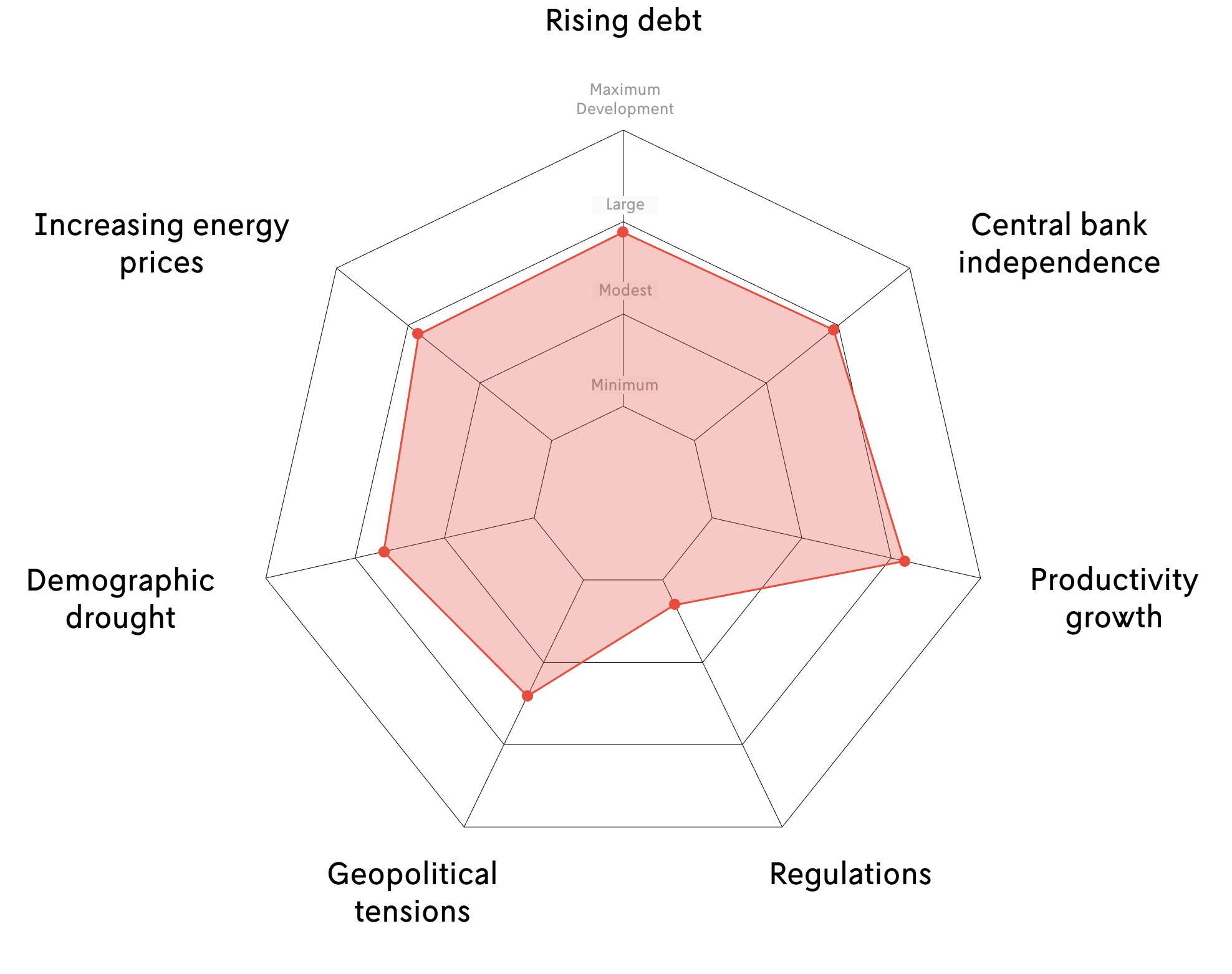
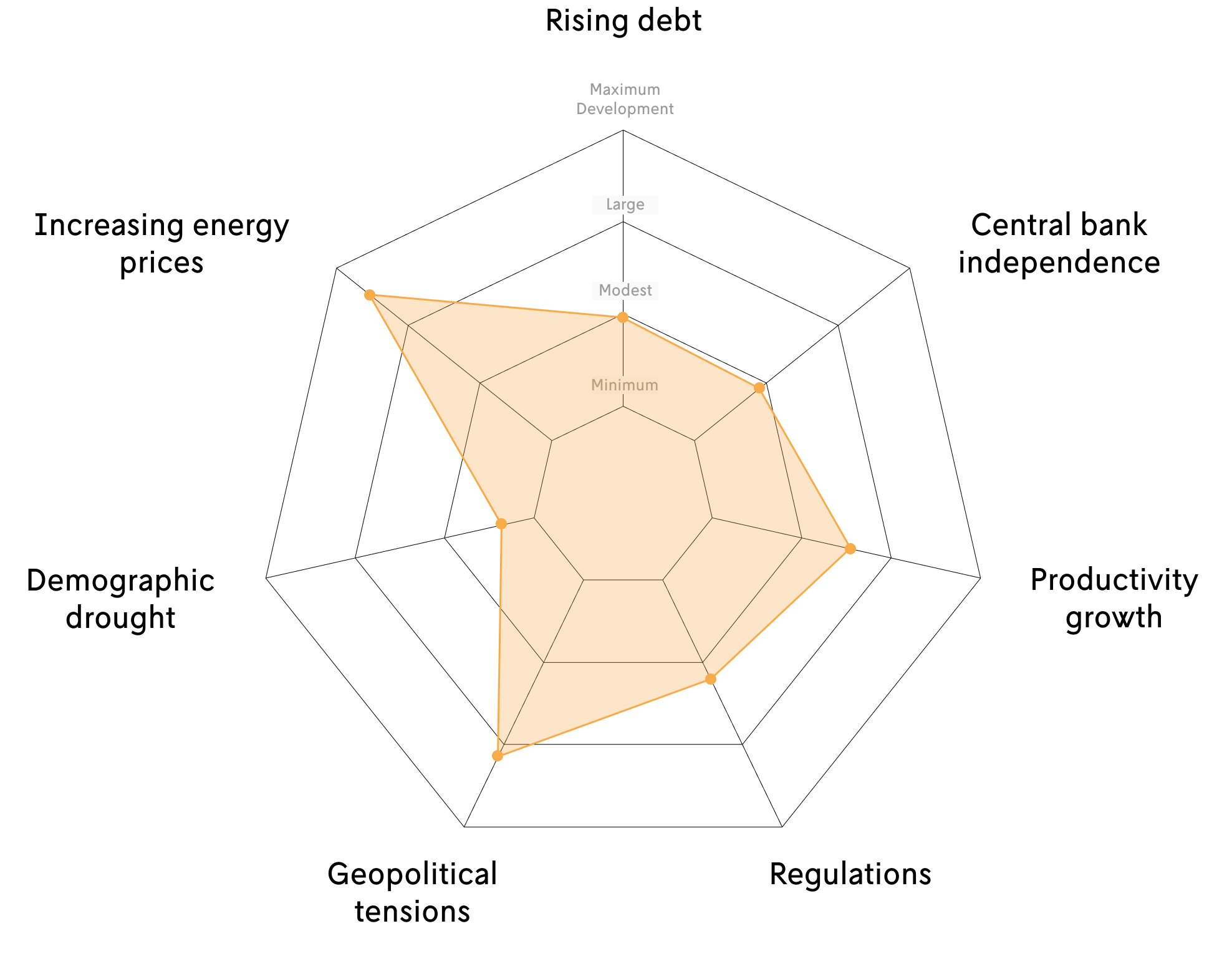
In our scenario-building process, we focused on the following set of key driving forces that will influence the future of the global economy:

  • Rising Debt
  • Demographic drought
  • Increasing energy prices
  • Geopolitical tensions
  • Regulations
  • Central bank independence
  • Productivity growth

In each scenario, we examine the different ways these drivers may evolve in the years ahead, as well as the different ways they may interact and influence each other. All four scenario descriptions also include a development timeline section, which lists three to six steps that could plausibly happen to move us closer to the given scenario. The purpose of this section is to give readers a list of signs and indicators to look out for when monitoring future developments.

Scenario 1: Hyperinflation leads to global famine

In a global climate marked by instability and deficient monetary policies, inflation spirals out of control. As superpower rivalry intensifies, a weakening dependency ratio and stagnant productivity growth increase debt levels. Prices for essential commodities and raw materials—such as fertilizers, grain, and oil—skyrocket. Despite the surging inflation, central banks find themselves unable to raise interest rates adequately due to political pressures and mounting debt.

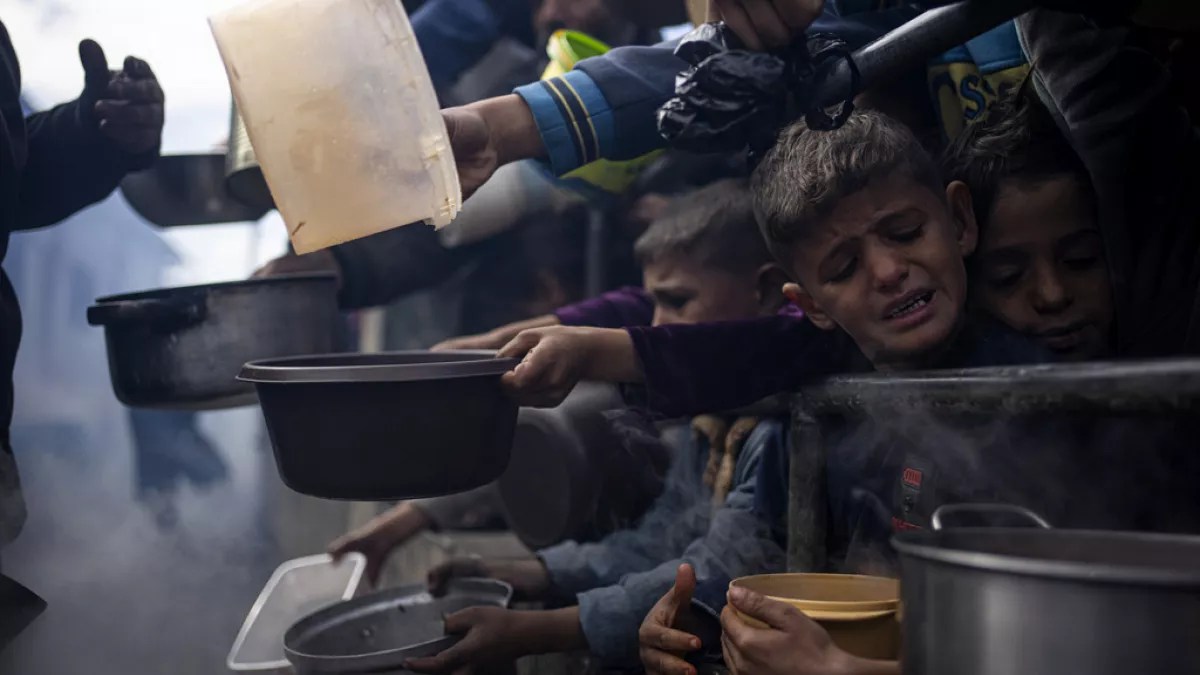
In an effort to revive struggling economies, new monetary stimulus programs are introduced, but these measures backfire, triggering hyperinflation. The economic shock is severe and immediate. Global trade grinds to a near halt. Amidst the chaos, people hoard goods, and the barter system reemerges. Starvation becomes rampant, with some regions facing deadly famine.
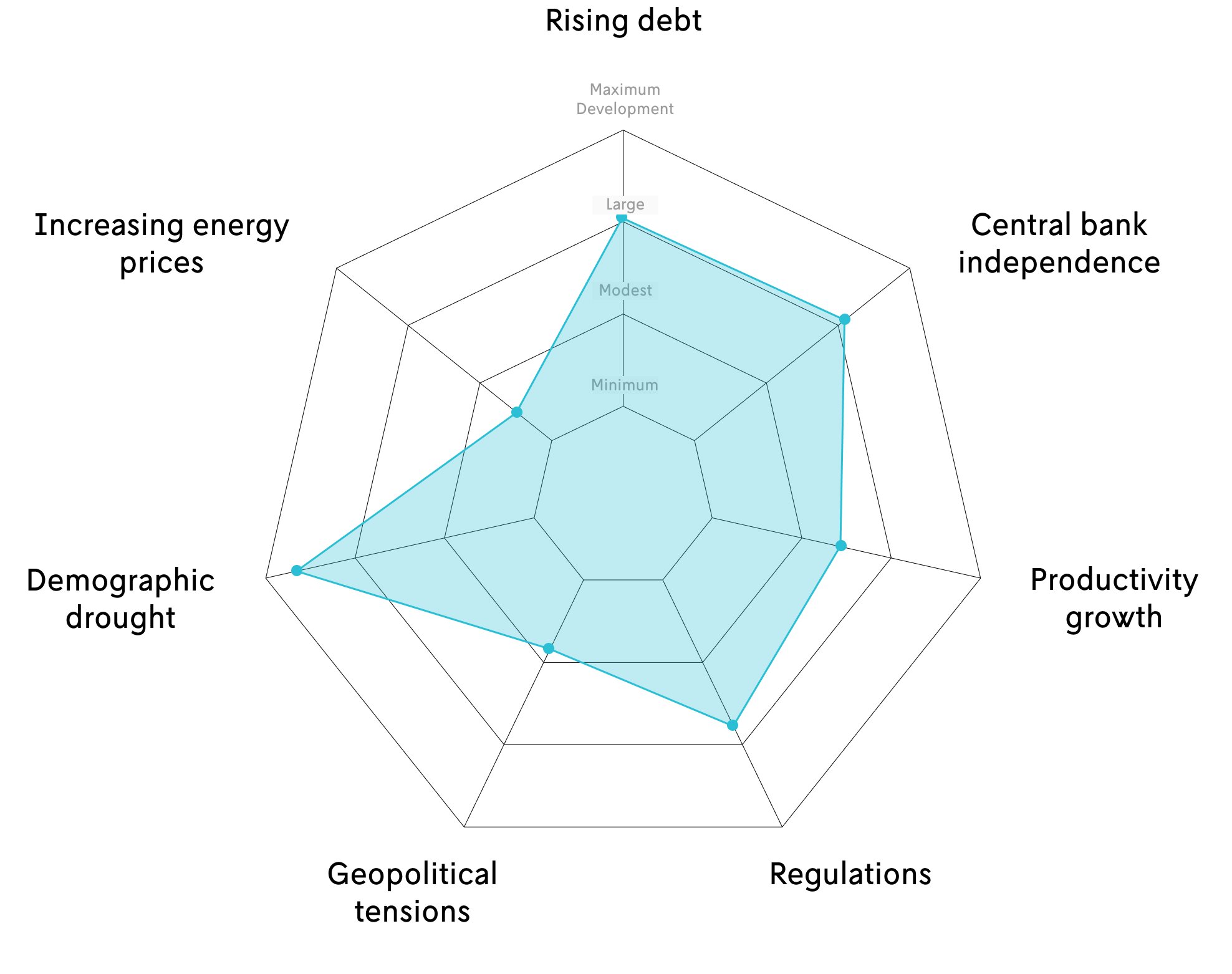
Western currencies are forcibly tied to the dollar, which provides a temporary solution to the problem of high indebtedness. Yet, the broader economic landscape remains fraught with uncertainty and instability as nations navigate the aftermath of these turbulent changes.

Development path for scenario 1

2025: Economic growth remains sluggish, with governments still running large deficits post-pandemic. Intensifying economic competition between China and the US leads to increasing trade tariffs and further strains global markets.

2027: China forms alliances and trade agreements with raw material-rich countries. Emerging markets significantly increase their share of Chinese exports, driving up global demand and prices for commodities.

2029: A proxy war between the US and China erupts in the Pacific, causing severe supply chain disruptions. Economic prospects deteriorate sharply, with soaring inflation eroding wages and plunging many into poverty.

2030: Western central banks are reluctant to raise interest rates amid political and economic pressure. Instead, they implement monetary stimulus measures, causing inflation in Europe to spiral abruptly out of control.

2035: The culmination of all these factors leads to a global famine.

Scenario 2: Deregulation leads to an asset bubble, culminating in a global financial crisis

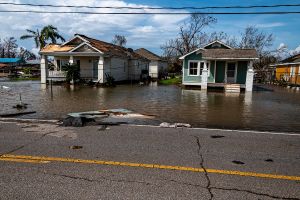
After a prolonged period of sluggish growth, governments opt to deregulate the financial sector to eliminate constraints. In the short term, this decision boosts productivity, economic growth, and employment rates. However, it also causes a sharp and unsustainable rise in the market values of assets and housing. The accumulation of high debt ultimately leads to a catastrophic bubble burst.

As the bubble bursts, capital flows into safe assets such as US bonds. Homeowners and households experience a dramatic collapse in their net wealth, leading to a wave of foreclosures. Though devastating, the financial collapse accelerates long-term productivity growth by eliminating unproductive firms from the market.

Development path for scenario 2

2026: A gradual ideological shift in politics sparks a demand for renewal of the Basel Accords.

2028: Looser financial regulations are implemented, boosting investments, income, and demand for housing and assets.

2030: Urbanisation adds pressure to housing prices. Private debt and asset prices reach record highs.

2032: The economy overheats, leading to a contraction in the housing market. A chain reaction of collapsing banks ensues, triggering a financial crisis.

Scenario 3: Demographic crisis leads to permanent economic stagnation

Global demographic changes severely impact economic growth, leading to a slow and painful stagnation. A shrinking labour force undermines fiscal stability and hampers economic expansion. Despite borrowing and investing, governments are largely powerless to cope with these structural shifts.

The labour shortage drives up labour costs, empowering workers to dictate terms in the job market. This dynamic increases unemployment and further exacerbates the dysfunction of the labour market. Consequently, the growth in real income and living standards in the Western world grinds to a permanent halt. Consequently, the megatrends of urbanisation and globalisation also begin to reverse as people move away from high-cost urban centres and countries turn inward to focus on domestic issues.

Development path for scenario 3

2025: Governments grapple with rising pension costs and a shrinking labour force. Low-skilled immigration fails to provide sufficient tax revenue.

2032: Birth rates plummet to unprecedented lows. While technological progress boosts individual labour output, automation solutions remain unfeasible.

2040: Despite growing R&D investments, returns diminish as labour continues to be a crucial component for increasing production.

2045: Low economic prospects drain investments and consumption, causing the global economy’s growth trend to turn negative permanently.

Scenario 4: Global economic volatility leads to widespread stagflation

A weak and volatile global economy faces the dual challenges of high inflation and deep depression. Superpower competition and severe geopolitical tensions disrupt supply chains and increase production costs, driving high inflation. In response, central banks sharply raise interest rates, which deepens the economic downturn.

Unemployment and bankruptcies surge, leading to widespread austerity measures around the world, particularly in the unstable euro area. Shortages of imports and basic goods become common. Recovery is sluggish due to stringent fiscal and monetary policies that prolong economic stagnation.

Development path for scenario 4

2027: Global polarisation intensifies as some countries try to challenge the status quo of the US hegemony. Supply chain disruptions drive up commodity prices.

2029: Technological obstacles hinder the transition to green energy, leading to rising energy prices.

2030: Significant interest rate hikes occur worldwide. Consumer price inflation remains high, and the global economy falls into a depression. Consequently, the world economy enters a prolonged period of stagflation.

The ‘Great Blackout’ is Arguably the Most Expedient Pathway Towards the Great Reset! What Would Happen if a Solar Flare Blackout, EMP, Or A Plague Killed All Technology? How Much Harder Would Life be?

It’s one or two years after an EMP attack and you are safely tucked away in your retreat somewhere in the middle of nowhere. Your storage foods have mostly been used and your high tech electronics is useless. The really bad stuff is mostly past. Now it’s try to stay fed and alive and pray that civilization as you know it is coming back. You’re going to have to work your environment to live. Ever wonder what life might be like? What would it really be like to have no running water, electricity, sewer, newspaper or Internet? No supermarket or fire department close at hand?

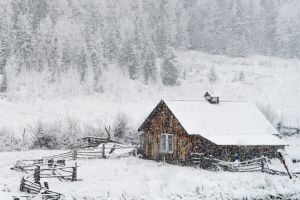
I have a good imagination but I decided to talk to someone who would know first hand what it was like: my mother. She grew up on a homestead in the middle of Montana during the 1920s and 1930s. It was a two room Cottonwood cabin with the nearest neighbor three miles away. She was oldest at 9, so she was in charge of her brother and sister. This was her reality; I feel there are lessons here for the rest of us.

There was a Majestic stove that used wood and coal. The first person up at four thirty A.M., usually her father, would start the fire for breakfast. It was a comforting start to the day but your feet would get cold when you got out of bed.

A crosscut saw and axe was used to cut wood for the stove and after that experience, you got pretty stingy with the firewood because you know what it takes to replace it. The old timers say that it warms you when you cut it, when you split it, and again when you burn it. The homes that were typical on homesteads and ranches of the era were smaller with lower ceilings than modern houses just so they could be heated easier. The saw and axe were not tools to try hurrying with. You set a steady pace and maintained it. A man in a hurry with an axe may loose some toes or worse. One side effect of the saw and axe use is that you are continuously hungry and will consume a huge amount of food. Lights in the cabin were old fashioned kerosene lamps. It was the kid’s job to trim the wicks, clean the chimneys and refill the reservoirs.

The privy was downhill from the house next to the corral and there was no toilet paper. Old newspaper, catalogs or magazines were used and in the summer a pan of barely warm water was there for hygiene. During a dark night, blizzard, or brown out from a dust storm, you followed the corral poles-no flashlights.

There were two springs close to the house that ran clear, clean, and cold water. The one right next to it was a “soft” water spring. It was great for washing clothes and felt smooth, almost slick, on your skin. If you drank from it, it would clean you out just as effectively as it cleaned clothes. Not all clean water is equal.

The second spring was a half mile from the cabin and it was cold, clear, and tasted wonderful. The spring itself was deep – an eight foot corral pole never hit bottom- and flowed through the year. It was from here that the kids would fill two barrels on a heavy duty sled with water for the house and the animals. They would lead the old white horse that was hitched to the sledge back to the buildings and distribute the water for people and animals. In the summer, they made two trips in the morning and maybe a third in the evening. In the winter, one trip in the morning and one in the evening. They did this alone.

Breakfast was a big meal because they’re going to be working hard. Usually there would be homemade sausage, eggs and either cornmeal mush or oatmeal. More food was prepared than what was going to be eaten right then. The extra food was left on the table under a dish towel and eaten as wanted during the day. When evening meal was cooked, any leftovers were reheated. The oatmeal or the mush was sliced and fried for supper. It was served with butter, syrup, honey or molasses.

The homemade sausage was from a quarter or half a hog. The grinder was a small kitchen grinder that clamped on the edge of a table and everybody took turns cranking. When all the hog had been ground, the sausage mix was added and kneaded in by hand. Then it was immediately fried into patties. The patties were placed, layer by layer, into a stone crock and covered with the rendered sausage grease. The patties were reheated as needed. The grease was used for gravies as well as re-cooking the patties. Occasionally a fresh slice of bread would be slathered with a layer of sausage grease and a large slice of fresh onion would top it off for quick sandwich. Nothing was wasted.

Some of their protein came from dried fish or beef. Usually this had to be soaked to remove the excess salt or lye. Then it was boiled. Leftovers would go into hash, fish patties, or potato cakes.

The kitchen garden ran mostly to root crops. Onion, turnip, rutabaga, potato and radishes grew under chicken wire. Rhubarb was canned for use as a winter tonic to stave off scurvy. Lettuce, corn, and other above ground crops suffered from deer, rats, and gumbo clay soil. Surprisingly, cabbage did well. The winter squash didn’t do much, only 2 or 3 gourds. Grasshoppers were controlled by the chickens and turkeys. There was endless hoeing.

Washing clothes required heating water on the stove, pouring it into three galvanized wash tubs-one for the homemade lye soap and scrub board, the other two for rinsing. Clothes were rinsed and wrung out by hand, then hung on a wire to dry in the air. Your hands became red and raw, your arms and shoulders sore beyond belief by the end of the wash. Wet clothing, especially wool, is heavy and the gray scum from the soap was hard to get out of the clothes.

Personal baths were in a galvanized wash tub screened by a sheet. In the winter it was difficult to haul, heat and handle the water so baths weren’t done often. Most people would do sponge baths.Everybody worked including the kids. There were always more chores to be done than time in the day. It wasn’t just this one family; it was the neighbors as well. You were judged first and foremost by your work ethic and then your honesty. This was critical because if you were found wanting in either department, the extra jobs that might pay cash money, a quarter of beef, hog or mutton would not be available. Further, the cooperation with your neighbors was the only assurance that if you needed help, you would get help. Nobody in the community could get by strictly on their own. A few tried. When they left, nobody missed them. You didn’t have to like someone to cooperate and work with him or her.

Several times a year people would get together for organized activities: barn raising, butcher bee, harvest, roofing, dance, or picnics. There were lots of picnics, usually in a creek bottom with cottonwoods for shade or sometimes at the church. Always, the women would have tables groaning with food, full coffee pots and, if they were lucky, maybe some lemonade. (Lemons were expensive and scarce) After the work (even for picnics, there was usually a project to be done first) came the socializing. Many times people would bring bedding and sleep out overnight, returning home the next day.

A half dozen families would get together for a butcher bee in the cold days of late fall. Cows were slaughtered first, then pigs, mutton, and finally chickens. Blood from some of the animals was collected in milk pails, kept warm on a stove to halt coagulation and salt added. Then it was canned for later use in blood dumplings, sausage or pudding. The hides were salted for later tanning; the feathers from the fowl were held for cleaning and used in pillows or mattresses. The skinned quarters of the animals would be dipped into cold salt brine and hung to finish cooling out so they could be taken home safely for processing. Nothing went to waste.
The most feared occurrence in the area was fire. If it got started, it wasn’t going out until it burned itself out. People could and did loose everything.
The most used weapon was the .22 single shot Winchester with .22 shorts. It was used to take the heads off pheasant, quail, rabbit and ducks. If you held low, the low powered round didn’t tear up the meat. The shooters, usually the kids, quickly learned sight picture and trigger control although they never heard those terms. If you took five rounds of ammunition, you better bring back the ammunition or a critter for the pot for each round expended. It was also a lot quieter and less expensive [in those days] than the .22 Long Rifle cartridges.

If you are trying to maintain a low profile, the odor of freshly baked bread can be detected in excess of three miles on a calm day. Especially by kids.

Twice a year the cabin was emptied of everything. The walls, floors, and ceilings were scrubbed with lye soap and a bristle brush. All the belongings were also cleaned before they came back into the house. This was pest control and it was needed until DDT became available. Bedbugs, lice, ticks and other creepy crawlies were a fact of life and were controlled by brute force. Failure to do so left you in misery and maybe ill.

Foods were stored in bug proof containers. The most popular was fifteen pound metal coffee cans with tight lids. These were for day to day use in the kitchen. (I still have one. It’s a family heirloom.) The next were barrels to hold the bulk foods like flour, sugar, corn meal, and rice. Everything was sealed or the vermin would get to it. There was always at least one, preferably two, months of food on hand. If the fall cash allowed, they would stock up for the entire winter before the first snowfall.

The closest thing to a cooler was a metal box in the kitchen floor. It had a very tight lid and was used to store milk, eggs and butter for a day or two. Butter was heavily salted on the outside to keep it from going rancid or melting. Buttermilk, cottage cheese and regular cheese was made from raw milk after collecting for a day or two. The box was relatively cool in the summer and did not freeze in the winter.

Mice and rats love humanity because we keep our environment warm and tend to be sloppy with food they like. Snakes love rats and mice so they were always around. If the kids were going to play outside, they would police the area with a hoe and a shovel. After killing and disposing of the rattlesnakes- there was always at least one-then they could play for a while in reasonable safety.

The mice and rats were controlled by traps, rocks from sling shots, cats and coyotes. The cats had a hard and usually short life because of the coyotes. The coyotes were barely controlled and seemed to be able to smell firearms at a distance. There were people who hunted the never-ending numbers for the bounty.

After chores were done, kid’s active imagination was used in their play. They didn’t have a lot of toys. There were a couple of dolls for the girls, a pocket knife and some marbles for the boy, and a whole lot of empty to fill. Their father’s beef calves were pretty gentle by the time they were sold at market – the kids rode them regularly. (Not a much fat on those calves but a lot of muscle.) They would look for arrow heads, lizards, and wild flowers. Chokecherry, buffalo berry, gooseberry and currants were picked for jelly and syrups. Sometimes the kids made chokecherry wine.

On a hot summer day in the afternoon, the shade on the east side of the house was treasured and the east wind, if it came, even more so. Adults hated hailstorms because of the destruction, kids loved them because they could collect the hail and make ice cream.

Childbirth was usually handled at a neighbor’s house with a midwife if you were lucky. If you got sick you were treated with ginger tea, honey, chicken soup or sulphur and molasses. Castor oil was used regularly as well. Wounds were cleaned with soap and disinfected with whisky. Mustard based poultices were often used for a variety of ills. Turpentine, mustard and lard was one that was applied to the chest for pneumonia or a hacking cough.

Contact with the outside world was an occasional trip to town for supplies using a wagon and team. A battery operated radio was used very sparingly in the evenings. A rechargeable car battery was used for power. School was a six mile walk one way and you brought your own lunch. One school teacher regularly put potatoes on the stove to bake and shared them with the kids. She was very well thought of by the kids and the parents.

These people were used to a limited amount of social interaction. They were used to no television, radio, or outside entertainment. They were used to having only three or four books. A fiddler or guitar player for a picnic or a dance was a wonderful thing to be enjoyed. Church was a social occasion as well as religious. 
The church ladies and their butter and egg money allowed most rural churches to be built and to prosper.

The men were required to do the heavy work but the ladies made it come together. The civilizing of the west sprang from these roots. Some of those ladies had spines of steel. They needed it. That’s a partial story of the homestead years. People were very independent, stubborn and strong but still needed the community and access to the technology of the outside world for salt, sugar, flour, spices, chicken feed, cloth, kerosene for the lights and of course, coffee. There are many more things I could list. Could they have found an alternative if something was unavailable? Maybe. How would you get salt or nitrates in Montana without importing? Does anyone know how to make kerosene? Coffee would be valued like gold. Roasted grain or chicory just didn’t cut it.

I don’t want to discourage people trying to prepare but rather to point out that generalized and practical knowledge along with a cooperative community is still needed for long term survival. Whatever shortcomings you may have, if you are part of a community, it is much more likely to be covered. The described community in this article was at least twenty to thirty miles across and included many farms and ranches as well as the town. Who your neighbors are, what type of people they are, and your relationship to them is one of the more important things to consider.

Were there fights, disagreements and other unpleasantness? Absolutely. Some of it was handled by neighbors, a minister or the sheriff. Some bad feelings lasted a lifetime. There were some people that were really bad by any standard and they were either the sheriff’s problem or they got sorted out by one of their prospective victims. 
These homesteaders had a rough life but they felt they had a great life and their way of life was shared by everyone they knew. They never went hungry, had great daylong picnics with the neighbors, and knew everyone personally within twenty miles. Every bit of pleasure or joy was treasured like a jewel since it was usually found in a sea of hard work. They worked hard, played hard and loved well. In our cushy life, we have many more “things” and “conveniences” than they ever did, but we lack the connection they had with their environment and community.

The biggest concern for our future: What happens if an event such as a solar flare, EMP, or a plague takes our society farther back than the early 1900s by wiping out our technology base. Consider the relatively bucolic scene just described and then add in some true post-apocalyptic hard cases. Some of the science fiction stories suddenly get much more realistic and scary. A comment out of a Star Trek scene comes to mind “In the fight between good and evil, good must be very, very good.”

Consider what kind of supplies might not be available at any cost just because there is no longer a manufacturing base or because there is no supply chain. In the 1900s they had the railroads as a lifeline from the industrial east.

One of the greatest advantages we have is access to a huge amount of information about our world, how things work and everything in our lives. We need to be smart enough to learn/understand as much as possible and store references for all the rest. Some of us don’t sleep well at night as we are well aware of how fragile our society and technological infrastructure is. Trying to live the homesteader’s life would be very painful for most of us. I would prefer not to. I hope and pray it doesn’t ever come to that.How long would it take us to rebuild the tools for recovery to the early 1900 levels?   Beans? There was almost always a pot of beans on the stove in the winter time. Chickens and a couple of milk cows provided needed food to balance the larder. They could not have supported a growing family without these two resources.

US Government Has Killed More Than 20 Million People In 37 “Victim Nations” Since WW2

The “U.S. government” is comprised of a wide variety of different people, many of which are good and decent human beings. So this obviously does not represent everyone who works in the government. More importantly, this does not represent U.S. citizens either, so please do not fall into the trap of defending the crimes of your government, because you feel yourself personally under attack. Identify yourself with integrity, humanity and Truth, not a criminal government or group.

After the catastrophic attacks of September 11 2001 monumental sorrow and a feeling of desperate and understandable anger began to permeate the American psyche. A few people at that time attempted to promote a balanced perspective by pointing out that the United States had also been responsible for causing those same feelings in people in other nations, but they produced hardly a ripple. Although Americans understand in the abstract the wisdom of people around the world empathizing with the suffering of one another, such a reminder of wrongs committed by our nation got little hearing and was soon overshadowed by an accelerated “war on terrorism.”

But we must continue our efforts to develop understanding and compassion in the world. Hopefully, this article will assist in doing that by addressing the question “How many September 11ths has the United States caused in other nations since WWII?” This theme is developed in this report which contains an estimated numbers of such deaths in 37 nations as well as brief explanations of why the U.S. is considered culpable.

The causes of wars are complex. In some instances nations other than the U.S. may have been responsible for more deaths, but if the involvement of our nation appeared to have been a necessary cause of a war or conflict it was considered responsible for the deaths in it. In other words they probably would not have taken place if the U.S. had not used the heavy hand of its power. The military and economic power of the United States was crucial.

This study reveals that U.S. military forces were directly responsible for about 10 to 15 million deaths during the Korean and Vietnam Wars and the two Iraq Wars. The Korean War also includes Chinese deaths while the Vietnam War also includes fatalities in Cambodia and Laos.

The American public probably is not aware of these numbers and knows even less about the proxy wars for which the United States is also responsible. In the latter wars there were between nine and 14 million deaths in Afghanistan, Angola, Democratic Republic of the Congo, East Timor, Guatemala, Indonesia, Pakistan and Sudan.

But the victims are not just from big nations or one part of the world. The remaining deaths were in smaller ones which constitute over half the total number of nations. Virtually all parts of the world have been the target of U.S. intervention.

The overall conclusion reached is that the United States most likely has been responsible since WWII for the deaths of between 20 and 30 million people in wars and conflicts scattered over the world.

To the families and friends of these victims it makes little difference whether the causes were U.S. military action, proxy military forces, the provision of U.S. military supplies or advisors, or other ways, such as economic pressures applied by our nation. They had to make decisions about other things such as finding lost loved ones, whether to become refugees, and how to survive.

And the pain and anger is spread even further. Some authorities estimate that there are as many as 10 wounded for each person who dies in wars. Their visible, continued suffering is a continuing reminder to their fellow countrymen.

It is essential that Americans learn more about this topic so that they can begin to understand the pain that others feel. Someone once observed that the Germans during WWII “chose not to know.” We cannot allow history to say this about our country. The question posed above was “How many September 11ths has the United States caused in other nations since WWII?” The answer is: possibly 10,000.

Comments on Gathering These Numbers

Generally speaking, the much smaller number of Americans who have died is not included in this study, not because they are not important, but because this report focuses on the impact of U.S. actions on its adversaries.

An accurate count of the number of deaths is not easy to achieve, and this collection of data was undertaken with full realization of this fact. These estimates will probably be revised later either upward or downward by the reader and the author. But undoubtedly the total will remain in the millions.

The difficulty of gathering reliable information is shown by two estimates in this context. For several years I heard statements on radio that three million Cambodians had been killed under the rule of the Khmer Rouge. However, in recent years the figure I heard was one million. Another example is that the number of persons estimated to have died in Iraq due to sanctions after the first U.S. Iraq War was over 1 million, but in more recent years, based on a more recent study, a lower estimate of around a half a million has emerged.

Often information about wars is revealed only much later when someone decides to speak out, when more secret information is revealed due to persistent efforts of a few, or after special congressional committees make reports

Both victorious and defeated nations may have their own reasons for underreporting the number of deaths. Further, in recent wars involving the United States it was not uncommon to hear statements like “we do not do body counts” and references to “collateral damage” as a euphemism for dead and wounded. Life is cheap for some, especially those who manipulate people on the battlefield as if it were a chessboard.

To say that it is difficult to get exact figures is not to say that we should not try. Effort was needed to arrive at the figures of 6six million Jews killed during WWI, but knowledge of that number now is widespread and it has fueled the determination to prevent future holocausts. That struggle continues.

Our “Leaders” Ceded National Sovereignty at 1992 “Earth Summit”- Like the COVID hoax, climate change is a flimsy pretext to impose a globalist communist tyranny.


Left, The WEF wants to return humanity to the stone age. Technology is reserved for them.

Like the COVID hoax, climate change is a flimsy pretext to impose a globalist communist tyranny. At the Rio Earth Summit in 1992, almost 200 countries worldwide agreed to disenfranchise their citizens and join the climate change psy op designed to enslave, rob and cull humanity.

“The First Global Revolution: A Report to the Club of Rome (1991),” reads “In searching for a new enemy to unite us, we came up with the idea that pollution, the threat of global warming, water shortages, famine, and the like would fit the bill. All these dangers are caused by human intervention, and it is only through changed attitudes and behavior that they can be overcome. The real enemy then, is humanity itself.”

“A key achievement of the 1992 conference was the establishment of the United Nations Framework Convention on Climate Change (UNFCCC) established in part as an international environmental treaty to combat “dangerous human interference with the climate system” and to stabilize greenhouse gas concentrations in the atmosphere. It was signed by 154 states at the United Nations Conference on Environment and Development (UNCED). By 2022, the UNFCCC had 198 parties. Its supreme decision-making body, the Conference of the Parties (COP) meets annually to assess progress in dealing with climate change.

“A key achievement of the 1992 conference was the establishment of the United Nations Framework Convention on Climate Change (UNFCCC) established in part as an international environmental treaty to combat “dangerous human interference with the climate system” and to stabilize greenhouse gas concentrations in the atmosphere. It was signed by 154 states at the United Nations Conference on Environment and Development (UNCED). By 2022, the UNFCCC had 198 parties. Its supreme decision-making body, the Conference of the Parties (COP) meets annually to assess progress in dealing with climate change.

from Jan 16, 2024

The 1992 Earth Summit on climate change in Rio de Janeiro, organized by the United Nations, brought together the most extreme environmental activists from around the world to deal with the supposed threat of global warming, and Agenda 21 was the document they drew up.

What came out of the Rio Summit was summed up by the radical environmentalists themselves, and one United Nations-approved introduction to the Agenda 21 document claimed that:

Effective execution of Agenda 21 will require a profound reorientation of all human society, unlike anything the world has ever experienced — a major shift in the priorities of both governments and individuals and an unprecedented redeployment of human and financial resources. This shift will demand that a concern for the environmental consequences of every human action be integrated into individual and collective decision-making at every level.

The document left no one alone, stating that: There are specific actions which are intended to be undertaken by … in short, every person on Earth.

quote-what-if-a-small-group-of-world-leaders-were-to-conclude-that-the-principal-risk-to-the-maurice-strong-71-38-79.jpgWhat it means for Americans is more than just an end to fossil fuels; it means a lower standard of living.

The strategy for implementing Agenda 21 was much broader than ever attempted before by the environmentalist movement. They sought global treaties and national legislation, as in the past. They also sought to shame individuals and corporations into changing their behavior on a voluntary basis. That, too, was not new. But they began fighting for “soft-law” changes to consumers’ living standards. “Soft law” is the use of centralized governments to bribe with aid either smaller government sub-units (states or localities) or private companies for following ever-more stringent eco-standards with tax breaks or outright cash “aid.”

On the state and local level, the push for “soft law” is led by the International Council for Local Environmental Initiatives, or ICLEI, which had been founded a couple of years before the Rio Summit. More than 1,000 state, county, and municipal government organizations around the world are ICLEI members and are pushing this radical environmentalist agenda with bribes and stiffer regulations. In many American towns, local officials boast about the impact of ICLEI in the form of putting state rebate checks on display for properly following new environmentalist incentives. For example, John Birch Society New England Regional Director Hal Shurtleff was able to point out that:

“Here is what’s disturbing. Here is a check, made out to the City of Newburyport from the Massachusetts Executive Office of Energy and Environmental Affairs. And why is this check on display? This is the second such check that I have found in a city or town that belongs to the ICLEI, the International Council on Local Environmental Initiatives, which is a government-to-government entity, unconstitutional on its face. Their goal is to implement Agenda 21, what they call “soft law” that came out of the Rio conference in 1992, very hostile to property rights, and freedoms.

ICLEI has become a big part of the subsidy and regulation regime on the state and local levels, but it’s not the only part of the eco-subsidy agenda. That also extends to the White House, where President Obama has called for the government to start picking winners and losers in the markets for more energy-efficient products. President Obama boasted in his May 6, 2011, weekly address to the nation that he would continue to “invest” in green jobs.

This is part of the reason why huge corporations such as General Electric were able to claim a $3.25 billion tax credit in 2010, paying no corporate income taxes last year. GE cashed in on federal “tax credits” for green projects, such as its wind turbine projects.

Of course, nobody objects to private companies offering more fuel-efficient automobiles or creating products that don’t fill up landfills. The problem with ICLEI and Agenda 21 is that they primarily seek governments to pick winners and losers in the marketplace. Governments usually pick the wrong winners. That was the lesson from the housing bubble of the last decade. The federal government promoted home ownership by subsidies, tax credits, and suppression of interest rates, and crashed the economy. The government doing the same thing on green jobs will do the same thing to the economy on a much larger scale.—

First Comment from RH-
No human in their right mind would sign off on a statement saying: 

“The real enemy then, is humanity itself.”
Who declares himself a real enemy to himself? 

We need to look at their actions, not words.  What they mean is we are the enemy.  It is their corporations that pollute, colonize territories to exploit labor (Niger, as one example), create shortages (famines and energy) and cause real or imaginary sicknesses.  These things harm us, not so much them. They will not change this behaviour voluntarily.

“The federal government promoted home ownership by subsidies, tax credits, and suppression of interest rates, and crashed the economy.”

My feeling is that the federal government was and still is carrying the water for the banks.  Home loans are a form of usuary to home borrowers. 30 year loans?  A generation ago, 15 years was considered too long.   Savings and Loans companies were too beneficial to home owners, so they had to be liquidated and they were in 1980s.  Tax credits centralize housing ownership to syndicators and make us renters not owners.  Banks were (and are) so greedy they speculated on home loans and that crashed the economy.  But, the banks were bailed out while the home owner was foreclosed on.  

Gerald Celente is saying we are “unbanking.”  We are withdrawing our money from the banks.  

He also says, when all else fails, they take us to war.  This could be interesting, eh?

Interesting! 10 Expenses You Need to Cut Now for the Upcoming Economic Depression

Nobody has said it yet, but the Coronavirus has turned into a TEOTWAWKI event. Not the kind of “end of the world we knew” event that we all expected, but still one nevertheless. No matter how many people end up getting sick and how many die, the current changes in the ways we do things are so severe, that many of these are likely to end up becoming a permanent part of our society.

Some of them will not necessarily be for the best. Our government, at all levels, has taken a huge amount of authority upon itself, much of which is of questionable legality. While I don’t think that there are many people who would argue the government’s right to quarantine, shutting down churches and other places of worship as “non-essential” comes directly against our First Amendment rights.

But the real question is whether or not the government is going to be willing to give up all that control that they’ve taken. Historically, governments which gain control over something are not quick to give that control up. What’s to make any of us think that they will do so in this case?

Nevertheless, for the moment, many of us are obeying various government mandates to stay home, with companies telling as many of their employees that can, to do so as well. So, as we all sit in our homes, trying to telecommute with noisy kids in the background and our spouses on the other side of the table, working on their computer, we need to start thinking ahead. There will be an end to all this and we will have to emerge from our caves to see the light of the sun once again.

But what sort of world will we emerge into? Experts are forecasting that anywhere from 20 to 34 percent of our workforce will be laid off during the course of this pandemic. If we come anywhere near the top end of those predictions, it will be huge; much worse than the Great Depression. Unfortunately, from the viewpoint of where we are today, a worldwide economic depression seems to be in all of our futures, starting even before the pandemic burns out.

So how can you and I prepare ourselves for that coming depression? There are actually many things that we can do, but the first of them is to restructure our finances. Specifically, get rid of, or at least cut down on unnecessary expenses, so that we are ready when the depression hits.

Car Payments

10 Expenses You Need to Cut Now for the Upcoming Economic Depression

Many families are paying more for their two car payments, than they are for their mortgage payment. If you think about that for a minute, it really doesn’t make much sense.

But cars and light trucks have gone up incredibly in price, at least partially due to all the bells and whistles they put on a car these days.

In a financial collapse, the people who are hit the hardest are those which are in debt. Those car payments are some of the biggest debt you have. So, it only makes sense to attack it first.

Trading your cars in for something used, but still in good condition, can save you a lot of money from your monthly payments. If you’re fortunate to find a good deal, you might even be able to get rid of one of those payments, really saving yourself some money.

Entertainment Expenses

The home computer has evolved into an entertainment center, or maybe the home entertainment center has evolved into a computer. Either way, many of us are spending a fair amount on cable service, plus an assortment of different movie websites. Netflix is no longer enough, producers have decided to divide and conquer, requiring us all to have multiple subscriptions in order to see all the movies we want to.

The obvious problem with this is that it can get rather expensive. Not only that, but it’s obviously an unnecessary expense. Now, I realize you might not agree with that, especially with your kids home from school. But at least find out how to cancel your subscriptions and have the information handy, so that if you have to, you can pull the plug on them.

Service Expenses

10 Expenses You Need to Cut Now for the Upcoming Economic Depression

From mowing our lawns, through curbside pickup of our groceries, to having a mechanic repair our cars, we all pay others to do things for us. That’s fine, when you can afford it, helping others to have jobs.

But when the economy goes belly up, you’re going to need to save that money.

One of my favorite money saving techniques is that I’m a consummate do-it-yourselfer. I do everything from making gifts for my wife to making my own furniture, with car repairs somewhere in-between. The more you can do for yourself, the less you have to pay others to do. And in the midst of the next depression, you probably won’t be able to afford paying someone else to do it.

Coffee Habits

10 Expenses You Need to Cut Now for the Upcoming Economic Depression

How much do you spend on coffee every month? Do you even know? How about every day? You should be able to figure that out.

That can add up to quite a bit over a month, especially if you’re buying the high-dollar made to order lattes and cappuccinos.

You can get just as good a cup of coffee, including all the assorted flavoring syrups, in your own kitchen. It might take a little experimentation to get it right, but you can probably even get a better cup of coffee than what you’re buying right now. And you can do it without paying seven bucks a cup.

Eating Out

Speaking of coffee, let’s expand on that idea. How much do you spend a month on eating out? If you happen to be the average American family, then that figure is somewhere between $250 and $300 per month. If you eat lunch out or from the cafeteria at work, that figure might be even higher.

There’s nothing wrong with eating out, just as long as it’s not in excess. How much is excess? That depends on how much you make. So for most of us, that figure is likely to be changing, sometime in the next few months. With that being the case, wouldn’t it be a good idea to start working on it now?

Don’t go overboard on take-out, just because you’re part of the lockdown going on. Take this time to experiment with some new recipes, so that you can keep your family happy, without having to eat out all the time.

Vices

10 Expenses You Need to Cut Now for the Upcoming Economic Depression

Speaking of coffee again, there are those people who would call coffee an addiction.

This includes people who are at least emotionally addicted to having their two cups in the morning, before they are human enough to talk to anyone without biting their hand off.

Another word we can use for that is “vice”, a word normally associated with smoking, drinking, gambling, prostitution and drugs.

I’m not trying to accuse you of anything, but if you smoke or drink, this might be a good time to think of quitting. The cost of a few beers a day or a couple of packs of smokes may not seem like much, but it does add up. I’m sure you could find something better to do with the extra $150 to $350 a month than a two-pack-a-day habit can cost.

Unnecessary Monthly Payments

Creditors, especially the big credit card companies, have worked overtime to convince us all that the way to buy anything is on credit. That’s led us to having an average credit card debt of $6,028. While some of those purchases may have been necessities, I’d venture to guess that many are things we could have waited to buy, if we had a little more patience.

Either way, they are a problem or, more likely, they will be a problem when the economy collapses and we’re stuck holding that debt. As with any other debt, it will be one more (or several more) creditors calling and asking us when we’re going to pay our bills. If you’ve secured that debt with some sort of collateral, you might end up losing whatever you’ve put up to cover the debt.

Excessive Shopping

10 Expenses You Need to Cut Now for the Upcoming Economic Depression

This one might cause some battles in your home, but how about cutting out unnecessary shopping? The trick here is to determine what really qualifies as unnecessary.

Women will say that all the “toys” that men buy are unnecessary and men will say that all the clothes their wives buy are. Either way, between the toys and the clothes, it can get really expensive.

Here’s something you can try, if you want to get a real handle on your shopping expenses. Make a deal with each other, that before you can buy something, you have to get the other to agree that it is necessary. If she wants a new pair of shoes, she’s got to convince her husband that she actually needs them. Likewise, if he wants to buy a tool, he’s got to convince her that he can’t do the pending repair or other project without it.

Quit Replacing Things

10 Expenses You Need to Cut Now for the Upcoming Economic Depression

Long ago our society transitioned to being a disposable society. Other than some pretty major things, like cars and houses, we no longer repair anything.

We throw it away and replace it. In many cases, there’s no other option.

But we’ve gone far beyond that now, in that we don’t just replace things that are broken, we replace things that are just fine, for no other reason than because they are “old”.

Of course, our definition of old in many cases is highly subject to questioning, as last year’s cell phone model really isn’t old, just because the company has come out with a new one. Yet many of us will replace that phone, just to have the new one, “complaining” that our old one “Just doesn’t work right anymore”.

Smartphones aren’t the only thing we do this with. We also do it with eyeglasses, frying pans and even dishes. Once people had a mixed batch of dishes, because they kept using the remainder of a set, when some of them got broken. Today, we’ll throw away the rest of the set or donate it to charity, just so we can buy a new one.

There’s nothing wrong with using something that’s “old”, as long as it works. Why not try to see how long you can keep that cell phone or those glasses, rather than seeing how quickly you can replace them?

Avoid Gimmick Products

Our homes are filled with gimmicks and gadgets. Some are obvious, while others manage to slip under the radar. One of those is cleaning supplies. There’s really not much you can’t clean with Clorox in a spray bottle, but many of us have special cleaners for the bathtub, the kitchen, our appliances and even the toilet. Not so surprisingly, most of those “special” products are basically the same thing, in different packaging.

Figure out what you really need and stick with it. Don’t let Madison Avenue convince you that you need their latest product, just because it’s “New” and “Different”. It’s probably neither. All that’s new is the packaging and the advertising campaign.

They Are Preparing For What’s Coming- Will the Liberals or the Conservatives Start a Civil Unrest?

Prepping is a safeguard against a whole range of possible scenarios, and everyone has their own opinions about what’s most likely to happen and what would be the biggest threat. There’s one thing pretty much everyone can agree on, though, and that’s that widespread civil unrest is going to bring on a social collapse, at least in the affected areas and maybe right across the country.

Who’s likely to cause this civil unrest, though? Does anyone have the ability to throw large parts of the USA into chaos? We’ve all seen often enough how local issues can spark unrest in a neighborhood or even a small city, but could the same happen on the scale of a county, a state, the whole Midwest or Atlantic seaboard?

Yes it could, and the most likely way it’s going to happen is that some incident upsets politically active people – not just in the town where it happens, but across the state or the country – so much they decide enough is enough, and try to bring about a radical change. That’s happened hundreds of times throughout history, in all sorts of countries – and while the USA is unique in many ways, it’s not unique enough to be immune from the threat of mass civil unrest.

Experts don’t argue about whether unrest could happen in the USA. It could; that’s a done deal. What they do argue about is where it’s most likely to come from. Any part of the political spectrum can be pushed into rebellion but for that to happen to the majority who’re pretty much in the center, things really have to be bad. More usually, when unrest happens it comes from either the right or left. It doesn’t always come from people who could be labeled as extremists either – often it’s people who’re identifiably to one side of center, but not particularly hard line.

Left or Right: Who Wants to Fight?

Listen to anyone on the left and they’ll tell you that the biggest threat of civil unrest comes from heavily armed groups on the “far right” or “alt right”. On the other hand, speak to anyone on the right and they will say that the real danger is the organized and violent flash mobs of Antifa and other “far-left” groups. Are they both correct, or is one – even both – wrong?

There’s no doubt that left and right both have extremes who’re more than willing to use violence. There aren’t a lot of them on either side though, so it’s unlikely they could directly cause widespread civil unrest. What they might be able to do is cause enough trouble to provoke a backlash from the mainstream on the other side, and that really could become civil unrest.

Thanks to the media it’s right-wing extremists who get the most attention, but in fact their numbers are every small. There are neo-Nazi and white supremacist groups in the USA, but most of them are tiny and too disorganized to cause any serious trouble. There have been lone wolf terrorists on the American far right, with Timothy McVeigh being the most notorious. They’re sometimes capable of committing serious atrocities, but mass civil unrest is beyond them.

Left-wing extremists are more numerous, unfortunately. The largest extreme left group in the USA right now is Antifa – but, with an estimated 15,000 hardcore members, even Antifa isn’t big enough to create civil unrest at a national level. Law enforcement could put down an Antifa uprising inside a couple of days. The far left might not like that, but it’s still a fact.

The mainstream menace?

But what about the mainstream left – the tens of millions of Americans who see themselves as on the left of the spectrum, but reject extremist positions like Marxism? Could they reduce the country to chaos? Yes, they could.

Mainstream leftists don’t have the enthusiasm for violence that groups like Antifa are notorious for, but they do have an endless appetite for getting involved in causes. Any perceived “injustice”, from border control to employment policies, is likely to attract a horde of protesting lefties. Usually nothing much happens beyond legitimate political protest, but sometimes things can get out of control.

If there’s a large protest movement, and its members feel they’re not being taken seriously, tempers can rise. If the people who’re getting angry are well enough organized this is where civil unrest can break out – and the problem is that large parts of the left are very well organized. This end of the political spectrum is closely linked to labor unions and a large, interlocking network of pressure groups; they’re very good at spreading messages, exploiting social media and getting people mobilized.

Many on the left also don’t have a lot of respect for the society we live in. They would like to see it “reformed” into something that fits their ideas better, and this attitude makes it easy for them to justify breaking the law. That’s why left-wing protests are prone to violence and looting; if everything you see around you is a symbol of oppression and inequality, it’s tempting to lash out.

The mainstream right is a bit different. It’s nothing like as well organized, for a start. The vast majority of right-of-center Americans aren’t actually very interested in politics, because they’re focused on work and family. When right-wingers do get annoyed about a political issue they’re less likely to do anything about it, for the same reason – they’re busy getting on with their lives.

On the other hand, if the right do get pushed hard enough that they decide to take action, they’re a lot more capable of creating some serious unrest. A lot of that is down to the simple fact that the right have more guns than the left, and tend to know how to use them. Any large, heavily armed, combat-effective insurgency in the USA would pretty much have to come from the right; the left just don’t have many people with those sort of skills.

Where’s the danger?

Both liberals and conservatives have the potential to create mass civil unrest if they decide they want to. That shouldn’t be a surprise; people are people, whatever they believe, and while some belief systems seem to encourage violence in their followers any of us can be pushed to rebellion by the right factors.

If conservatives rose up that would be more disruptive, and more dangerous to the government. Firstly, conservatives are more heavily armed; secondly they have an inbuilt respect for law and order, so for them to start overthrowing society they have to be very angry.

Realistically, though, the political left is the main threat when it comes to civil unrest. They’re organized, they get upset easily and there are a lot of them. Most unrest in western countries is caused by leftist groups, and the USA Is just as vulnerable as anywhere else. Our citizens might be better armed to protect themselves, but mass action by the left could still tear society apart in a hurry. If that happens, all the systems we rely on in everyday life will soon fall apart across the whole area affected by the disorder – and, unless you’re prepared for that, you’re in for a pretty hard time.

Hollywood in Crisis – A Principality Falls in an Avalanche of Scum, Body Parts, and Anguish

Here’s an excellent overview of what’s going down at the moment with the P. Diddy reveals by Elizabeth Nickson.

We repeat that it is more than likely that these Hollywood take-downs of P. Diddy &Co. happened some time ago, most of the perpetrators already dealt with. Hollywood has been a ghost town, according to certain commentators, for several years now.

Notice the hideous picture of a Mother of Darkness at the beginning of the article.

Listen to the end (1 minute 43 seconds). Putin knows precisely what he’s saying about literal cannibalism —

********

A Principality Falls in an Avalanche of Scum, Body Parts, and Anguish – Hollywood in Crisis

The Grand Wizard’s spell has been broken and not a minute too soon

   ELIZABETH NICKSON

U.S. Attorney Damian Williams said:

“As alleged in the Indictment, for years, Sean Combs used the business empire he controlled to sexually abuse and exploit women, as well as to commit other acts of violence and obstruction of justice.  Today, he is charged with racketeering and sex trafficking offenses.  If you have been a victim of Combs’ alleged abuse – or if you know anything about his alleged crimes – we urge you to come forward.  This investigation is far from over.”

Hollywood’s reputed Mother of Darkness
.

Absurdistan has been picking away at the sheer ghastliness of the entertainment business for two years, but this?

The P. Diddy fall is a bonanza. People are literally running for the hills, CEOs and politicians resigning en masse and vanishing from the public stage.

It is instructive and fascinating too, that the trigger, the arrest of the P. Diddy, and the revelations of his crimes, has roiled the black community like nothing I’ve seen before. Rappers, producers and comics have been telling these stories for a decade, but were dismissed. Their lives, the culture of black America, has been polluted by the worship of gangsters, rap and drugs, heavily and relentlessly promoted by Hollywood. Chief among those promoters, Diddy.

Now Katt Williams, Tina Torres, Corey Feldman, Ally Carter, Jaguar Wright and others are shown to be right. And they claim to know much much more about the corruption, the dark abomination among elites like the Obamas, Ashton Kutcher, Justin Bieber, Russell Simmons, Leonardo de Caprio, Princes Harry and Andrew, Tyler Perry, Will and Jada Smith, Kelly Osborne, Martha Stewart, Oprah, Rick Ross, Usher, Cuba Gooding Jr., Lebron James, TD Jakes. Clive Davis is identified as the puppet master.

The abuse lawsuits are mounting, including a class action, and yesterday the Buzbee Law Firm was appointed lead counsel for fifty individuals who were assaulted by Diddy and the sports, film and political stars who went to “freak-offs”. The J Lo marriage collapse was said to be triggered by her involvement – the FBI visited Ben Affleck, and Ashton Kutcher’s participation has led his wife, Mila Kunis, to move out of the family house.

Dozens of other resignations have occurred in the two weeks since. But within the first 24 hours:

Here is the alleged list of participants in the P. Diddy “parties”. Let me draw it plain. They, allegedly, were the abusers of the children and young adults enmeshed in the Diddler’s coils. Because they weren’t just orgies, they were rapes. The current film, Blink Twice, is said to be a description of how innocents were drawn in and then assaulted.

This would just be another round of performative circus distractions running up to the Big Election, but accompanied by the collapse of Hollywood production, fallen by 60% this year, and the shuttering of one division after another in various conglomerates, might be the Hollywood death blow the culture frankly needs. Like broadcast news, then cable news, Hollywood has been losing audience share for years, to the point where productions have picked up and moved to countries like Ireland. But sixty percent? In any other industry that would be terminal.

For a decade or more, they have skated on premium television, but the productions have methodically mutated into stuff that is so vile, so violent, so shorn of beauty or virtue a full half of America has just turned it off.

Here are some testimonies of experienced film makers begging for work. They are heart rending. Were their product not so abusive, one would pity. Instead, there is a certain grim satisfaction derived from listening to the pleas.

The following are the accusations of insiders and, if any of this is true, is much much worse than any of us can imagine:

Oprah is a handler. She keeps people silent and is fully complicit and activist in the Diddy network. Jay Z murdered any young singer that threatened Beyonce’s status, including his mistress and unborn child the day Beyonce’s first pregnancy was announced. Jay Z’s house was raided late last week, and he is said to be more powerful and more evil than Diddy. Diddy was refused bail because it was thought he would try to murder witnesses.

The Diddler (as he is called by his black accusers) drugs children so that they are pliable during the rituals, where according to witnesses, CEOs, sports and film stars, politicians and senior bureaucrats will rape many children, dismember a child or two, and eat them in a frenzied solicitation of Lucifer or Baal or Baphomet.

I am sorry to publish this on a Sunday, but an acknowledgement of the evil that lives among us is a station on the spiritual path. (ER: Agreed!)

The Sinaloa Cartel was still Catholic enough to be disgusted and in a vain attempt to out him, they lodged a suit against Diddy in New York. Underground tunnels are said to link Diddy’s neighborhood with the Playboy Mansion, once the seat of darkness, with the Getty, where some of the rituals are performed.

To continue with the accusations of insiders: this group – the Kardashians, Oprah. Diddy, Jay Z. – etc are so rich because they traffic children across the U.S. The 320,000 that have crossed the border during the Biden/Harris administration are caught in their web. These men and women are members of the Brulee, the black cohort in the Illuminati. The use of children as sacrifice to the dark gods for the purpose of wealth and fame and power has been entrenched in Hollywood’s culture because it is a fast conduit. In fact, unless you are a member, prepare to be marginalized.

Satanism, once a hobby of the dark elites and a few repellent outsiders, is mainstream. And Diddy is a high priest. The “freak-off” tapes are used as blackmail, and are sold on the dark web; the last one, which included Rihanna, for $500,000, according to Jaguar Wright. There appears to be some kind of a glitch that the higher you climb on the ladder of fame, the more humiliating semi-public acts and rituals you must perform. Every advance is accompanied by more appalling blackmail tapes.

#Jaguar Wright

Wright has been blowing the whistle for a long time
.

As far as I can make out, the least repulsive crime this man is accused of is running “freak off” parties that entrapped young stars in compromising positions, so that they are controllable; at the same time, immuring them in a life more seedy than you and I want to imagine. The Kings, the abusers of the young, are powerful sports stars, famous actors and politicians. This week, in an interview between Tucker Carlson and Roseanne, Roseanne states that when she was hospitalized, many of the young people in care had been victims of these freak-off parties, their lives and innocence so destroyed they could no longer function. Here is one example of a young singer who prayed her way out of gang rape by Diddy and Kanye. She is part of a class action against both.

Kanye found Jesus at some point, and started warning people about what had been happening. During his conversion – conversions can be arduous – he collapsed from exhaustion and despair, and Diddy, the Kardashian/Jenners and Lou Taylor, who engineered Britney Spear’s conservatorship, attempted to steal his fortune and have him committed. Britney’s lost fortune is said to have been invested in the Kardashian empire via Taylor, who manages their various enterprises and fortune.

Here is Kanye, saying “I told you”. (ER: Apologies to readers for not being able to insert this 14-second Tiktok clip, but to us, this doesn’t look like Kanye West at all. So where’s the original?)

And of course, Diddy was running a blackmail operation that lured in politicians, CEOs, university presidents and sports stars, and addicted them to dark practices, extreme sexual expression, and black magic. People have been poking around the Kardashians for years now, looking for the criminality. The accusations come to focus around Kris Jenner setting up a church through which she launders their money, and the principal way they make their money is through child trafficking. Kim has been interviewed by the Feds, since the raids, given what was found in videos at P Diddy’s residences.

Evidence shows that Diddy washed money through JD Jake’s church. Rumour has it that Ben Affleck divorced Jennifer Lopez because he was warned by the FBI. The old case of the nightclub shooting has raised its head again, that the gun belonged to Lopez and since her hands were covered by gunshot residue, the shooting could be reopened. (ER: According to pictures we’ve seen, Affleck has been replaced prompting the question, where is he?)

Justin Bieber seems to be the most pitiable character caught up in this. By the accounts of many witnesses (two used to be enough for Time Magazine btw) Bieber was first signed by Usher, who had been raped and ‘owned’ by Diddy, and at some point Bieber was traded off to Diddy and used in the freak-offs as a particular prize to be passed around. After Bieber collapsed, quit the industry, joined Hillsong Church, and met and married Hayley Baldwin, both of whose parents are devout Christians, he began to talk. But it was clear, from his tragic mien, that the kid had been badly used. The release of his song, “I lost my soul at a Diddy party”, is at the top of the charts this week. One line: “I lost my soul and so much more.”

There are thousands of hours of videotape in the hands of the FBI. Enough to collapse one of our world’s principal profit centers and the most malignant propaganda tool the world has even known.

ER: GRAPHIC WARNING – this is the video about Frazzle Drip involving the torture of a 15 year old girl by Hillary Clinton and Huma Abedin.

Ally Carter, who has been testifying as a child survivor since 2020, and who went viral in 2021, states she went into Child Protective Services at the age of 13 and was trafficked by Riverside Child Protective Services. This tailors with the evidence from border patrol, that Child Protective Services is the conduit through which migrant children are trafficked.

“These were not freak-offs,“ says Ally Carter. “These were Satanic ritual orgies. And the victims were the children.” This is the final connection. The revolting sexual activity of the stars of Hollywood is just a cover up of the Satanic Ritual Abuse – SRA – of tens of thousands of children. And, as Carter says, those stars knew what was going on, that children were being abused, raped and killed, and did nothing.

This class action announced on Friday afternoon could end with thousands of named victims and every star who attended those parties is liable.

When retribution arrives, it is a mighty force. I pray this is the time. At the end of Blink Twice, directed by insider Zoe Kravitz, the victims end up owning the empire. One could wish for no greater resolution.

ER: Apologies to readers for not being able to upload this 48 section Tiktok video on the lawsuit filed against P.Diddy.

Here is Ally Carter explaining what happened to her as a drugged fifteen year old, a “party favor”, at a Diddy party. Trafficked by CPS. It is graphic.

#Ally Carter

‘You don’t live in the world you think you do’

ER: Apologies for not being able to include this video. It’s 7 minutes and we do recommend watching it.

Genocide is their End Game: Those with any assets worth stealing are then given an ultimatum – hand them over or starve or be sent to the debtors’ prison, which in the US will doubtless mean utilization of the vast sprawling network of FEMA camps.

“In a nutshell, they are to cull a large percentage of the human race and to turn the survivors into a completely controlled army of slaves who own nothing and are dictated to and tracked, traced and monitored 24 / 7 everywhere, even inside their own homes, which of course they will no longer own.”

“It only starts to make sense when you understand that everything that has happened and is happening is due to a meticulously planned and sinister plot being implemented by the narrow clique of gangsters who now control our world.”

The period from 1945 to 2019 was for many a “Golden Age” – a period of relative peace, prosperity, stability, and freedom. This has now ended as the most dangerous and destructive timeline in the history of the World has begun, initiated by malevolent and extremely ruthless Plutonian forces characterized by a complete lack of empathy intent on creating a global totalitarian regime. If this timeline is not derailed soon – and there is little sign that it will be – the result will be death, destruction, and enslavement on a biblical scale for the majority of humanity and we are already seeing this starting. Examples of other such inflection points in history that lead to catastrophe are the shooting of Archduke Ferdinand in Sarajevo that triggered the onset of the 1st World War and the declaration of war on Germany by Britain in 1939, using the excuse that it had a pact with Poland, but what we are seeing now is an order of magnitude higher and truly global in nature so that nowhere on Earth will escape the dragnet. This time around the trigger is the timed release of a relatively harmless virus that has been heavily hyped by the media non-stop to make the public think it is akin to the Black Death.
With respect to the timing of the release of the virus and attendant media hysteria, this was determined by two factors. One was that the global debt situation had become critical with the world economy on the verge of collapse – they needed a crisis to provide the excuse for another orgy of money creation, so they crashed world markets into March and put the blame on the virus.

The way the heist works couldn’t be simpler. Those in control collapse the world economy and force the majority of its population into massive debt just to survive. Those with any assets worth stealing are then given an ultimatum – hand them over or starve or be sent to the debtors’ prison, which in the US will doubtless mean utilization of the vast sprawling network of FEMA camps
Around this time a large proportion of the world’s population deemed surplus to requirement and an unnecessary burden on the environment and a nuisance will be culled (meaning killed) either by lethal injection or starvation…

We now have almost the entire world population unknowingly engaging in occult rituals that are designed to transport them into a new subservient reality. This is the first time this has ever happened in the history of the world… It is important to understand that this narrow but extremely wealthy and powerful clique at the top of the pyramid already controls everything – Central Banks including and especially the Fed, governments, politicians, and judiciaries, who are nearly all “for sale”, the clergy, the media, etc. 

(left, Clive Maund) 
They don’t entirely control the internet yet …but they are working on it, and soon they will close this window. As for their objectives, in a nutshell, they are to cull a large percentage of the human race and to turn the survivors into a completely controlled army of slaves who own nothing and are dictated to and tracked, traced, and monitored 24 / 7 everywhere, even inside their own homes, which of course they will no longer own.
 Their grandiose plans include clearing the countryside of those who aren’t culled so that it can “return to nature” apart from the private estates of the NWO that will be replete with an army of servants and private security. Survivors occupying the countryside after The Great Cull will be coerced and eventually forcibly removed to heavily surveilled box type high rise living quarters in the cities that they may have to share on a rotating basis with others, which will be made easier by them owning no property, perhaps in the manner of Japanese “love hotels”. 
The NWO is of the view that the world is grossly overpopulated, and they are right, it is, with the massively bloated population placing a crushing burden on planetary ecosystems…the NWO is going to intercede and forcibly reduce their numbers via lethal vaccines with a “kill switch” which is why the virus vaccines will be compulsory or via a deliberately induced wave of mass starvation caused by supply chain disruptions, such as is now imminent, or a combination of the two.


There are three big reasons for all the severe restrictions imposed this year, which are as follows. They are eliminating as much human interaction as they can, in order to destroy social cohesion, isolate people and prevent them from exchanging ideas and thus learning the truth of what this is all about, so reducing the chances of insurrection and possible revolution, and also for good measure to weaken them psychologically and physically. 

This is why they have closed down all places where people meet – bars cafes and pubs, restaurants, gyms, etc. and even art galleries, churches and museums, and are making people afraid of interacting with each other via masks and antisocial distancing, etc. It is particularly important to stop churchgoers’ meetings because those with faith have principles and believe in something bigger than themselves which gives them the courage to act that many others lack.
 A big reason for the lockdowns is to destroy as many small businesses as possible in order to make people dependent, either on large corporations for employment, which they control or on government handouts such as the pending Universal Guaranteed Income (UGI), which you will only receive if you behave yourself and accept all their diktats. The NWO is already talking about people owning nothing by 2030 and being happy and we can already see how they will bring this about. 
As mentioned above they will do it by crashing the economy and forcing people to go heavily into debt just to survive. They then come along and make you an offer you can’t refuse, saying “You have to pay back that debt, but you can’t, so we will eliminate it for you in exchange for all of your property.” 
Through this method, they will be able to acquire most Real Estate owned by people in what will be the biggest heist of all time. Some of you may have already seen the WEF video You’ll own nothing. And you’ll be happy that starts with a grinning idiot who clearly at least owns, or at least rents, a good tube of toothpaste. 
What we have witnessed this year is absolute insanity on a global scale, all purportedly for an illness that is not much different from the flu and kills less than 1% of its victims, and has virtually no effect on the young. We have seen society destroyed with the forced prevention of human interaction, bars, cafes, and pubs closed and millions forced out of business, concert halls and museums closed and football games played before empty stadiums. 

Children having their development stunted and being psychologically scarred by being shut indoors and isolated from their classmates and friends, people told how many people they can have visited their house, etc. It is sheer lunacy, and yet, up to now, people have gone along with it due to being brainwashed and weak. It only starts to make sense when you understand that everything that has happened and is happening is due to a meticulously planned and sinister plot being implemented by the narrow clique of gangsters who now control our world.
 Their goals have been set out above, which include exterminating 70% or more of the population and herding the rest into high tech urban ghettoes to be farmed as slaves, where their every move and even their thoughts will be monitored and controlled. THE SECRET TO STOPPING THEM IS FOR MILLIONS TO WITHDRAW THEIR SUPPORT AND REFUSE TO GO ALONG WITH THEIR DEMANDS, REGARDLESS OF PERSONAL CONSEQUENCES. That is the only way to derail this apocalyptic timeline that is fast-tracking the majority of the population towards either death or slavery.

The Wealthiest People Preparing For The Financial Crisis- The Only Thing we Can do is Prepare for an Economic Collapse!

The worst thing about a financial collapse is that you cannot predict when it is going to happen, how soon it will happen, or how long it will last for.

All you can do is take the steps needed to prepare for an economic collapse, embrace frugal methods, and start thinking about your bank and wallet as a survival tool, rather than a spending tool.

When the last economic crisis hit, the 2008 financial crisis, the world was shocked at the speed in which it set in. From what started as a meltdown in the US mortgage market, the rest of the world collapsed in a domino effect in rapid succession.

For most of us, that economic collapse was something we just weren’t prepared for, and for those that were not prepared, it was a very tough period.

The question everyone is asking now is ‘when is the next economic collapse?’. It could be this year, the next or in five years. But as many economists argue, we are due for one, and the next one could be much worse than the previous financial downturns.

Since the only thing we can do is ready ourselves for another economic downturn, we take a look at 8 steps you can start taking now to survive an economic collapse.

But first, let’s take a look at some of the basics, to understand why we need to prepare for an economic collapse.

What is an economic collapse?

Simply put, an economic collapse, interchangeably used with the term financial collapse, is a series of very severe economic conditions. Many survivalists and preppers say an economic collapse is the one thing that they are preparing for, as it includes several symptoms that place risk on our necessary needs, such as food, water, power, and safety.

One of the worst factors about a financial collapse is the fact that it doesn’t abide by a timeline. Natural disasters, for instance, while very destructive, are short, with their duration measuring only for days let alone weeks. This allows recovery efforts to commence almost immediately. Economic downturns, however, are unmeasurable in length and for most, will last a minimum of a year, with the aftereffects resonating for several years as a nation recovers.

During an economic collapse, some symptoms affect large companies and industries, with very visible signs, felt in the family home. For instance, common symptoms of collapse are high bankruptcy rates, widespread unemployment, hyperinflation, a spike in death rates (attributable to depression or other financial causes), social collapse, and a high increase in crime.

What is an Economic collapse?

What causes an economic collapse?

Financial systems can be affected by a large number of different scenarios, and for the most part, a country can bounce back quite quickly with severe financial fluctuations going undetected by the majority of the population. But for the causes, they seem to be factors that can create a ripple effect in a country’s financial industry, resulting in economic loss shockwaves.

If we look back at history, one financial collapse is not like the other. Yes, their symptoms are the same and in the home, loss, grief, and stress are all experienced, but their causes remain unique.

The 2008 Global Financial crisis was triggered by factors such as the burst of the US housing bubble, easy credit conditions, fraudulent lending services, overleveraging, and shadow banking practices. This is different from Venezuela’s economic collapse, which has only been felt in that country and not across the world. In Venezuela, the causes of its economic crisis were caused by presidential policies and a fall in oil prices as well as several other contributing factors. Since its beginning, Venezuela has experienced severe spikes in crime, corruption, poverty, and hunger issues.

There have been some other economic downturns that have completely different causes but have all displayed widespread unemployment, poverty, hunger, and social chaos. They include:

  • 1998 Argentine Great Depression
  • 2001 Turkish Economic Crisis
  • 2008 Icelandic Financial Crisis
  • European Debt Crisis
  • 2014 Russian Financial Crisis

The economic crisis is not just limited to societies, it can also be limited at an individual level. But, an individual can recover much quicker than a society, by making good choices for him or herself. Keep in mind, this his pernicious crisis can likely be prevented or minimizes with some planning. Avoiding certain situations and leaning towards safe investing strategies can make all the difference.

What causes an economic collapse?

What are the warning signs of an economic collapse?

As we have seen above, a financial downturn can set in very rapidly, and before we know it we have lost our jobs, stores are shutting down, and we’re left high and dry. But there are some warning signs to watch out for. These are early indicators for a potential financial downturn and possible economic collapse.

Of course, your first source is to stay up to date with the news. All good survivalists are avid readers of politics, finance, and weather – the three things that can kick us out of our home or make us go hungry. So inevitably, they are the go-to sections for survivalists, and anyone else that cares about what happens in the world, and indirectly themselves.

According to Lombardi Letter, there are five signs that an economic collapse is about to happen. They are:

  1. Growing government debt: when an economy slows, the government usually steps in to help stimulate spending again, but with high debt, the government might not be able to make that injection.
  2. Stock markets trading at all-time highs: investors are taking more risk on the market, markets continue to trade higher meaning investments are bull-market driven and not research-based which could lead to a stock market bubble.
  3. Unemployment rate: eligible worker, retirement, and student rates all identify trends in people not contributing to the economy and could slow down economic growth
  4. Unstable government: this boils down to the leader and government team in the decisions and actions that may affect the economy in various ways
  5. Rising national debt: this means less consumer spending in the economy and more money spent on paying a debt.

Although those five economic collapse red flags are present in any collapse, there are also other things we can do to be ahead of a financial collapse disaster. And that is to look at what the warning signs displayed by the people involved in it all, America’s elite Wall Street executives and Silicon Valley entrepreneurs.

What are the warning signs of an economic collapse?

What are the world’s richest preppers doing?

A good sign of an economic downturn is when you see some of the world’s richest executives preparing for an economic disaster. You know things are about to go wrong if they are taking considerable efforts to protect themselves and their families.

Silicon Valley millionaires and Wall Street investors are buying big houses overlooking lakes in New Zealand and other underpopulated places in the world should they need the security of a hideaway to bug out to, should a severe financial downturn happen.

One of the world’s wealthiest technology entrepreneurs, and Trump advisor, Peter Thiel (co-founder of PayPal),  became a New Zealand citizen in 2011 and has a large family mansion fitted with panic rooms on a homestead property. He plans to live out an economic collapse in that self-sufficient mansion in New Zealand, far away from Silicon Valley, when the early warning signs appear. Facebook Product Manager Antonio Martinez has five acres of isolated land in the Pacific Northwest where he has stockpiled food, water, generators, and solar panels with shelter as a bug out location.

On the Wall Street executive side, a member of an investment firm, quoted in the New Yorker, has a helicopter on standby at all times to take him to his underground bunker where he plans on living out an economic collapse with a self-sufficient garden, power source and food and water supply. Meanwhile, Mayfield Fund managing director Tim Chang has bug-out bags for him, his wife and four-year-old, and several established bug-out locations in regional areas.

Richest preppers
Peter Thiel (middle) with President Trump.

How can you prepare for an economic collapse?

Let’s face it, we can’t fight an economic collapse, we can’t run from it either. Even if it were to be isolated to one country, such as in Venezuela, our savings would be very little in any other country, effectively trapping us and turning us into financial crisis refugees. The only thing we can do is prepare for an economic collapse and be a little more frugal when the going gets tough.

So let’s take a look at the 8 steps you can take to prepare for an economic collapse.

1. Learn simple economics so you can identify early warning signs

The list I provided above on economic collapse red flags to look out for is not a complete list, there are an endless amount of warning signs that you will be able to see if you regularly view financial news on the stock market’s performance and the nation’s economy.

Basic understandings of economics will help you in not only noticing an early downturn but will help you identify possible safe havens for your money and economic minefields that you should avoid.

How can you prepare for an economic collapse?

2. Cash is king

When you have cash, it’s buying power that many might lose. When I mention cash, this also refers to money in the bank. Just make sure that whatever investments you have, you can quickly liquidate them should you need to and secure the cash. I would recommend not having investments in anything that takes longer than a week to withdraw. As you have seen in the past, an economic recession can set in in the blink of an eye and some resources may not be valid for liquidating due to early bankruptcy.

If I can give any advice to financial collapse preppers out there, it would be to get your savings in a safe place. Savings and checkings accounts should always carry a certain amount of emergency money as these can be withdrawn quickly. This is much better than having all of your money in a term deposit account that provides restrictions on when you can withdraw your money.

Also try to have a set amount of cash on hand, especially if you are picking up warning signs of a recession. This amount of money will be able to act as an emergency stash until you can withdraw the money in your account and have your assets liquidated.

cash is king in an economic collapse

3. Start building an emergency cash fund

An emergency fund should not be in credit, it should be from the cash you saved in a savings account from your monthly income. You can file this in any savings account with your bank (most allow for a free account to be opened). This fund is essentially a do not touch fund, or as some prefer to call it, a SHTF fund. Make sure you have enough money to at least allow you to buy tickets to another country and support yourself and your family for a month.

This type of fund allows you to leave a country before the US dollar becomes weak and should provide for enough time to get a job in that country until the collapse has resided.

Prepping basics: how to start prepping

4. Start being more frugal with your monthly bills

When you have no money coming in, the worst thing to have is money coming out on expenses that you don’t need. Start minimizing your bills by going through them each month with a highlighter and seeing where most of your money is going. Is there a way to limit that? Perhaps the power is a little higher than it should be and the air-conditioning or heater is being left on?

Practicing sustainable methods such as organic gardening, generating your power, and utilizing your own space is a great way to also lessen monthly expenses and become more self-reliant in case of an economic collapse where regular comforts might not be reachable in the same manner as we are used to. You can invest in solar panels or grow your produce to supplement your food expenditures. This is also a growing trend as a lot of people are pushing towards self-sufficiency and off-the-grid methods.

A few of the people that have already moved to unpopulated areas are running gardens on their properties that can completely sustain their whole family all-year-round. It doesn’t take long to learn urban gardening skills or country homesteading skills and they are both very fun and rewarding tasks.

urban garden

5. Generate an additional (collapse-proof) form of income

Our writer from Venezuela was an engineer but started making cheese, learned to use a CNC crafting and cutting kit, and became a freelance writer for various websites as a way to find alternative income when his country’s economy collapsed.

Diversifying the income, and distributing the money in the accounts you believe you may need, and even your means to receive money is crucial. In an economy like this, I believe that keeping the 20% of the monthly income in silver would have worked, but Venezuela is not a place where preppers and people concerned about taking the direction of their future are plentiful, so a trading network would have been pretty difficult to set up.

Many try starting an at-home business to ensure they have a bit of extra cash each month aside from their normal job, and as a fallback when times are tough and they have faced job loss. Of course, those skills would have to be essential skills required in a collapse, which could be things such as sewing, gardening, building, repairs, selling your foods, accounting, and other things that households would regularly require.

employment in an economic collapse

6. Get out of debt

If you have considerable debt, build a strategy to get out of it as quickly as possible. In the case of a financial collapse, there will be multiple job losses and widespread income loss. The sooner you remove debt the sooner you can remove the worry of having to pay debts when you have no source of income.

As a method to manage any debt you have owing, try the following:

  • Create a spreadsheet budget plan in excel or online using a free budget calculator
  • Use a column for incomings and another for outgoings.
  • Create another column for your debt repayments and list their interest rates as well
  • Identify and rank each debt by their interest rates from high to low
  • As you find you have savings in the bank, pay off the debt with the highest interest rate
  • When that debt is paid off completely,  move onto the next one.
get out of debt

7. Make sure your passport is current

Should the country be at a point where it is about to take a steep dive downwards, it might be time to get out and spend some time abroad. This is a common move for many economic refugees as they wait for their country to regain financial security.

Your passport should have enough remaining time, with at least a few years on it so that you can avoid unnecessary complications with having to renew a passport overseas. Also, research countries that you might choose as a refuge destination and research their visa laws, as well as any possible employment there.

Make sure your passport is current

8. Start prepping

If a financial collapse does occur, you are going to want to start prepping so that, should an economic downturn occur, you have enough food saved up while you either grow your food in the garden to supplement it or find another source of free food. Chances are you will need food more than water as water will still run, but stores may close down and shelves may empty quite quickly.

Part of our guide to start prepping involves identifying a bug-out plan, location, a suitable bug out bag and bug out contents. If a true economic collapse was to occur, there will be a high increase in crime rates, social disorder, looting, and likely clashes with law enforcement and military. It is a safe option to consider leaving busy urban areas as these are most likely the areas that will be prone to violence.

how to be a prepper

9. Use Websites and Apps Now

In this age of technology, the best way to prepare is to make use of the applications and websites available to you. There are many investing applications to store money. Here is a list of best investing applications to consider.

Fidelity Investments is a well-known investment brokerage. The firm charges a fee or commission for executing buy and sell orders submitted by an investor. These brokerage accounts are operated through licensed firms. Through this, the investors deposit funds and buy investments. Fidelity has almost 200 investor centers around the United States. They assist customers on iMessage, google assistant, and Facebook messenger. The fidelity mobile application is fresher and easier that bring excellent trade executions and exchange-traded fund (ETF) research on the mobile screen.

The Robin Hood application has been very significant in the online brokerage industry since it launched in 2014 as a mobile application. It allows customers to buy and sell stocks without paying any commission. It offers an abundance of research, news, charting, and educational resources. It is successful because it allows individuals to open accounts with very little funds and gives them access to their entire platform.

The Acorns application is a newer kind of investment. It automatically links debit and credit card purchases while investing from them. It has 650 thousand members most of which are millennials. People can easily invest spare change to the next dollar on all purchases. Acorns do not charge a commission but they can charge one dollar per month fee on some accounts.

The Nutmeg application, which was launched in 2011, is a cheaper investment platform. It focuses on ETFs and tracker funds to provide wealth management services. The portfolio invested, as well as the different countries and industry sectors invested in, are reviewed regularly by Nutmeg. Even if the markets fluctuate, the portfolios will have the same exposure to each asset.

The TD Ameritrade mobile application is one of the most powerful platforms on the market. It gives a succinct brief on the market, as well as stock and portfolios. It allows the person to trade in foreign currencies and many other complex options. Large investment selection makes it the number one application. You’ll have access to research and top-notch customer support.

10. Expand your Skills

It is important to learn skills that can serve as an alternative to the individual’s job, should you lose your job. And, in the current climate of job globalization and automation, almost every sort of job is at risk. During the financial crises, there is a huge rate of unemployment. A person should utilize his skills in another industry or field so they can stand out from all the other candidates who will also be searching for jobs.

Over to you…

Many of us have already been affected by past economic downturns. They are reoccurring beasts that can be escaped. The only thing we can do is to ensure we are prepared so that we can survive the many problems that come with an economic collapse.

In this post, we have identified what is an economic collapse, how to tell when a financial collapse is about to happen, and how to prepare for an economic collapse. I hope this information has helped you form a more clear picture of how to start your economic collapse preparations.

Must Watch! FDA Blew Off Scheduled Meetings With COVID Vaccine Injury Victims, Emails Show

Despite public statements by government officials affirming the safety and efficacy of COVID-19 vaccines in early 2022, documents obtained by Children’s Health Defense (CHD) reveal that, at that time, public health officials were increasingly concerned about vaccine-related adverse events.

The 300 pages of documents released on Aug. 22 contain private correspondence from 2021 and early 2022 between U.S. Food and Drug Administration (FDA) and National Institutes of Health (NIH) officials, and emails from vaccine-injured individuals to NIH scientists.

CHD requested the documents via a Freedom of Information Act (FOIA) request in 2022. In April 2023, CHD sued the NIH to obtain the records after the agency failed to respond. In an October 2023 settlement, the NIH agreed to produce 7,500 pages of documents at a rate of 300 pages per month.

Last month’s tranche of documents showed that in late 2021 and early 2022, FDA and NIH officials privately expressed concerns about the growing rate of adverse events related to the COVID-19 vaccines — concerns that reached high-level FDA officials.

A Jan. 24, 2022, email (pages 239-240) to Dr. Janet Woodcock, the FDA’s principal deputy commissioner of food and drugs, and Peter Marks, M.D., Ph.D., director of the FDA’s Center for Biologics Evaluation and Research, alerted them to the existence of “scientific data” regarding adverse events.

The email, titled “Impromptu Meetup” and sent by an individual whose name is redacted, stated:

“We are in [Washington] DC the remainder of today and tomorrow. Some of our epidemiologists happen to be in town as well and would like to have the opportunity to review with you the scientific data they have.

“Also checking in to see what progress has been made with our researchers?”

In a reply later that day, Woodcock said, “We are evaluating the data and analyses that have been done on adverse events after vaccination, particularly neurologic AE’s” (adverse events).

However, she added that the FDA was “not having in person meetings” at that time but stated that “something could be set up for a discussion between the scientists but it would need to be scheduled to ensure the right people attend.” She did not clarify who the “right people” would be.

On the same day, Marks also responded to the email, stating that the FDA has “connected with” NIH researcher Dr. Avindra Nath — who was studying vaccine-related adverse events — and was “also working through contacting other physicians as well.”

Marks added that he “sent a note to our pharmacovigilance group to see if they can free up time today or tomorrow” but said that “setting up a virtual meeting at some point in the near future when there is more time to plan participants and the agenda may make sense.”

There is no indication as to whether this meeting ultimately took place.

The emails followed just months after another NIH scientist, Farinaz Safavi, M.D., Ph.D., of the NIH Division of Neuroimmunology and Neurovirology, appeared to acknowledge the potential dangers of COVID-19 boosters.

In a Sept. 30, 2021, email (page 129), Safavi told a vaccine-injured individual, “We do not have any data to suggest for or against booster shot [sic] but the consensus among our team is not to take if patient develop [sic] significant neurological complications post vaccine.”

The individual emailed Safavi earlier that day asking whether it was advisable to receive the then-new COVID-19 booster, despite saying that “nothing has really changed” regarding their symptoms.“I think my ears are still off, but I have gotten used to it.”

The injured person previously contacted Safavi earlier in 2021 complaining about injuries sustained following vaccination — describing in a March 26, 2021, email (page 136), “severe paresthesias in my face and scalp and tongue and chest band tightness,” and “severe muscle spasms in my scalp and jaw and even my gums and teeth hurt.”

Vaccine injury victims felt ‘very betrayed’

But while some people injured by the vaccines received replies and advice from NIH scientists, the latest documents showed that many others received no such replies. Some sent desperate emails to NIH scientists asking for help or an update.

For instance, in a Jan. 14, 2022, email (pages 234-235) to Nath, a vaccine-injured person praised Nath for his previous work helping the vaccine-injured, but then noted that he and other NIH scientists subsequently abandoned them. The email stated, in part:

“Dr. Safavi left a vaccine injured chat last September, something strange was going on. The active engagement from the spring and summer was replaced with distance and vague responses, then nothing. But then some people get telehealth visits, and vague responses … and others are told ‘there is no research’ and that’s it for them.

“I am sure you would understand now why the hundreds+ who were turned down for any assistance are now extremely upset after waiting for so long … many feel very betrayed. They have been waiting and waiting, all while suffering every single day. … The conversation isn’t happening. They are dying.”

Marks and other FDA officials appear to have met with vaccine-injured individuals a few months prior, according to an Aug. 18, 2021, email sent to Nath (page 283). In that email, the vaccine-injured person wrote:

“Our ‘injured’ MDs and I are meeting with peter marks and paul Richards [sic] at the FDA Monday morning. I have discussed this with Janet Woodcock and Paul for the last few weeks.

“Hopeful they will be willing to help us ‘nobodies’ in our quest to get medical help for people, or any sort of acknowledgement so people are able to begin dialogue with their home physicians.”

Some victims said Marks blew off scheduled meetings with them.

Dr. Danice Hertz, a retired gastroenterologist from California injured by the Pfizer-BioNTech COVID-19 shot she received in December 2020, previously told The Defender that she and a group of vaccine-injured individuals secured a Zoom meeting with Marks in early 2021 — which he then skipped.

Previously released documents from CHD’s lawsuit against the NIH contained emails showing that Marks and Woodcock were aware of reports about COVID-19 vaccine injuries in early 2021, including emails from injured people throughout 2021 and 2022 seeking help regarding their injuries.

Previously released documents also revealed that Dr. Anthony Fauci received such emails during the same period.

Other documents indicate that, as early as January 2022, NIH researchers were aware of at least 850 peer-reviewed case reports and/or research articles about COVID-19 vaccine reactions.

In one email (name and agency redacted), NIH researchers were told the federal government was “saddled” with the “mess” of dealing with those injured by the COVID-19 vaccines, due to the liability shield enjoyed by vaccine manufacturers.

Marks, FDA still publicly claim COVID shots are safe and effective

Marks continues to promote the COVID-19 vaccines as safe and effective and downplay the extent and severity of vaccine-related adverse events.

Last month, he advised the public to get newly updated formulations of the COVID-19 shots, stating the new vaccines “meet the agency’s rigorous, scientific standards for safety, effectiveness, and manufacturing quality.” He said vaccination “continues to be the cornerstone of COVID-19 prevention.”

In a subsequent interview with NPR though, Marks hedged on the question of how effective the new vaccines are.

“The vaccine is not intended to be perfect,” Marks said. “It’s not going to absolutely prevent COVID-19. … But if we can prevent people from getting serious cases that end them up in emergency rooms, hospitals or worse — dead — that’s what we’re trying to do with these vaccines.”

During congressional testimony in February, Marks said, “There was a signal for myocarditis or pericarditis only after the primary vaccination series with the Pfizer mRNA vaccine in those 12 to 17 years of age, and that now that signal is not being seen more recently.”

Marks also claimed that numerous false reports are submitted to the Vaccine Adverse Event Reporting System (VAERS), though other experts have disputed this assertion.

However, Marks also acknowledged that the FDA was overwhelmed with adverse event reports after the COVID-19 vaccines became available, stating that “the avalanche of reports was tremendous.”

COVID-19 returns in 2024!

Imagine it’s 2019 and someone told you that a worldwide pandemic was going to start soon… A Coronavirus would spread around the world, overwhelming hospitals and causing quarantines, lockdowns, and millions of deaths

You would have thought the person was completely crazy, right?

Now imagine it’s 2024…

The video below will shock you because you will be among the first to find out the truth!

This article was originally published by The Defender — Children’s Health Defense’s News & Views Website under Creative Commons license CC BY-NC-ND 4.0.