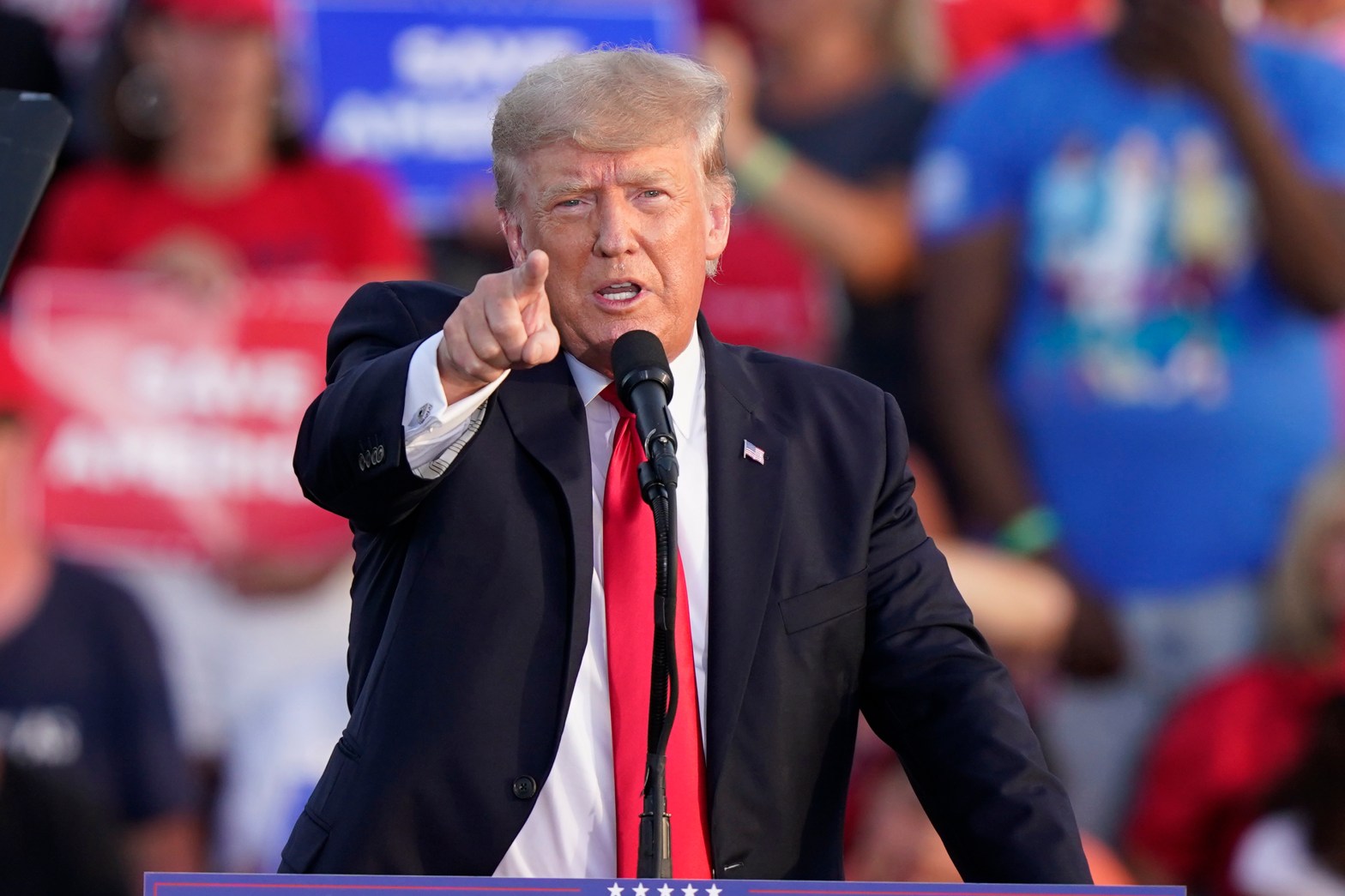
Donald Trump Op-Ed: ‘I built the wall; Biden built a humanitarian catastrophe’

Guest Op-Ed by President Donald J. Trump | The Washington Times

When I was president, I delivered on my promise to build a border wall to protect our country. All Joe Biden had to do was paint it.

Instead, Biden has enacted the most radical open borders agenda imaginable. This is perhaps the first time in world history a nation has purposely and systematically dismantled its own defenses to invite millions of foreign migrants to enter its territory and break its laws.

No one knows who they are, presenting a dangerous threat to Americans. To say that Biden has provoked a national security disaster does not even begin to do justice to the calamity.

In May, illegal border crossings were nearly 700% higher than when I was president during the same period last year. For each of the last three months, more unaccompanied minors have arrived than in any prior month in recorded history. Seizures of ultra-lethal fentanyl are up 265% from last year — more of the drug has already been intercepted than in the entirety of 2020.

Joe Biden has restored catch-and-release, torn up our hard-earned asylum agreements with Mexico, Guatemala, Honduras, and El Salvador, and announced that anyone on the planet who lives in a crime-afflicted area now qualifies for asylum in the United States. Meanwhile, ICE is effectively shut down, senior border security officials have been fired, and criminals are being released in record numbers.

To top it all off, the Biden administration has announced a new program whereby the U.S. government will literally pay to fly illegal aliens’ relatives from other countries to join them in the United States.

These policies are utterly depraved — the actions of someone who by all indications wants to completely abolish America’s southern border.

Yet of all the vindictive, shocking, and self-defeating border security actions Joe Biden has taken, none surpasses his decision to stop the final completion of the wall.

Nearly 740 miles of border wall had been fully funded and more than 660 miles were already built or undergoing construction, Customs and Border Protection confirmed on Jan. 15, five days before I left office. After more than two years of litigation and Democrat obstruction, the wall was going up at an average rate of two miles per day. We had already more than doubled the length of the physical barrier protecting our southern border. We had also replaced much of the previously existing dilapidated fencing with new impenetrable metal beams, focusing on the highest traffic areas that border patrol agents themselves had identified.

The wall was planned, approved, paid for, and virtually done. Only a few key areas remained to be completed. All Joe Biden had to do was let the contractors finish their work. The border agents wanted it, and it would make the whole country safer.

Instead, Biden sabotaged the completion of the wall, ordered an immediate halt to construction on his first day in office, impounded the funds Congress had appropriated and took steps to terminate the National Emergency declaration that had facilitated it.

By stopping construction, Joe Biden purposely and deliberately left gaps in the wall, creating unsealed channels right in the middle of the border to be exploited by human traffickers and drug smugglers. I built a wall — Biden built a humanitarian catastrophe.

This decision has also done egregious harm to our sovereignty. As my administration clearly demonstrated, walls work. After my border wall was constructed, illegal border crossings dropped by 90 percent in the Yuma area and 80 percent in the Rio Grande Valley, and parts of El Paso. Illegal drug trafficking and human smuggling also drastically decreased in those areas. Building just 12 miles of border wall in San Diego alone reduced necessary border patrol manpower by 150 agents a day, saving millions of taxpayer dollars, and freeing up those agents to provide additional border security elsewhere.

As a result of Biden’s abdication of his sworn duties, Texas now says they will “build the wall.” This should not be necessary and is at best a band-aid over the gaping wound Biden created.

Border security is a core responsibility of the federal government — and my administration had already done everything required to complete the project. We secured the necessary legal authorities, acquired the land, designed, engineered, and tested the wall. With little help from Congress, my administration obtained the money, executed the contracts, and hired the personnel. For Texas to be unnecessarily forced to repeat these complicated steps will take months or years if it is even possible for them to do it at all.

Governors and state legislatures should certainly do what they can — but there is no substitute for federal action.

We handed Biden the most secure border in history. We ended asylum fraud, terminated catch and release, negotiated historic migration agreements with Mexico and other countries, and virtually stopped illegal immigration. Precisely because of these policies, we achieved an incredible 90% reduction in illegal crossings.

Our nation is being destroyed by Biden’s border crisis. The United States must immediately restore the entire set of border security and immigration enforcement measures we put into place — and critically, we must finish the wall.

A nation without borders is not a nation at all. For the sake of our country, Joe Biden must finish sealing the border immediately, or the American People must elect a Congress that will.

What Is Your Retirement Plan? (Retirement is something everyone seems to look forward to. But the reality of that retirement may not be as realistic as we dream.)

Retirement is something everyone seems to look forward to. But the reality of that retirement may not be as idealistic as we dream.

For many of the “Baby Boomer” generation, our retirement fund consists of whatever we’re going to receive from Social Security and nothing more.

When it comes to retirement, most of us are worse off than our parents’ generation was.

So Why Is This So?

First of all, our average tenure working for a company is less than five years, meaning that we’re not even minimally vested for retirement. That’s a huge difference from our parents’ generation, where many worked for a company for 20 or more years, and then went on to work another 10, 15 or 20 years for another company.

Secondly, we’re notoriously poor at saving for retirement. More than half of us have no savings whatsoever when we retire. Averaging the entire population we barely reach $200,000 in retirement savings and investments when it’s time to retire.

Finally, our biggest “investment” our home, doesn’t have the equity value that it should, because we tend to move before paying it off. The average time a homeowner spends in their home is eight years; and that’s actually up from a decade ago. Only 37% of homeowners have been in their homes for more than 10 years.

If you look at any amortization schedule, you’ll see that unless real estate prices have increased drastically in the city where the home is, the amount of equity only equals about 15% of the cost of the home. What this all means is that most of us can’t really afford to retire.

Experience

work experience

Personally, I’ve worked in a variety of fields, including engineering, being an overseas missionary and now as a freelance writer. Although I worked long enough to be vested for retirement at both of the companies I was an engineer for, I only have retirement coming from one of them, as I cashed out the other one to start my own business.

The other company’s retirement fund will be paying me a grand total of $112 per month, when I reach retirement age in a few short years.

It’s not that I wasn’t a good employee, by far. I was an excellent employee. Between those two companies, I garnered a total of five promotions in 15 years, going from junior technician all the way up to engineering manager. I’ve also been successful in my missions work and my writing career, although I can’t say the same for my earlier business ventures.

I know; I know; I should have been putting money into a 401K all those years I was a missionary and self-employed. That’s an easy thing to say; but a lot harder to do, when you barely have enough money coming in to make ends meet. So, while I might be able to look back and tell myself “You should have,” it wasn’t a practical reality at the time.

So what am I going to do? For that matter, what are all the other “Baby Boomers” out there, who are in a similar situation going to do?

Since few of us have savings worth speaking of or any retirement coming from the companies we worked for, how are we going to keep a roof over our heads and food on the table when it comes time to retire? Allow me to throw out a few possibilities.

Keep Working

keep working

The easiest thing to do, in order to make sure that you have enough money to live on, is to just keep working. If you’re able to do your job now, what’s to keep you from doing it a few more years, until your health makes it difficult?

Staying on the job for that extra time may help to increase the retirement you receive, when it does become necessary to retire. Of course, not all companies are willing to keep older people on the payroll.

There’s a definite move towards companies trying to have a younger workforce, mostly because they can pay those younger people less money.

So your company may actually push you into retirement. But even so, that doesn’t mean that you have to retire; you can always go to work someplace else.

Reinvent Yourself

Going to work someplace else may mean reinventing yourself and changing what you do, at least to some extent. That may mean becoming a consultant, especially if you’re highly skilled in a very specific field.

Companies don’t usually mind older consultants, because there’s a natural tendency to believe that those older experts have lots of years of experience.

What Is Your Retirement Plan

An alternative way of handling that is to join the gig economy and work from home as a freelancer. Companies pay billions of dollars per year to freelancers, to do a wide range of tasks.

Many of these companies are smaller ones, who don’t need a full-time staff member to do that particular task or who have that particular skill set.

Hiring freelancers allows them to hire the expertise they need, without having the financial burden of a full-time employee.

I’ve been a freelancer for 11 years now and I have no intention of stopping when I reach retirement age. Oh, I’ll probably slow down a bit, becoming more selective in the work I accept. But I’ve been at this long enough that I’m already pretty selective of who I work for and what jobs I take on.

But that’s not the only thing I’m planning on doing. I’ve always been an entrepreneur, either as my full-time job or as a sideline. I’ve also been a bit of an inventor, having an engineering background.

So I’ve got a couple of projects in the works, which I’m hoping will grow into small businesses, essentially making products from recycled material. If those work out, they’ll be able to augment my retirement income at least to some extent.

The other way I’m reinventing myself is to turn my hobby into a sideline business. I’ve been a woodworker all my life, and as I’ve grown older, my projects have become more artistic.

I’m currently working on “building my brand,” making upscale handmade wood products and turning my hobby into a business. This will help me to cut down on my writing hours, doing something I enjoy and still being able to make money off it.

Lower Your Cost of Living Now

If you know that your retirement income and your living expenses don’t match up, then just maybe it’s time to change your cost of living. I don’t mean waiting until you retire to do so; I mean doing so now, so that by the time you retire, you’re already living within your means.

What Is Your Retirement Plan

My wife and I just bought a house in a small town near here.

While it might seem a bit strange to buy a house when you’re reaching retirement age, interest rates are low enough that our house payments are lower than a comparable sized rental.

They’re actually on par with what we’ve been paying for a small apartment and two storage units, one of which was my workshop.

Based upon our combined income, we could have qualified for a loan that was twice what we ended up spending on our home. But that wasn’t our goal. Rather, our goal was to find something that we would be able to afford in retirement.

By buying a house in a small town, we saved $100,000 over buying it here in the city and we ended up with a much bigger lot. We literally own ¼ of a city block, giving us room for a larger vegetable garden, raising chickens and putting in a fish pond.

What Is Your Retirement Plan

It may not look like it makes sense, but downsizing can save you a lot of money, especially if you can do like we have and downsize to a lower cost of living area at the same time. Housing and energy are typically our biggest expenses, so going for a smaller place might be all you need to do, in order to make your retirement budget work.

I’ve always done a lot of things for myself, rather than paying others to do them for me. That includes everything from cooking to remodeling projects to replacing the engine on my car. It’s a great way of saving money and has allowed me to live above my income, simply because I’m not paying someone else to do things that I can do myself.

Part of that is that I’m adding solar power, wind power and solar hot water heating to our home. While I don’t expect to power everything that way, I hope to cut our electric bill by 10 to 20 percent. I’m also hoping to grow all our own produce, cutting down on our food bills.

Move In With Your Kids

What Is Your Retirement Plan

Once upon a time, it was normal for grandma and/or grandpa to move in with their kids, when they couldn’t make it on their own anymore. They’d help around the home in whatever way they could, contributing to the family. While we don’t do that so much anymore, it’s a tradition worth bringing back.

When my first wife divorced me, my youngest daughter and her husband invited me to move in with them. That was fortunate for me, as I couldn’t pay my ex the amount of support I had to (while waiting for the divorce to finalize) and still have enough to live on.

But it also allowed them to move into a bigger place, as I was contributing to the household income. So we weren’t crowded in their original home.

Now that I’m remarried, that same couple is asking when my wife and I are going to retire and move back in with them. They want us there, especially now that they’re having their first baby. We get along good and really don’t have any of the power struggles of two couples living in the same home.

Live Like You Did In Your Youth

What Is Your Retirement Plan

If you don’t get along well enough with your kids, so that you can move in with them, perhaps you could do what many of us did in college or in the years thereafter and get a roomie. My brother, who is a year older than me and is already retired has a roommate that he’s lived with for several years now.

They were buddies in high school and have managed to maintain their friendship through their various marriages, divorces and living out of state.

Living alone when you’re retired probably isn’t a good idea anyways, especially if you’re single. Not having anyone there when you fall or have health problems can be outright dangerous.

On top of that, there’s the problem of being so alone. We need social interaction to survive; and having a housemate or apartment-mate can help provide that social interaction.

Final Words

So, those are my ideas. As you can see, I’m already working on several of them, even though I still have a few years before I reach retirement age.

I’m not waiting till the last minute, as I figure it will take some time to prepare. Which ones of those will work for you?

Or do you have any other ideas that will work to make retirement financially possible? If so, I’d love to hear them. Maybe your idea will make my own retirement a little bit better.

Human Life Will Be Unrecognizable- If Celeste Solum is right, we are in much worse trouble than we think. She comes from an Illuminati background and worked as a FEMA planner for 20 years. So she is in a position to know. (The goal is to offload 90% of the population.)

According to FEMA whistle blower Celeste Solum, left, Americans have been cast in the role of Jews in Nazi Germany and will meet the same fate. 
Global governance means we’ll have to play by a “totally new set of rules.”

If Celeste Solum is right, we are in much worse trouble than we think. She comes from an Illuminati background and worked as a FEMA planner for 20 years. So she is in a position to know.
Her horrifying vision is the darkest you will find. I cannot confirm that it will transpire but this may be a case of “forewarned is forearmed.” Prepare for “a world of hurt.”
She doesn’t write so I couldn’t find a text to repost. Instead she gives interviews to people like Mike Adams, Dave Hodges and David Icke. I listened to a few and provide some of her claims:

dees-walmart.jpeg

With robotics, most human beings have become redundant to the Illuminati. When there are famines and power blackouts, people will stream to “reception centers” (at Costco’s and Walmarts of all places?) where they will be interned and sent to concentration camps where they will be gassed or guillotined.  The goal is to offload 90% of the population.

Covid tests are intended to collect your DNA. The vaccines contain aborted fetus stem cellsand human proteins that have been bred in plants and mice (“a human in a mouse suit.”) They also contain “hydrogels” – nanoparticles that permanently fuse with your tissue, that connect with a 5G computer network that “monitor your health” at all times and determine if you can go to work or buy food. 
Speaking of food, meat will be phased out and concentration camp rations –“micronutrients” — introduced for the general public. There will be no “going to the supermarket.” We will not be allowed “to take anything from nature” and must downsize to half our carbon footprint. If we live in a mansion, we must move to a bungalow. (I know it sounds crazy.) 
 FEMA estimates only 3% of gun owners will resist gun confiscation by force. 

 They are making an inventory of everything of material value. All private property “will be federalized.” 
CRACKPOT?It is tempting to dismiss Solum as a crackpot and a fear monger. There were many red flags. She tends to exaggerate, claiming she grows 500 varieties of tomatoes on her farm in Montana and there are “seven million drones” monitoring us. She places a lot of emphasis on cosmic changes: “2000 year cycles’; “the sun has gone silent” and the “magnetosphere” has weakened. We are in the “end times.” She claims that a second Wuhan virus was released- a “plant destroyer” that decimated her orchards in Montana. 

coleman.png

On the other hand, consider her message in the context of what is actually happening. Trillions have been spent and millions of lives have been disrupted or destroyed for a virus that has a .25% mortality rate. 68,000 Britons have been fined for lockdown breeches. A young couple was terrorized by 12-man SWAT team who thought they were having a party. An 82-year-old grannie was watching TV in bed when police arrived to warn her about having tea in her garden with two friends earlier that day.  A Michigan restaurant owner was led away in shackles after publicly warning Americans they were being enslaved. 
Make up your own mind. But my view is prepare for the worst and pray for the best.

Americans will soon be forced into a guerrilla war of survival – Can America win against the globalist occupation forces?

How many of you believe that this country is plunging head-first into a state of revolution? How many of you believe that a planned currency collapse coupled with the implementation of a brutal martial law and gun confiscation will be the trigger events which will incite the coming revolution? In addition, nonsense climate change policies designed to bring America and most Americans to their knees will occur under a Democratic Party leadership. The Democrats are aligned with the UN troops in our country under the Kigali Principles of UN Peacekeeper intervention (ie invasion of the United States). As I have demonstrated, Nancy Pelosi and Beto O’Rourke are aligned with former Mexican President Nieto who took $100 million to leave the Sinaloa cartel alone. In part, I blame the deaths of these 9 American citizens on Pelosi, Eric “Fast and Furious” Holder and Obama. It was their open border, let-the-drugs-flow policies that led to these deaths. These horrific murders are just the beginning of what is coming to both sides of the border. What else can we expect than when we witness Pelosi and O’Rourke hanging out with Nieto?

The exit of California from the Union would devastate our economy and agricultural production. Key Democrats are aligned with this movement. Senators Kamala Harris and Feinstein and Governor, Gavin Newsome, are aligned with the Communist Chinese on a number of fronts. Many Democrats and even some Republicans are being blackmailed by the Epstein operation. I could go on, but the readers know where this is leading. We are a nation that has forsaken its rule of law just like Nazi Germany did in 1932. Adam Schiff is holding Soviet-style hearings with secret witnesses, hearsay evidence and outright liars. This is your judicial future America should the Democrats takeover. We would be witnessing the Obama administration on steroids.

Being a coach and former athlete, I know the feeling of a once-inferior opponent rising up to defeat my team. I know the feeling of underestimating an opponent. I have done that with the Democrats. The Kentucky Governor’s race is proof of what I am saying along with the fact that Texas is turning “blue”. We are all faced with the possibility that the Democrats could be running the country in the next several months. These are Democrats in name only. These individuals are Communists and I am not exaggerating when I say that many are demonically possessed and serve Satan. Then there are radicalized Democrats like AOC and Omar. They run their Congressional offices like a makeshift terrorist organization. They crawled out from underneath the rock we call the “Justice Democrats”. There is nothing that these people will not do to solidify their power. And I have just had the “aha moment” of my life when I have come to the final realization that they and their fellow servants of Satan could be running this country in a few months.

Many of us in the alternative media believe that this is the likely scenario that will very soon turn this country into the most dangerous country on the face of the earth. It might behoove us to look a little closer at the nature of revolution in order to predict where all of this is likely headed. In the present political climate, I see no way to stem the tide of unthinkable brutality and violence which seems imminent. It is in this mindset that I set about to research the topic of revolution and this series of articles reflects the results of the research. And as a result of past and common patterns of revolution, it appears as if a clear picture is beginning to emerge.

We already are in a civil war. The last thing to happen in a civil war is the piling up of bodies. And America, make no mistake about it, the enemy controls the media, the military industrial complex, the stock market and the banks. Guerrilla war will be the only viable form of resistance.

Four Levels of Warfare

Most military strategists identify four levels of conflict; (1) nuclear war is the trump card of all conflict; (2) conventional warfare; (3) guerrilla warfare; and, (4) terrorism.

It is safe to say that if our country does indeed descend into revolution, nuclear war will not come into play, for if it did, there would be nothing to rule over in the aftermath.

The United States has witnessed civil war of a conventional nature In the 1860’s as two mighty armies of that era locked horns in what proved to be the conflict in which America suffered her greatest loss of life. In the Civil War, both sides had equivalent weaponry and as a result employed conventional tactics. However, given the disparity of technology and resources between the people the globalist controlled forces of the new Democratically controlled government, a conventional war would prove to be a disaster for the rebel forces. If key elements of the military were to break away and support the people, perhaps a conventional war would unfold. However, it is not likely that the upcoming civil war will be conventional as it is not probable that the military will bifurcate and turn in on itself. The likely mode of the revolutionary war conflict facing the people of the United States is that it will consist of either guerrilla warfare or terrorism.

Guerrilla Warfare Or Terrorism?

Terrorism is the least preferred option by any insurgent group. With terrorism, there is absolutely no hope of final victory because territory is never occupied. For that reason, nobody aspires to engage in terrorism if they have a viable alternative and the American people do have a choice given how well armed we are. However, terrorism arising out a defeated guerrilla force is a distinct possibility as it would represent American guerrilla’s fallback position should they be defeated. Subsequently, does the MIAC Report which labeled Libertarians, Constitutionalists, Second Amendment Supporters, Ron Paul Supporters, Veterans and now Christians as domestic terrorists, make a little more sense as to why DHS made these bold proclamations? The DHS of the Obama years understood and demonstrated their understanding of these facts and has also prepared for what I just wrote about in the previous paragraph. Hillary was to be 2016 recipient of Obama’s work, but Donald Trump happened.

The Veterans Administration estimates that there are approximately 21.5 million veterans living in the United States. We also live in a country with over 300 million privately owned guns. These combined factors point clearly to a guerrilla war being the preferred and necessary mode of combat which will likely be visited upon this country.

What Is Guerrilla Warfare?

Guerrilla warfare, for most of human history, is not new. Tribal war, which traditionally pits one guerrilla force against another, is the oldest form of warfare. The new “conventional” form of warfare, which pits guerrillas against “conventional” forces, is more recent as it first arose in Mesopotamia 5,000 years ago.

The good news for future American freedom fighters is that guerrilla war has been getting more successful since 1945, but unfortunately guerrilla fighters still lose most of the time. An analysis of past conflicts featuring guerrilla war, reveals that only 25% of guerrilla forces, out of 443 such conflicts since 1775, were successful. The government prevailed almost 64% of the time with the remainder of the conflicts ended in a stalemate. Conversely, since the end of WWII, the percentage of success for guerrilla forces has indeed gone up to 39.6%. Yet that still means that government forces have continued to prevail 51% of the time. When the American people engage in a guerrilla war in the upcoming years, the people have less than a 40% chance of success.

Length of Guerrilla Wars

Guerrilla wars are rarely short and as a result do not favor the American culture and our collective psyche of instant gratification. When Americans flip the switch on the wall, we expect the light to come on. Will Americans set aside their entitlements as well as their entrenched soft lifestyle and rise to the occasion? Only time will tell.

The Vietnamese culture with an external locus of control predominating the people where the group is more important than the individual is the perfect mindset for guerrilla fighters. This could prove to be the American rebels biggest challenge because guerrilla warfare is not something that one does like driving over a speed bump. It is a way of life, a very hard way of life filled with misery, extreme sacrifice and unspeakable losses.

For my money, the best guerrilla fighters in the modern era were the Viet Cong in which Vietnamese people were involved in some form of guerrilla war from 1942-1975. After the Americans invaded Vietnam, the forces in the north had a saying, “born in the north, to die in the south.” There were nearly two generations of Vietnamese people in which war was an unavoidable part of life. What General Westmoreland and LBJ failed to recognize was that in order to defeat and totally subdue the Vietnamese people, the Americans would have had to have engaged in unspeakable genocide because despite the fact that the US won every single battle of the war, the Vietnamese rebels were never going to give up. Do we Americans have that same tenacity to persevere like the Vietnamese?

Prior to WWII, guerrilla wars lasted an average of seven years. Following WWII, guerrilla conflicts lasted an average of 10 years. Will Americans embrace the tenets and sacrifices of guerrilla war and can it ever become a way of life? I believe that conditions would have to be unspeakably horrendous for America to embrace a conflict under these conditions. I think that things would have to be so bad, so completely genocidal, that fighting and dying would be the only viable alternative for America in order to embrace guerrilla warfare as a way of life. What I am saying here is that we are a very soft people.

How Close Are We to the Inevitable Conflict?

Successful guerrilla leaders such as Lawrence of Arabia, Mao, Castro and Giap all concur that there are three phases of any guerrilla war. However, before the phases can unfold there are two preconditions which must be met.

The first condition which is a prerequisite for guerrilla war, is based upon the fact that there has to be a decisive battle for the belief systems of the people as a whole. The globalists have invested billions of dollars in order to dominate the mainstream media. On the other side is the alternative media. Both sides are vying for control of the belief systems of the country.

There are two very distinct ideologies playing out today in the court of public opinion. On one hand, the future rebels are adept at exposing the loss of national sovereignty and civil liberties every chance they get. Conversely, the globalist dominated media is spending billions of dollars to convince the masses that there is no such thing as a conspiracy theory and despite some governmental incompetence, the government loves and protects its people. And the globalists are being somewhat effective. Have you ever noticed that when you are describing a globalist inspired conspiracy such as what happened at Benghazi, and no matter how well documented your position is, that your audience frequently responds with “you must be one of these conspiracy theorists.” Our facts are rarely attacked because they are accurate, but the idea of the existence of any kind of conspiracy is what is challenged. This kind of programming coming from the media is brilliant and effective. Who is winning this war of words? The jury is still out, but the unmistakable conclusion is that the ideological battle lines for the upcoming conflict have clearly been drawn. One might argue that social media censorship will eventually beat down the alt media.

The globalists sell the sheep on the notion that we have to control you to protect you (from a threat of our creation), and the other side is saying “we will take our chances, give us freedom.”

The second precondition which must be met prior to descending into guerrilla war consists of both sides engaging in an arms race. In response to the Obama administration’s threat of seizing our guns for the false flag events of the Aurora Batman massacre and Sandy Hook, Americans went on a gun-buying frenzy which continues to this day. DHS has engaged in their own arms buildup as they have purchased 2.2 billion rounds of ammunition to go with 2700 new armored personnel carriers and that is not all. The federal government has invested in 730,000 drones, super soldier robots and intelligence gathering techniques which are mind-blowing. As an aside, Snowden’s public revelations related to the extent of the NSA’s illegal surveillance activities contained nothing that most of us in the alternative media did not already know. It is my belief that Ed Snowden knows a lot more than has been reported related to the reasons underlying the NSA spying and the media is refusing to report on it.

In summary, the American people and their government have engaged in an arms race very similar in nature to two rival countries preparing to go to war.

Conclusion

The preconditions for armed conflict and the likelihood that the conflict will be guerrilla is very likely. In Part Two of this series, an analysis of the commonalities between past guerrilla conflicts (e.g. Giap, Mao, Castro, etc.) will be offered. Emerging from the discussion in the next part in this series is the discovery of the fact that there three overlapping phases to guerrilla war and it will be a shocking surprise to all of us as to how far along this country is in relation to these three phases. All that is needed is the right trigger event and that will be discussed in the next part as well.

Trump at Ohio rally says Biden is ‘destroying’ the country, declares: ‘I told you’ [Video]

Trump at Ohio rally says Biden is ‘destroying’ the country, declares: ‘I told you’

Rally likely to be the first of many as president rejoins political life after hiatus.

Former President Donald Trump at an Ohio rally on Saturday slammed the Biden administration for its brief track record thus far, claiming the U.S. under President Joe Biden has been wracked by crime, “left-wing indoctrination” and other debilitations.

“Gas prices are spiking, inflation is skyrocketing, and China, Russia and Iran are humiliating our country,” he said, declaring that “Joe Biden is destryoing our nation right before our very eyes.”

“I told you,” the former president said to the crowd of Biden’s alleged failures.

Trump aggressively targeted what he said was Biden’s poor showing on immigration, claiming Biden’s “policy is to make illegal immigration as easy as possible,” that Biden had re-instituted the controversial “catch-and-release” immigration program, and that his administration had “crippled” Immigration and Customs Enforcement.

He pointed to the surge of young illegal immigrants at the southern U.S. border, whom he described as “just wonderful kids” but many of which, he claimed, have been put on “suicide watch” while in U.S. custody, something reported recently by various news outlets.

The rally was meant as a bolstering event for Max Miller as he attempts to unseat Ohio Rep. Anthony Gonzalez, who was among the 10 Republicans who voted for Trump’s impeachment following the Jan. 6 riot at the U.S. Capitol.

Trump earlier this year gave Miller his “complete and total endorsement” in Miller’s bid for Ohio’s 16th Congressional district seat. At the rally he called Miller “a trusted aide of mine in the White House” and touted Miller’s work in international relations under the Trump administration.

“In Congress Max will be tough on illegal immigration,” he told the crowd. “…He will stand up to China, and he will protect Ohio jobs.”

The event also functioned as a return to form for the former president, whose freewheeling rallies helped propel his dark horse candidacy to victory in 2016 and established him as a high-spirited, pull-no-punches candidate who regularly captivated crowds with his freeform political style.

Trump’s future in the Republican party has been somewhat uncertain since his departure from the White House in January. The GOP had struggled for years with internecine squabbling over whether the party should stick to its relatively seasoned status quo or if it should follow Trump’s more aggressive, no-holds-barred style of confrontational politics.

The Jan. 6 Capitol riot—what many commentators and politicians have described as an “insurrection”—further deepened those divisions, with numerous Republicans breaking ranks to impeach Trump and vote for his conviction.

Yet Trump remains broadly popular among Republicans, according to recent polling, and Saturday’s rally is likely just the first of many, with the former president virtually guaranteed to remain a fixture on the Republican circuit in the months and years ahead.

How well he is received in that environment will likely determine his probability of running again in 2024; Trump himself has not ruled out another bid at the White House.

Who Is A “Terrorist” In Biden’s America? (Far from being a war against “white supremacy,” the Biden administration’s new “domestic terror” strategy clearly targets primarily those who oppose US government overreach and those who oppose capitalism and/or globalization.)

Far from being a war against “white supremacy,” the Biden administration’s new “domestic terror” strategy clearly targets primarily those who oppose US government overreach and those who oppose capitalism and/or globalization.

In the latest sign that the US government’s War on Domestic Terror is growing in scope and scale, the White House on Tuesday revealed the nation’s first ever government-wide strategy for confronting domestic terrorism. While cloaked in language about stemming racially motivated violence, the strategy places those deemed “anti-government” or “anti-authority” on a par with racist extremists and charts out policies that could easily be abused to silence or even criminalize online criticism of the government.

Even more disturbing is the call to essentially fuse intelligence agencies, law enforcement, Silicon Valley, and “community” and “faith-based” organizations such as the Anti-Defamation League, as well as unspecified foreign governments, as partners in this “war,” which the strategy makes clear will rely heavily on a pre-crime orientation focused largely on what is said on social media and encrypted platforms. Though the strategy claims that the government will “shield free speech and civil liberties” in implementing this policy, its contents reveal that it is poised to gut both.

Indeed, while framed publicly as chiefly targeting “right-wing white supremacists,” the strategy itself makes it clear that the government does not plan to focus on the Right but instead will pursue “domestic terrorists” in “an ideologically neutral, threat-driven manner,” as the law “makes no distinction based on political view—left, right or center.” It also states that a key goal of this strategic framework is to ensure “that there is simply no governmental tolerance . . . of violence as an acceptable mode of seeking political or social change,” regardless of a perpetrator’s political affiliation.

Considering that the main cheerleaders for the War on Domestic Terror exist mainly in establishment left circles, such individuals should rethink their support for this new policy given that the above statements could easily come to encompass Black Lives Matter–related protests, such as those that transpired last summer, depending on which political party is in power.

Once the new infrastructure is in place, it will remain there and will be open to the same abuses perpetrated by both political parties in the US during the lengthy War on Terror following September 11, 2001. The history of this new “domestic terror” policy, including its origins in the Trump administration, makes this clear.

It’s Never Been Easier to Be a “Terrorist”

In introducing the strategy, the Biden administration cites “racially or ethnically motivated violent extremists” as a key reason for the new policy and a main justification for the War on Domestic Terror in general. This was most recently demonstrated Tuesday in Attorney General Merrick Garland’s statement announcing this new strategy. However, the document itself puts “anti-government” or “anti-authority” “extremists” in the same category as violent white supremacists in terms of being a threat to the homeland. The strategy’s characterization of such individuals is unsettling.

For instance, those who “violently oppose” “all forms of capitalism” or “corporate globalization” are listed under this less-discussed category of “domestic terrorist.” This highlights how people on the left, many of whom have called for capitalism to be dismantled or replaced in the US in recent years, could easily be targeted in this new “war” that many self-proclaimed leftists are currently supporting. Similarly, “environmentally-motivated extremists,” a category in which groups such as Extinction Rebellion could easily fall, are also included.

In addition, the phrasing indicates that it could easily include as “terrorists” those who oppose the World Economic Forum’s vision for global “stakeholder capitalism,” as that form of “capitalism” involves corporations and their main “stakeholders” creating a new global economic and governance system. The WEF’s stakeholder capitalism thus involves both “capitalism” and “corporate globalization.”

The strategy also includes those who “take steps to violently resist government authority . . . based on perceived overreach.” This, of course, creates a dangerous situation in which the government could, purposely or otherwise, implement a policy that is an obvious overreach and/or blatantly unconstitutional and then label those who resist it “domestic terrorists” and deal with them as such—well before the overreach can be challenged in court.

Another telling addition to this group of potential “terrorists” is “any other individual or group who engages in violence—or incites imminent violence—in opposition to legislative, regulatory or other actions taken by the government.” Thus, if the government implements a policy that a large swath of the population finds abhorrent, such as launching a new, unpopular war abroad, those deemed to be “inciting” resistance to the action online could be considered domestic terrorists.

Such scenarios are not unrealistic, given the loose way in which the government and the media have defined things like “incitement” and even “violence” (e. g., “hate speech” is a form of violence) in the recent past. The situation is ripe for manipulation and abuse. To think the federal government (including the Biden administration and subsequent administrations) would not abuse such power reflects an ignorance of US political history, particularly when the main forces behind most terrorist incidents in the nation are actually US government institutions like the FBI

Furthermore, the original plans for the detention of American dissidents in the event of a national emergency, drawn up during the Reagan era as part of its “continuity of government” contingency, cited popular nonviolent opposition to US intervention in Latin America as a potential “emergency” that could trigger the activation of those plans. Many of those “continuity of government” protocols remain on the books today and can be triggered, depending on the whims of those in power. It is unlikely that this new domestic terror framework will be any different regarding nonviolent protest and demonstrations.

Yet another passage in this section of the strategy states that “domestic terrorists” can, “in some instances, connect and intersect with conspiracy theories and other forms of disinformation and misinformation.” It adds that the proliferation of such “dangerous” information “on Internet-based communications platforms such as social media, file-upload sites and end-to-end encrypted platforms, all of these elements can combine and amplify threats to public safety.”

Thus, the presence of “conspiracy theories” and information deemed by the government to be “misinformation” online is itself framed as threatening public safety, a claim made more than once in this policy document. Given that a major “pillar” of the strategy involves eliminating online material that promotes “domestic terrorist” ideologies, it seems inevitable that such efforts will also “connect and intersect” with the censorship of “conspiracy theories” and narratives that the establishment finds inconvenient or threatening for any reason.

Pillars of Tyranny

The strategy notes in several places that this new domestic-terror policy will involve a variety of public-private partnerships in order to “build a community to address domestic terrorism that extends not only across the Federal Government but also to critical partners.” It adds, “That includes state, local, tribal and territorial governments, as well as foreign allies and partners, civil society, the technology sector, academic, and more.”

The mention of foreign allies and partners is important as it suggests a multinational approach to what is supposedly a US “domestic” issue and is yet another step toward a transnational security-state apparatus. A similar multinational approach was used to devastating effect during the CIA-developed Operation Condor, which was used to target and “disappear” domestic dissidents in South America in the 1970s and 1980s. The foreign allies mentioned in the Biden administration’s strategy are left unspecified, but it seems likely that such allies would include the rest of the Five Eyes alliance (the UK, Australia, Canada, New Zealand) and Israel, all of which already have well-established information-sharing agreements with the US for signals intelligence.

The new domestic-terror strategy has four main “pillars,” which can be summarized as (1) understanding and sharing domestic terrorism-related information, including with foreign governments and private tech companies; (2) preventing domestic terrorism recruitment and mobilization to violence; (3) disrupting and deterring domestic terrorism activity; and (4) confronting long-term contributors to domestic terrorism.

The first pillar involves the mass accumulation of data through new information-sharing partnerships and the deepening of existing ones. Much of this information sharing will involve increased data mining and analysis of statements made openly on the internet, particularly on social media, something already done by US intelligence contractors such as Palantir. While the gathering of such information has been ongoing for years, this policy allows even more to be shared and legally used to make cases against individuals deemed to have made threats or expressed “dangerous” opinions online.

Included in the first pillar is the need to increase engagement with financial institutions concerning the financing of “domestic terrorists.” US banks, such as Bank of America, have already gone quite far in this regard, leading to accusations that it has begun acting like an intelligence agency. Such claims were made after it was revealed that the BofA had passed to the government the private banking information of over two hundred people that the bank deemed as pointing to involvement in the events of January 6, 2021. It seems likely, given this passage in the strategy, that such behavior by banks will soon become the norm, rather than an outlier, in the United States.

The second pillar is ostensibly focused on preventing the online recruitment of domestic terrorists and online content that leads to the “mobilization of violence.” The strategy notes that this pillar “means reducing both supply and demand of recruitment materials by limiting widespread availability online and bolstering resilience to it by those who nonetheless encounter it.“ The strategy states that such government efforts in the past have a “mixed record,” but it goes on to claim that trampling on civil liberties will be avoided because the government is “consulting extensively” with unspecified “stakeholders” nationwide.

Regarding recruitment, the strategy states that “these activities are increasingly happening on Internet-based communications platforms, including social media, online gaming platforms, file-upload sites and end-to-end encrypted platforms, even as those products and services frequently offer other important benefits.” It adds that “the widespread availability of domestic terrorist recruitment material online is a national security threat whose front lines are overwhelmingly private-sector online platforms.”

The US government plans to provide “information to assist online platforms with their own initiatives to enforce their own terms of service that prohibits the use of their platforms for domestic terrorist activities” as well as to “facilitate more robust efforts outside the government to counter terrorists’ abuse of Internet-based communications platforms.”

Given the wider definition of “domestic terrorist” that now includes those who oppose capitalism and corporate globalization as well as those who resist government overreach, online content discussing these and other “anti-government” and “anti-authority” ideas could soon be treated in the same way as online Al Qaeda or ISIS propaganda. Efforts, however, are unlikely to remain focused on these topics. As Unlimited Hangout reported last November, both UK intelligence and the US national-security state were developing plans to treat critical reporting on the COVID-19 vaccines as “extremist” propaganda.

Another key part of this pillar is the need to “increase digital literacy” among the American public, while censoring “harmful content” disseminated by “terrorists” as well as by “hostile foreign powers seeking to undermine American democracy.” The latter is a clear reference to the claim that critical reporting of US government policy, particularly its military and intelligence activities abroad, was the product of “Russian disinformation,” a now discredited claim that was used to heavily censor independent media. This new government strategy appears to promise more of this sort of thing.

It also notes that “digital literacy” education for a domestic audience is being developed by the Department of Homeland Security (DHS). Such a policy would have previously violated US law until the Obama administration worked with Congress to repeal the Smith-Mundt Act, thus lifting the ban on the government directing propaganda at domestic audiences.

The third pillar of the strategy seeks to increase the number of federal prosecutors investigating and trying domestic-terror cases. Their numbers are likely to jump as the definition of “domestic terrorist” is expanded. It also seeks to explore whether “legislative reforms could meaningfully and materially increase our ability to protect Americans from acts of domestic terrorism while simultaneously guarding against potential abuse of overreach.” In contrast to past public statements on police reform by those in the Biden administration, the strategy calls to “empower” state and local law enforcement to tackle domestic terrorism, including with increased access to “intelligence” on citizens deemed dangerous or subversive for any number of reasons.

To that effect, the strategy states the following (p. 24):

“The Department of Justice, Federal Bureau of Investigation, and Department of Homeland Security, with support from the National Counterterrorism Center [part of the intelligence community], are incorporating an increased focus on domestic terrorism into current intelligence products and leveraging current mechanisms of information and intelligence sharing to improve the sharing of domestic terrorism-related content and indicators with non-Federal partners. These agencies are also improving the usability of their existing information-sharing platforms, including through the development of mobile applications designed to provide a broader reach to non-Federal law enforcement partners, while simultaneously refining that support based on partner feedback.”

Such an intelligence tool could easily be, for example, Palantir, which is already used by the intelligence agencies, the DHS, and several US police departments for “predictive policing,” that is, pre-crime actions. Notably, Palantir has long included a “subversive” label for individuals included on government and law enforcement databases, a parallel with the controversial and highly secretive Main Core database of US dissidents.

DHS Secretary Alejandro Mayorkas made the “pre-crime” element of the new domestic terror strategy explicit on Tuesday when he said in a statement that DHS would continue “developing key partnerships with local stakeholders through the Center for Prevention Programs and Partnerships (CP3) to identify potential threats and prevent terrorism.” CP3, which replaced DHS’ Office for Targeted Violence and Terrorism Prevention this past May, officially “supports communities across the United States to prevent individuals from radicalizing to violence and intervene when individuals have already radicalized to violence.”

The fourth pillar of the strategy is by far the most opaque and cryptic, while also the most far-reaching. It aims to address the sources that cause “terrorists” to mobilize “towards violence.” This requires “tackling racism in America,” a lofty goal for an administration headed by the man who controversially eulogized Congress’ most ardent segregationist and who was a key architect of the 1994 crime bill. As well, it provides for “early intervention and appropriate care for those who pose a danger to themselves or others.”

In regard to the latter proposal, the Trump administration, in a bid to “stop mass shootings before they occur,” considered a proposal to create a “health DARPA” or “HARPA” that would monitor the online communications of everyday Americans for “neuropsychiatric” warning signs that someone might be “mobilizing towards violence.” While the Trump administration did not create HARPA or adopt this policy, the Biden administration has recently announced plans to do so.

Finally, the strategy indicates that this fourth pillar is part of a “broader priority”: “enhancing faith in government and addressing the extreme polarization, fueled by a crisis of disinformation and misinformation often channeled through social media platforms, which can tear Americans apart and lead some to violence.” In other words, fostering trust in government while simultaneously censoring “polarizing” voices who distrust or criticize the government is a key policy goal behind the Biden administration’s new domestic-terror strategy.

Calling Their Shots?

While this is a new strategy, its origins lie in the Trump administration. In October 2019, Trump’s attorney general William Barr formally announced in a memorandum that a new “national disruption and early engagement program” aimed at detecting those “mobilizing towards violence” before they commit any crime would launch in the coming months. That program, known as DEEP (Disruption and Early Engagement Program), is now active and has involved the Department of Justice, the FBI, and “private sector partners” since its creation.

Barr’s announcement of DEEP followed his unsettling “prediction” in July 2019 that “a major incident may occur at any time that will galvanize public opinion on these issues.” Not long after that speech, a spate of mass shootings occurred, including the El Paso Walmart shooting, which killed twenty-three and about which many questions remain unanswered regarding the FBI’s apparent foreknowledge of the event. After these events took place in 2019, Trump called for the creation of a government backdoor into encryption and the very pre-crime system that Barr announced shortly thereafter in October 2019. The Biden administration, in publishing this strategy, is merely finishing what Barr started.

Indeed, a “prediction” like Barr’s in 2019 was offered by the DHS’ Elizabeth Neumann during a Congressional hearing in late February 2020. That hearing was largely ignored by the media as it coincided with an international rise of concern regarding COVID-19. At the hearing, Neumann, who previously coordinated the development of the government’s post-9/11 terrorism information sharing strategies and policies and worked closely with the intelligence community, gave the following warning about an imminent “domestic terror” event in the United States:

“And every counterterrorism professional I speak to in the federal government and overseas feels like we are at the doorstep of another 9/11, maybe not something that catastrophic in terms of the visual or the numbers, but that we can see it building and we don’t quite know how to stop it.”

This “another 9/11” emerged on January 6, 2021, as the events of that day in the Capitol were quickly labeled as such by both the media and prominent politicians, while also inspiring calls from the White House and the Democrats for a “9/11-style commission” to investigate the incident. This event, of course, figures prominently in the justification for the new domestic-terror strategy, despite the considerable video and other evidence that shows that Capitol law enforcement, and potentially the FBI, were directly involved in facilitating the breach of the Capitol. In addition, when one considers that the QAnon movement, which had a clear role in the events of January 6, was itself likely a government-orchestrated psyop, the government hand in creating this situation seems clear.

It goes without saying that the official reasons offered for these militaristic “domestic terror” policies, which the US has already implemented abroad—causing much more terror than it has prevented—does not justify the creation of a massive new national-security infrastructure that aims to criminalize and censor online speech. Yet the admission that this new strategy, as part of a broader effort to “enhance faith in government,” combines domestic propaganda campaigns with the censorship and pursuit of those who distrust government heralds the end of even the illusion of democracy in the United States.

Food Confiscation: How to protect your food stores and production from government confiscation

Did you know that if you have even a small subsistence farm to grow and or raise food for your family it all could be confiscated. Did you know the government is currently trying to identify and register all food producers to support this goal? Whether you are aware or not, at any time the president deems necessary, the US can now confiscate key resources in the name of national security. In particular, the food you worked hard to grow or raise could be seized. Naturally, it makes no sense to spend your time and money developing a farming capability to insulate your family from hard times only to have it seized. By following a few basic rules, you can help to protect your food supply and ensure those that helped cause the collapse and refused to prepare aren’t fed on your watch.

President Obama also nationalized our nation’s food supply through executive order. This executive order effectively orders the heads of various agencies to include the US Department of Agriculture (USDA) to identify critical resources under their purview and develop policies on how to ensure their production and procurement during national emergencies. As with most government regulation, this order on the surface doesn’t sound too draconian. However, the devil is in the details regarding its implementation. In order for the USDA to “secure” the US food supply, it becomes necessary to identify everyone involved in food production. Once identified, then upon order, the USDA can send nationalized goon squads to confiscate any and all “critical resources” deemed necessary for national security. National security may very soon include declaring “preppers” “extremists and depriving them of their stores of food. In this particular case, it could involve your entire crop.

Doubt this affects you? Consider this, if you live in North Carolina, you must register with the state if you have even one chicken. This is ostensibly being done to rapidly inform, monitor, and protect the state’s poultry farmers from avian flu strains. However, as soon as anyone in government starts talking about “protecting” anything, one should suspect subterfuge. In this case, the government suddenly feels that you must be forced to “register” even if you have one chicken. By the government’s own admission, small isolated flocks have almost no risk to catching or passing the current avian flu strains due to their lack of ability to intermingle with wild waterfowl and then spread the virus to other birds. As such, one must consider alternative reasons the government feels that it is necessary to pry so deeply into private citizens’ lives. I would entertain the government’s arguments if they were focused solely on large commercial poultry farms, but they are not. This North Carolina regulation targets even an owner of a single bird as a pet and as such, is far too broad to be considered justifiable. However, when considering the quiet push behind the scenes by the USDA to identify all food producers, it makes much more sense.

You may be thinking that North Carolina is an isolated incident or that this is only applicable to poultry, but it is not. Let’s look at Wisconsin, which now “mandates” livestock premises registration. Again, as in North Carolina, if the regulation was solely focused on large scale livestock operations, it could be justifiable for the monitoring and tracking of disease. However, just like in North Carolina, this applies to even the smallest of hobby farms and in fact applies to anyone that has even one animal. It is also completely unnecessary. Just like the family that has a few chickens as pets in North Carolina, the family in Wisconsin with a pot belly big or rabbits do not pose any demonstrated increased risk to the livestock of the state. As such, once again, the trend supports a motive more indicative of complete registration and tracking of “all” food resources vice monitoring and mitigation of livestock diseases. Wisconsin isn’t alone. Both Michigan and Indiana also mandate registration of “any” livestock of any number being kept anywhere. Digging a bit deeper, the state link to the USDA policy of registration, monitoring, and tracking of all livestock (under the guise of tracking infectious disease) becomes very clear. In fact, the Council of State Governments blatantly tells us the states are in fact tracking all farms and livestock at the behest of the USDA.

Again, I recognize that skeptics will assert these are nothing more than well intentioned regulations being taken out of context and that they would need to see more specific evidence. To rebut their arguments, I could write volumes about the numerous new government regulations relating to heirloom seeds, animal and plant propagation, food storage, small gardens, raw foods, off-grid living, and water rights. When these regulations are considered in their entirety they form a powerful body of evidence that supports my assertion the government is building a broad database to use in the event it decides to confiscate food. However, the willfully ignorant and blind supporters of government tyranny are not of my concern. No amount of “evidence” will overcome their cognitive dissonance. My concern is to warn and inform those of you amongst us that have proven immune to brain washing and still have free thinking independent minds. Therefore, the fact remains that there is a growing trend at both the federal and state level of forcing everyone with live stock, orchards, gardens, etc. to register with the government. Once this database is complete, the government will no doubt use it to extract taxes and fees, conduct inspections and raids, and ultimately, should the need arise, confiscate your food. To prevent mitigate possible confiscation attempts from both government agents and looters; one should consider employing my four rules of food security.
Living without power, cars, electronics or running water may seem like a nightmare scenario but to pioneers it was just the way life was. Having the skills to survive without modern conveniences is not only smart in case SHTF, it’s also great for the environment. Keep in mind that the key to a successful homestead does not only lie on being able to grow your own food but on other skills as well. Learning these skills will take time, patience and perseverance, and not all of these skills are applicable to certain situations. Hopefully, though, you managed to pick up some great ideas that will inspire you and get you started! Just like our forefathers used to do,  The Lost Ways Book teaches you how you can survive in the worst-case scenario with the minimum resources available.It comes as a step-by-step guide accompanied by pictures and teaches you how to use basic ingredients to make super-food for your loved ones.

My first rule comes from the movie “Fight Club.” Don’t talk about your food production and storage. Although it may be obvious to neighbors you garden or raise a small amount of livestock such as hogs and poultry for personal consumption, the broader public doesn’t need to know. Continuing with that point, how much food you put up for long term storage and where it is stored should never be an open topic of discussion. Let them think you have nothing in food stores even if that means using disinformation.

My second rule is to disperse your food stockpiles using food caches. If you have stored adequate amounts of food for your family properly, even a complete confiscation of your current harvest shouldn’t push you to food lines and soup kitchens. Just like with firearms, don’t store your food all in one place. Food preserved properly can be cached in the ground just like most anything else and store literally for years. In fact, well camouflaged in-ground storage areas similar to mini-root cellars are excellent places to store food. Just make sure you don’t mix foods like apples and potatoes, which will cause the other to go bad quickly in your food cache. The simplest of these food caches can be constructed by digging a hole below the frost line big enough to store what you want. Then load your cache, cover it with a board, add a layer of insulation, and cover it with a layer of dirt (dirt alone can be used to cover and insulate). To finish it, camouflage the cache site any remove traces of a trail to it. I favor using a technique where you cache a mixed bundle of food stuffs capable of supporting the basic nutritional needs of your family for a month. This method allows a cache to remain undisturbed until you actually are going to use it and includes all of your food staples. It also justifies the investment of energy making the site.

My third rule requires developing the skills to identify and use wild and edible plants. As I have written many times about any government bureaucrat with an accompanying goon squad or looter can identify a cellar of potatoes and a field of corn. However, very few will ever be able to recognize wild spinach, pokeweed, dandelions, chicory, huckleberries, and common milk weed as “food.” In fact, most will walk right past these tasty, super-nutritious wild plants assuming them to be weeds in a fallow field you didn’t plant this year. Further, even if they recognize them as potentially being cultivated, they wouldn’t have enough sense or knowledge to know when to pick them, what parts to pick, and how to prepare them without potentially poisoning themselves. Like the bureaucrats and looters though, if you don’t study this knowledge on your own, you will not be capable of employing this critical food security technique. I find that the best way to employ this technique is in a deliberate fashion. Leave small plots of your garden or fields to appear “fallow,” but in reality, plant these plots with a natural mix of wild edibles. This requires you to collect the seeds from various edible plants the season before and store them in a cool, dark, dry location. In the spring, till up the soil in that plot, mix the wild seeds, and broadcast them throughout the fresh soil. Then lightly cover the seeds and allow nature to do its work. The plot will grow up appearing as if it is a natural mix of weeds typical of any fallow field or recently disturbed ground, but in reality will be a dense mix of mutually supporting edible plants that require little to no further gardening. In fact, the yield may far exceed the yields of your cultivated plant species, will naturally choke out undesirable weeds, and require no additional work aside from harvesting. I apply the same basic concept to my fruit and nut trees. Naturally, having an orchard setting is smart, but also intentionally plant Black Walnut, Butternut, various hickory, apple, pear, plum, and pawpaw trees throughout your property and forest. These trees will also blend in to the natural flora and an untrained eye will never be able to pick them out as fruit and nut bearing trees outside of an orchard setting. Respective of livestock, one faces more difficult challenges keeping their existence hidden. One technique to leverage is to raise free range animals, which are difficult to completely account for and round up. In the event of an inspection, theft, or confiscation, it is unlikely that without the owners help, the offender will be able to locate and completely coral and capture all of the free range livestock. For animals such as ducks and chickens, this can be accomplished pretty easily; especially, if non-traditional coups are used and they are dispersed throughout the property. However, with grazing livestock and hogs, a fence must be used to limit their range. Still though, with enough property, one can let their animals roam as they graze and forage like the old cattle ranchers of the West. Ultimately, if confiscations were to begin, one could simply release their livestock to become feral and be hunted rather than allowing their livestock to be stolen or seized.

My fourth rule is to register absolutely nothing unless you absolutely have to. Whether or not you choose to comply with government regulations is a matter you must individually assess and decide upon. If registering your farm, livestock, or garden isn’t mandatory, this is a no brainer…don’t. However, when it becomes “mandatory,” one must consider the pros and cons. For example, maybe it is best if you just register “some” of your livestock to give legitimacy to your farming operation, but not draw unnecessary attention from authorities. Maybe you simply want no trouble and are willing to risk confiscation so you comply 100%. Maybe the risks are not the issue and you decide that your moral and ethical code to resist encroaching tyranny at all opportunities is more important so you register nothing. I cannot make this decision for you, but you must make it. Either way, my first three rules are designed to work equally well whether or not you decide to comply when the time comes.

In summary, the USDA working in conjunction with the military and the Department of Homeland Security have set in motion plans to identify and track all critical resources in this country to include food. The impact of this could mean that in a time of crisis, if the government deems it necessary, it will confiscate your food. To ensure your food security, I have provided you four basic rules to follow that will help you cache your food, diversify your crops, and provide for better overall food security in the face of looting or confiscation.

DOJ Announces a Lawsuit Against The State of Georgia For Demanding Voting Integrity in Elections – Feds Fearful States Will Deconstruct Election Fraud

The U.S. Department of Justice has announced a lawsuit against the State of Georgia, the Georgia Legislature and the people of Georgia in order to stop any election reform that will deconstruct decades of carefully assembled election fraud.

Georgia is very important to the corrupt agents within federal institutions.  The leftist activists have worked methodically to use Georgia as a key battleground in their efforts to continue manipulating election outcomes.

The DOJ is worried, very worried, that as people wake up to the scale of election fraud perpetrated upon this nation more states will begin enacting laws that will block voter fraud.

The DOJ civil rights division does not want their gains in Georgia to be lost in the same way those , schemes collapsed in Florida over the past four years.  Strong laws that require voter ID to verify the validity of a person to vote are antithetical to the fraud Washington DC needs in order to control the U.S. government.

The issue of voter ID is a critical one that gets conflated by parseltongue words intended to confuse the issue. The issue of voter ID is NOT about proving “who you are“; the issue of voter ID is “proving you are eligible to vote“.

Erosion of state requirements for valid and authentic voter ID has made the challenge more difficult. Ex. a driver’s license is NOT proof that you are eligible to vote. A utility bill or some arbitrary document is NO proof of that either. To be eligible to vote you have to provide a legal: (1) Birth certificate, or (2) A Certificate of Naturalization, or (3) a voter ID which was obtained with one of the above. Voter ID is not proving who you are; voter ID is proving you are lawfully eligible to vote. There is a big difference.

The DOJ does not want to see people having to prove they are lawfully eligible to vote, that is the essence of the lawsuit against Georgia – and that will be the essence of every lawsuit of a similar nature.

(DOJ ANNOUNCEMENT) – The U.S. Justice Department announced today that it filed a lawsuit against the State of Georgia, the Georgia Secretary of State, and the Georgia State Election Board over recent voting procedures adopted by Georgia Senate Bill 202, which was signed into law in March 2021. The United States’ complaint challenges provisions of Senate Bill 202 under Section 2 of the Voting Rights Act.

[…] The United States’ complaint challenges several provisions of Senate Bill 202, including a provision banning government entities from distributing unsolicited absentee ballot applications; the imposition of costly and onerous fines on civic organizations, churches and advocacy groups that distribute follow-up absentee ballot applications; the shortening of the deadline to request absentee ballots to 11 days before Election Day; the requirement that voters who do not have identification issued by the Georgia Department of Driver Services photocopy another form of identification in order to request an absentee ballot without allowing for use of the last four digits of a social security number for such applications; significant limitations on counties’ use of absentee ballot drop boxes; the prohibition on efforts by churches and civic groups to provide food or water to persons waiting in long lines to vote; and the prohibition on counting out-of-precinct provisional ballots cast before 5 p.m. on Election Day. The complaint asks the court to prohibit Georgia from enforcing these requirements.

Pay attention to this next part:

[…] Deputy Attorney General Lisa O. Monaco also issued a memo to United States Attorneys and FBI Field Offices today on investigating and prosecuting threats to election officials. To assist with this important effort the department will also establish an intra-Departmental task force to address the rising threats.

As we have mentioned previously, the United States Department of Justice is prepared to use federal law enforcement (FBI) to secure their position.  The purpose of this announcement should be crystal clear to everyone.  We discussed and outlined the background previously. 

In the background of these maneuvers Big Tech and Corporate Media have been instructed to push the “domestic extremist” narrative; and any truth-tellers are considered subversive, ie. against the interests of the U.S. government.  The January 6th DC protest is being used as evidence for that narrative. Deplatforming, censorship and ultimately control of voices who would warn of the larger issues continues daily.

Let me be very clear… stop and hear the drums… Something is about to happen.  Approximately 100 million American voters are considered dissidents now.

The FBI is preparing for the American people to realize, perhaps reluctantly, and then implement the grassroot solution to deal with a corrupt federal government; a solution I would call “extreme federalism”.

The solution to the scale of DC corruption is local and state action using the constitution, specifically the 10th amendment, against the advancing overreach of corrupt DC officials. Extreme federalism is local and state government refusing to comply, totally ignoring, unconstitutional demands by the federal government. This approach can become visible in varying degrees of intensity.  State laws protecting voting integrity is only one facet.

Beyond simple legislative push-back, imagine if the State of Texas refused to facilitate any task for the border visit by Kamala Harris. No Texas state trooper escorts, no security, no facilitation once the White House entourage exits the airport. Extreme federalism is the intentional use of the state right provisions outlined within the constitution to stop facilitating federal offices of any form or function.

Imagine if FBI field offices were forced to close by state action taking back ownership of the property by eminent domain. Imagine if state national guard elements were instructed not to comply with federal requests for support. Extreme federalism is local sheriffs, constitutional officers, rebuking unconstitutional decrees and refusing to comply with federal agencies.

Extreme federalism is executed along the same concept of “sanctuary cities” or “sanctuary states” defying federal law.  However, extreme federalism is the reverse scenario where the unconstitutional efforts are identified by states who create sanctuaries for law-abiding citizens who forcefully demand representative government and self-determination.

Extreme federalism is a reaffirmation of the original intent of the United States constitution, and we do not need F-15s and nuclear weapons to achieve it.  What we need is strongwill, brave state-level leadership and unrelenting citizen determination.

The First States That Will Go Down In A Collapse. Do You Live In The Red Zone? (Is the USA going to collapse? Nobody can say. There are a few things that could cause a collapse, but who knows if any of them will?)

Is the USA going to collapse? Nobody can say. There are a few things that could cause a collapse, but who knows if any of them will?

What we can be sure of, though, is that if a crisis comes it won’t affect the whole country equally.

If one of the doomsday scenarios preppers fear happens, even if it’s a national event the effects will hit some places sooner, and harder, than others.

Some states will collapse almost immediately, and things there could get very bad, very quickly. Other states will hold up better, and even if they do completely collapse the process will be slower, giving people time to prepare, adapt and survive.

If you want to maximize your chances of making it through a crisis you need to know what states to avoid. Here are the top five:

California

This one probably won’t surprise anyone. California is famously vulnerable to natural disasters – earthquakes and wildfires are common, and huge parts of the state are vulnerable to tsunamis as well – but that’s only half the problem. California has some other massive vulnerabilities, too.

For a start, it’s densely populated. Compared to the likes of New Jersey or Rhode Island it isn’t that densely populated – it ranks 17th in the nation – but a combination of relatively high density and very high population makes it very vulnerable.

California’s big cities are incredibly reliant on supplies from outside. San Diego and Los Angeles bring in up to 90% of their water from Northern California; if the infrastructure that carries that water breaks down (and it isn’t in any better shape than the rest of our infrastructure) the cities will collapse into chaos within days.

San Francisco is a lot smaller and has a cooler, wetter climate, but it isn’t in the clear either. Over 85% of the Bay Area’s water comes from the Hetch Hetchy Valley in the Yosemite National Park, 150 miles to the east, and if that stops flowing San Francisco will be just as screwed as the big cities.

California isn’t helped by the fact it’s such an obvious target for attackers.

The First States That Will Go Down In A Collapse. Do You Live In The Red Zone?

Silicon Valley and the San Francisco area is the center of the global tech industry; an EMP attack on California is a quick and easy way to devastate the US economy – but it would also cause a rapid and massive collapse as the bankrupt state’s crumbling infrastructure simply broke under the impact.

Florida

Florida’s politics might be different to California’s, but unfortunately, its vulnerability to collapse is similar.

It also suffers a lot of natural disasters – hurricanes, this time – and it’s also densely populated. In fact, Florida’s people are packed in a lot more densely than California’s, although that’s balanced by the fact there aren’t as many of them.

Like California, Florida is highly urbanized – about 92% of Floridians live in an urban area. That makes them very dependent on outside supplies that probably won’t come in a crisis, and as the old saying goes, civilization is never more than three missed meals from anarchy.

If disaster hits, life in Florida is going to get ugly in a hurry.

The First States That Will Go Down In A Collapse. Do You Live In The Red Zone?

Alaska

You’re probably wondering what Alaska is doing on the list. After all, it’s about as unlike highly urbanized California as you can get.

Alaskans are self-sufficient, many of them hunt and they don’t rely on vulnerable infrastructure for such basic necessities as water.

Unfortunately, Alaska does rely on imports of some other necessities, with gasoline and heating oil being the most important. It also buys in most of its processed food and almost all its manufactured goods.

And, while Alaskans can easily supplement their diet by hunting and fishing, farming is another story.

A harsh climate and short growing season mean the state is nowhere near self-sufficient in grains, fruit and vegetables, and true self-sufficiency is pretty hard to achieve.

The First States That Will Go Down In A Collapse. Do You Live In The Red Zone?

Alaska might not be torn apart by urban riots in the first days of a crisis, but it will still collapse within weeks as food stocks run down and gas disappears.

Hawaii

All the things that count against Alaska also count against Hawaii, and there are a couple of other issues, too.

While Hawaii has more agriculture than Alaska, the biggest crops are sugarcane and pineapples – not exactly staple foods. The climate means it’s a bit more feasible to grow your own food there, but on the downside, land is scarce and expensive.

Hawaii is also heavily urbanized, with almost 92% of the population living in cities. Like California or Florida, as soon as supplies from out of state stop arriving those cities will collapse fast and hard.

The First States That Will Go Down In A Collapse. Do You Live In The Red Zone?

There’s another serious problem with Hawaii, too – it’s an island chain in the middle of the Pacific. At least if you’re in Alaska when the collapse comes you can get to Canada. If you’re in Hawaii, plan on being there for a long, long time.

New York

If the power goes off and supplies of food and water stop coming, the Big Apple will rot in a hurry.

The state of New York contains the USA’s most populous city, over eight million people with basically no ability to be self-sufficient.

While New York does have some agriculture, including a lot of basic foods – the state is the largest cabbage producer in the country, for example – in a crisis not much of that food is going to make it into the city, so you can expect hungry mobs to fan out into the rural parts of the state looking for food.

New York

Along with the city’s already high crime levels, the collapse of New York is going to be fast and brutal.

The Alternatives

If you live in one of these collapse-prone states, the best advice is to be ready to bug out as fast and as far as you can.

The ideal solution is to move to a more rural state where any collapse will be slower and less violent, giving you time to adjust to the new normal.

The Great Plains states are a good choice – large, sparsely populated and heavily agricultural.

It’s easy to be self-sufficient there, and you’re a long way from the chaos that will erupt when America’s helpless cities start to starve.

WHY WAR? (Do our “Defense Departments” really defend us? Absolutely not! Their very title is a lie.)

Albert Einstein’s letter to Sigmund Freud

“Why War?”, the title of this book, was also the title of a famous letter written to Sigmund Freud by Albert Einstein.

In 1931, the International Institute for Intellectual Cooperation invited Albert Einstein to enter correspondence with a prominent person of his own choosing on a subject of importance to society. The Institute planned to publish a collection of such dialogues. Einstein accepted at once, and decided to write to Sigmund Freud to ask his opinion about how humanity could free itself from the curse of war. Here are some quotations from Einsteins’s letter, translated from the original German:

“Dear Professor Freud,

“It is common knowledge that, with the advance of modern science, this issue has come to mean a matter of life and death for civilization as we know it; nevertheless, for all the zeal displayed, every attempt at its solution has ended in a lamentable breakdown.

If society collapses, you can bet that the foods the pioneers ate will become dietary staples

The Lost Ways prepares you to deal with worst-case scenarios with the minimum amount of resources just like our forefathers lived their lives, totally independent from electricity, cars, or modern technology.

So pay chose attention because this video will change your life forever for the good!

“I believe, moreover, that those whose duty it is to tackle the problem professionally and practically are growing only too aware of their impotence to deal with it, and have now a very lively desire to learn the views of men who, absorbed in the pursuit of science, can see world-problems in the perspective distance lends. As for me, the normal objective of my thought affords no insight into the dark places of human will and feeling. Thus, in the enquiry now proposed, I can do little more than seek to clarify the question at issue and, clearing the ground of the more obvious solutions, enable you to bring the light of your far-reaching knowledge of man’s instinctive life to bear upon the problem…

“As one immune from nationalist bias, I personally see a simple way of dealing with the superficial (i.e. administrative) aspect of the problem: the setting up, by international consent, of a legislative and judicial body to settle every conflict arising between nations. Each nation would undertake to abide by the orders issued by this legislative body, to invoke its decision in every dispute, to accept its judgments unreservedly and to carry out every measure the tribunal deems necessary for the execution of its decrees. But here, at the outset, I come up against a difficulty; a tribunal is a human institution which, in proportion as the power at its disposal is inadequate to enforce its verdicts, is all the more prone to suffer these to be deflected by extrajudicial pressure…”

Freud replied with a long and thoughtful letter in which he said that a tendency towards conflict is an intrinsic part of human emotional nature, but that emotions can be overridden by rationality, and that rational behavior is the only hope for humankind.

Tribalism, and its relationship to nationalism

Can we give better answers today to the questions raised by the exchange of letters between Albert Einstein and Sigmund Freud?

Charles Darwin’s observations convinced him that in humans, just as in other mammals, the emotions and their expression are to a very large extent inherited universal characteristics of the species.

The study of inherited behavior patterns in animals (and humans) was continued in the 20th century by such researchers as Karl von Frisch (1886-1982), Nikolaas Tinbergen (1907-1988), and Konrad Lorenz (1903-1989), three scientists who shared a Nobel Prize in Physiology or Medicine in 1973.

The third of the 1973 prizewinners, Konrad Lorenz, is the most controversial, but at the same time very interesting in the context of studies of the causes of war and discussions of how war may be avoided.

As a young boy, he was very fond of animals, and his tolerant parents allowed him to build up a large menagerie in their house in Altenberg, Austria. Even as a child, he became an expert on waterfowl behavior, and he discovered the phenomenon of imprinting.

He was given a one day old duckling, and found, to his intense joy, that it transferred its following response to his person. As Lorenz discovered, young waterfowl have a short period immediately after being hatched, when they identify  as their “mother” whomever they see first. In later life, Lorenz continued his studies of imprinting, and there exists a touching photograph of him, with his white beard, standing waist-deep in a pond, surrounded by an adoring group of goslings who believe him to be their mother. Lorenz also studied bonding behavior in waterfowl.

It is, however, for his controversial book “On Aggression” that Konrad Lorenz is best known. In this book, Lorenz makes a distinction between intergroup aggression and intragroup aggression. Among animals, he points out, rank-determining fights are seldom fatal. Thus, for example, the fights that determine leadership within a wolf pack end when the loser makes a gesture of submission. By contrast, fights between groups of animals are often fights to the death, examples being wars between ant colonies, or of bees against intruders, or the defense of a rat pack against strange rats.

Many animals, humans included, seem willing to kill or be killed in defense of the communities to which they belong. Lorenz calls this behavioral tendency a “communal defense response”. He points out that the “holy shiver” – the tingling of the spine that humans experience when performing a heroic act in defense of their communities – is related to the prehuman reflex for raising the hair on the back of an animal as it confronts an enemy – a reflex that makes the animal seem larger than it really is.

Experts predict that an EMP strike that wipes out electricity across the nation would ultimately lead to the demise of up to 90% of the population. However, this figure begs an important question: if we were able to live thousands of years without even the concept of electricity, why would we suddenly all die without it?

In an essay entitled “The Urge to Self-Destruction” (in “The Place of Value in a World of Facts”, A. Tiselius and S. Nielsson editors, Wiley, New York, 1970), Arthur Koestler writes:

“Even a cursory glance at history should convince one that individual crimes, committed for selfish motives, play a quite insignificant  role in the human tragedy compared with the numbers massacred in unselfish love of one’s tribe, nation, dynasty, church or ideology… Wars are not fought for personal gain, but out of loyalty and devotion to king, country or cause…

“We have seen on the screen the radiant love of the Fuhrer on the faces of the Hitler Youth… They are transfixed with love, like monks in ecstasy on religious paintings. The sound of the nation’s anthem, the sight of its proud flag, makes you feel part of a wonderfully loving community. The fanatic is prepared to lay down his life for the object of his worship, as the lover is prepared to die for his idol. He is, alas, also prepared to kill anybody who represents a supposed threat to the idol.”

The emotion described here by Koestler is the same as the communal defense mechanism (“militant enthusiasm”) described in biological terms by Lorenz.

Population genetics

Human emotions evolved during the long period when our ancestors lived in small, genetically homogeneous tribes, competing for territory on the grasslands of Africa.

To explain from an evolutionary point of view the communal defense mechanism discussed by Lorenz – the willingness of humans to kill and be killed in defense of their communities – we have only to imagine that our ancestors lived in small tribes and that marriage was likely to take place

within a tribe rather than across tribal boundaries. Under these circumstances, each tribe would tend to consist of genetically similar individuals. The tribe itself, rather than the individual, would be the

unit on which the evolutionary forces of natural selection would act. The idea of group selection in evolution was first proposed by J.B.S. Haldane and R.A. Fischer, and more recently it has been discussed by W.D. Hamilton and E.O. Wilson.

Military-industrial complexes

In his farewell address, US President Dwight D. Eisenhower warned his nation against the excessive power that had been acquired during World War II by the military-industrial complex: “We have been compelled to create an armaments industry of vast proportions,” Eisenhower said, “…Now this conjunction of an immense military establishment and a large arms industry is new in American experience. The total influence – economic, political, even spiritual – is felt in every city, every state house, every office in the federal government. … We must not fail to comprehend its grave implications. Our toil, resources and livelihood are all involved; so is the very structure of our society. … We must stand guard against the acquisition of unwarranted influence, whether sought or unsought, by the military-industrial complex. The potential for the disastrous rise of misplaced power exists and will persist. We must never let the weight of this combination endanger our democratic processes. We should take nothing for granted.”

Because the world spends roughly two trillion dollars each year on armaments, it follows that very many people make their living from war. This is the reason why it is correct to speak of war as a social, political and economic institution, and also one of the main reasons why war persists, although everyone realizes that it is the cause of much of the suffering of humanity.

We know that war is madness, but it persists. We know that it threatens the survival of our species, but it persists, entrenched in the attitudes of historians, newspaper editors and television producers, entrenched in the methods by which politicians finance their campaigns, and entrenched in the financial power of arms manufacturers – entrenched also in the ponderous and costly hardware of war, the fleets of warships, bombers, tanks, nuclear missiles and so on.

Colonialism

The Industrial Revolution opened up an enormous gap in military strength between the industrialized nations and the rest of the world. Taking advantage of their superior weaponry, Europe, the United States and Japan rapidly carved up the remainder of the world into colonies, which acted as sources of raw materials and food, and as markets for manufactured goods. Between 1800 and 1914, the percentage of the earth under the domination of colonial powers increased to 85 percent, if former colonies are included.

The English economist and Fabian, John Atkinson Hobson (1858-1940), offered a famous explanation of the colonial era in his book “Imperialism: A Study” (1902). According to Hobson, the basic problem that led to colonial expansion was an excessively unequal distribution of incomes in the industrialized countries. The result of this unequal distribution was that neither the rich nor the poor could buy back the total output of their society. The incomes of the poor were insufficient, and rich were too few in number. The rich had finite needs, and tended to reinvest their money. As Hobson pointed out, reinvestment in new factories only made the situation worse by increasing output.

Hobson had been sent as a reporter by the Manchester Guardian to cover the Second Boer War. His experiences had convinced him that colonial wars have an economic motive. Such wars are fought, he believed, to facilitate investment of the excess money of the rich in African or Asian plantations and mines, and to make possible the overseas sale of excess manufactured goods. Hobson believed imperialism to be immoral. The cure that he recommended was a more equal distribution of incomes in the manufacturing countries.

Nuclear War

Do our “Defense Departments” really defend us? Absolutely not! Their very title is a lie. The military-industrial complex sells itself by claiming to defend civilians. It justifies vast and crippling budgets by this claim; but it is a fraud. For the military-industrial complex, the only goal is money and power. Civilians like ourselves are just hostages. We are expendable. We are pawns in the power game, the money game.

Nations possessing nuclear weapons threaten each other with “Mutually Assured Destruction”, which has the very appropriate acronym MAD.

What does this mean? Does it mean that civilians are being protected? Not at all. Instead they are threatened with complete destruction. Civilians here play the role of hostages in the power games of their leaders.

A thermonuclear war today would be not only genocidal but also omnicidal. It would kill people of all ages, babies, children, young people, mothers, fathers and grandparents, without any regard whatever for guilt or innocence. Such a war would be the ultimate ecological catastrophe, destroying not only human civilization but also much of the biosphere.

Nuclear weapons are criminal! Every war is a crime!

War was always madness, always immoral, always the cause of unspeakable suffering, economic waste and widespread destruction, and always a source of poverty, hate, barbarism and endless cycles of revenge and counter-revenge.

It has always been a crime for soldiers to kill people, just as it is a crime for murderers in civil society to kill people. No flag has ever been wide enough to cover up atrocities. But today, the development of all-destroying thermonuclear weapons has put war completely beyond the bounds of sanity and elementary humanity.

Can we not rid the world of these insane and antihuman weapons before everything of value in our beautiful world is reduced to radioactive ashes? Can we not rid the world of the institution of war?

On December 6th President Trump’s words shook the world.

For the first time in over 2000 years, Jerusalem was recognized as the capital of Israel.

Whether he knows it or not, President Trump fulfilled his part in a frightening biblical prophecy exactly as the scriptures predicted.

Only the top church leaders and Bible scholars know the real meaning behind this great and terrible moment, yet no one is saying a thing about it…

So pay chose attention because this video will change your life forever for the good!