Food Shortages Coming! There’s a severe lack of food diversity that leaves many throughout the world vulnerable.

How bad will it get for you?

How Bad It Will Get

Our world’s food supply is increasingly under the strain of multiple factors: inflation, war, and drought just to name a few.  But should we be panicking about food scarcity in the future?  Will it impact you directly?

If you follow the headlines and various social media channels, you might think the doom and gloom of famine are right around the corner, but is it really?  Before every storm that impacts an area, we see empty store shelves.  Every hint at a reason to panic or have a concern, and you see people stoking the fear by posting pictures of XYZ store’s one aisle with empty shelves.

Food scarcity has become a popular talking point to whip up views, but is there any truth to it?  This blog will examine this issue from a logical, evidence-based approach and not a fear-based perspective.  We will tell you up front that, yes, there is room to be concerned.  If you have followed my channel for any length of time, you know we are very level headed and not out to scare people, but you need to pay attention to what’s happening.  We’ll cover the reasons for concern in this blog, but even more importantly, we’ll cover the solutions in the second half of this blog, so you’ll definitely want to stick around for that.  So let’s jump in…

YES, THERE IS A COMING FOOD SHORTAGE

Food Shortage

The facts are out there.  The cost to operate farm or ranches, or input costs, are way up because of low feed grain supplies, high fertilizer prices, and even fuel costs to operate all the heavy and light machinery.  Many ranchers have taken advantage of the current high prices and sold off many of their herds.  This will challenge supplies in fourteen to fifteen months.  As we mentioned in other videos, natural gas is used to make fertilizer.  The cost of natural gas has been way up since the start of the Russian-Ukrainian war, and it will likely climb even higher still owing to the sabotage of the Nord Stream pipelines, even though they were offline, and the increased demands of winter.  Fertilizer production takes a back seat to people’s essential heat.  

The grain production and exporting normally done by Russia and Ukraine have also been significantly reduced due to the conflict.  Russia and Ukraine account for nearly a third of global wheat supplies alone.  Add to this sunflower seeds and oil.  Ukraine is the highest volume producer of this oil seed.  Russia is the second largest.  Beyond grain, these two countries are also significant exporters of iron, steel, and wood products, all of which are needed for a global economy to grow.  Even this is related to food scarcity in some ways.  If you can’t build an economy, it falls into a prolonged recession.  This leads to massive inflationary pressures.  That, in turn, leads to what the experts call a “Food Mirage,” where categories of food may be plentiful, but prices are beyond the means of low-income households.  You might see this phenomenon now if you’ve cut back on your beef purchases or stocked up on flour.

Finally, as we covered in another blog, grain hoarding activities of India and China make grain more expensive and global supplies tighter.  The fact remains that most countries don’t produce everything they need to feed their population.  Even countries with ample land and water for food production favor cheaper exports where they can.  There are very few banana plantations in the contiguous United States, for instance, and though we grow plenty of fruits like grapes and avocados, we import even more.  Though California produces 90% of the tomatoes in the United States, it is also 35% of world production.  Likewise, while the United States accounts for less than 2 percent of global rice production, it ships almost 5 percent of global exports and is currently the fifth-largest exporter.  So, you may pass by on your morning commute a crop of something thriving in the field, but there’s a solid chance that what is growing there will never reach your dinner table.  A supply chain may see that food shipped off to cheaper manufacturers overseas before making its way back to the United States via supply chains that have, at least in the last year, proven incredibly fragile, at best.

All of these human-made challenges aside, a natural crisis is occurring at a rate we haven’t seen in a while.  We won’t put it anywhere on par with the dust bowl, as some would have you believe, but there is no denying similar conditions are fomenting.  The whole western part of the United States is in a multi-decade drought.  It’s drier and hotter than it has been in hundreds of years.  Some heatwaves are so prolonged that they have disrupted fruit setting on the vine.  This was the case with the California tomato harvests that are down to their lowest levels in decades.  And, here we are talking hundreds of thousands of metric Tonnes lower.  We don’t want to cherry-pick the fruits and vegetables here.  If you do the research and talk to the farmers, you will know that challenges from weather, drought, heat, and other natural extremes have dropped production rates around the world for rice, wheat, corn, soybeans, sorghum, barley, and more.  We will put links to some of these farm reports below, so you don’t have to just take my word for it.  

We will be the first to tell you that hurricane Ian literally went right across the citrus belt of Florida, some 375,000 acres.  That state has produced 70% of all US citrus over the last decade.  The citrus harvest began around the middle of September.  While it is too early to tell how much of it will be a loss, it’s safe to say that citrus trees laden with fruit don’t fare well to sustained winds of around a hundred miles per hour.  Right now, farmers can’t even get out to their crops to assess and report the damage, but it would be wise to brace for a citrus shortage and the high prices that will come with that.  Ongoing problems like soil salinity will plague the most impacted areas for years.

The manmade and natural challenges to our food supply combine to give the supply side of the equation a very dismal outlook.  From economics to war, to input costs, to lower harvests, to drought in some places and floods in others, I’m not going to lie; the answer to the question of whether we are facing a food crisis is an emphatic “yes.”  Still, do “you” face a food crisis?

HERE’S WHY THE ANSWER MAY BE NO

Foodie

Some countries worldwide are heading right into famine in the next year and possibly through the rest of this decade.  There’s no doubt about it.  They have never produced the amount of food required to sustain their populations.  The sale of other minerals, chemicals, and industrial commodities allowed them to purchase the needed food for their people.  Those food resources are now highly priced and straining these countries’ economies to the point of collapse, or they aren’t available for purchase and importation anymore.  Ukrainian grain exports are lower than they have ever been.

Then some countries do produce enough of a type of food for their population but have long generated income by exporting.  These countries are no longer exporting as much if any, grain.  China and India are the best examples of this.  China, in particular, is hoarding grain and suffering through some pretty extreme weather events right now.  They’re not likely to up their exports to save the world when they need the food in their own country.  Producing enough of a type of food to feed your population, however, is becoming more of a rarity these days.  The food produced, however, needs new distribution channels.  Establishing these new channels that turn to a country’s own population doesn’t happen overnight.

There’s a severe lack of food diversity that leaves many throughout the world vulnerable.  Our ancestors foraged and ate an abundance and diversity of different foods, but modern agricultural processes have specialized our food resources to a handful of staple options.  These forgotten foods, edible but rarely commercially produced or harvested, compose around 200,000 plant species, but they have been put aside in favor of higher-yielding or better consumer-appealing crops.  Hand a person a Sunchoke, Pumpkin or Sweet Potato leaves, Purslane, Moringa, Goose Berries, a bag of Buckwheat or Amaranth, or a handful of Chocolate Berries, and you will get some pretty odd looks. 

So, in assessing your and your area’s potential for food scarcity, you must ask yourself a couple of questions.  First, how dependent upon external sources of food are you?  If all your food comes from a grocery store, you will suffer worse than someone who grows even a little bit of what they eat.  If all your food comes into your area on trucks, you will have a more challenging time with any shortage.  So, how removed from the soil are you?  If you live miles from where the food comes from, you are last on the list when shortages occur.  Second, how dependent upon very specific staples are you?  If your diet relies on one or two grains like wheat and oats, you probably aren’t in a position to pivot and pay up for quinoa, amaranth, or almond flour.  Some alternate grains might not even be readily available where you live.

Third, how close to the food are you?  And by this, we mean, do you cook it yourself, or do you rely upon restaurants and food processors?  It’s one thing to go to a store and buy an increasingly more expensive can of minestrone or french onion soup.  If your economy holds up, and there isn’t another onion crop failure, or there’s wheat enough for the pasta in your minestrone, you might be okay.  Otherwise, would you know how to cook either of these soups, where to source onions, or how to make your own pasta?  If you answer that you can do that by sourcing locally and cooking on your own if you had to, you will suffer far less than someone who responded that they couldn’t.

So, while we don’t think every living plant will wither and die like in some science fiction or fantasy movie, leaving a world’s population starving, we can’t deny that shortages will occur.  In the next few years, you will hear more about shortages, supply chain failures, crop failures, and even famine.  There won’t be any shortage of doom and gloomers posting pictures of their local grocery store shelves or lamenting about how they can’t get this or that food item.  In some cases, this will lead to runs on stores which will further impede food supply issues.  How dependent upon the very narrow fixed system of production, how specific your diet is, and what you know about food and food preparation and sourcing will be the factors that determine the extent that the coming global food scarcity will impact your life.  It’s undeniable that there will be less food in the system.  Therefore, there will be diminished options for most and challenges for everyone.

Is the coming food shortage real?  Yes.  Will it impact you directly?  Let’s answer that with a maybe.  In a country like the United States where there is a food abundance, you may be able to pivot and change your diet, pay the higher prices and just have food as a more prominent line item in your budget.  Most people in the world, however, aren’t in that situation.  As they suffer, it will put upward pressure on prices and supply.  So, you will feel the impact of the coming food shortage even if it doesn’t directly impact your daily caloric intake.

WHAT CAN YOU DO?

What Can You Do

So, what can you do?  Start by asking yourself those questions, then work to become more dependent.  We think food independence and not just storing food is such a huge issue moving forward that we will be making it a significant topic on this channel.  There is food scarcity coming, but there are things you can do to lessen or even negate the impact that will have on your life.  

First, turn to locally sourcing your resources.  Shorten that supply line, so it doesn’t rely upon other countries.  Where’s the closest small-scale farming operation to you?  

Second, buy bulk and set aside to keep your food reserves high.  Buying a mega-size 2-pack of cereal might seem more than you need right now, but you’ll be glad to have the extra box set aside when the farm reports are made public.  We know many people who form their own little family co-ops, buy in bulk and parse it amongst themselves.  That’s a great solution.  You might not be able to eat a bushel of apples, but you could certainly save money by buying extra and swapping them with others in your co-op.  Apples, by the way, are one of the crops looking to do well this year.  So, there’s a glimmer of good news.  

Third, grow something.  Figure out a way, whether that is sprouts and herbs on a window sill, your own hydroponic system in your garage, or a container garden on your balcony.  If it gets truly bad, that food production will be critical to you.  Though you may be unable to eat all the sweet potatoes you grow in a 40-gallon container, the surplus harvest can be traded for other food resources.  You might not eat from the fruit tree you planted today for several years still, but planting it now puts a long-term insurance policy on future food insecurity.  

Fourth, cook and preserve every morsel of food you buy.  Dehydrate, freeze-dry, powder, stew, can, pickle, or whatever other method works best for you.  This builds up your inventory and teaches you vital skills that can be applied to existing and future food resources.  When the people suffering through the Dust Bowl ran low on food, they rendered some of the only vegetable matter still available to them, the tumbleweed, edible by pickling it.

That brings up the final thing you can do here to lessen the impact of food scarcity–diversify your diet and cook for yourself.  That’s really two things, but we put them together here because if you’ve never sprouted red amaranth, you can get 40,000 seeds for under $6.00.  If you get a few sprouts sprinkled over your fish at your favorite restaurant, you will pay up for it.  Still, you must know how to sprout this grain from seed.  You have to know in what ways you can eat it, whether you actually like the taste of it, and whether it agrees with your digestive system.  All of that has to come now, before the more extensive food crisis strikes, so there’s much you should be doing now.

There is a looming food crisis, and it is barreling right down upon us.  As a prepper, what you do now will determine whether that will impact you.  As we mentioned earlier, we’re working on blogs to roll out over the next several months to teach you more food independence.  We want to link to a couple of critical, must-read food blogs we have done in the past that will provide you with the minimal basics of what you should have in place.  The first is How to Easily Build a 2-Week Food Supply.  If you don’t have this in place, you will be a victim of whatever disaster comes your way.  We guarantee that.  So, please let this be your starting point and watch this video.  The second blog we suggest here is 3 Months Is All You Need As A Prepper – Here’s Why. Specific preps can be extended and rationed to last even longer than you plan for them to.  A food shortage may not require you to turn solely to your stored food.  If it doesn’t, knowing how you can stretch your supply will be critical to your survival.  Finally, watch 16 lbs of Food to Keep you Alive: Crucial Prepper Pantry Food Items.  Understanding the low-cost, high-yield foods you could be eating now to offset shortages elsewhere might soon mean the difference between an empty bowl or food in your belly.

Look, we are facing a food crisis for reasons of our own making and reasons far beyond our control.  We will be honest with you; we may have reached the apex in the collective history of our food production and supply.  That doesn’t mean it is all downhill from here, as some would want to scare you into believing.  It does, however, mean that you will have to change your ways if you plan on thriving through this long, slow, disaster of global proportions. 

As always, stay safe out there.
72 Types Of Americans That Are Considered “Potential Terrorists”

Are you a conservative, a libertarian, a Christian or a gun owner?  Are you opposed to abortion, globalism, Communism, illegal immigration, the United Nations or the New World Order?  Do you believe in conspiracy theories, do you believe that we are living in the “end times”?

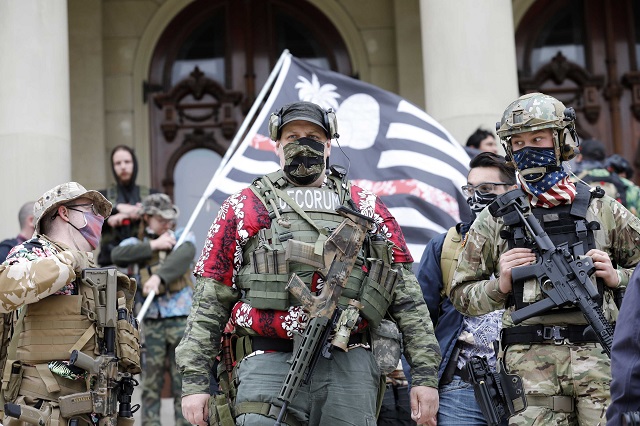
If you answered yes to any of those questions, you are a “potential terrorist” according to official U.S. government documents.

At one time, the term “terrorist” was used very narrowly. The official definition of terrorism is “The use, or threat, of force with the intention of achieving a political goal.” That makes it pretty clear what sort of people are covered, and for decades it worked well.  The government applied the label “terrorist” to people like Osama bin Laden and other Islamic jihadists.  But the Obama administration removed all references to Islam from terror training materials, and instead the term “terrorist” was applied to large groups of American citizens.

And if you are a “terrorist”, that means that you have no rights and the government can treat you just like it treats the terrorists that were being held at Guantanamo Bay.  So if you belong to a group of people that is now being referred to as “potential terrorists”, please don’t take it as a joke.  The first step to persecuting any group of people is to demonize them.  And right now large groups of peaceful, law-abiding citizens are being ruthlessly demonized.

Below is a list of 72 types of Americans that are considered to be “extremists” and “potential terrorists” in official U.S. government documents.  To see the original source document for each point, just click on the link.  As you can see, this list covers most of the country…

1. “Those that talk about “individual liberties”
2. “Those that advocate for states’ rights
3. “Those that want “to make the world a better place”
4. “The colonists who sought to free themselves from British rule”
5. Those that are interested in “defeating the Communists”
6. Those that believe “that the interests of one’s own nation are separate from the interests of other nations or the common interest of all nations”
7. Anyone that holds a “political ideology that considers the state to be unnecessary, harmful,or undesirable”
8. Anyone that possesses an “intolerance toward other religions”
9. Those that “take action to fight against the exploitation of the environment and/or animals”

10. “Anti-Gay”
11. “Anti-Immigrant”
12. “Anti-Muslim”
13. “The Patriot Movement”
14. “Opposition to equal rights for gays and lesbians”
15. Members of the Family Research Council
16. Members of the American Family Association
17. Those that believe that Mexico, Canada and the United States “are secretly planning to merge into a European Union-like entity that will be known as the ‘North American Union”
18. Members of the American Border Patrol/American Patrol
19. Members of the Federation for American Immigration Reform
20. Members of the Tennessee Freedom Coalition
21. Members of the Christian Action Network
22. Anyone that is “opposed to the New World Order”
23. Anyone that is engaged in “conspiracy theorizing”
24. Anyone that is opposed to Agenda 21
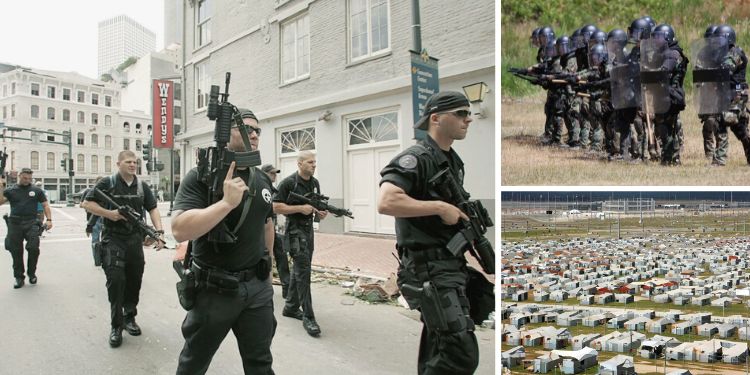
25. Anyone that is concerned about FEMA camps
26. Anyone that “fears impending gun control or weapons confiscations”
27. The militia movement
28. The sovereign citizen movement
29. Those that “don’t think they should have to pay taxes”
30. Anyone that “complains about bias”
31. Anyone that “believes in government conspiracies to the point of paranoia”
32. Anyone that “is frustrated with mainstream ideologies”
33. Anyone that “visits extremist websites/blogs” 
34. Anyone that “establishes website/blog to display extremist views”
35. Anyone that “attends rallies for extremist causes”
36. Anyone that “exhibits extreme religious intolerance”
37. Anyone that “is personally connected with a grievance”
38. Anyone that “suddenly acquires weapons”
39. Anyone that “organizes protests inspired by extremist ideology”
40. “Militia or unorganized militia”
41. “General right-wing extremist”
42. Citizens that have “bumper stickers” that are patriotic or anti-U.N.
43. Those that refer to an “Army of God”
44. Those that are “fiercely nationalistic (as opposed to universal and international in orientation)”
45. Those that are “anti-global”
46. Those that are “suspicious of centralized federal authority”
47. Those that are “reverent of individual liberty”
48. Those that “believe in conspiracy theories”
49. Those that have “a belief that one’s personal and/or national ‘way of life’ is under attack”
50. Those that possess “a belief in the need to be prepared for an attack either by participating in paramilitary preparations and training or survivalism”
51. Those that would “impose strict religious tenets or laws on society (fundamentalists)”
52. Those that would “insert religion into the political sphere”
53. Anyone that would “seek to politicize religion”
54. Those that have “supported political movements for autonomy”
55. Anyone that is “anti-abortion”
56. Anyone that is “anti-Catholic”
57. Anyone that is “anti-nuclear”
58. “Rightwing extremists”
59. “Returning veterans”
60. Those concerned about “illegal immigration”
61. Those that “believe in the right to bear arms”
62. Anyone that is engaged in “ammunition stockpiling”
63. Anyone that exhibits “fear of Communist regimes”
64. “Anti-abortion activists”
65. Those that are against illegal immigration
66. Those that talk about “the New World Order” in a “derogatory” manner
67. Those that have a negative view of the United Nations
68. Those that are opposed “to the collection of federal income taxes”
69. Those that supported former presidential candidates Ron Paul, Chuck Baldwin and Bob Barr
70. Those that display the Gadsden Flag (“Don’t Tread On Me”)
71. Those that believe in “end times” prophecies
72. Evangelical Christians

The groups of people in the list above are considered “problems” that need to be dealt with.  In some of the documents referenced above, members of the military are specifically warned not to have anything to do with such groups.

We are moving into a very dangerous time in American history.  You can now be considered a “potential terrorist” just because of your religious or political beliefs.  Free speech is becoming a thing of the past, and we are rapidly becoming an Orwellian society that is the exact opposite of what our founding fathers intended.

Government Asset Protection- Government Laws And Its Legal System Play A Part In Asset Protection (The Government Has Failed Its Obligation to Fathers, to Protect Them With The Constitutional Due Process That Is Required When Fundamental Rights Are At Stake.)

According to wikipedia: Asset protection consists of methods available to protect assets from liabilities arising elsewhere. It should not be confused with limiting liability, which concerns the ability to stop or constrain liability to the asset or activity from which it arises. Assets that are shielded from creditors by law are few: common examples include some home equity, certain retirement plans and interests in LLCs and limited partnerships (and even these are not always unreachable). Assets that are almost always unreachable are those to which one does not hold legal title. In many cases it is possible to vest legal title to personal assets in a trust, an agent or a nominee, while retaining all the control of the assets. The goal of asset protection is similar to bankruptcy, and the two practice areas go hand-in-hand. When a debtor has none to few assets, the bankruptcy route is preferable. When the debtor has significant assets, asset protection may be more sensible.[citation needed]

Government laws and its legal system play a part in asset protection. In some venues they may protect too much, while in others, they’re the villain that we should be protected from. This article examines when and where.

Three categories of ‘claimants’ who seek to get what someone else owns are:

* Creditors for payments owed
* Lawsuit Claimants for damage incurred
* Divorce/paternity litigants for what can be got

Each category shows up in a different type of court where different protections are afforded to defendants. Let see what government laws and its legal affiliates offer in each case.

Protection from creditors:

Your creditors are people you willingly contracted with for services or products in return for payment. You received their products and now you say you can’t pay them, because you’re bankrupt.

You file in bankruptcy court – a federal court – to have the judge determine how much you must pay to whom based on the assets you still have. Both state and federal laws protect some of your assets on the basis that you ought not to be left destitute – on the street so to speak. States have homestead laws and insurance laws that protect you too.

But federal law protects your government-regulated retirement accounts – such as your 401(k) or IRA, against creditor’s claims under your bankruptcy. Some people have enormous amounts of money in these accounts.

No one ever goes to jail for being a debtor to creditors. There’s no debtor’s prison, supposedly. That’s a good thing. But some of this protection from creditors is just too much.

Protection from ‘damaged’ claimants:

Legal suits are filed in superior courts for claiming significant reimbursement for damage incurred. Your liability insurance can handle most of these.

But there’s the danger of unfair suits that are based on phony or trumped-up damages. These suits often target people with ‘deep pockets’ as defendants. Claimant lawyers often take these cases on contingency.

Such defendants worry about the court making unfair court findings, an order to pay money way out of proportion to fairness, or just shelling out outrageous court costs to prove their innocence from fault. Many of these defendants settle with the claimants for a smaller amount than demanded just because it’s too costly to prove their innocence. That’s what the claimants – and their lawyers- are really looking for.

These defendants should consider asset strategies to reduce their appearance of having ‘deep pockets’. Many asset transfer techniques can achieve this.

Government’s part in protection is at least in a court system that affords a jury and some due (fair) process. But, sometimes, allowing contingent fee-only complaint lawyers or winning defendants unable to collect their legal fees perhaps fosters many nuisance suits.

Protection voided for a litigant in divorce/paternity suits:

Such suits are filed in a state’s ‘family’ courts. At stake are the fundamental rights – i.e. constitutional rights- of one of the litigants. These include custody loss of a child, loss of most all his assets, and then a continual taking of much of his income for up to 23 years in some states – all against his wishes to remain a parent caring and supporting his child directly.

But what makes this area unique is that there’s no need to find any ‘wrong’ much less a serious one like ‘unfitness’ in order to have such rights taken from him. That, in itself, should signal gross unfairness.

It’s the perversion of laws over the last 60 years along with no-fault divorce, and the almost assured sex-based outcome that the father will lose those rights that, together, has turned this ‘unfair’ taking into a multi-billion dollar a year industry. And, that industry has promulgated the propaganda that supports the ‘unfair’ taking as valid. So, it maintains and grows itself – further destroying the rights of fathers and their children’s rights to them.

The government and its family court system – with the help of all its affiliates and beneficiaries of the plunder of fathers – have created a kidnap and extortion scheme inflicted on fathers in the guise of ‘legality’. A father’s rightful and constitutional demand to parent and support his child directly at least equally to the mother is ignored.

The government has failed its obligation to fathers, to protect them with the constitutional due process that is required when fundamental rights are at stake. No creditor protections are afforded him under child support orders no matter how bankrupt he becomes. Fathers are routinely sent to jail under contempt for not paying what they can’t.

The only asset protection for a potential father – since government’s constitutional protections are denied him – is to be forewarned of the tyranny he’ll face for becoming a father, no matter how decent a man and father he is.

If you have any dissatisfaction with my content, you can tell me here and I will fix the problem, because I care about every reader and even more so about your opinion!

The End Is Coming!!! 8 Great Depression Era Recipes We Will Need Soon (Although this happened over 90 years ago, today we prepare ourselves for all types of worst-case scenarios.)

On October 29, 1929, the US Stock Market crashed, surging the country into what we know as the Great Depression. During the Great Depression, countless jobs were lost, millions lost their incomes, and families started to go hungry. This was during a time when many still lived off their own homestead, and if they didn’t, they needed to start.

Situations got so desperate, hungry people made food out of almost nothing. Canned goods, flour, and eggs from your own chickens were sometimes all that was available, if anything at all. Some only had one meal per day, and went hungry at nighttime. Others ate the same food for days or weeks on end because that’s all that was available to them.

Although this happened over 90 years ago, today we prepare ourselves for all types of worst-case scenarios. We know that, of course, this Depression-era famine will happen again, so here are some recipes that your parents or grandparents made during the Great Depression out of nearly nothing.

By no means you need to follow any of these recipes exactly, just adapt with what you have.

Depression Bread

Firstly, this bread is a huge loaf made from only 4 ingredients, all of which will already be in your food reserve.

Keeping homemade bread on-hand adds to many of the dishes on this list.

Ingredients

  • 5 lbs. flour
  • 5 tbsp yeast
  • 6 tsp salt (optional, if you have it)
  • 6 cups warm water, more or less depending on your flour

Instructions

Add flour to a bowl or board and make a well in the flour mound.

Add yeast, salt, and warm water to well and knead into a dough.

Allow to rise for 60 minutes, or until doubled in size.

Add to a baking pan and make 3-4 slits with a knife on the top of the dough.

Bake at 350 degrees for about 30 minutes until the bread is nicely browned on top.

Chipped Beef On Toast

Secondly, using the bread you just made, slice off some nice thick slices to serve with this dried meat Depression delicacy.

What You’ll Need

  • 8 oz. dried beef jerky
  • 2 tbsp butter or oil
  • 4 tbsp flour
  • 4 cups milk
  • Salt and pepper to taste
  • Sliced homemade bread, for serving
  1. Add jerky and oil to a pan over medium heat. Cook until the meat softens, about 3-4 minutes.
  2. Stir in your flour and cook for 1-2 minutes. Add milk and bring to a low boil. Allow sauce to thicken for up to 5 minutes.
  3. Season with salt and pepper if you have it.
  4. Serve over homemade bread, toasted if desired.

Dandelion Salad

This salad can be harvested from your own backyard, just as they did in the 1930’s.

As we know, dandelions are totally edible and delicious, they just require lots of cleaning before eating.

Ingredients

  • 1 lb. freshly picked dandelions, cleaned well
  • 2 tbsp lemon juice or vinegar
  • 2-3 tbsp oil

Guidelines

Head outside and pick the largest, freshest dandelions you can find.

Then, cover the dandelions completely in cold water and rinse 3-4 times.

Using a knife, peel off the darkest outer leaves from the root. Rinse again.

Once clean, either chop or leave whole, depending on your preference.

Add to a large bowl and season with vinegar and oil. Serve immediately.

Baked Beans

8 Great Depression Era Recipes We Will Need Soon

Beans are cheap, plentiful, and filling.

They were very common in the Depression era, and recently have had a resurgence with the Covid-19 epidemic.

If you do not have every vegetable used, omit without issue.

What It Is Needed

  • 1 package soaked dried beans, or 2 cans of beans
  • One tomato, chopped
  • 1 onion, chopped
  • 2 cloves garlic, chopped
  • 2 tbsp lard
  • Two tbsp molasses
  • One cup water
  • Instructions
  1. Soak your beans, if using dried, overnight and drain the liquid.
  2. Prepare your veggies by chopping. Omit any vegetable that you do not have on-hand.
  3. Add lard to a stock pot and cook your vegetables until tender.
  4. Add the beans, molasses, and water. Cook all together with a lid on for 2-3 hours or until the beans have your desired consistency. Add more water if needed.
  5. Serve hot. Leftovers of this dish keep very well and can be eaten many days in a row.

Ash Cakes

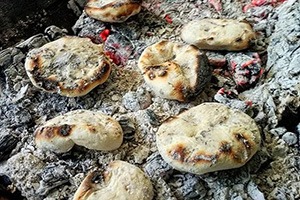
Ash cakes got their name because different renditions are cooked in the hot white ash of your campfire. These are only 3 ingredients but are filling and have a great texture.

Ingredients

  • ½ cup cornmeal
  • 1 cup meat stock or water
  • 2 tbsp lard or grease

Instructions

8 Great Depression Era Recipes We Will Need Soon

Mix both ingredients together in a bowl and allow to sit overnight to hydrate the cornmeal. Pat into a bread pan and refrigerate or add to your cool storage before allowing to set up.

The next day, slice into 1-inch slices and fry in melted lard. Serve hot and crispy.

Hoover Stew

This stew is an amalgamation of what you currently have in your reserve. This recipe is very easily adaptable to the items you already possess.

Essentials

  • 1 box noodles
  • A can of tomatoes
  • 1 package of hot dogs, or 1 can of sausage or meat
  • A can of corn, peas or beans
  • 2-4 cups water

Guidelines

8 Great Depression Era Recipes We Will Need Soon

Mix all ingredients together in a pot until boiling.

Then simmer for 15-20 minutes until the noodles are tender.

If you have aromatics, onion and garlic would be a great addition.

If not, the recipe is great as is.

Potato Soup

Many of us have potatoes buried in our yards right now, saving them through winter. This is a great way to use up your potato harvest at the end of winter, but you can always use canned potatoes too.

Ingredients

  • 4 large potatoes, peeled and sliced (or 2 cans of potatoes)
  • 2 garlic cloves, chopped
  • One carrot, sliced
  • A can of meat, sausage, or hot dogs (optional)
  • 3 cups water or stock
  • 3 cups milk
  • Any herbs you have on-hand
  • Salt to taste

What To Do

Potato Soup

Slice all your potatoes, garlic, and carrots. Add to a soup pot with the meat,  water, and milk. Bring to a boil and reduce the heat, keeping the mix at a low simmer.

Then, cook for 30 minutes until all veggies are tender.

Add herbs and salt, if using. Serve hot.

Rice Pudding

And finally, our only Great Depression dessert recipe. There aren’t many comforts during a depression, but at least this rice pudding will bring some familiarity to an undesirable situation.

What It Is Needed For This

  • 1 cup rice
  • 2 cups milk
  • 2 tbsp butter
  • 3 tbsp honey, maple syrup, or molasses
  • Pinch of cinnamon
  1. Combine all ingredients in a small saucepan and cook over low heat, about 20 minutes, stirring frequently.
  2. Taste for doneness and cook an additional 5 minutes, tasting until desired consistency.
  3. Serve warm.

Therefore, we may need our parents or grandparents’ Great Depression-era recipes sooner than we think, thanks to the increasing instability brought on by governments and the current pandemic.

Cooking with almost nothing is possible, as the 1930’s and early 1940’s taught us. All of these recipes are easily made with what you should already have in your root cellar and non-perishable reserves. Use your judgement to add or omit any ingredients that suit you.

In conclusion, the next time the economy crashes, which may be sooner than we think, keep prepared with some recipes to keep your family fed and your homestead moving forward.

Are Cops And Military The Second Big Threat When SHTF?

Preparing to survive in a post-SHTF world is challenging. More than anything, we have to realize that we’re preparing blind. We don’t know what sort of disaster we’re facing or what the post-disaster world is going to look like. With those two pieces of information missing, it’s hard to know exactly how people will react and what they will do. Therefore, we must prepare for the worst.

There is a wide-ranging assumption that public servants will abandon their posts. I would have to say that this assumption is totally unfair. We live in a hurricane zone and my wife is a city employee. She and her co-workers are required to agree that they will stay on the job, protecting the citizens of the city and keeping city services running, both during and after a hurricane. While a few might abandon their posts if things get bad enough, most seem to be people who will follow through on that requirement.

But what about a worst-case scenario? What about in the wake of an EMP or other grid-destroying event, which would result in a true breakdown of society and the banking system; a situation where they would no longer be paid to do their jobs?

That’s a difficult question. For some, like my wife, their positions probably wouldn’t exist anymore. But the real issue here is emergency workers and law enforcement officers. We would greatly need their services in the wake of such a serious disaster. Would they stay on the job or would they feel they had to abandon their posts to care for their families?

There’s really no way of knowing the answer to that question until the time comes. It is a very individual question, so I imagine that some will stay, while others leave. Whether they stay or leave will largely determine whether they are friend or foe.

The Cops Who Stay on the Job

Police officers tend to be highly disciplined individuals, much like soldiers. In fact, many start out as soldiers, then move to law enforcement when they get out of the military. As such, they are largely people with a high regard for the law. Oh, there are the few bad apples; but despite stories saying otherwise, there aren’t many of them.

Those who stay on the job will be concerned with maintaining law and order in the worst of circumstances. They will also be subject to the politicians who are still in place over them. This means that if those politicians declare martial law, they will most likely enforce martial law, unless they believe that to be an unlawful order.

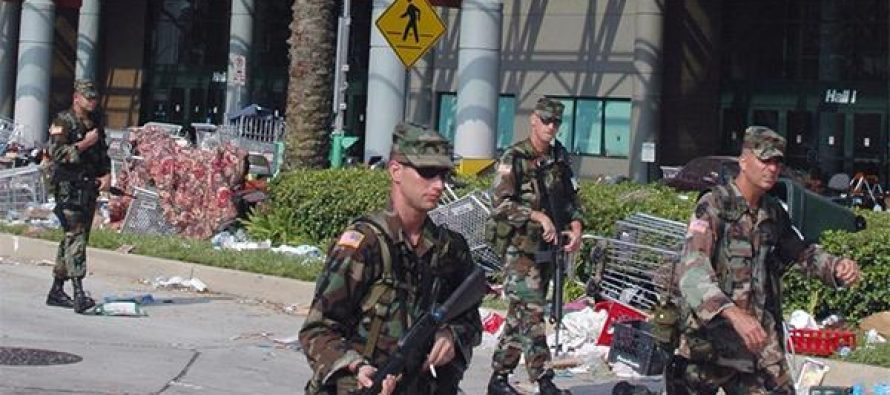
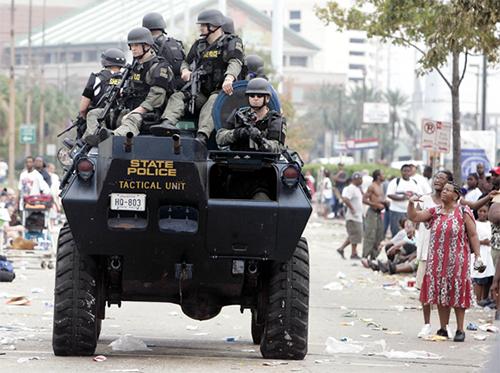
This could get sticky. As we saw during Hurricane Katrina, declaring martial law would probably mean they would be confiscating guns as well. That would put the police in the position of appearing to be the enemy in the eyes of any Second Amendment supporter. Whether or not they actually became an enemy would depend on how you, I and other gun owners would react to them. If we use force to reject their orders to turn over our guns, they will use force in response. That makes them our de-facto enemies.

The Cops Who Abandon their Posts

Some police officers may choose to abandon their posts, especially if they feel that their families are in danger. In that case, the question is what they will do to protect and care for their families. While there are very few bad cops out there, there is always the possibility that a cop will turn bad in such circumstances, out of desperation to take care of their families.

These people will be dangerous, because they will be able to present themselves to the public as law-enforcement officers, when in fact they are acting like criminals. There could even be some cases in smaller communities, where the police take over, much as warlords take over in times of anarchy. Should that happen, the police in question would be extremely dangerous.

It would be our duty, in such a case, to stand up against the police. But here’s the problem. How do you tell if what they are doing is in the public interest, or just in self-interest? If they are acting in the public interest, our duty is to support them, so we need to be sure they are the enemy, before treating them as such.

The National Guard

If military forces are called out to help gain control, it will be the National Guard, not the active military. US law prohibits the use of US military forces within the borders of the United States. Even if politicians in high places wanted to use the regular Army, it is doubtful that Army officers, all of whom know that prohibition in the law, would allow it.

But state Governors can call out the National Guard to help law enforcement in maintaining law and order. It’s not unusual for this to happen in the case of natural disasters. I would say that we should expect it to happen in a true SHTF scenario.

National Guard forces are US Army reserve soldiers and formations, which are “owned” by the governors of the several states. They serve a dual role, both as state owned military forces and reserves for the federal forces. If called out in a disaster situation, they could serve either to support law-enforcement or to provide disaster relief. In either case, they would be armed.

The Police and Military when SHTF – Friend or Armed Foe 2

Should martial law be declared, it is highly likely that the National Guard would be called out. If guns are confiscated, they are the ones who would most likely do the confiscation. They would probably be as polite as possible about it; but if they decided to obey that order, they would do their best to fulfill it.

However, the National Guard, like other military forces, is made up of predominantly conservatives. There’s a very good chance that they would refuse an order to disarm the population. Military officers swear an oath to uphold the Constitution and they would likely see the disarm order as a clear violation of the Second Amendment. As such, it would be their duty to refuse that order.

UN Troops

Of all these options, UN troops is the most dangerous. Any decision to use UN troops would have to be made at the federal government level. Were such a decision to be made, the troops which would be brought in to help maintain civil order would not be American troops. They would be unfamiliar with our culture (other than what they had seen in movies) and unfamiliar with our laws.

To these troops, a firearm confiscation order would seem perfectly reasonable, especially when you consider that they would probably come from a country where they don’t enjoy our Second Amendment protections. There would be no appeal to them on the grounds of our Constitution.

Should this happen, refusing an order to turn over your guns would be dangerous. The only thing that would protect any of us is the fact that there is no federal gun registration. Even so, there are states which require a permit to own guns, as well as concealed carry licenses which many of us have. That would give them a starting point for where to look.

Getting into a battle with armed troops is foolish. In such a situation, the only practical recourse is to hide all your guns where they won’t be able to find them, with the exception of a few, which you could then allow them to confiscate, making them think you’ve obeyed the order.

Regardless of the specific situation we would end up encountering, chances are that any police or military forces which were still in operation, would be there as part of whatever government managed to survive. Unless such forces decide to go rogue, we can count on them being there to help.

That doesn’t mean they’ll be our friends though. Unless you know them personally, they will look on you with suspicion, just like they will everyone else. Anyone carrying a weapon openly will be suspect. That doesn’t mean that they’ll hassle you, take away your weapons, fire upon you or arrest you; it just means that they will be watching to make sure that you aren’t a problem that they need to deal with.

The best thing you and I will be able to do in such a situation is to keep ourselves below the radar, so that we aren’t noticed. If we are not noticed, hopefully we will be left alone.

Should orders go out to confiscate any supplies that are stockpiled, it would probably be a good time to put our bug out plans into effect. Hopefully, we’ll all have a cache of supplies elsewhere, so that when we lose the supplies that we have stockpiled at home, we’ll still be okay.

The ultimate and final choice is between Good and Evil (People who have taken a blood oath can be found throughout society in positions of authority and power in nearly every corner of the globe.)

The blood oath is fundamental.  Biden and most of his cabinet and most courts and congress have probably taken it. That’s why they are excluded from mandatory vaccines. 
These people swore an oath or to represent citizens, but their true loyalty is to Satan (Communism.).They are traitors and should be treated as such.

Worldwide the vaccine passports is leading to a Chinese Communist social credit system where your every word and move are monitored for political correctness.

Like our “leaders,” the Chinese Communist Party (CCP)are Satanists.
We now face persecution from this evil red dragon in the form of medical tyranny.We’re dealing with PURE EVIL. 

The Final Choice is Good or Evil. What Choice Will Those with a Blood Oath Make?

The ultimate and final choice is between Good and Evil.

The Chinese say, “you can’t stand in two boats”; as the boats move apart, you will be forced to choose one boat or fall into the water. Those who have taken a blood oath are conflicted between doing what is Good or following a path that stops at no Evil. 

The way to discern good or evil is to evaluate it against Truth, Compassion and Tolerance; this is the characteristic of the cosmos. Those who adhere to these universal principles are good. The ones who deviate from Truth, Compassion and Tolerance are wicked.

marx-hand.jpg

Karl Marx signalling the “hidden hand”, indicating the real power of the world from behind the scenes controls him and he has taken a Blood Oath.

In the Communist Manifesto (Chapter 2), Karl Marx spells out that communism is Satanism:

“There are, besides, eternal truths, such as Freedom,, etc., that are common to all states of society. But Communism abolishes eternal truths, it abolishes all religion, and all morality, instead of constituting them on a new basis; it therefore acts in contradiction to all past historical experience.”

Because communism is opposed to Truth and it abolishes all morality; therefore it is easy to see communism is evil.

Communism was created by evil and it is spread by evil people, hidden in the top layers of society with dual loyalties.

Today, the Chinese Communist Party (CCP) is playing the leading role to establish global communism.

The CCP requires a blood oath to join; it has brutally persecuted many groups in China since coming to power in 1949, killing an estimated 60-80m people who were opposed to communism.

This genocide in China has continued until today, because the CCP is always persecuting someone. One noteworthy group is Falun Gong, a peaceful meditation practice that was brought to the public in May, 1992. It was very popular in China, with over 100m people taking up the practice. The practice has five slow moving qigong exercises and a series of lectures that help people improve themselves to their very core.

Because Falun Gong practices Truth, Compassion and Tolerance, the CCP has persecuted them since July 20, 1999. Practitioners were detained, arrested, put to forced labor, imprisoned, tortured and had live organ harvesting (faluninfo.net).

 The CCP is against Truth, Compassion and Tolerance. Now, the CCP and those aligned with it are utilizing every means at their disposal to persecute the entire world. Good people everywhere now face persecution from this evil red dragon in the form of medical tyranny.

COMMUNIST AGENTS

The CCP goal is the destruction of the USA and imposition of The Great Reset — worldwide communism. People are recruited because they hold positions of status or influence in society, and they are able to maintain their positions, while at the same time, secretly pledging their loyalty to something else.

The CCP requires a blood oath to become a member with these words:

“… ready at all times to sacrifice my all for the Party…”

“…both parties stop and swear unto death while standing in the midst of the blood, swearing by G-d (thus making G-d their 3rd party) to kill the covenant breaker and his seed after him if the terms of the covenant are breached.”

pence-coin.jpeg

Traitor VP Mike Pence received this “token of appreciation” immediately after voting against Pres. Trump on Jan 6th, 2021. It’s rare to see high level secret society ceremonies in a public setting.

“All this I most solemnly and sincerely promise and swear, with a firm and steadfast resolution to keep and perform the same, without the least equivocation, mental reservation, or self-evasion whatsoever, binding myself under no less a penalty than that of having my body severed in twain, my bowels taken thence and burned to ashes, and these scattered by the four winds of heaven, that no more remembrance may be had among men or Masons of so vile a wretch as I should be, should I, in the least, knowingly or wittingly, violate or transgress this my Master Mason’s Obligation. So help me God and keep me steadfast.”

The Jesuit oath (from 1533 Jesuit oath):

“In confirmation of which I hereby dedicate my life, soul and all corporeal powers, and with the dagger which I now receive, I will subscribe my name, written in my blood in testimony thereof; and should I prove false or shaken in my determination, may my brethren and fellow soldiers of the militia of the Pope cut off my head and my feet and my throat from ear to ear, my belly opened and sulphur burned therein with all the punishment that can be inflicted upon me by demons in eternal hell forever.”

Finally, the Mafia also has a blood oath (related by Joe Valachi in testimony to Congress):

“I sit down at the table. There is wine. Someone put a gun and a knife in front of me. The gun was a .38 and the knife was what we call a dagger. Maranzano [the boss] motions us up and we say some words in Italian. Then Joe Bonanno pricks my finger with a pin and squeezes until the blood comes out. What then happens, Mr. Maranzano says, ‘This blood means that we are now one Family. You live by the gun and the knife and you die by the gun and the knife.’

Those swearing a blood oath are often required to spy and commit crimes for these groups. Their blood oath has priority over any other oath, they literally pledge their lives to these groups and must keep this secret. Their feet are more firmly planted in the evil boat, but they still have a chance until the end to make a better choice.

HANDSIGN-FAUCI.jpg

Dr. Fauci is Jesuit trained and a Deep State operative through six administrations. Watch his signals to know where his loyalties lie.

DUAL LOYALTIES

People who have taken a blood oath can be found throughout society in positions of authority and power in nearly every corner of the globe.

Many have literally “sold their souls” for wealth and other benefits. People who take a blood oath are recruited in, no one can “apply” to join and membership often follows family lines. The secret organizations see the power the person has access to, they can also “direct” things to make a person gain even more power, even becoming president of the United States.

Is it a surprise the “hidden hand” has guided events and created history in this manner? The large scale ritual sacrifices are now on a grand scale: two World Wars, the Holocaust (which means “burnt offering), 9/11 and now the biggest of all…the COVID/CCP Virus. All of these events were perpetrated by people with dual loyalties, whose feet are in two boats.

Government agents can do anything they want if the government is corrupted- Can FEMA confiscate your food supplies?

A disaster strikes in your city so severe that military, law enforcement, and major emergency response forces such as FEMA are deployed to handle the situation.

But then, to your surprise, you have FEMA personnel and law enforcement agents knocking on your door…and they demand to enter and see and take all the food, water, and supplies that you have on hand.

When deployed, FEMA provides disaster-relief experts to assist with the efforts of state and local governments, deploys personnel and equipment to assist with disaster-relief efforts and recovery, and offers funding to help support the rebuilding phase after the disaster has ended.

In a nutshell, FEMA is an agency designed to help handle and coordinate responses to major disasters. When they come it’s ‘to help’ right?

That’s what you may think until the FEMA personnel come knocking on your front door and demanding to take what you have.

But why would FEMA try to requisition your stockpile of food and supplies in the first place? Could they get away with it? If so, how should you react? We’ll attempt to answer those questions in this article.

Why Would FEMA Requisition Your Stockpile?

One scenario in which FEMA could requisition your possessions, including your stockpile, is if martial law were to be declared.

Knock Knock! It’s FEMA, We Need Your Stockpile

Martial law is the complete suspension of current laws enacted by the civilian government in favor of laws set by military authorities. Usually invoked during times of emergency, such as war or natural disaster, the purpose of martial law is to give the local authorities unlimited authority to create and enforce laws.

In other words, when martial law is declared, all existing laws on the books would effectively go out the window. Forget about having freedom of speech or the right to own your property. If the authorities were to decree in a martial law that they can come onto your property and take anything they want, there would be nothing to stop them from doing so.

That’s because when martial law is declared, it will be a top priority of the authorities to maintain strict control over the local population.

This will involve four major steps:

  1. Controlling the movements of the population and ensuring no one can leave (unless if the affected area needs to be evacuated)
  2. Controlling speech and propaganda
  3. Disarming the population to ensure they can’t fight back
  4. Making the population dependent on the authorities for food, water, and medication

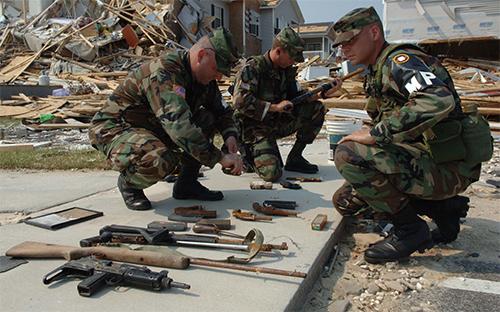
After Hurricane Katrina, police units literally went door-to-door to confiscate firearms from legal gun owners.

In a longer term situation, the government could do the same thing, only they would take food, water, medicine, and other necessities. FEMA, with support from deployed law enforcement or military units, is an agency that would be among the most likely to carry this out.

The purpose of doing so would be to ensure that people can’t be self-sufficient. The authorities could then create bread lines to force people to stand in line for food. In other words, people will only be able to eat when and where the authorities would decree. They could withhold food

How Should You React and Prepare?

A major disaster that involves government agencies confiscating necessities and supplies from the local population may seem unlikely, but it’s not at all outside the realm of probability. That’s why it’s a potential scenario that you need to be ready for.

There are three primary things you should do to react to this kind of situation:

Hide Your Stockpile

Knock Knock! It’s FEMA, We Need Your Stockpile

Think about extra hidden rooms in the home where you could store food, water, medicine, and other items.

If no such room exists in your home, consider making one.

For example, would it be possible to build a storage area into a wall?

Or what if you built an underground storage place outside?

The point is to make sure that not all of your preps are clearly obvious. When the FEMA personnel come stomping through your house, you want to make sure it’s difficult for them to detect your stockpile.

They’ll likely check the kitchen, pantry, and garage first; whether they give the rest of the house and property a closer inspection likely depends on how strictly they’ve been ordered to remove the food and water supplies from the local population.

For an added tip, consider having multiple secret rooms or storage areas. In the event the FEMA personnel find and requisition one stockpile, they’ll hopefully be satisfied and move onto the next house.

Don’t Resist The Authorities

Secondly, make sure that you don’t resist the authorities when the time comes. Whether you like it or not, if FEMA and police are at your door you’re not going to be able to resist them, and if you do, you’ll be arrested and your items will be confiscated anyway.

Knock Knock! It’s FEMA, We Need Your Stockpile

Play it safe, and don’t resist while ensuring that much of your preps are kept a secret. Besides food, water, and medicine, the same goes for your firearms, ammunition, and other valuables as well.

Anything you think the government would want to confiscate from you, you’ll want to keep hidden in the event of a large-scale disaster happening.

Don’t Make It Obvious That You’re A Prepper

Additionally, you won’t want to announce to the rest of the world that you’re a prepper either. It’s always smart to keep your preps under-the-radar and only to inform those close to you within your circle of trust about your preparations.

This is one more reason why it’s smart to have your stockpiles hidden and not so obvious. If you have guests over at your house, for instance, they may not think twice about your preparations now but they definitely will remember after disaster strikes.

The last thing you’d want is for your neighbors to come knocking on your door after a disaster demanding you share your food, or otherwise for them to alert FEMA personnel that you have

In the event of a major natural disaster or emergency that brings on a massive government response, be prepared to have government forces coming to your door for your stockpile. The best way to get around this to ensure you won’t be dependent on the upcoming breadlines is to keep part of your stockpile hidden and secret.

Where are some hidden places in your home or property where you could safely stockpile food and water? This is something you’ll want to start thinking about if you haven’t already.

How The State Will Strip You Of Your Rights When SHTF (There comes a point at which the only thing in your mind is to know if you will return home alive. Everything else is secondary. At that point, the state has already massacred you internally)

Dealing with this subject has been quite difficult for me. Both the concept of the state stripping you of everything and the SHTF concept have as many backgrounds as diverse interpretations, so trying to approach this from a single point of view is a complicated task.

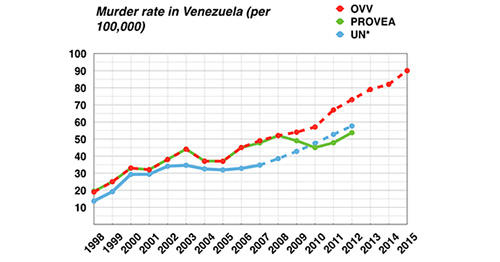
In my country, Venezuela, after 20 years of “revolution,” we have bottomed out and learned to live in situations we never imagined (so much so that I was able to write an article on survival techniques I never imagined myself using on daily basis).

How the State Will Strip You off Everything When the SHTF

It’s not that the governments before Hugo Chavez were much better. But there was a much more stable political and economic situation with access to the international market.In 1999, when Chávez’s government was instated, oil prices were the highest in Venezuela’s history. The newly born Communist policy in the country was hardly felt and had very few repercussions on the professional citizens who lived on a monthly salary.

That’s probably why those first few years didn’t really feel like something was taken away from us. In addition, the newly elected president had a 60% popular approval rating and promised endless opportunities for the neediest people.

One of the first economic policies was the implementation of exchange control, currently in effect. Any operation with foreign currency was managed by the state. Later came the control of the prices of basic products, which caused the disappearance of those items and initiated a black market that is also very much in force to this day.The real problem began in 2004 with the accelerated decrease in oil prices that translated into a lower income for the government. Remember that we are talking about an oil-reliant country.

The decay was soon seen in many aspects. There was no longer maintenance on public roads, and public services failed often until reaching the point of constant failures of electric service, even for days.

The public health situation is also getting worse and worse. As a health professional, I have seen this deterioration for the last 10 years.

I am an oncologic breast surgeon. In Venezuela, breast cancer is the main cause of death from cancer in women. However, in the hospital where I work, the most important hospital in Caracas, there are no basic services for this issue. No chemotherapy, the radiotherapy equipment has been inoperative since 2015, and surgical procedures are suspended every week.

For me, as a doctor, it is frustrating not to be able to help my patients in any way. Just last week two breast cancer patients who were going to the operating room were suspended for the fourth time in a row. This time the anesthesia machine was failing.

The purchasing power of the Venezuelan citizen also decreased. It seemed to have happened from one day to the next, but if you look at the political situation since 1988, the decline took a long time; all that was left was to hit rock bottom.

Finding ourselves in extreme situations makes our defense system act in a primitive way. This means activating the fight or flight response at any time within any context—and yes, the state takes advantage of that.

The state will rip you off, but it doesn’t happen all of a sudden. There are a lot of logistics; it takes a long time to develop the kind of policy that makes citizens totally dependent on the state.

You start by losing something unimportant, like some kind of monetary bonus now given to you as government-run grocery store credits, and you end up losing your freedom and all kinds of rights, including freedom of speech and protest, but these issues are so extensive that they require an article of their own to explain them properly.

The state has taken charge, with great success I must say, and you are now living in fear of the so-called public authorities, meaning police and military police, since they serve as pro-government forces of repression.

Many of us have lost the incentive to go out and protest. We did it for more than 10 years. However, I have seen the evolution of the manifestations before and now.

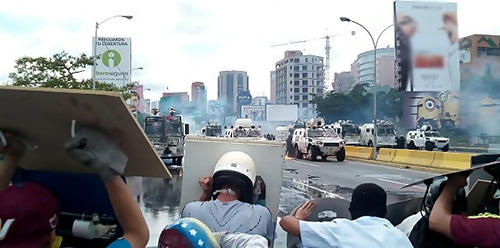
I remember 2003 when repression was minimal, almost non-existent. Today many friends who still have the strength to continue have gotten gas masks in order to defend themselves from the hundreds of tear gas grenades used by the authorities that should be defending people.

In any public protest, savage repression is a constant. That violence is what we Venezuelans have become used to.When there is no public or social security, when the devaluation of the currency is occurring on a daily basis, and when you don’t know if the bakery on the corner is going to be broken into tomorrow, at that moment, the debacle has already occurred.

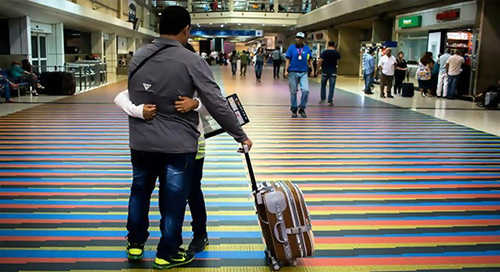
Defending oneself from these kinds of problems is as difficult as trying to explain them. Many have chosen to leave and seek a future in other countries. That way the state even strips you of your own country by causing you to become self-exiled.

I don’t blame them. We all have more than one family member or close friend who has been kidnapped or stolen from violently, and sadly, all we can say is “You should be thankful you weren’t killed”.

Personal security becomes a problem of epic proportions, to the extent that going out on the street is considered a risky activity—a risk to which, unfortunately, you have to get used to in order to live a normal life.Living in that state of continuous stress in which your rights are violated, in cities where, despite paying high taxes, everything seems to be in ruins, is part of that hopelessness that the state achieves in the individual.

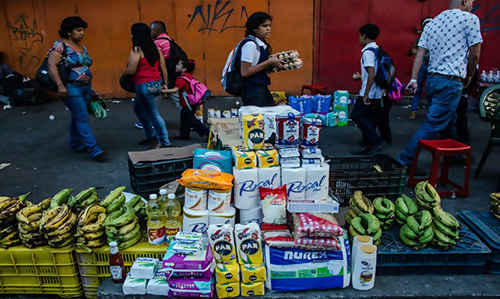
Living in a place where a good monthly salary fora top executive, for example, does not reach $100 a month, is not easy, especially taking into consideration that a basic shopping list for a family of four can cost up to $140 monthly.

So the mismanagement of incompetent and corrupt civil servants results in the deep separation of three social classes: extreme poverty, which represents more than 80% of the population and is totally dependent on the government; the working middle class, which manages to subsist through one or two basic incomes plus the economic help of family members abroad; and those who do business with the government and can live in a very comfortable, ideal world that has nothing to do with reality.

Of course, there are exceptions to this, and some people have high incomes without being involved in dubious businesses.

It is sad to see how fourth-level professionals, trained in the country, must leave in order to provide for their families.

I know it is not a unique situation in the world—it has happened and will continue to happen—but it is very different to read about it than to see it sitting in the front row or even being the leading character.

Nowadays it is the common denominator, and more and more qualified professionals and technicians step into the international airport in search of a better quality of life.That’s why there is a whole generation that has no kind of roots in their country and only waits for the opportunity to leave.

I think the worst part of all this is the desolation sown in all of us. It seems to be an endless story, with the political disqualification of opposition leaders, political prisoners, and many more vexations.

Writing all this is not easy, but it makes me reflect. It is an exercise in introspection. Without a doubt, the state strips you of everything in its eagerness to stay in charge. That’s the way they do it.

There comes a point at which the only thing in your mind is to know if you will return home alive. Everything else is secondary. At that point, the state has already massacred you internally. You can never be the same again. I’m sure I am not.

Even if you are a person who is not involved in politics, an “apolitical” citizen, in this state of anarchy, you have to fix your position.

As Desmond Tutu said, “If you are neutral in situations of injustice, you have chosen the side of the oppressor.”

7 Unexpected Consequences of an Economic Crisis: That Will Throw The Nation Into Total Chaos

Other than the obvious consequences, what might we expect from a partial economic collapse? A total collapse of the economy would throw the nation into utter chaos. But what if we endure an economic depression, or a severe and long-lasting downturn? I think that some of the effects are not so obvious.

1. The college and university system will collapse

As I explained in this previous post, the system of higher education is a house of cards. The cost of getting a college degree has risen sharply and steadily, while real income has remained relatively flat. The price rise is due to the easy availability of grants and loans for education. But with so many persons getting a college degree, its value in the marketplace has plummeted. Many college grads are out of work, or they are working in a job that does not require a degree. Eventually, this practice of paying more and more, for something that is worth less and less, will collapse the system. Colleges and universities will not have enough paying students, and professors will not agree to a drastic pay cut. Overhead expenses are far too high.

All that is needed is an economic collapse, or partial collapse, to topple this house of cards. Many universities and colleges will be forced by economics to shut down.

2. Agricultural yields will plummet

The current U.S. agricultural system is based on the expectation of high yields. But high yields are obtained by high inputs — all the things that go into growing the crop, including lots of fertilizer, perhaps irrigation, herbicides, pesticides, labor, machinery. Then those high yields are sold and the money is then used to fund the inputs for the next crop cycle.

An economic collapse will mean that farmers will not be able to afford all the inputs needed for high yields. And when yields fall, the amount of money from that crop will be less. Then the next crop cycle will have even less money for inputs, resulting in even lower yields. And the process will continue — lower yields, less money, lower inputs — until many farmers are out of business and a food crisis results.

3. Violent crime will increase

When people lack money and food, they become desperate. And desperate people do desperate things. Theft and robbery will skyrocket, and people will be afraid in their homes, and afraid to go out in the community. Even a quick trip to the market will become risky. Sales of most goods will plummet, causing the economic crisis to worsen. Protests will turn violent. Home invasion robberies will become much more common. Many people will be killed or injured as a result of this increase in violent crimes.

4. Law enforcement will be overwhelmed

The law enforcement system in the U.S. is commercial. Officers are paid. We don’t keep a large excess of officers on the payroll, just in case crime sharply increases. So it is relatively easy for the system to be overwhelmed. And that means a call to 911 might not bring the police to your door in time, if at all. Those who have firearms for home defense will be much better off than those who rely solely on the police. But many households have no firearms. And that means that robberies will increase, and so will the economic damage and the number of injuries and deaths.

5. The healthcare system will be overwhelmed

The healthcare system is also commercial, and lacks a safety margin in the form of excess doctors and nurses. Hospitals operate at close to capacity. A sudden increase in persons who are sick or injured will overwhelm the system.

The aforementioned increase in violent crime will undoubtedly increase injuries. But it is less obvious that a disruption to the food production and distribution system will increase illnesses. Plenty of good healthy food is the first line of defense against illness. Malnourished persons are much more likely to get sick. So an extended disruption to the food supply will cause an increase in illnesses.

6. Travel anywhere will become dangerous

As a result of all the above described problems, travel will be dangerous. Want to make a quick trip to the supermarket? You risk having your house robbed, if it is left unoccupied. And you risk being attacked on your way back from the market. Robbers might wait outside the market and follow anyone who looks like they purchased a lot of food.

There will be protests in many places, and violence will often break out. People who are hungry and afraid do not make the best decisions. Then there is the cultural aspect of the situation. We live in a culture that tells us to expect the government to take care of us, and to protest whenever anything doesn’t go our way. Ironically, self-sufficiency is abhorrent to our narcissistic culture.

I expect that the roadways will be dangerous, as violent criminals will see travelers as easier targets than homes.

7. The death rate will jump higher

People will be malnourished because of the disruption in the food supply, so they will get sick more easily. Violent crimes and violent protests will result in many more injuries than usual. And yet healthcare will be much more difficult to access. There will be a shortage of hospital beds. It will be difficult to get a doctor’s appointment. There may be a shortage of prescription and OTC medications.

All of these factors will make life a riskier endeavor.

Now if you are a seasoned prepper, who has long considered the dangers inherent in an economic collapse, you may have anticipated some of the above consequences. But I hope I’ve added to your understanding of the possible problems that we may soon face.

Classified FEMA Report Confirms Preppers’ Worst Fears (It contains some very important information that confirms the government’s understanding of the EMP threat posed by our own sun.)

Forward thinkers are always ostracized. It has been that way throughout history. Preppers are no different. We just ought to be thankful we are not living in the time of Socrates, or else we would be lining up for the hemlock.

From large scale civil unrest to the one of an EMP generated by the sun, it’s clear that preppers have been way ahead of their time. These topics were once deemed “paranoid”, or “delusional” but all of the sudden names in pop culture and even world governments are paying attention to these types of threats.

One such threat seems to be leading the pack and has shown up in many recent government reports. FEMA in particular seems to be concerned about the threat of a geomagnetic storm that would emanate from the sun and cause massive power outages across the planet.

A once classified FEMA report has surfaced and goes in depth on the level of preparations and concern that they have for a storm of this magnitude.

Understanding Reports and Unpublished Documents

The government buys ammo, writes and drafts lots of reports and documents that never really see the light of day. Now, we must be smart about that bit of information.

It’s important to take a look at these for what they are. There is a lot of research and science that goes into creating these drafts and reports. They are not a bunch of made up steps and stats.

However, some of these reports are also never going to be acted upon. That means, though the report may contain some very effective information, it’s not going to affect law or protocol in any way.

To be completely clear, what we have here is an unpublished document that was written by FEMA. It contains some very important information that confirms the government’s understanding of the EMP threat posed by our own sun.

The title of this unpublished report is very telling.

Mitigation Strategies for FEMA Command, Control and Communications During and After a Solar Superstorm

FEMA and NOAA’s Geomagnetic Storm Timeline

There are many takeaways from this classified FEMA report, but the geomagnetic storm timeline is the core of this document. This timeline shows that this report was put together with a tremendous amount of research and a focus on following the solar superstorm, from its start as a sunspot all the way crashing into the earth’s atmosphere.

G Minus 5 Days

This is the first spotting of the large sunspot on the surface of the sun. The focus is on large, complex magnetic fields on the surface of the sun. From this point we would have a 5 day window to prepare, but it would be very hard to determine the threat at this point.

G Minus 17 Hours

At the launching of a massive CME we are left with just 17 hours to prepare. Radio, radiation storms and geomagnetic storm warnings and watches are also issued at this point.

G Minus 16 hours 40 minutes

The solar radiation storm arrives at this time and we lose 15% of our satellite fleet due to solar panel damage. There could be greater loss and efficacy issues with GPS.

We would have about 20 minutes notice before this happened. “We” doesn’t necessarily mean you and I would hear anything.

G Minus 15 minutes

CME arrives at the NASA ACE Satellite.

There is no going back from this point. This is basically the point when we have an EMP on our planetary doorstep.

0 HourServices Interrupted

At the heart of the EMP fear is the loss of services. We all know that once shipping stops things get ugly fast. When the food and medicine are no longer being shuttled around the nation, people get hungry and desperate.

Water systems will also be affected by an EMP. Much of the process that cleans your water is governed by computers and machine systems. Those go away, too!

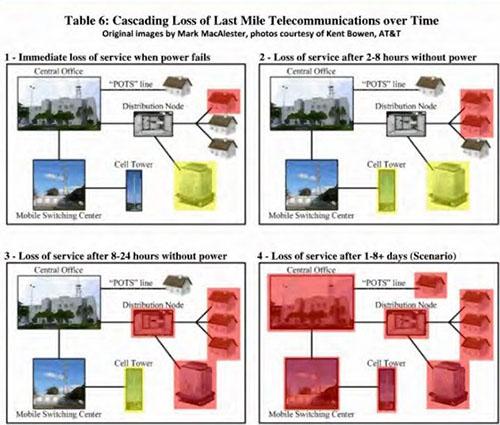
In this report they discussed something that was very interesting in terms of communications and infrastructure. It is called the “Cascading Loss of Last Mile Telecommunications over Time”. It’s a terrifying look at how over the span of 8 days all communications will fall, starting with communications from home telecom lines.

Classified FEMA Report Confirms Preppers’ Worst Fears

The diagram below offers up a telling scenario where this cascading loss takes its grip starting at the residential level and working its way through to the Central Office.EMP Recovery

The infrastructure needed to tackle EMP recovery is expensive and hard to make. That’s the deal. We are talking about things like oil cooled transformers that are 60,000 a piece and require special equipment to move around.

Special equipment that will likely not be EMP proof!

Recovery from an EMP is something of a pipe dream if we are honest and if the whole nation is affected. Maybe the military could bring up sections of the grid at a time, or maybe not. However, it really is more of a countdown on human life.

The survival of our society will depend on how many people die in the time it takes to recover from that EMP.

What to Make of all This Reporting?

There are two big takeaways from all these documents coming to light, research being done and even Donald Trump bringing the threat of an EMP to the forefront.

#1. People are Paying Attention

While we can all agree that our bloated government is full of people looking for a way to bide their time and get another day closer to pension, this keeps coming up. Grid down situations are a concern in the halls of government. I don’t think we can deny that.

Even the most cynical of us must agree that without electricity it gets much harder to collect taxes.

How far they will go to take action against an EMP threat is another thing entirely. However, we also have to be honest about our responsibility in this.

We the people cannot bray about small government all day and then complain that they aren’t 100% prepared to assist the public following a total grid down situation.

#2. A Prepper’s Responsibility

The second and more important takeaway from this report is that we have a responsibility to prepare and get as many others prepared as possible.

A widespread grid down situation is going to kill anyone who is not prepared for it. It’s even going to kill tons of people who are prepared for it. Now is the time to take action and make your action known. I really believe that us, preppers, can influence the world positively.

People might seem put off by the message but, trust me, they go home, and they think about putting up their own food and being ready for when disaster strikes.