The Distance We Invent to Feel Safe
There is a particular kind of lie that modern civilization tells itself, not out of malice but out of necessity—the belief that certain endings are too large, too absolute, to truly happen. Nuclear war has quietly settled into that category, filed somewhere between historical trauma and speculative fiction, referenced in classrooms and documentaries, yet emotionally dismissed as something that belongs to another era. And yet, beneath this carefully maintained distance, the machinery of such a war has not only survived the passing decades but has evolved, refined, and embedded itself deeper into the structure of global power. It exists now not as a relic, but as an active system, calibrated and maintained with a precision that suggests not abandonment, but readiness.
What makes this reality unsettling is not simply the existence of nuclear weapons, but the normalization of their presence within geopolitical balance. Entire doctrines have been built around them, entire careers dedicated to their maintenance, entire strategies designed not to use them—but to ensure that, if used, they would end everything quickly enough to remain strategically “effective.” The language itself becomes a kind of quiet distortion, transforming annihilation into terminology that feels almost clinical. Words like deterrence, second-strike capability, escalation control—these are not just concepts, but psychological buffers, allowing societies to coexist with the knowledge that, at any given moment, the infrastructure for their own destruction is operational.
A System Designed to Decide Faster Than Humans Can Think
If one were to trace the opening moments of a modern nuclear war, what would stand out is not chaos, but speed—an almost unnatural compression of time that reduces decision-making to instinct, or something even less reliable. The systems in place today are not built for prolonged reflection; they are built for immediate interpretation and rapid response. Satellites orbiting the Earth continuously scan for thermal signatures, algorithms filter incoming data, and command structures stand ready to interpret signals that could determine the fate of entire populations within minutes.
In such a system, ambiguity becomes dangerous. A false alarm is not merely an error; it is a potential trigger. History has already provided glimpses of how close these systems have come to failure—moments when incoming signals were misinterpreted, when human hesitation prevented escalation, when the difference between existence and catastrophe rested on the judgment of a single individual choosing not to act. These incidents are often remembered as successes, evidence that the system works. But they can just as easily be interpreted as warnings, fragile anomalies in a structure that does not inherently favor caution.
What emerges from this architecture is something that feels less like control and more like momentum. The decision to launch is not made in isolation; it is shaped by doctrine, by expectation, by the fear that waiting even a few minutes could eliminate the possibility of response entirely. In this context, rationality becomes entangled with urgency, and the line between defensive action and irreversible escalation begins to blur.
When a City Stops Being a City
The detonation of a nuclear weapon over a modern urban environment is often described in terms of blast radius and yield, but these measurements fail to capture the transformation that actually occurs. A city is not simply destroyed—it is fundamentally redefined in an instant. The structures that once provided order—buildings, roads, communication networks—are not just damaged, but stripped of their function, reduced to materials reacting to extreme energy.
At the center of the explosion, there is no experience, no perception, only disappearance. Further out, the event unfolds in layers: a flash that arrives before sound, intense enough to ignite surfaces and blind those who see it; a shockwave that compresses the air into a moving wall of pressure, collapsing structures and hurling debris with lethal force; and a surge of heat that transforms the environment into something closer to a furnace than a landscape. These are not sequential events in the way we typically understand time—they overlap, reinforce each other, and create conditions that overwhelm the senses before they can fully register what is happening.
Yet the most profound change is not immediate. It emerges in the moments that follow, when the city ceases to function as a system. Emergency services cannot respond because there is no infrastructure left to support them. Communication breaks down because the networks that sustain it are either destroyed or rendered useless. Survivors find themselves not in a damaged version of their previous environment, but in something entirely unfamiliar—a space where the rules that once governed movement, safety, and survival no longer apply.
Fire as a System, Not an Accident
It is tempting to imagine fire as a secondary consequence of nuclear detonation, a byproduct of the initial explosion. In reality, it becomes the dominant force, transforming localized destruction into something far more expansive and uncontrollable. When multiple fires ignite simultaneously across a dense urban landscape, they do not remain isolated. They merge, intensify, and begin to interact with the atmosphere itself, creating what is known as a firestorm—a phenomenon that behaves less like a collection of fires and more like a single, evolving system.
In such a system, heat rises rapidly, drawing in cooler air from the surrounding areas with increasing force. Winds accelerate, feeding the flames with oxygen while pulling debris, embers, and toxic gases into a circulating pattern that sustains and expands the fire. The temperature climbs to levels that not only destroy materials but alter them chemically, releasing compounds that further degrade air quality and reduce the chances of survival for anyone within the affected zone. Breathing becomes difficult, then impossible, not because of direct injury, but because the environment itself can no longer support life.
Modern cities, with their dense concentrations of synthetic materials, fuel sources, and interconnected structures, are particularly susceptible to this kind of transformation. What begins as a series of ignition points quickly evolves into a condition where the distinction between individual fires disappears, replaced by a continuous field of heat and motion that consumes everything within its reach.
The Invisible Layer That Stays Behind
Long after the fires have burned out and the immediate destruction has settled into silence, another form of damage continues to unfold—one that cannot be seen, smelled, or easily understood in the moment. Radiation introduces a different kind of time into the equation, stretching the consequences of the event far beyond its initial impact. It lingers in the environment, embedded in soil, carried by wind, absorbed into water sources, and ultimately into living organisms.
What makes radiation particularly insidious is the gap between exposure and effect. Individuals who appear unharmed in the immediate aftermath may begin to experience symptoms hours or days later, as the damage at the cellular level manifests in ways that are both painful and difficult to treat. Over longer periods, the impact becomes even more diffuse, increasing the likelihood of cancers, affecting reproductive health, and introducing genetic changes that can persist across generations.
This creates a form of uncertainty that complicates recovery. It is not always clear which areas are safe, which resources can be trusted, or how long the contamination will last. The environment itself becomes unpredictable, a space where the absence of visible danger does not guarantee safety, and where the process of rebuilding must contend with variables that cannot be easily controlled.
A Planet That Begins to Change Its Behavior
Perhaps the most profound shift occurs not at the level of cities or regions, but at the scale of the planet itself. The fires generated by multiple nuclear detonations would release vast quantities of soot and particulate matter into the upper atmosphere, where they could remain for extended periods, altering the way sunlight reaches the Earth’s surface. This is not merely a reduction in brightness; it is a disruption of the energy balance that drives climate systems.
As sunlight diminishes, temperatures drop, sometimes dramatically. Growing seasons shorten, crops fail, and the delicate timing that agriculture depends on begins to unravel. Rainfall patterns shift, sometimes unpredictably, creating conditions where some regions experience drought while others face excessive precipitation. The global food system, already dependent on precise coordination and stable conditions, struggles to adapt to these changes.
What makes this scenario particularly severe is its reach. Unlike the immediate effects of nuclear explosions, which are concentrated in specific locations, climate disruption extends across borders, affecting regions that may not have been directly involved in the conflict. The result is a form of shared vulnerability, where the consequences of localized decisions propagate outward, reshaping the conditions of life on a global scale.
The Quiet Collapse of Everything That Connects Us
Modern civilization is often described in terms of its visible achievements—cities, technology, infrastructure—but its true strength lies in the networks that connect these elements into a functioning whole. Energy systems distribute power across vast distances, communication networks enable instant exchange of information, and supply chains coordinate the movement of goods with remarkable efficiency. These systems are optimized for performance, but they are also highly sensitive to disruption.
A nuclear conflict would not need to destroy every component of these networks to render them ineffective. It would be enough to disrupt key nodes, creating imbalances that propagate through the system. The loss of satellites would impair navigation and communication, the destruction of major ports would interrupt trade, and damage to energy infrastructure would limit the ability to maintain even basic services. As these failures accumulate, the system begins to lose coherence, transitioning from a state of coordinated activity to one of fragmentation.
For individuals, this collapse may not appear as a single dramatic event, but as a gradual erosion of normality. Services become unreliable, resources become scarce, and the routines that once structured daily life begin to break down. In this environment, survival becomes less about immediate danger and more about adaptation to a world that no longer operates according to familiar rules.
The Psychological Threshold No One Prepares For
Beyond the physical and systemic consequences lies a dimension that is harder to quantify but equally significant—the psychological impact of living through such a transformation. Human societies are built on expectations of continuity, on the assumption that tomorrow will resemble today closely enough to allow for planning, cooperation, and trust. A nuclear war would shatter these expectations almost instantly, replacing them with uncertainty on a scale that few individuals or institutions are equipped to manage.
In such conditions, behavior becomes difficult to predict. Some communities may respond with cooperation, pooling resources and supporting one another in an effort to rebuild. Others may fragment, driven by fear, scarcity, and the breakdown of trust in institutions. The outcome would likely vary across regions, shaped by cultural, social, and economic factors, but the overall effect would be a landscape of human responses that defy simple categorization.
What remains constant, however, is the sense of dislocation—the feeling that the world has shifted in a way that cannot be reversed, that the frameworks which once provided meaning and stability are no longer sufficient. This psychological threshold, once crossed, changes not only how individuals perceive their environment, but how they relate to each other and to the future itself.
A System That Does Not Need a Conspiracy to Fail
It is often tempting to search for hidden causes behind events of great magnitude, to imagine that there must be a deliberate plan guiding them. In the case of nuclear war, the reality is both simpler and more unsettling. The risk does not arise from a single secret agenda, but from the interaction of systems, doctrines, and human decisions that, together, create conditions where catastrophic outcomes become possible.
The structure is inherently unstable in subtle ways. It relies on rapid decision-making, on technological systems that must function flawlessly, and on assumptions about human behavior that may not hold under extreme pressure. It is not designed to fail, but neither is it designed to guarantee safety under all circumstances. Instead, it exists in a state of tension, balanced between deterrence and escalation, where the margin for error is small and the consequences of that error are immense.
In this sense, the danger is not hidden. It is embedded in the very design of the system, in the choices that have been made over decades about how to manage power, risk, and uncertainty.
What Remains After Everything Ends
To ask how devastating a modern-day nuclear war would be is, ultimately, to confront a question that resists simple answers. The destruction of cities, the loss of life, the disruption of climate and systems—these can be described, modeled, and, to some extent, understood. But the deeper impact lies in the transformation that follows, in the shift from a world defined by stability and growth to one characterized by uncertainty and adaptation.
What remains is not merely a damaged version of the past, but a fundamentally altered reality, where survival depends not only on physical resilience, but on the ability to navigate a landscape that no longer conforms to familiar patterns. It is in this transformation that the true devastation becomes apparent—not only in what is lost, but in what can no longer be recovered.
And perhaps the most unsettling aspect of all is that this outcome does not require imagination. It requires only the continuation of systems that already exist, operating as they were designed, waiting—quietly, efficiently—for a moment that may never come, but for which everything is already prepared.
The Distance We Invent to Feel Safe
There is a particular kind of lie that modern civilization tells itself, not out of malice but out of necessity—the belief that certain endings are too large, too absolute, to truly happen. Nuclear war has quietly settled into that category, filed somewhere between historical trauma and speculative fiction, referenced in classrooms and documentaries, yet emotionally dismissed as something that belongs to another era. And yet, beneath this carefully maintained distance, the machinery of such a war has not only survived the passing decades but has evolved, refined, and embedded itself deeper into the structure of global power. It exists now not as a relic, but as an active system, calibrated and maintained with a precision that suggests not abandonment, but readiness.
What makes this reality unsettling is not simply the existence of nuclear weapons, but the normalization of their presence within geopolitical balance. Entire doctrines have been built around them, entire careers dedicated to their maintenance, entire strategies designed not to use them—but to ensure that, if used, they would end everything quickly enough to remain strategically “effective.” The language itself becomes a kind of quiet distortion, transforming annihilation into terminology that feels almost clinical. Words like deterrence, second-strike capability, escalation control—these are not just concepts, but psychological buffers, allowing societies to coexist with the knowledge that, at any given moment, the infrastructure for their own destruction is operational.
The Day the System Almost Broke
There is a story that circulates quietly in academic circles and military archives, often reduced to a footnote, rarely explored in its full psychological weight. It is the story of a night in 1983, when a Soviet early-warning system reported what appeared to be incoming American missiles. The data was clear, the signal consistent with an attack profile, the system functioning exactly as it had been designed to function. Protocol demanded escalation. Protocol demanded response.
And yet, the man responsible for interpreting that signal chose to hesitate.
His name was Stanislav Petrov, and what he did was not heroic in the conventional sense. He did not save the world through action, but through inaction—through doubt. He questioned the data, considered the possibility of error, and ultimately reported the alert as a false alarm, despite having no definitive proof. In doing so, he disrupted the chain of logic that could have led to retaliation.
What makes this story unsettling is not only how close the system came to failure, but how dependent it was on a single human decision that went against protocol. The system itself did not prevent catastrophe; it nearly enabled it. It was not designed to pause, to reflect, or to question its own outputs. It required a human being to introduce uncertainty into a process that was otherwise moving toward irreversible action.
This raises a question that is difficult to ignore: what happens in a system that becomes increasingly automated, increasingly optimized for speed, when there is no longer space for hesitation?
A Mind Inside the Machine
I once spoke with someone who had worked within the outer layers of such systems—not directly involved in launch decisions, but close enough to understand how they functioned in practice. He described it not as a system of control, but as a system of expectation. Everything within it was designed to anticipate the worst-case scenario, to assume that incoming signals represented genuine threats, to reduce ambiguity wherever possible.
“There is no room for optimism,” he told me, his voice carrying a weight that suggested experience rather than theory. “The system doesn’t ask what is likely. It asks what is possible—and then prepares for that.”
What stayed with me was not the technical detail, but the emotional tone. There was no sense of drama in the way he spoke, no overt fear, just a quiet acknowledgment of how the system reshapes the way people think. When you operate within a framework where the cost of being wrong is measured in millions of lives, caution begins to look like weakness, and hesitation becomes something to be minimized.
Over time, this creates a kind of psychological alignment, where individuals begin to internalize the logic of the system itself. Decisions are no longer experienced as moral dilemmas, but as procedural necessities. The question is not whether to act, but whether the conditions for action have been met.
The Moment of Impact, Seen From the Inside
Imagine, for a moment, not the explosion itself, but the seconds leading up to it—not from the perspective of satellites or command centers, but from within a city that has no knowledge of what is about to happen. The morning unfolds as it always does. Traffic moves, people check their phones, conversations begin and end in the ordinary rhythm of daily life. There is no visible warning, no gradual escalation that allows the mind to adjust.
Then, without transition, the world changes.
There is a flash that arrives faster than thought, a sudden intrusion of light so intense that it overwhelms the senses before it can be processed. For those closest to the center, there is no experience of the event, only absence. Further out, perception lags behind reality, creating a moment of confusion where the brain struggles to interpret what it is seeing. The shockwave follows, collapsing structures, shattering glass, and turning the environment into a field of moving debris.
But what is most striking is not the violence itself, but the disconnection—the way in which the event exists outside the framework of ordinary experience. There is no context for it, no immediate understanding. It does not feel like a continuation of the world, but like an interruption, something that does not belong to the same reality that existed moments before.
After the Fire, the Silence
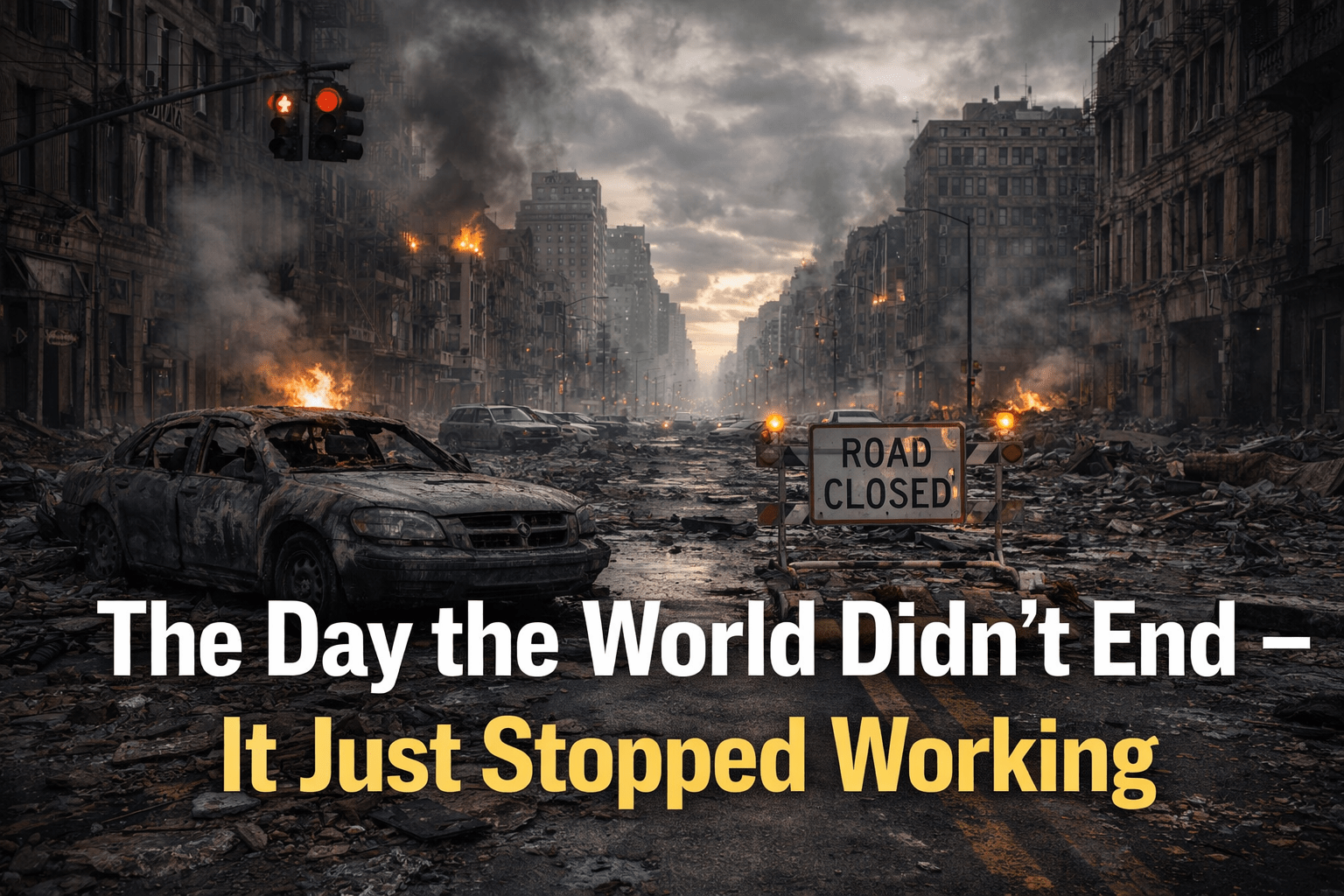
When the immediate effects subside, what remains is not simply destruction, but a kind of altered silence. It is not the quiet of peace, but the absence of systems that once generated noise—traffic, communication, the constant hum of infrastructure. In their place, there is a stillness that feels unnatural, as if the environment itself has paused.
Survivors, if they exist within this space, are confronted with a landscape that no longer aligns with memory. Landmarks are gone or unrecognizable, pathways are blocked, and the basic assumptions that guide movement—where to go, how to find help, what is safe—no longer apply. The mind attempts to reconstruct order from fragments, but the fragments do not fit together in a meaningful way.
It is in this phase that the true scale of the event begins to emerge, not through immediate comprehension, but through accumulation. Each failed attempt to restore normality, each realization that a system no longer functions, adds to a growing awareness that what has occurred is not temporary.
The Slow Realization of a Global Event
Perhaps the most disorienting aspect of a modern nuclear war would be the gradual realization that it is not confined to a single location. Information, when it becomes available, would reveal that multiple cities have been affected, that the event is not isolated but coordinated. The scale expands beyond the local, beyond the national, into something that feels planetary.
At this point, the concept of distance begins to lose meaning. It no longer matters how far one is from the initial explosions, because the consequences are no longer tied to proximity alone. Supply chains begin to fail, communication networks degrade, and the flow of information becomes inconsistent. What was once a connected world starts to fragment into isolated pockets of awareness.
This fragmentation creates a new kind of uncertainty, one that is not defined by immediate danger, but by the absence of reliable knowledge. People begin to operate on incomplete information, making decisions based on assumptions that may or may not be accurate. In such an environment, even rational actions can lead to unintended consequences.
A Climate That No Longer Behaves Normally
As days turn into weeks, the effects extend beyond human systems into the environment itself. The sky begins to change in subtle ways—light becomes diffused, temperatures shift, and patterns that once felt stable start to behave unpredictably. These changes are not immediately dramatic, but they are persistent, gradually altering the conditions under which life operates.
Agriculture, which depends on relatively stable climate patterns, becomes increasingly unreliable. Crops fail not because of a single catastrophic event, but because the conditions required for their growth are no longer consistent. The impact is cumulative, spreading across regions and compounding over time.
What emerges is not a sudden collapse, but a slow degradation, a steady movement away from the conditions that made modern civilization possible. It is a process that lacks a clear endpoint, making it difficult to respond to, difficult to plan for, and difficult to reverse.
The Uncomfortable Truth Beneath It All
At some point, the narrative returns to a question that is both simple and deeply unsettling: how could something like this happen in a world that understands its consequences so well? The answer does not lie in ignorance, but in the structure of the systems that have been built over time.
These systems are not irrational. They are, in many ways, highly logical, designed to manage risk, to deter aggression, and to maintain stability. But they are also constrained by assumptions—about human behavior, about technological reliability, about the nature of conflict—that may not hold under all conditions. When those assumptions fail, the system does not necessarily adapt; it continues to operate according to its design.
This is what makes the possibility of nuclear war so difficult to fully grasp. It is not the result of chaos or unpredictability alone, but of order—of systems functioning as intended within parameters that do not account for every possibility.
What Devastation Really Means
In the end, devastation is not only about destruction. It is about transformation—about the shift from one set of conditions to another, from a world that is understood to one that is not. A modern nuclear war would not simply reduce cities to ruins; it would alter the frameworks through which reality itself is experienced.
The question, then, is not only how many would survive, or how much would be destroyed, but what kind of world would remain for those who do. A world where the past exists as memory, but no longer as a guide. A world where systems must be rebuilt without the certainty that they will function as before. A world where the line between recovery and adaptation becomes increasingly difficult to define.
And perhaps the most unsettling realization of all is that this world is not beyond our capacity to imagine. It exists, in fragments, in models, in historical precedents, in the quiet corners of strategic planning. It is not hidden.
It is simply… waiting.
The Hour That Didn’t Feel Different
If a modern nuclear war were to begin, it would not announce itself in a way that matches its significance. There would be no universal alarm, no synchronized awareness spreading across the planet in real time. Instead, the beginning would be uneven, almost indifferent, unfolding in fragments that only later connect into something coherent. In one part of the world, it might still be early morning, people moving through routines shaped by repetition and predictability, while in another, it would be night, cities dimly lit, reduced to quieter versions of themselves. Somewhere between these ordinary moments, a sequence of decisions would be made—brief, compressed, irreversible.
Inside command centers, the atmosphere would not resemble panic so much as intensity sharpened into focus. Data streams would converge, screens updating faster than the human eye can comfortably process, voices measured but carrying an urgency that does not need to be expressed loudly. The language used in such environments has already stripped away emotional weight; it is designed to function under pressure, to reduce complexity into actionable categories. Yet beneath that structure lies a simple and unbearable truth: the people present would know, almost immediately, that whatever happens next will not be contained.
And still, outside those rooms, life would continue for a few minutes more, unchanged.
The First Break in Reality
The first detonations would not feel like part of a war. They would feel like a rupture in reality itself, an event so far outside normal experience that the mind initially rejects it as something else—an industrial accident, perhaps, or a natural disaster of unprecedented scale. The brightness alone would defy expectation, not just because of its intensity, but because of its suddenness, arriving without context, without warning, without any gradual build-up that allows for understanding.
For those far enough from the center to survive the initial seconds, perception would become unreliable. Sound would lag behind light, creating a delay that feels almost unnatural, as if cause and effect have been separated. The shockwave would arrive not as a single force, but as a sequence—pressure building, breaking, and then continuing in ways that the body struggles to interpret. Structures would fail not gracefully, but abruptly, collapsing inward or outward depending on forces that are no longer intuitive.
What follows is not a moment, but a transition. The world that existed minutes ago does not return.
Information Begins to Fracture
In the immediate aftermath, one of the most critical elements of modern life—information—begins to degrade in ways that are both subtle and profound. Communication networks, already strained or partially destroyed, no longer provide a consistent picture of reality. Messages are delayed, incomplete, or contradictory. Some regions lose connectivity entirely, while others remain partially functional, creating pockets of awareness that do not align with each other.
This fragmentation has consequences that extend beyond confusion. Decisions begin to be made on the basis of incomplete or incorrect data, and coordination—whether at the level of governments or individuals—becomes increasingly difficult. Rumors fill the gaps left by missing information, spreading faster than verified facts, shaping perceptions in ways that may not correspond to reality.
In such an environment, the concept of a shared understanding begins to dissolve. There is no longer a single narrative of what is happening, only overlapping and often conflicting interpretations, each shaped by limited access to reliable information.
The Second Wave Is Not What People Expect
What many would perceive as a second wave of destruction would not necessarily come in the form of additional explosions, but in the realization that the initial events were not isolated. As more information becomes available—fragmented, delayed, but gradually accumulating—it becomes clear that multiple targets have been hit, that the scale of the event extends far beyond a single city or region.
This realization does not arrive all at once. It builds slowly, piece by piece, each new report expanding the perceived scope of the situation. A city here, another there, infrastructure nodes, military installations, ports, communication hubs—each loss adding to a growing sense that what is unfolding is not a contained conflict, but something systemic.
At this point, the psychological shift becomes unavoidable. The event is no longer interpreted as something that can be managed or recovered from quickly. It begins to resemble something else entirely—something that does not have a clear boundary or endpoint.
The Global System Starts to Slip
Modern civilization relies on continuity, on the assumption that systems will keep functioning from one moment to the next. When that continuity is broken in multiple places simultaneously, the effects begin to propagate through the network in ways that are difficult to predict.
Financial systems, for example, are built on trust and synchronization. When communication is disrupted and uncertainty increases, that trust erodes rapidly. Markets become volatile, then unstable, and eventually cease to function in any meaningful way. Currency, which depends on shared belief in its value, begins to lose its practical significance in environments where basic resources become the primary concern.
Supply chains, already sensitive to disruption, begin to fail as key nodes are removed or rendered inoperable. Goods that were once taken for granted—food, medicine, fuel—become scarce, not necessarily because they no longer exist, but because the systems required to distribute them no longer function efficiently.
Energy infrastructure, if damaged or destabilized, introduces another layer of complexity. Power outages spread, sometimes in cascading patterns, affecting not only comfort, but critical services such as healthcare, water treatment, and communication.
The system does not collapse all at once. It begins to slip, unevenly, unpredictably, creating a landscape where stability exists in some places and disappears in others.
Survival Becomes a Different Kind of Problem
In the early stages, survival might still be understood in relatively familiar terms—avoiding immediate danger, seeking shelter, finding food and water. But as the situation evolves, these priorities begin to shift. It is no longer just about immediate threats, but about navigating an environment that continues to change in ways that are difficult to anticipate.
Radiation, for instance, introduces uncertainty into movement and resource use. Areas that appear safe may not be, and the lack of reliable information makes it difficult to assess risk accurately. Water sources may be contaminated, food supplies compromised, and medical assistance either unavailable or insufficient.
At the same time, the social environment becomes less predictable. Institutions that once provided structure—governments, emergency services, law enforcement—may be overwhelmed or unable to operate effectively. In their absence, communities may either organize themselves or fragment, depending on local conditions and available resources.
Survival, in this context, is not just a matter of endurance, but of adaptation. It requires constant reassessment, the ability to function with incomplete information, and the willingness to make decisions under conditions of uncertainty.
The Sky Changes, Slowly but Permanently
Days after the initial events, changes begin to appear in the environment that are not immediately linked to the explosions themselves. The sky, once a stable backdrop, begins to shift in subtle ways—light becomes muted, colors less defined, the distinction between day and night slightly altered.
These changes are the result of particles injected into the upper atmosphere, where they begin to interfere with the transmission of sunlight. At first, the effects may seem minor, barely noticeable to those focused on more immediate concerns. But over time, they accumulate, altering temperature patterns and affecting the processes that depend on consistent environmental conditions.
Agriculture is among the first systems to feel this impact. Crops that rely on predictable sunlight and temperature cycles begin to fail, not catastrophically at first, but inconsistently. Yields decrease, harvests become unreliable, and the margin for error—already thin in many parts of the world—disappears.
The realization that these changes are not temporary adds another layer of complexity to an already unstable situation. It suggests that the consequences of the initial events will extend far into the future, shaping conditions in ways that cannot be easily reversed.
The Point Where the Past Stops Being Useful
As weeks turn into months, a deeper transformation begins to take hold, one that is less visible but equally significant. The knowledge, systems, and assumptions that once guided behavior become less relevant, not because they were incorrect, but because the conditions under which they applied no longer exist.
Skills that were once peripheral—adaptability, improvisation, local knowledge—become central, while others lose their immediate value. Long-term planning gives way to short-term decision-making, not by choice, but by necessity. The future becomes harder to imagine in concrete terms, as the variables that shape it remain unstable.
This is the point at which the true depth of the event becomes clear. It is no longer just a disruption, but a transition into a different kind of reality, one where continuity with the past is limited, and where the path forward is uncertain.
The First Winter That Wasn’t Supposed to Exist
What follows in the months after a large-scale nuclear exchange is not immediately recognized as a new era. At first, it feels like an extension of crisis, a prolonged emergency that will eventually stabilize, that will eventually allow for recovery. But there is a moment—difficult to pinpoint, impossible to ignore—when it becomes clear that what is happening is not temporary. The patterns do not return. The disruptions do not resolve. Instead, they deepen, layering uncertainty over what little structure remains.
The change begins subtly, almost imperceptibly, in the behavior of the environment. Days grow dimmer in a way that is not entirely explained by weather. Sunlight feels weaker, filtered through a sky that no longer reflects the clarity it once did. Temperatures begin to drop outside their expected ranges, not dramatically at first, but consistently enough to disrupt cycles that depend on precision. Agriculture, already strained, begins to fail in ways that cannot be corrected through adaptation alone. Crops planted with knowledge accumulated over generations no longer behave as expected, and the margin between success and failure collapses into unpredictability.
This is the beginning of what scientists have long described in models, often debated but rarely internalized: a disruption of climate systems severe enough to alter the baseline conditions of life. It does not announce itself as “nuclear winter.” It simply becomes the new normal—colder, dimmer, less reliable. And once it settles, it resists reversal.
Hunger Without a Clear Cause
One of the most disorienting aspects of systemic collapse is that its causes become difficult to trace. Hunger, for example, does not arrive as a single event. It spreads gradually, unevenly, often disconnected from the original source of disruption. A failed harvest in one region leads to shortages in another, which in turn affects distribution networks elsewhere. The global system that once absorbed local failures and redistributed resources no longer functions with the same efficiency, and small disruptions begin to compound.
For those experiencing it, hunger is rarely understood in abstract terms. It is immediate, physical, and deeply personal. It reshapes priorities, alters behavior, and erodes the social structures that depend on stability. Communities that once operated on trust and cooperation may find themselves strained, not necessarily because of conflict, but because the conditions that supported cooperation no longer exist.
What makes this phase particularly severe is its persistence. Unlike the immediate aftermath of explosions, which, however devastating, has a clear temporal boundary, the degradation of food systems unfolds over time. It does not peak and decline; it accumulates, creating a sustained pressure that affects populations far beyond the initial zones of destruction.
The Quiet Disappearance of Order
As resources become scarce and systems continue to fail, the structures that maintain order begin to weaken. This process is not always dramatic. In many cases, it is subtle, unfolding through small changes that gradually alter the behavior of institutions and individuals alike.
Governments, for example, may still exist in form, but their ability to function effectively becomes limited. Communication breakdowns, resource constraints, and the sheer scale of the crisis reduce their capacity to respond. Policies that might have been effective under stable conditions become inadequate, and decision-making shifts from long-term planning to immediate crisis management.
Law enforcement and emergency services face similar challenges. Without reliable infrastructure, without consistent supply chains, their ability to maintain order diminishes. This does not necessarily lead to immediate chaos; in some areas, communities adapt, creating localized systems of organization. In others, the absence of effective authority leads to fragmentation, where different groups operate according to their own rules.
What emerges is not a single pattern of collapse, but a mosaic of conditions, varying from place to place, shaped by local factors and the availability of resources.
Memory Becomes a Burden
There is a psychological shift that occurs when the past no longer aligns with the present in a meaningful way. At first, memory serves as a guide, a reference point for how things should work, how systems should function, how problems should be solved. But as conditions continue to diverge from those expectations, memory begins to lose its utility.
This creates a form of dissonance that is difficult to resolve. Individuals find themselves recalling a world that operated under different assumptions, where actions had predictable outcomes, where systems responded in expected ways. In the new reality, those assumptions no longer hold, and relying on them can lead to failure.
Over time, this tension reshapes perception. The past becomes less of a guide and more of a contrast, a reminder of conditions that are no longer accessible. For some, this may lead to adaptation, a gradual shift in expectations and behavior. For others, it may result in a kind of psychological stagnation, an inability to fully engage with a reality that feels fundamentally altered.
The Second Layer of Silence
If the immediate aftermath of nuclear war is defined by destruction and noise, the later stages are marked by a different kind of silence—one that emerges as systems cease to function and activity declines. This silence is not empty; it is filled with absence. The absence of communication, of movement, of the constant interactions that once defined daily life.
In urban areas, this transformation is particularly stark. Cities, once characterized by density and activity, become fragmented spaces, where large sections may be uninhabited or inaccessible. Infrastructure that once supported millions becomes inert, its complexity no longer serving a purpose in the absence of the systems that sustained it.
This shift alters not only the physical environment but the way it is experienced. Space feels different when it is no longer structured by human activity, when familiar landmarks no longer carry the same meaning, when the pathways that once connected different parts of the city are disrupted or gone entirely.
The Question No One Can Answer Clearly
At some point, the focus shifts from immediate survival to a broader, more abstract question: what comes next? Not in the sense of immediate plans, but in terms of long-term trajectory. Can systems be rebuilt? Can stability be restored? Or has the scale of disruption created conditions that fundamentally limit the possibility of recovery?
There is no single answer to this question, and any attempt to provide one must contend with a high degree of uncertainty. Some regions may recover partially, rebuilding localized systems that provide a degree of stability. Others may remain in prolonged states of disruption, where the combination of environmental, economic, and social factors makes recovery difficult.
What complicates this further is the interconnected nature of the pre-war world. Recovery in one area may depend on conditions in another, creating dependencies that are difficult to reestablish in a fragmented environment.
What Devastation Looks Like When It Settles
In the end, the devastation of a modern nuclear war is not defined solely by the moment of impact, but by what follows—by the way in which the event reshapes the conditions of existence over time. It is a layered process, unfolding across different scales, from the immediate to the global, from the physical to the psychological.
It is visible in the altered climate, in the disrupted systems, in the changed behavior of individuals and communities. But it is also present in less tangible ways—in the loss of predictability, in the erosion of trust, in the difficulty of imagining a future that resembles the past.
And perhaps the most unsettling aspect of all is that this outcome is not the result of a single failure, but of a system operating within its intended parameters, responding to perceived threats in ways that are consistent with its design.
There is no single point at which it can be said to have gone wrong. Instead, there is a convergence—a series of decisions, conditions, and assumptions that align in a way that produces a result far greater than any one of them alone.

 Ultimate-Survival