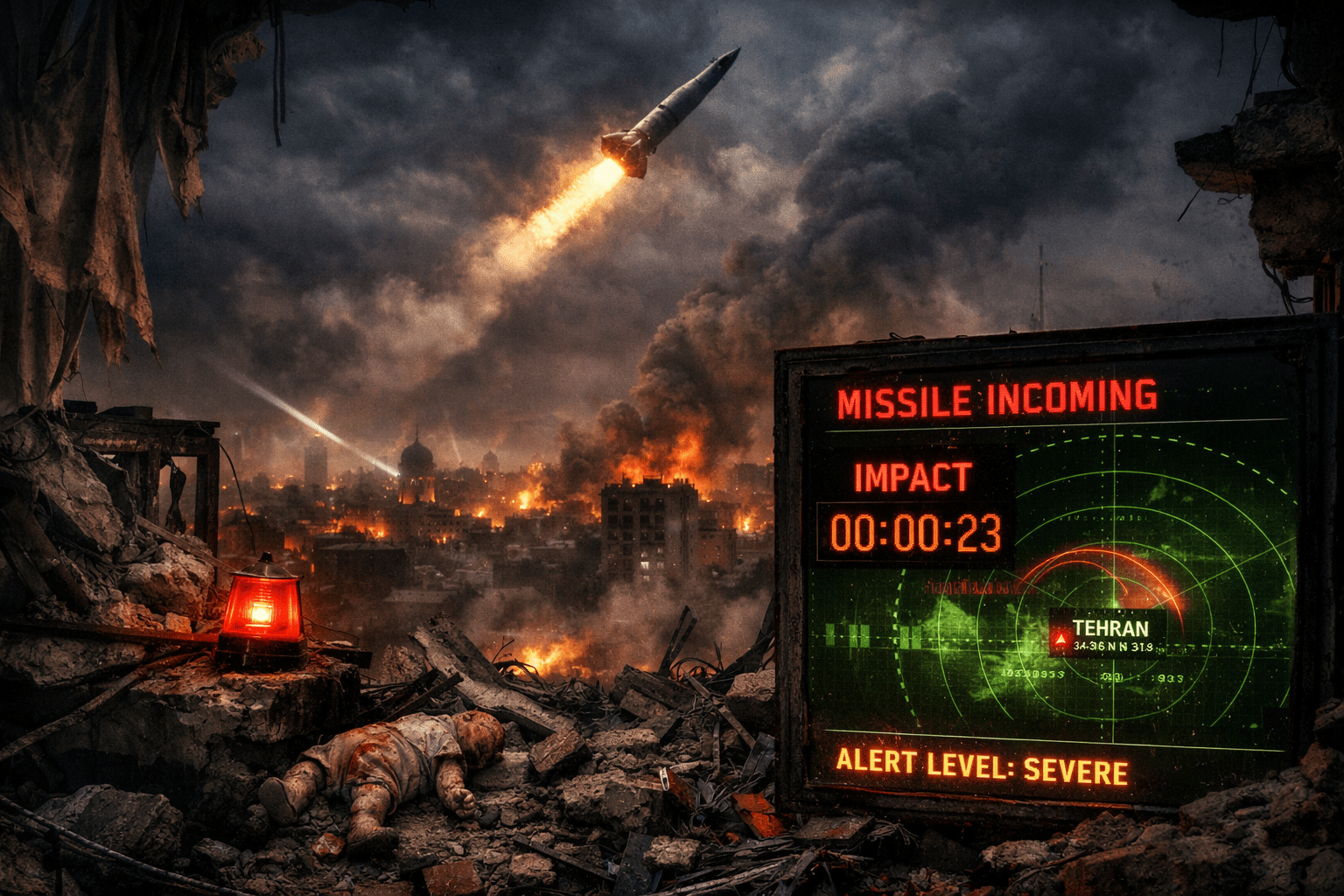
There is a particular kind of silence that comes before impact. Not metaphorical silence—the real one. The kind that settles in the seconds after a warning, when people stop talking not because they have nothing to say, but because language suddenly feels useless.
When we talk about the missile capabilities of Iran, we rarely talk about that silence.
We talk instead about range. About deterrence. About strategic balance. Clean words. Words that behave themselves in policy papers. But missiles are not clean things. They are decisions made visible in the sky.
Memory as a Weapon
To understand why these weapons exist in such numbers, you have to look backward. Not in a detached, archival sense, but in the way memory lingers in people who lived through it.
The Iran–Iraq War was not just a war of trenches and borders—it was a war of cities. Sirens. Night skies breaking open. Families learning, very quickly, that distance no longer meant safety.
That kind of memory does not fade into theory. It hardens. It becomes doctrine.
Missiles, in this sense, are not just tools of war. They are a refusal to ever be that vulnerable again.
But here is the problem with building security out of fear: fear does not stay contained. It spreads. It anticipates threats that have not yet materialized. It prepares for futures that, in preparing for them, become more likely.
The Geography of Fear
On a map, missile ranges are drawn as circles. Clean, geometric, almost elegant.
Inside those circles are places like Israel, where entire populations live with the knowledge that warning times could be measured in minutes. There are also military bases tied to the presence of the United States—small, heavily fortified points that carry disproportionate strategic weight.
But maps don’t show what it feels like to live inside a circle like that.
They don’t show how routine changes. How people begin to calculate distance differently. How a normal day acquires a second layer—a quiet awareness that everything could fracture without warning.
Missiles reshape geography, but more than that, they reshape time. They compress it. Decisions that once unfolded over days are now forced into moments. There is no room for doubt when something is already in the air.
Proxies and Shadows
Modern conflict rarely announces itself clearly. It moves through intermediaries, through deniable actions, through actors like Hezbollah, where responsibility becomes something you argue about after the fact—if there is an “after.”
This ambiguity is strategic. It allows pressure without immediate consequence. But it also creates a kind of fog where miscalculation thrives.
A rocket is launched. A response follows. Then another. Each side convinced it is reacting, not escalating.
From a distance, analysts call this a “cycle.” On the ground, it feels more like being pulled into something that no one fully controls.
How Catastrophe Actually Begins
There is a comforting belief that large-scale war requires large-scale decisions. That somewhere, at some high level, someone chooses escalation deliberately.
In reality, things often break in smaller ways.
A strike that goes further than intended.
A system that misreads incoming data.
A leader who cannot afford, politically, to appear weak.
And suddenly, what was meant to be a signal becomes a threshold crossed.
If missiles were exchanged directly between Iran and Israel, the response would not be symmetrical—it would be exponential. If forces tied to the United States were drawn in, the conflict would not remain regional for long.
People often imagine escalation as a ladder. Step by step.
It isn’t.
It’s closer to a collapse.
The World After the First Night
What happens after the first large exchange is rarely discussed in detail, perhaps because it is difficult to do so without sounding alarmist.
Energy infrastructure becomes a target. The Gulf—so essential, so exposed—turns from an economic artery into a pressure point. Markets react instantly, but markets are the least important part of it.
More immediate is the human aftermath.
Hospitals operating beyond capacity.
Communication networks failing at the worst possible moment.
Families trying to locate each other in cities where familiar landmarks no longer exist in the same way.
There is also something quieter, but no less damaging: the psychological rupture. The realization that what once felt stable was, in fact, fragile.
And once that realization takes hold, it does not fully go away.
The Nuclear Question That Won’t Stay Quiet
Hovering over all of this is the unresolved issue of nuclear capability. Not confirmed, not absent—just uncertain enough to matter.
Uncertainty is its own form of pressure.
If Iran were ever perceived to cross that threshold, even ambiguously, the regional reaction would be immediate. Others would follow, or prepare to. The logic of deterrence would multiply, not stabilize.
More actors. More weapons. Less time.
Conclusion: Living on the Edge of Possibility
It is easy to think of missiles as future events—things that might happen, under certain conditions, at some later time.
But in a way, their impact is already here.
They shape decisions.
They influence behavior.
They define what leaders believe they can or cannot risk.
And for ordinary people, even when nothing happens, they exist as a possibility that never fully disappears.
That may be the most unsettling part of all.
Not the explosion itself, but the waiting.
The knowledge that somewhere, at any given moment, the silence before impact could begin.

 Ultimate-Survival