A CONVERSATION WE NEED TO HAVE
Let me tell you about September 2, 2025. You probably saw the video—President Trump posted it himself on Truth Social. A boat in the Caribbean, a missile strike, a spectacular explosion. Trump said it was full of “narco-terrorists” from the Tren de Aragua gang. He warned anyone thinking about bringing drugs into America: “BEWARE!”
It was exciting. It was definitive. It was justice being served, or so we were told.
What you didn’t see—what Trump carefully edited out—was what happened next.
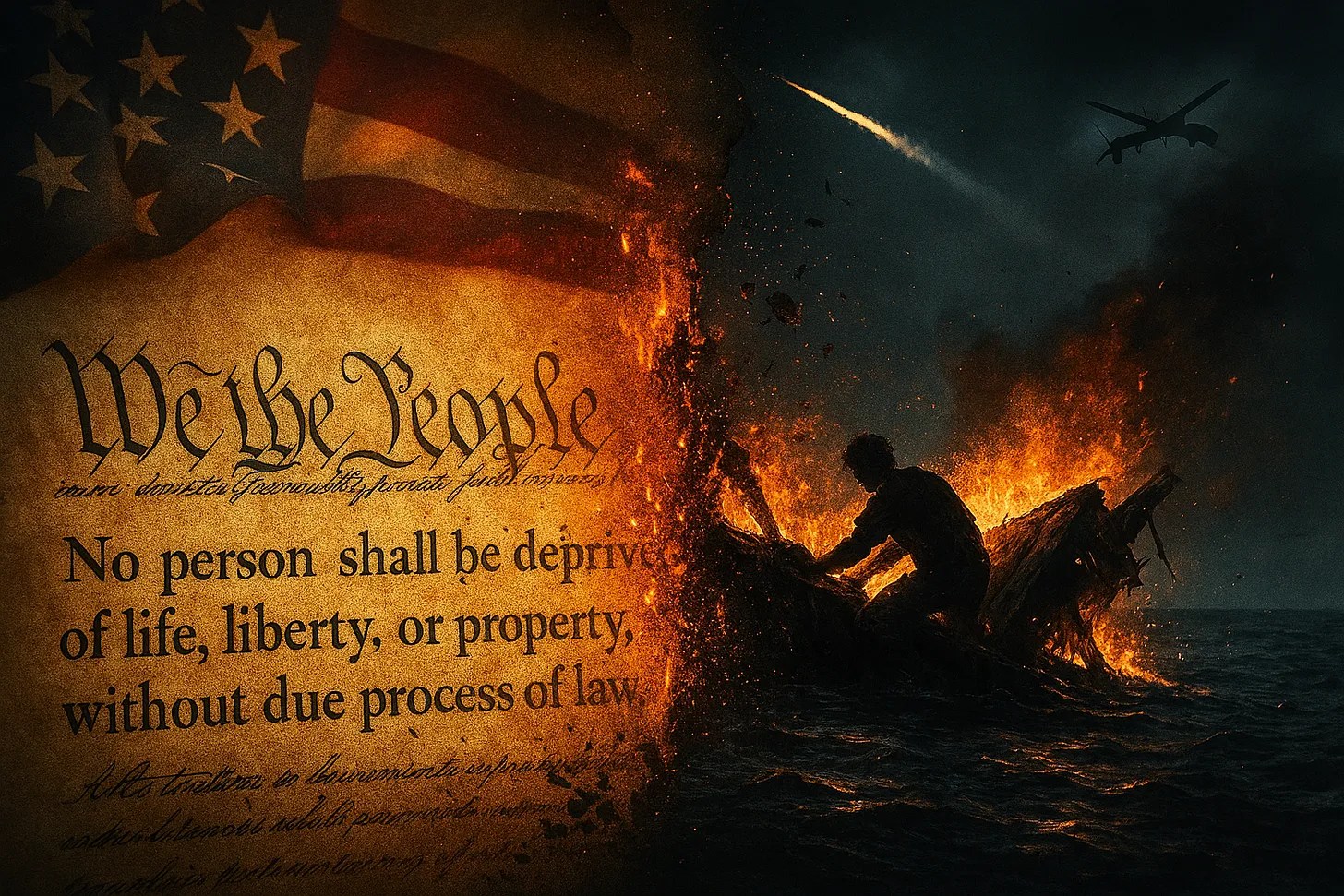
Two men survived that first strike. They were clinging to the burning wreckage of their boat, injured, defenseless, no threat to anyone. And then, on orders from Defense Secretary Pete Hegseth, a second missile was fired. Those two men were, in the words of a government official who watched it happen, “blown apart in the water.”
We know this now because yesterday—November 28, 2025, nearly three months later—The Washington Post published an investigation based on interviews with government officials and military personnel who had direct knowledge of the operation. These whistleblowers risked everything to tell the American people what really happened that day.
The order, according to two people with direct knowledge, was simple: “Kill everybody.”
One official who watched the live drone feed said something that should haunt every American: “If the video of the blast that killed the two survivors were made public, people would be horrified.”
So they made sure you’d never see it.
WHY I’M WRITING THIS
I’m a veteran, fire chief, and disaster responder. I’ve spent most of my adult life in public service. I’ve saved lives, recovered bodies, and told families their loved ones aren’t coming home. I served in the Coast Guard during Vietnam. I’ve responded to disasters across three continents – hurricanes, earthquakes, and floods. I’ve seen what humans do to each other in the worst of times.
But I’ve also seen what happens when good people stand by and do nothing. When they tell themselves that their leaders must know best. When they convince themselves that the people being killed probably deserved it anyway. When they decide that legal niceties like trials and evidence and due process are luxuries we can’t afford anymore.
I’ve studied history. I know what happened in Germany in the 1930s. And I’m watching it happen here, now, in my country.
So I’m writing this because somebody has to say it plainly: We are watching our country commit murder, call it justice, and dare anyone to object.
THE FACTS, WITHOUT THE PROPAGANDA
Here’s what we know happened on September 2, based on reporting from The Washington Post, CNN, ABC News, and other outlets, all citing government and military sources:
The U.S. military was tracking a boat in the Caribbean near Trinidad. Intelligence analysts believed the eleven people aboard were smuggling drugs. Notice I said “believed”—in classified briefings to Congress, Pentagon officials have admitted they don’t actually identify specific individuals before strikes. They just need to “establish that those on board the vessels are affiliated with cartels.” That’s the standard. Not proof. Not warrants. Not due process. Just a belief.
Defense Secretary Pete Hegseth gave what’s being described as a verbal directive before the operation: kill everyone on board. Not “neutralize the threat.” Not “disable the vessel.” Kill everybody.
SEAL Team 6 fired a missile. It hit the boat and ignited a massive fire. From command centers and on live drone feeds, military commanders watched the boat burn. Then, as the smoke cleared, they saw something they apparently weren’t expecting: two survivors, clinging to the smoldering wreckage.
This is where it gets important. Under international law—specifically the Geneva Conventions that the United States ratified in 1955—those two men were what’s called “hors de combat.” It’s a French term meaning “out of combat.” They were wounded, defenseless, incapable of fighting, holding on to burning wreckage in the ocean. Under the laws of war that America helped write, they became protected persons the moment they were incapacitated.
Admiral Frank M. “Mitch” Bradley was overseeing the operation from Fort Bragg, North Carolina. He told people on a secure conference call that the survivors were “still legitimate targets” because they could “theoretically call other traffickers to retrieve them and their cargo.”
Think about that logic for a moment. Two injured men, clinging to a burning boat in the ocean, are a threat because they might have a cell phone and might call for help. So the solution is to kill them.
Bradley ordered a second strike to “fulfill Hegseth’s directive that everyone must be killed.” Another missile was fired. The two men were blown apart in the water.
The boat was hit four times total—twice to kill people, twice more to sink the evidence.
THE COVER-UP
For nearly three months, nobody in the administration told the American people what really happened. Trump posted his edited video. Hegseth went on Fox News and claimed “we knew exactly who was in that boat.” They talked about protecting Americans from drugs and terrorism.
When Pentagon officials briefed the House Armed Services Committee in late October, they told lawmakers the second strike was to sink debris that posed a navigational hazard. Representative Seth Moulton—a Marine Corps veteran who was in that briefing—later said this explanation was “patently absurd.” The idea that wreckage from one small boat in a vast ocean requires a missile strike is, in his words, a lie.
We’re only learning the truth now because people inside the government and military had the courage to talk to journalists. They violated classification rules. They probably ended their careers. They might face prosecution. They did it anyway because they knew what happened was wrong.
THIS WASN’T THE ONLY TIME
Since September 2, the U.S. military has destroyed at least 22 more boats in the Caribbean and Eastern Pacific. At least 83 people are dead—probably more. None of them got a trial. None of them got to face their accusers. None of them got to present evidence or call witnesses or appeal to a jury of their peers.
The administration calls them all “narco-terrorists.” But here’s what we know from Pentagon officials’ own admissions to Congress: they don’t know who these people are before they kill them. They see boats, they see behavior that looks suspicious, they make assumptions about cartel affiliation. That’s it.
On October 16, two survivors of a strike were pulled from the water by helicopter and taken to a Navy ship. They were later sent back to Ecuador and Colombia. This proves that capturing survivors was always an option. The September 2 killings weren’t operationally necessary. They were a choice.
So why did protocols change after September 2? If killing those survivors was legal and proper, why did the military suddenly start rescuing people instead? The change itself is an admission that somebody, somewhere, recognized they’d crossed a line.
WHY THIS IS A WAR CRIME
I’m not a lawyer. But I’ve operated under the UCMJ *Uniform Code of Military Justice as well as the Incident Command System (ICS) for decades. I understand chains of command, rules of engagement, and the difference between lawful orders and unlawful ones. So let me explain this in plain English.
The Geneva Conventions—which the United States helped create, signed, and ratified—are very clear about people who are hors de combat. You cannot kill them. Period. It doesn’t matter if they’re enemy soldiers. It doesn’t matter if they’re terrorists. If they’re wounded, sick, shipwrecked, or otherwise unable to fight, they’re protected persons. Killing them is a war crime.
Article 40 of Additional Protocol I to the Geneva Conventions states: “It is prohibited to order that there shall be no survivors, to threaten an adversary therewith or to conduct hostilities on this basis.”
Hegseth’s “kill everybody” order is a textbook violation of this prohibition. In military terms, it’s called a “no quarter” order. It was a war crime when the Nazis did it in World War II. It’s a war crime now.
The administration’s defense is that we’re in an “armed conflict” with drug cartels, so normal rules don’t apply. This legal theory has been rejected by international law experts, the United Nations, our ally the United Kingdom (which stopped sharing intelligence with us because they believe these strikes are illegal), and even some military lawyers inside the Pentagon.
But let’s say, for argument’s sake, that we accept the administration’s theory. Let’s say this is a war. Even in war, you can’t kill wounded survivors. Even in war, you can’t give “no quarter” orders. These rules exist precisely because war brings out the worst in humanity, and we need boundaries.
The former military lawyer who advised Special Operations forces during the height of counterterrorism operations put it simply: even if we were at war with these traffickers, an order to kill boat occupants who were no longer able to fight “would in essence be an order to show no quarter, which would be a war crime.”
Since there is no legitimate war between the United States and drug traffickers, killing people in boats amounts to murder.
THE DUTY TO DISOBEY
On November 18, six members of Congress released a video. All of them are veterans—Army, Navy, Air Force, CIA. They spoke directly to active-duty military personnel and intelligence officials:
“Our laws are clear. You can refuse illegal orders. You must refuse illegal orders. No one has to carry out orders that violate the law or our Constitution.”
President Trump called this “SEDITIOUS BEHAVIOR, punishable by DEATH!”
Let that sink in. Six military veterans reminded service members of their legal duty under the Uniform Code of Military Justice—the duty to refuse unlawful orders—and the President of the United States accused them of sedition and suggested they should face the death penalty.
The Pentagon opened an investigation into Senator Mark Kelly, a former Navy captain and astronaut, for participating in the video.
Here’s what they’re not telling you: under the UCMJ, under the Manual for Courts-Martial, and under the Nuremberg Principles established after World War II, service members have a duty to disobey unlawful orders. “I was just following orders” is not a defense for war crimes. This has been settled law since 1945.
An order is unlawful if it violates the Constitution, federal law, or international treaties to which the United States is a party. An order to kill wounded, defenseless survivors meets all three criteria.
The six veterans who made that video know something that many Americans have forgotten: the oath service members take is not to the President. It’s to the Constitution. And when those two come into conflict, the Constitution wins.
Why did they feel compelled to make that video in November? Because they were hearing from active-duty troops who were troubled by what they were being ordered to do. Senator Elissa Slotkin said she’d been contacted by service members worried about the legality of the boat strikes and whether they could be held personally liable for the deaths.
Those troops were right to be worried.
TODAY THE CARIBBEAN, TOMORROW YOUR STREET
This is where I need you to really pay attention, because this is about more than boats in the Caribbean.
The precedent being set here is that the U.S. government can kill people based on suspicion alone. No arrest. No charges. No trial. No judge. No jury. No appeals. Just surveillance, assessment of affiliation, and death.
The administration says these are “narco-terrorists” affiliated with “Designated Terrorist Organizations.” That designation—a bureaucratic label applied by the executive branch—is apparently enough to justify execution without trial.
Now ask yourself: what stops this logic from being applied domestically right here on our streets and in your backyard?
We already have gang task forces that track suspected gang members. We have fusion centers that collect intelligence on “persons of interest.” We have predictive policing algorithms that identify people likely to commit crimes. We have the National Guard deployed in Washington, D.C., to “fight crime.”
If the military can kill suspected cartel members in international waters based on affiliation and behavior, why not suspected MS-13 members in Los Angeles? Why not suspect Tren de Aragua members in New York? Why not suspected “domestic terrorists” in your town?
The answer used to be: because we’re a nation of laws. Because the Constitution guarantees due process. Because we don’t execute people without trial.
But that answer is drowning and dying in the Caribbean.
WE’VE SEEN THIS BEFORE
In 1933, Germany was a democracy. It had a constitution, courts, and civil rights. The Weimar Republic had problems—economic chaos, political extremism, street violence—but it was a functioning democratic state.
Then the Reichstag burned. Chancellor Hitler declared a state of emergency. The Reichstag Fire Decree suspended civil liberties “for the protection of the people and the state.” It was temporary, they said. Necessary to deal with the communist threat.
Most Germans weren’t Nazis. Most Germans didn’t want to murder millions of people. But they were tired. They were scared. They wanted order. They wanted someone strong to fix things.
And step by step, decree by decree, emergency by emergency, they got used to it.
They got used to people disappearing in the night. They got used to certain groups being designated as enemies of the state. They got used to the idea that normal legal protections didn’t apply to dangerous people. They got used to looking the other way.
By the time they realized what they’d become, it was too late.
I’m not saying Trump is Hitler. I’m not saying America is Nazi Germany. What I am saying is that the descent into authoritarianism follows patterns. And we’re seeing those patterns now.
It starts with an emergency—real or manufactured. In 1933, it was the communist threat. In 2025, it’s the drug crisis and illegal immigration.
It continues with the designation of enemies who are less than human. In 1933, it was Jews, communists, Romani, and homosexuals. In 2025, it’s “narco-terrorists,” “illegals,” “gang members.”
It requires the suspension of normal legal protections for these designated enemies. “They’re not real citizens.” “They’re terrorists.” “They’ve forfeited their rights.” “The normal rules don’t apply.”
It demands unquestioning loyalty from enforcers. When military lawyers raise concerns, they’re ignored. When the Commander of Southern Command questions the legality, he’s pushed out. When members of Congress remind troops of their duty to refuse unlawful orders, they’re accused of sedition.
It depends on good people going along. Not because they’re evil, but because they’re tired, or scared, or they trust their leaders, or they tell themselves that the people being killed probably deserve it anyway.
The German people didn’t wake up one morning and decide to commit genocide. They got there through a thousand small compromises. Each one seemed reasonable at the time. Each one was presented as necessary for security. Each one was just one more step down a path they didn’t realize they were on.
We are on that path now.
THE CHOICE BEFORE US
Let me be very clear about what we’re facing. This is not a policy dispute. This is not a difference of opinion about border security or drug enforcement. This is a fundamental question about what kind of country we are.
Either we are a nation of laws where even suspected criminals get trials, or we are a nation where the government can kill anyone it labels an enemy.
Either we are a country that follows the Geneva Conventions we helped write, or we are a country that commits war crimes when convenient.
Either we have a Constitution that means something, or we have a piece of paper that powerful people ignore when it gets in their way.
You cannot have it both ways.
And here’s the thing that should terrify every American: if the rules don’t apply to people in boats in the Caribbean, they don’t apply to anyone. The principle is the same whether the target is a suspected drug smuggler off the coast of Trinidad or a suspected gang member in Chicago.
Once you accept that the government can kill people without trial based on suspicion and affiliation, you’ve accepted the end of the rule of law. All that’s left is trust—trust that they’ll only kill the bad people, trust that they’ll never make mistakes, trust that the definition of “bad people” will never expand to include you or someone you love
WHAT NEEDS TO HAPPEN NOW
First, there must be a full investigation. Not an internal Pentagon review. Not a Justice Department memo. A real investigation with subpoena power, sworn testimony, and consequences for lying.
We need to know:
- Who authorized the “kill everybody” order
- Who executed it
- Who knew about it
- Who lied to Congress about it
- Who classified the drone footage to hide it from the American people
Second, there must be accountability. Admiral Bradley ordered the second strike. He should be court-martialed. Hegseth gave the order to kill everyone. He should face charges—war crimes, murder, conspiracy to commit murder. President Trump authorized and defended these operations. Congress must investigate his role.
The SEAL Team 6 operators who fired that second missile should be questioned. Did they know it was unlawful? Did they object? Were they ordered to fire anyway? Under the UCMJ, they had a duty to refuse. If they didn’t, why not? And if they did refuse but were overruled, who overruled them?
Third, these operations must stop immediately. Every boat strike since September 2 has operated under the same illegal framework. Every person killed since then died without due process, without trial, without the protections guaranteed by the Constitution and international law.
Fourth, we need legislation—clear, explicit, enforceable legislation—that reaffirms the military’s duty to refuse unlawful orders and protects service members who do so. The six veterans who made that video shouldn’t be investigated. They should be commended. And every service member who refuses to participate in these illegal operations should be protected, not punished.
Finally, we need to have a national conversation about who we want to be. Because right now, we’re becoming something our founders would have despised and our grandparents who fought actual Nazis would have rejected.
I’ve worked on disasters all over the world. I’ve seen what happens when governments fail, when the rule of law collapses, when might makes right. It’s not the chaos you’d expect. It’s worse. It’s the slow normalization of horror. It’s good people convincing themselves that terrible things are necessary. It’s the erosion of the shock and shame that should protect us from our worst impulses.
That’s what I’m seeing now in my own country. Not chaos. Normalization.
We saw a boat explode and thought: good, one less threat. We didn’t ask: who were they? What evidence did we have? Did they get a trial?
We’re told there have been 22 more strikes and 83 more deaths, and we think: the system is working. We don’t ask: is this murder?
We hear that survivors were deliberately killed, and we think: they were probably guilty anyway. We don’t ask: when did America start executing people without trial?
This is how it happens. Not with jackboots and concentration camps on day one. With the slow acceptance of the unacceptable. With the gradual redefinition of what’s normal.
THE QUESTION FOR EVERY AMERICAN
I’m going to end with a question, and I want you to really think about your answer.
If you were one of those two men clinging to that burning wreckage, wounded and defenseless, would you want the U.S. military to fire another missile and blow you apart?
Your answer should be no. Obviously no. That’s murder.
But now the harder question: Does your answer change if someone tells you those men were drug smugglers? Does it change if they were murderers? Does it change if they were terrorists?
If your answer changes based on who they were or what they’d done, then you don’t actually believe in the rule of law. You believe in revenge. You believe in mob justice. You believe that some people deserve to die without trial.
And if that’s what you believe, then you’ve already surrendered the Constitution. You’ve already accepted authoritarianism. You’re just haggling over who gets to decide who lives and who dies.
The whole point of due process—of courts and trials and appeals—is that we don’t trust any person or any government to make those decisions in the heat of the moment based on suspicion and anger. We build in delays and procedures and appeals precisely because we know that even good people make mistakes. Especially when they’re scared. Especially when they’re convinced they’re fighting evil.
The men who wrote our Constitution understood this. They’d lived under tyranny. They knew what happened when kings and presidents claimed the power to declare someone an enemy and have them killed. They wrote the Fifth Amendment specifically to prevent it: “No person shall be deprived of life, liberty, or property, without due process of law.”
Not “no citizen.” No person. Because the principle isn’t about nationality. It’s about humanity.
WE ARE AT A CROSSROADS
Every generation faces a moment when it has to decide what kind of country this will be. For the Founders, it was whether to accept tyranny or fight for self-government. For the Civil War generation, it was whether to end slavery or let the nation fracture. For the World War II generation, it was whether to fight fascism or let it consume the world.
This is our moment.
We can accept that our government kills people without trial and calls it justice. We can tell ourselves that it’s necessary, that it’s only happening to bad people, that it could never happen to us. We can look away and hope someone else will object.
Or we can say: no. Not in my name. Not in my country. Not now. Not ever.
I’m a fire chief. A Coast Guard veteran. A disaster responder. A grandfather. I’ve seen the best and worst of humanity. I’ve seen people risk their lives to save strangers. I’ve seen people turn on their neighbors out of fear.
I know which version of America I want my grandchildren to inherit.
The question is: which version will we leave them?
Because what’s happening in the Caribbean isn’t staying in the Caribbean. The precedents being set, the laws being broken, the lies being told—they’re coming home. They’re already here.
If we can kill them without trial, we can kill anyone without trial.
If we can lie about their deaths, we can lie about anything.
If we can punish people for reminding soldiers to obey the law, we’ve lost the law entirely.
This isn’t about drugs. This isn’t about immigration. This isn’t about terrorism.
This is about whether America is still America.
And the answer to that question depends on what we do next.
WHAT YOU CAN DO
Don’t just read this and move on. Don’t tell yourself there’s nothing you can do. There is always something you can do.
Contact your representatives in Congress. Tell them you want a full investigation into the September 2 killings and all subsequent boat strikes. Tell them you want accountability for Hegseth, Bradley, and anyone else involved. Tell them you support the six veterans who reminded troops of their duty to refuse unlawful orders.
Support the whistleblowers. The people who risked everything to tell the truth about what happened deserve our gratitude and our protection. If legal defense funds are established for them, contribute. If they face prosecution, speak out.
Talk to people. Share this story. Explain what happened. Help people understand why it matters. Don’t let this become just another outrage that we’re angry about for a day and forget tomorrow.
Support organizations defending civil liberties and the rule of law. The ACLU, Human Rights Watch, veterans’ organizations, constitutional advocacy groups—they’re fighting this battle in courts and Congress. They need resources.
If you’re in the military or know someone who is, remind them of their oath. They swore to support and defend the Constitution. Not the President. Not the Secretary of Defense. The Constitution. And sometimes, defending the Constitution means refusing orders that violate it.
Vote. In every election—federal, state, local—vote for people who believe in the rule of law, who will hold the executive branch accountable, who understand that America’s strength comes from our principles, not from our willingness to abandon them.
Don’t get used to this. That’s the most important thing. Don’t let this become normal. Stay shocked. Stay angry. Stay committed to the idea that America can be better than this.
The descent into authoritarianism depends on good people gradually accepting the unacceptable. Every time we shrug and move on, every time we tell ourselves it’s not that bad, every time we convince ourselves that objecting won’t make a difference—that’s another step down.
We can stop. We can turn around. But only if we refuse to take the next step.
A FINAL WORD FROM A VETERAN
I raised my right hand and swore an oath to support and defend the Constitution against all enemies, foreign and domestic. That oath didn’t come with an expiration date or when I took off the uniform.
I’ve served under multiple presidents, both parties. I’ve followed orders I agreed with and orders I didn’t. I’ve respected the chain of command and the civilian control of the military that makes our democracy work.
But there are some orders no one should follow. There are some actions no one should defend. There are some lies no one should accept.
Killing defenseless survivors is murder. Lying to Congress about it is a crime. Attacking people who object is tyranny.
I won’t accept it. I won’t normalize it. I won’t shut up about it.
And neither should you.
The two men blown apart in the water on September 2 didn’t get a voice. They didn’t get a trial. They didn’t get justice.
The least we can do is tell their story. The least we can do is demand accountability. The least we can do is refuse to become the kind of people—the kind of country—that looks away.
Because if we look away now, we’ll have to keep looking away. And eventually, we won’t recognize what we’ve become.
I’ve seen that happen in other countries. I won’t watch it happen in mine.
Not without a fight.

 Ultimate-Survival